Terrible advice!
Dave Gee
safetycolumn@cs.com
Ron Page stumped me. He asked what the latest, best advice was for disposing of old or damaged LiPo batteries. This is a surprisingly hard question! People who are smarter than I (easy to find) were asked for a solution (hard to get) and the results were not very helpful.
In the past, the procedure was to drain the electrical charge and then throw away the cells. Well, how do you safely discharge a damaged cell or pack? “Hook up a light bulb and wait,” was the answer. Okay, where do you keep a puffed or punctured cell for those days or weeks? Not an appealing option.
Other authorities used to recommend soaking the battery in a bucket of salt water to neutralize it. This one might take a long time too, and what happens to the contaminated water afterward? Dump it into the sewer? Let it soak into ground water? Those chemicals must be bad for the environment.
Fellow Model Aviation “Electrics” columnist Greg Gimlick, who is well informed about almost everything, said that some battery makers have quit putting instructions in with their packs about discharging and salt water baths. They simply mention “local regulations for proper disposal.”
Some hardware store chains will accept batteries for disposal. In my area, there are the occasional electronics recycling collection events. Sometimes they will accept our airborne battery packs, and other times not. The best results involve a little trickery. I stuck some cells in a bag with an old computer and arrived when workers were busy. How’s that for lousy advice?
Even worse is what I’ve heard from more than one so-called expert: Bury the cells in the backyard and dig ’em up six months later when they have neutralized and drained their charge.
Sure, what could go wrong with that plan? Never mind the harmful chemicals soaking into the soil. How about forgetting where or when you buried them, or what if you move? What if a crew of pirates shows up some night to steal your buried treasure? It’s got to be the worst advice ever, so please don’t follow it.
There has to be a better idea for LiPo battery disposal. These days, almost

every model uses these cells, so a bunch of pilots are facing this problem. Dear readers, please help me out on this question. Do you have the training or experience to know a better way? Please share your expertise and I will print the latest best answer to this problem.
In the meantime, visit the link listed in “Sources” to read Model Aviation’s “LiPo Battery Basics” series, which includes information about disposing of your batteries.
Left, Right, or Center
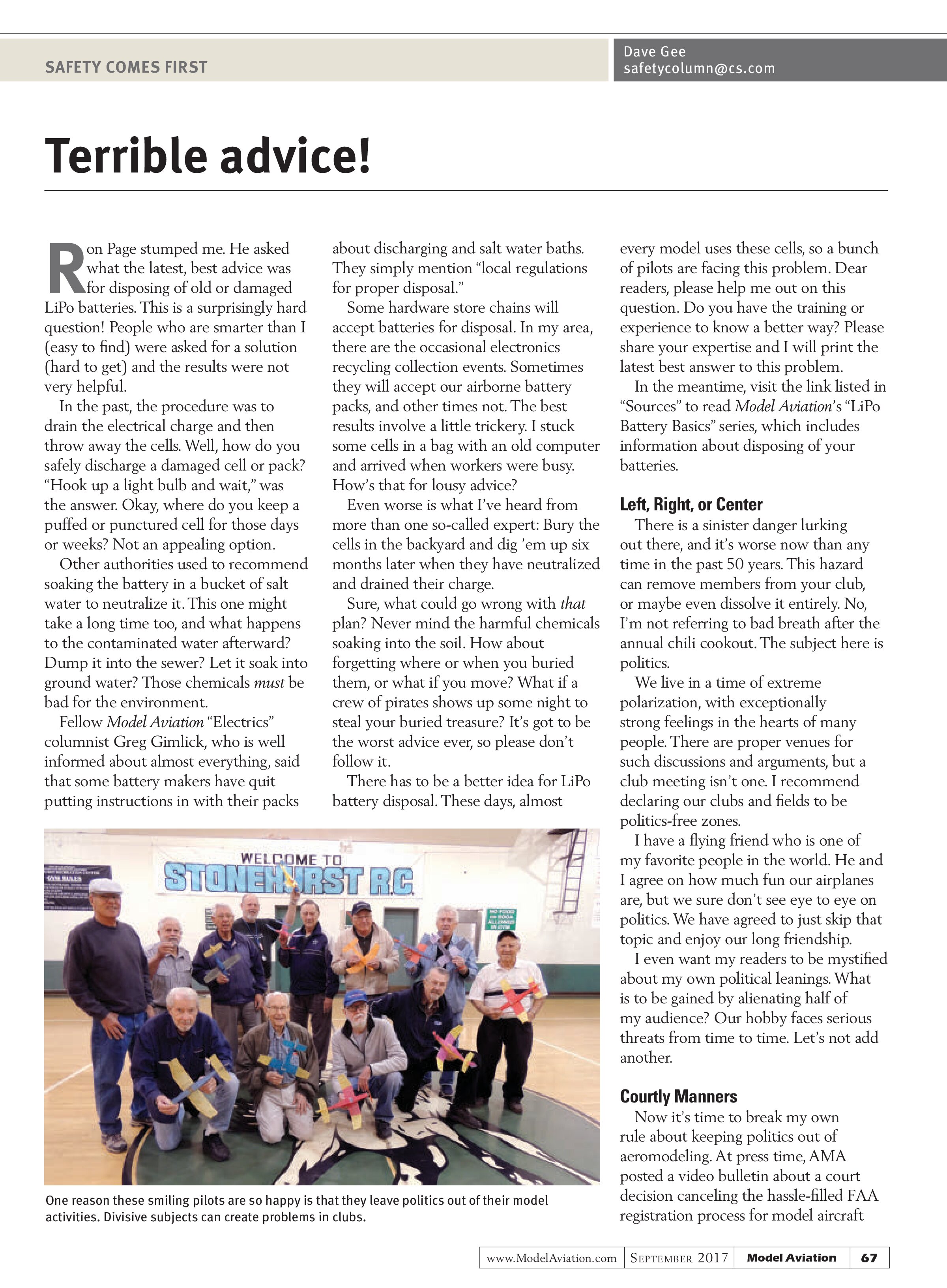
There is a sinister danger lurking out there, and it’s worse now than any time in the past 50 years. This hazard can remove members from your club, or maybe even dissolve it entirely. No, I’m not referring to bad breath after the annual chili cookout. The subject here is politics.
We live in a time of extreme polarization, with exceptionally strong feelings in the hearts of many people. There are proper venues for such discussions and arguments, but a club meeting isn’t one. I recommend declaring our clubs and fields to be politics-free zones.
I have a flying friend who is one of my favorite people in the world. He and I agree on how much fun our airplanes are, but we sure don’t see eye to eye on politics. We have agreed to just skip that topic and enjoy our long friendship.
I even want my readers to be mystified about my own political leanings. What is to be gained by alienating half of my audience? Our hobby faces serious threats from time to time. Let’s not add another.
Courtly Manners
Now it’s time to break my own rule about keeping politics out of aeromodeling. At press time, AMA posted a video bulletin about a court decision canceling the hassle-filled FAA registration process for model aircraft
weighing between .55 and 55 pounds. The AMA reporters were calm and professional, but let me express a great big “Woo Hoo, Yeah Baby” on this one!
Range Check Bounces
Bruce Williams was kind enough to share a lesson he learned the hard way. This is some useful information! He wrote the following:
“I needed to do a radio range check on a new electric-powered warbird using my usual technique. This consists of my friend observing the model on my deck at home while I drive the transmitter about ½ mile away and park. Then we connect via cellphone so that we can make sure that the control surface actions match the transmitter stick movements.
“The transmitter’s motor arming remains in the off position, with the throttle stick in shut-down position. Previous tests always showed solid radio connectivity at that distance. On this occasion, however, we failed to follow the standard procedure.
“We usually start with the transmitter on and the plane’s LiPo battery plugged in (with proper control responses verified) before taking the transmitter out to the testing point. This time, however, we didn’t connect the airplane’s battery first. Upon arrival at the distant testing location, I phoned my friend at home, who then plugged in the plane’s battery to begin the testing process.
“The moment I moved a stick on the transmitter, I could hear excited shouts and a crashing sound over the phone. The plane’s rudder had gone to full right and the motor went to full power, sending the plane hurtling into an iron railing. Luckily, only the plane was injured and not my assistant.
“Afterward, back at the house, we rechecked and found we had faultless radio connectivity and the motor stayed off until the transmitter’s arming switch was switched on and the throttle stick was run up. The radio is 2.4 GHz spread spectrum technology, so interference is highly unlikely.
“It appears that the problem was in powering up the plane’s receiver while

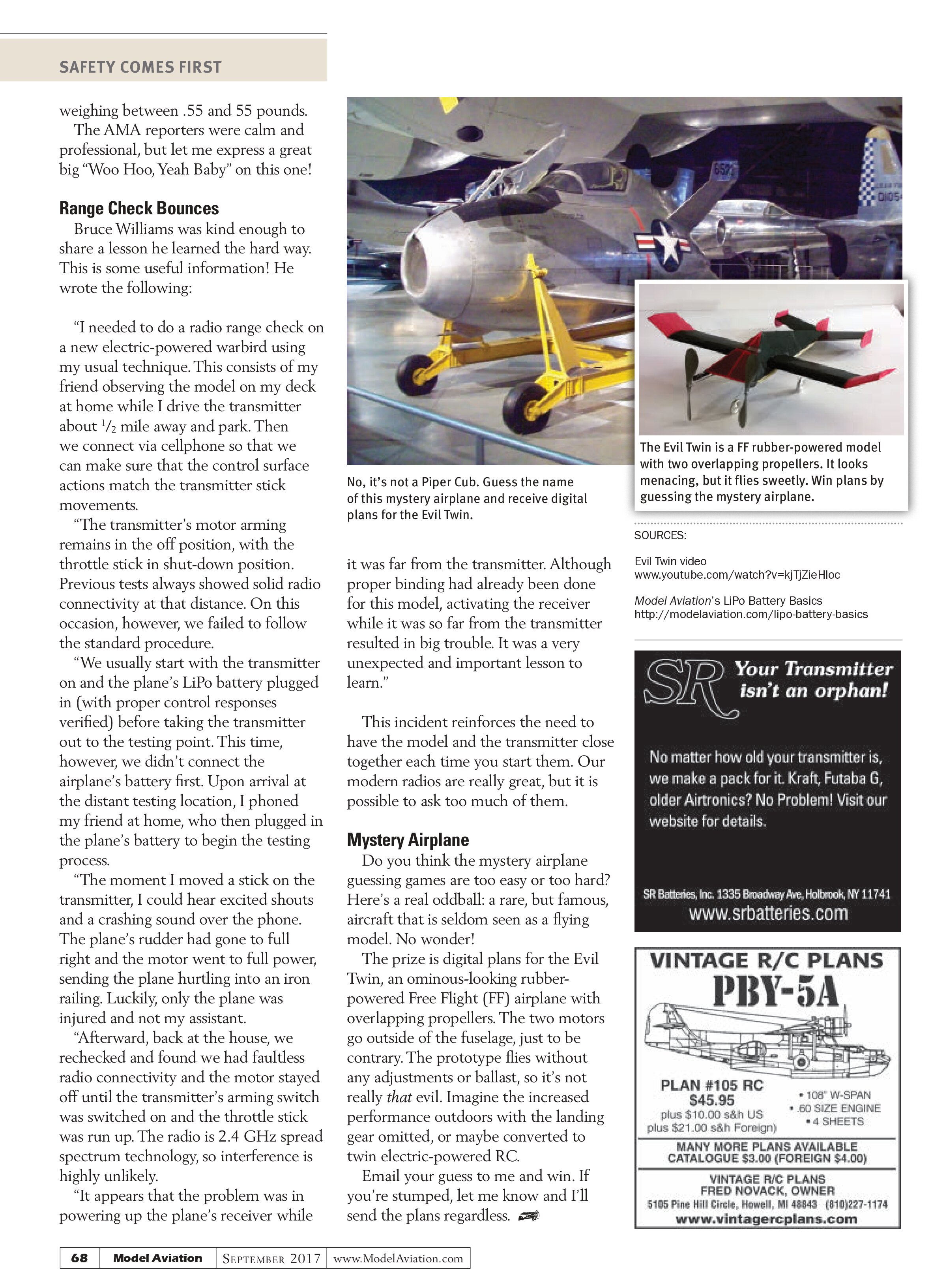
No, it’s not a Piper Cub. Guess the name of this mystery airplane and receive digital plans for the Evil Twin.
it was far from the transmitter. Although proper binding had already been done for this model, activating the receiver while it was so far from the transmitter resulted in big trouble. It was a very unexpected and important lesson to learn.”
This incident reinforces the need to have the model and the transmitter close together each time you start them. Our modern radios are really great, but it is possible to ask too much of them.
Mystery Airplane
Do you think the mystery airplane guessing games are too easy or too hard? Here’s a real oddball: a rare, but famous, aircraft that is seldom seen as a flying model. No wonder!
The prize is digital plans for the Evil Twin, an ominous-looking rubber-powered Free Flight (FF) airplane with overlapping propellers. The two motors go outside of the fuselage, just to be contrary. The prototype flies without any adjustments or ballast, so it’s not really that evil. Imagine the increased performance outdoors with the landing gear omitted, or maybe converted to twin electric-powered RC.
Email your guess to me and win. If you’re stumped, let me know and I’ll send the plans regardless.

The Evil Twin is a FF rubber-powered model with two overlapping propellers. It looks menacing, but it flies sweetly. Win plans by guessing the mystery airplane.
SOURCES:
Evil Twin video
www.youtube.com/watch?v=kjTjZieHloc
Model Aviation’s LiPo Battery Basics
http://modelaviation.com/lipo-battery-basics