Product Spotlight
MODEL AERO SPIRIT SEAPLANE PARKFLYER
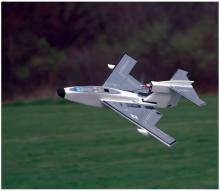
Joe Hass reviewed the Model Aero Spirit Seaplane Parkflyer. Here is what he had to say:
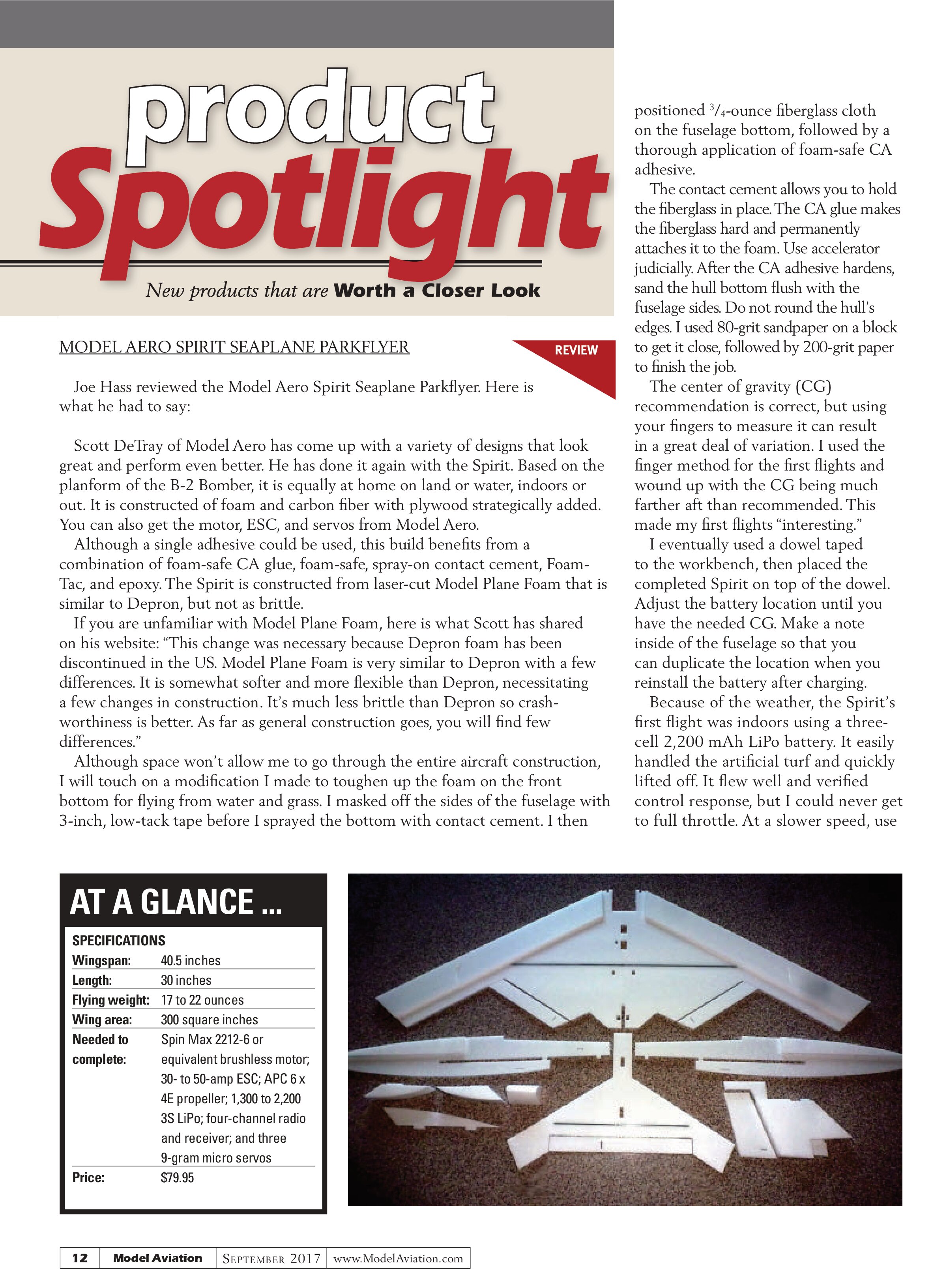
Scott DeTray of Model Aero has come up with a variety of designs that look great and perform even better. He has done it again with the Spirit. Based on the planform of the B-2 Bomber, it is equally at home on land or water, indoors or out. It is constructed of foam and carbon fiber with plywood strategically added. You can also get the motor, ESC, and servos from Model Aero.
Although a single adhesive could be used, this build benefits from a combination of foam-safe CA glue, foam-safe, spray-on contact cement, Foam-Tac, and epoxy. The Spirit is constructed from laser-cut Model Plane Foam that is similar to Depron, but not as brittle.
If you are unfamiliar with Model Plane Foam, here is what Scott has shared on his website: “This change was necessary because Depron foam has been discontinued in the US. Model Plane Foam is very similar to Depron with a few differences. It is somewhat softer and more flexible than Depron, necessitating a few changes in construction. It’s much less brittle than Depron so crash-worthiness is better. As far as general construction goes, you will find few differences.”
Although space won’t allow me to go through the entire aircraft construction, I will touch on a modification I made to toughen up the foam on the front bottom for flying from water and grass. I masked off the sides of the fuselage with 3-inch, low-tack tape before I sprayed the bottom with contact cement. I then positioned ¾-ounce fiberglass cloth on the fuselage bottom, followed by a thorough application of foam-safe CA adhesive.
The contact cement allows you to hold the fiberglass in place. The CA glue makes the fiberglass hard and permanently attaches it to the foam. Use accelerator judicially. After the CA adhesive hardens, sand the hull bottom flush with the fuselage sides. Do not round the hull’s edges. I used 80-grit sandpaper on a block to get it close, followed by 200-grit paper to finish the job.
The center of gravity (CG) recommendation is correct, but using your fingers to measure it can result in a great deal of variation. I used the finger method for the first flights and wound up with the CG being much farther aft than recommended. This made my first flights “interesting.”
I eventually used a dowel taped to the workbench, then placed the completed Spirit on top of the dowel. Adjust the battery location until you have the needed CG. Make a note inside of the fuselage so that you can duplicate the location when you reinstall the battery after charging.
Because of the weather, the Spirit’s first flight was indoors using a three-cell 2,200 mAh LiPo battery. It easily handled the artificial turf and quickly lifted off. It flew well and verified control response, but I could never get to full throttle. At a slower speed, use a lot of rudder for turns.
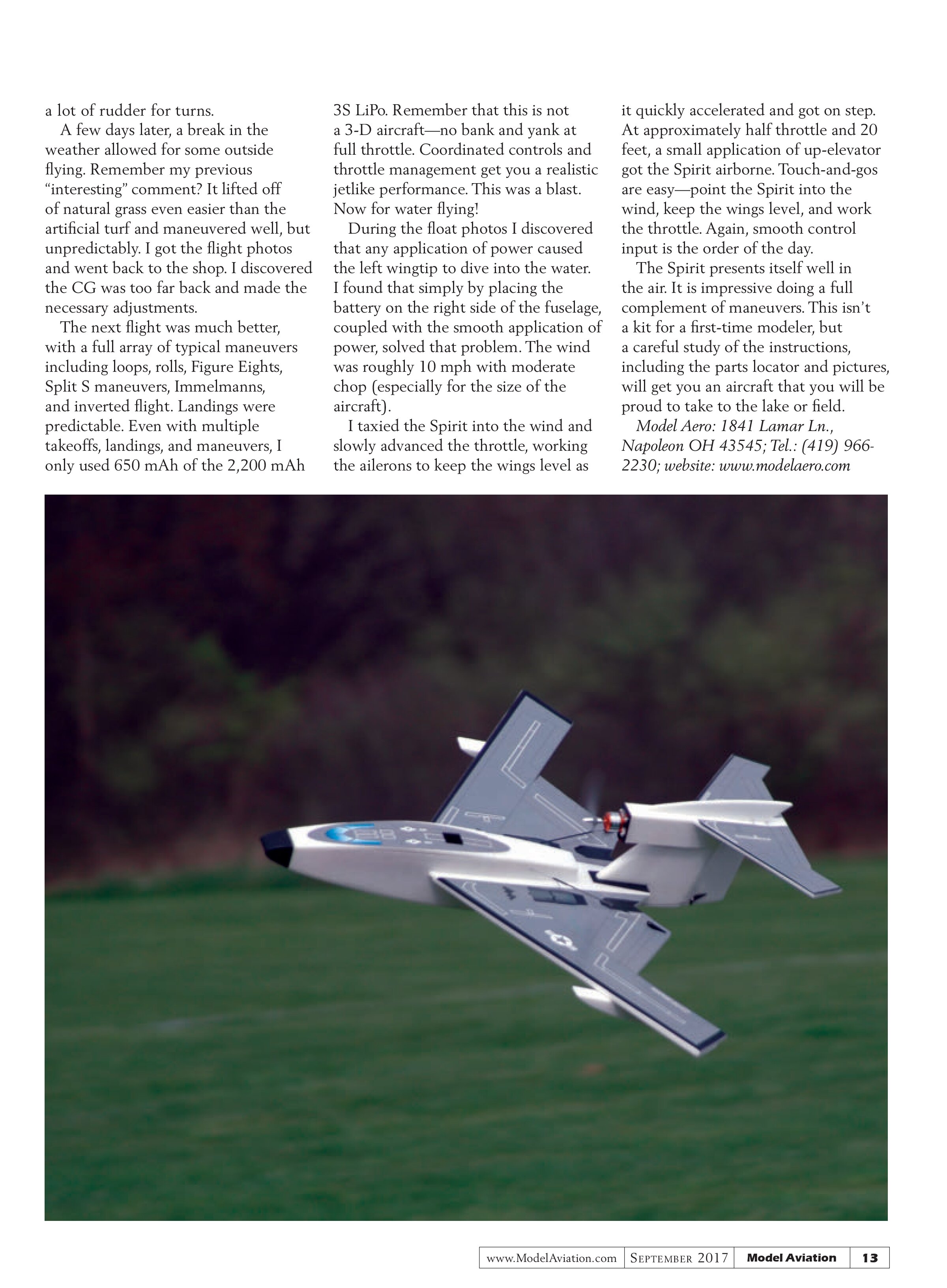
A few days later, a break in the weather allowed for some outside flying. Remember my previous “interesting” comment? It lifted off of natural grass even easier than the artificial turf and maneuvered well, but unpredictably. I got the flight photos and went back to the shop. I discovered the CG was too far back and made the necessary adjustments.
The next flight was much better, with a full array of typical maneuvers including loops, rolls, Figure Eights, Split S maneuvers, Immelmanns, and inverted flight. Landings were predictable. Even with multiple takeoffs, landings, and maneuvers, I only used 650 mAh of the 2,200 mAh 3S LiPo. Remember that this is not a 3-D aircraft—no bank and yank at full throttle. Coordinated controls and throttle management get you a realistic jetlike performance. This was a blast. Now for water flying!
During the float photos I discovered that any application of power caused the left wingtip to dive into the water. I found that simply by placing the battery on the right side of the fuselage, coupled with the smooth application of power, solved that problem. The wind was roughly 10 mph with moderate chop (especially for the size of the aircraft).
I taxied the Spirit into the wind and slowly advanced the throttle, working the ailerons to keep the wings level as it quickly accelerated and got on step. At approximately half throttle and 20 feet, a small application of up-elevator got the Spirit airborne. Touch-and-gos are easy—point the Spirit into the wind, keep the wings level, and work the throttle. Again, smooth control input is the order of the day.
The Spirit presents itself well in the air. It is impressive doing a full complement of maneuvers. This isn’t a kit for a first-time modeler, but a careful study of the instructions, including the parts locator and pictures, will get you an aircraft that you will be proud to take to the lake or field.
Model Aero: 1841 Lamar Ln., Napoleon OH 43545; Tel.: (419) 966-2230; website: www.modelaero.com
AT A GLANCE ...
SPECIFICATIONS
Wingspan: 40.5 inches
Length: 30 inches
Flying weight: 17 to 22 ounces
Wing area: 300 square inches
Needed to complete: Spin Max 2212-6 or equivalent brushless motor; 30- to 50-amp ESC; APC 6 x 4E propeller; 1,300 to 2,200 3S LiPo; four-channel radio and receiver; and three 9-gram micro servos
Price: $79.95

it quickly accelerated and got on step. At approximately half throttle and 20 feet, a small application of up-elevator got the Spirit airborne. Touch-and-gos are easy—point the Spirit into the wind, keep the wings level, and work the throttle. Again, smooth control input is the order of the day.

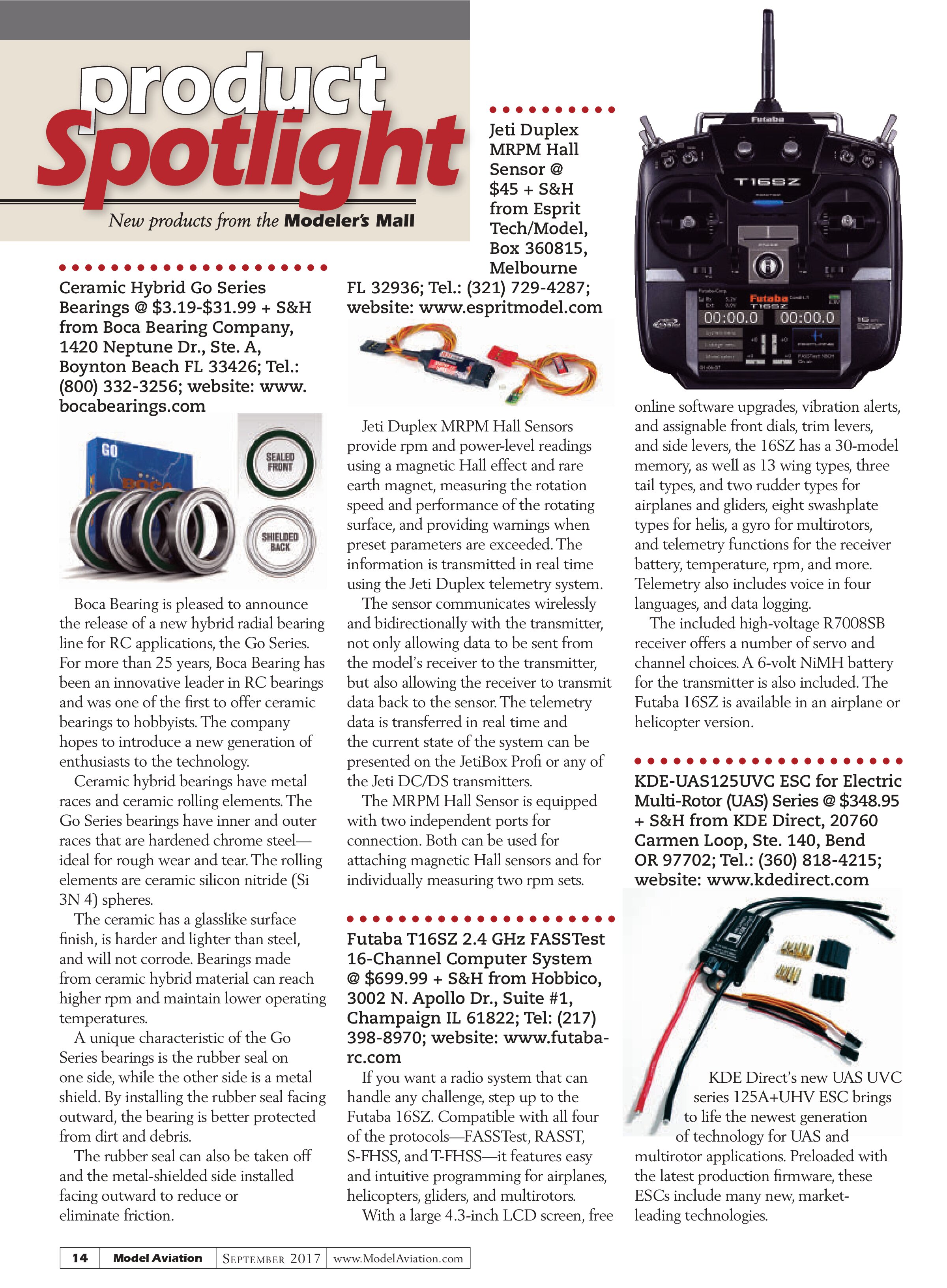
Ceramic Hybrid Go Series Bearings @ $3.19-$31.99 + S&H from Boca Bearing Company, 1420 Neptune Dr., Ste. A, Boynton Beach FL 33426; Tel.: (800) 332-3256; website: www.bocabearings.com
Boca Bearing is pleased to announce the release of a new hybrid radial bearing line for RC applications, the Go Series. For more than 25 years, Boca Bearing has been an innovative leader in RC bearings and was one of the first to offer ceramic bearings to hobbyists. The company hopes to introduce a new generation of enthusiasts to the technology.
Ceramic hybrid bearings have metal races and ceramic rolling elements. The Go Series bearings have inner and outer races that are hardened chrome steel—ideal for rough wear and tear. The rolling elements are ceramic silicon nitride (Si 3N 4) spheres.
The ceramic has a glasslike surface finish, is harder and lighter than steel, and will not corrode. Bearings made from ceramic hybrid material can reach higher rpm and maintain lower operating temperatures.
A unique characteristic of the Go Series bearings is the rubber seal on one side, while the other side is a metal shield. By installing the rubber seal facing outward, the bearing is better protected from dirt and debris.
The rubber seal can also be taken off and the metal-shielded side installed facing outward to reduce or eliminate friction.

Jeti Duplex MRPM Hall Sensor @ $45 + S&H from Esprit Tech/Model, Box 360815, Melbourne FL 32936; Tel.: (321) 729-4287; website: www.espritmodel.com

Jeti Duplex MRPM Hall Sensors provide rpm and power-level readings using a magnetic Hall effect and rare earth magnet, measuring the rotation speed and performance of the rotating surface, and providing warnings when preset parameters are exceeded. The information is transmitted in real time using the Jeti Duplex telemetry system.
The sensor communicates wirelessly and bidirectionally with the transmitter, not only allowing data to be sent from the model’s receiver to the transmitter, but also allowing the receiver to transmit data back to the sensor. The telemetry data is transferred in real time and the current state of the system can be presented on the JetiBox Profi or any of the Jeti DC/DS transmitters.
The MRPM Hall Sensor is equipped with two independent ports for connection. Both can be used for attaching magnetic Hall sensors and for individually measuring two rpm sets.
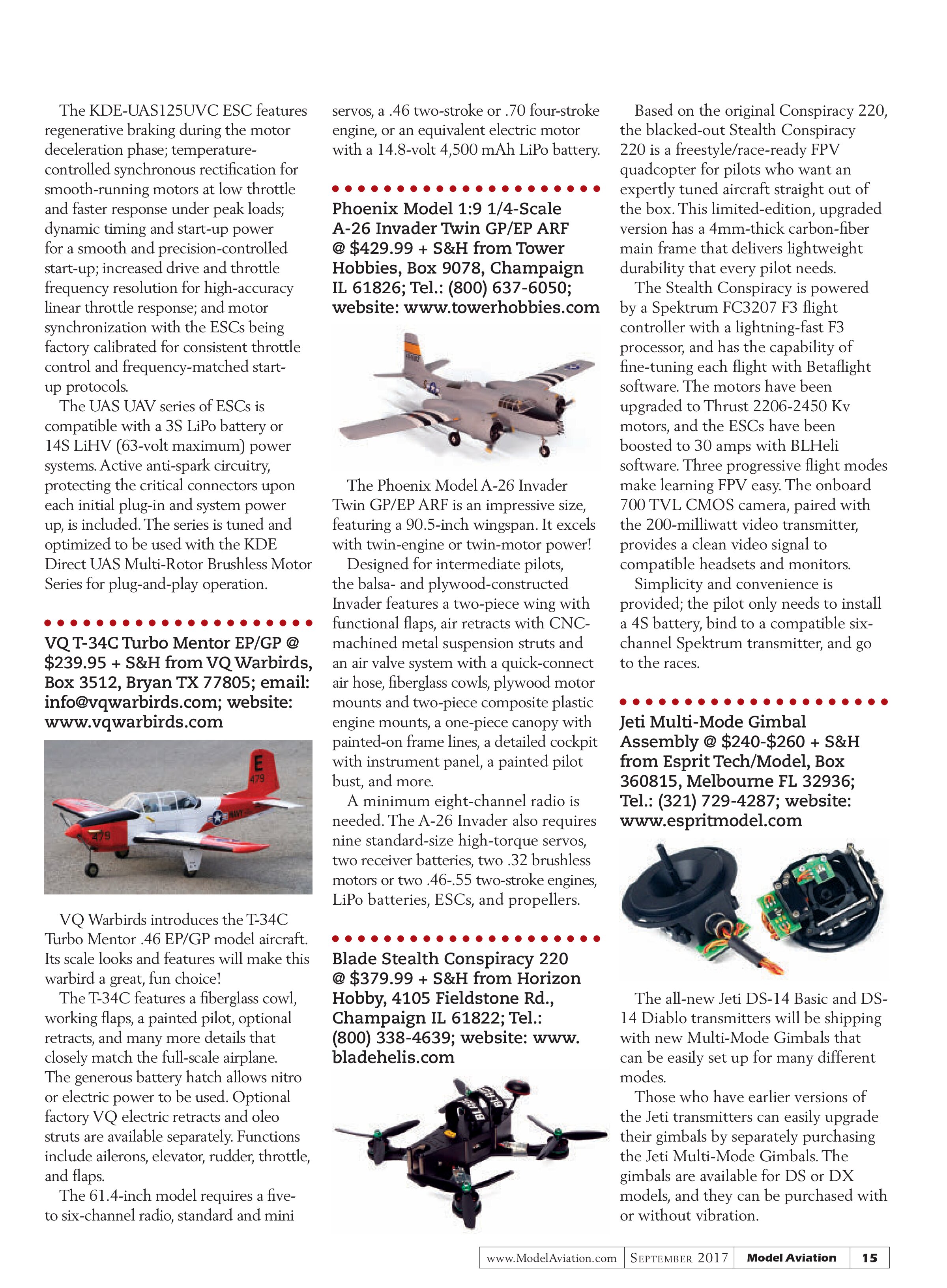
Futaba T16SZ 2.4 GHz FASSTest 16-Channel Computer System @ $699.99 + S&H from Hobbico, 3002 N. Apollo Dr., Suite #1, Champaign IL 61822; Tel: (217) 398-8970; website: www.futaba-rc.com
If you want a radio system that can handle any challenge, step up to the Futaba 16SZ. Compatible with all four of the protocols—FASSTest, RASST, S-FHSS, and T-FHSS—it features easy and intuitive programming for airplanes, helicopters, gliders, and multirotors.
With a large 4.3-inch LCD screen, free online software upgrades, vibration alerts, and assignable front dials, trim levers, and side levers, the 16SZ has a 30-model memory, as well as 13 wing types, three tail types, and two rudder types for airplanes and gliders, eight swashplate types for helis, a gyro for multirotors, and telemetry functions for the receiver battery, temperature, rpm, and more. Telemetry also includes voice in four languages, and data logging.
The included high-voltage R7008SB receiver offers a number of servo and channel choices. A 6-volt NiMH battery for the transmitter is also included. The Futaba 16SZ is available in an airplane or helicopter version.
KDE-UAS125UVC ESC for Electric Multi-Rotor (UAS) Series @ $348.95 + S&H from KDE Direct, 20760 Carmen Loop, Ste. 140, Bend OR 97702; Tel.: (360) 818-4215; website: www.kdedirect.com

KDE Direct’s new UAS UVC series 125A+UHV ESC brings to life the newest generation of technology for UAS and multirotor applications. Preloaded with the latest production firmware, these ESCs include many new, market-leading technologies.
The KDE-UAS125UVC ESC features regenerative braking during the motor deceleration phase; temperature-controlled synchronous rectification for smooth-running motors at low throttle and faster response under peak loads; dynamic timing and start-up power for a smooth and precision-controlled start-up; increased drive and throttle frequency resolution for high-accuracy linear throttle response; and motor synchronization with the ESCs being factory calibrated for consistent throttle control and frequency-matched start-up protocols.
The UAS UAV series of ESCs is compatible with a 3S LiPo battery or 14S LiHV (63-volt maximum) power systems. Active anti-spark circuitry, protecting the critical connectors upon each initial plug-in and system power up, is included. The series is tuned and optimized to be used with the KDE Direct UAS Multi-Rotor Brushless Motor Series for plug-and-play operation.
VQ T-34C Turbo Mentor EP/GP @ $239.95 + S&H from VQ Warbirds, Box 3512, Bryan TX 77805; email: info@vqwarbirds.com; website: www.vqwarbirds.com

VQ Warbirds introduces the T-34C Turbo Mentor .46 EP/GP model aircraft. Its scale looks and features will make this warbird a great, fun choice!
The T-34C features a fiberglass cowl, working flaps, a painted pilot, optional retracts, and many more details that closely match the full-scale airplane. The generous battery hatch allows nitro or electric power to be used. Optional factory VQ electric retracts and oleo struts are available separately. Functions include ailerons, elevator, rudder, throttle, and flaps.
The 61.4-inch model requires a five- to six-channel radio, standard and mini servos, a .46 two-stroke or .70 four-stroke engine, or an equivalent electric motor with a 14.8-volt 4,500 mAh LiPo battery.
Phoenix Model 1:9 1/4-Scale A-26 Invader Twin GP/EP ARF @ $429.99 + S&H from Tower Hobbies, Box 9078, Champaign IL 61826; Tel.: (800) 637-6050; website: www.towerhobbies.com

The Phoenix Model A-26 Invader Twin GP/EP ARF is an impressive size, featuring a 90.5-inch wingspan. It excels with twin-engine or twin-motor power!
Designed for intermediate pilots, the balsa- and plywood-constructed Invader features a two-piece wing with functional flaps, air retracts with CNC-machined metal suspension struts and an air valve system with a quick-connect air hose, fiberglass cowls, plywood motor mounts and two-piece composite plastic engine mounts, a one-piece canopy with painted-on frame lines, a detailed cockpit with instrument panel, a painted pilot bust, and more.
A minimum eight-channel radio is needed. The A-26 Invader also requires nine standard-size high-torque servos, two receiver batteries, two .32 brushless motors or two .46-.55 two-stroke engines, LiPo batteries, ESCs, and propellers.
Blade Stealth Conspiracy 220 @ $379.99 + S&H from Horizon Hobby, 4105 Fieldstone Rd., Champaign IL 61822; Tel.: (800) 338-4639; website: www.bladehelis.com

Based on the original Conspiracy 220, the blacked-out Stealth Conspiracy 220 is a freestyle/race-ready FPV quadcopter for pilots who want an expertly tuned aircraft straight out of the box. This limited-edition, upgraded version has a 4mm-thick carbon-fiber main frame that delivers lightweight durability that every pilot needs.
The Stealth Conspiracy is powered by a Spektrum FC3207 F3 flight controller with a lightning-fast F3 processor, and has the capability of fine-tuning each flight with Betaflight software. The motors have been upgraded to Thrust 2206-2450 Kv motors, and the ESCs have been boosted to 30 amps with BLHeli software. Three progressive flight modes make learning FPV easy. The onboard 700 TVL CMOS camera, paired with the 200-milliwatt video transmitter, provides a clean video signal to compatible headsets and monitors.
Simplicity and convenience is provided; the pilot only needs to install a 4S battery, bind to a compatible six-channel Spektrum transmitter, and go to the races.
Jeti Multi-Mode Gimbal Assembly @ $240-$260 + S&H from Esprit Tech/Model, Box 360815, Melbourne FL 32936; Tel.: (321) 729-4287; website: www.espritmodel.com

The all-new Jeti DS-14 Basic and DS-14 Diablo transmitters will be shipping with new Multi-Mode Gimbals that can be easily set up for many different modes.
Those who have earlier versions of the Jeti transmitters can easily upgrade their gimbals by separately purchasing the Jeti Multi-Mode Gimbals. The gimbals are available for DS or DX models, and they can be purchased with or without vibration.