Focal Point
Comet

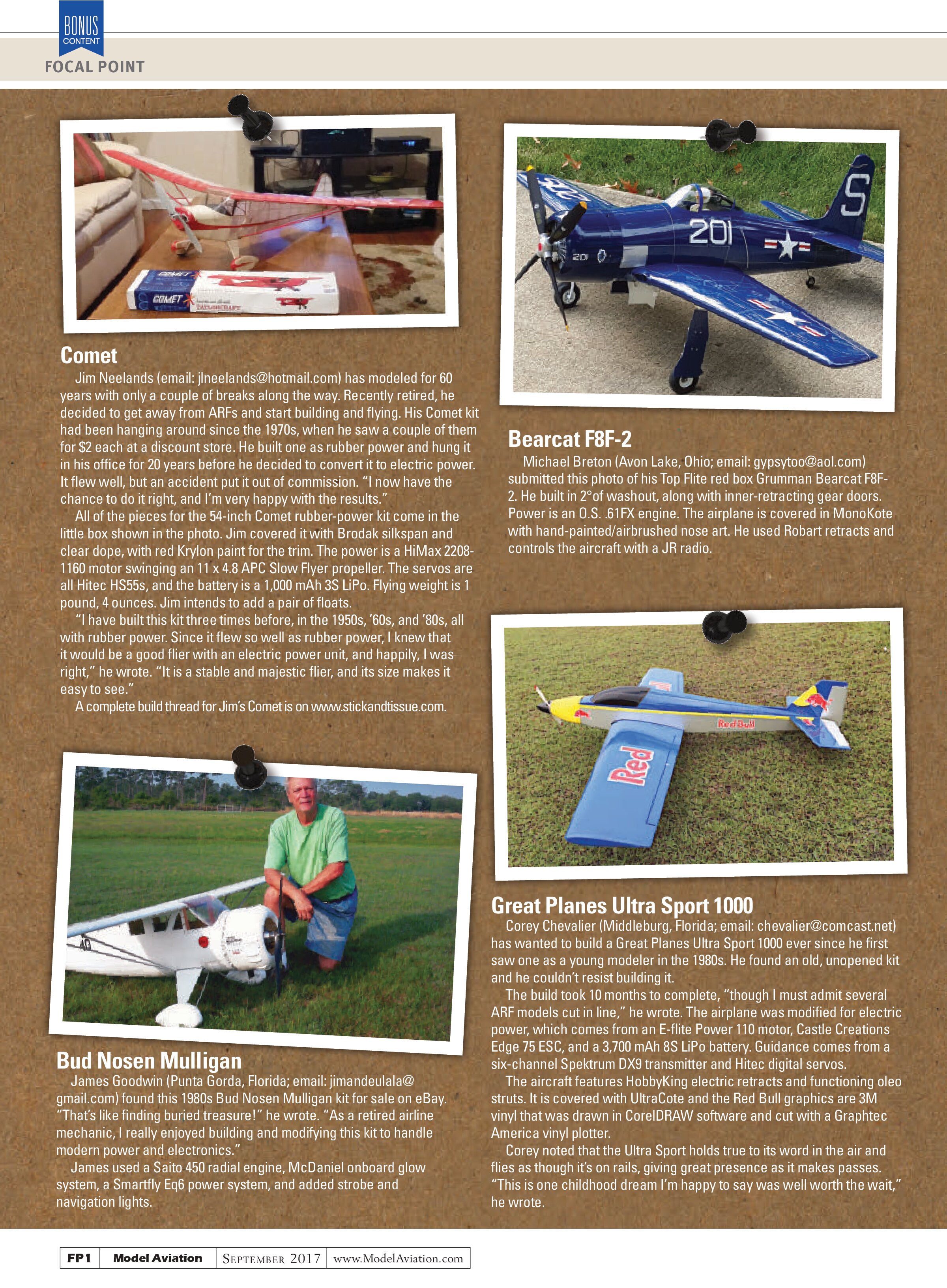
Jim Neelands (email: jneelands@hotmail.com) has modeled for 60 years with only a couple of breaks along the way. Recently retired, he decided to get away from ARFs and start building and flying. His Comet kit had been hanging around since the 1970s, when he saw a couple of them for $2 each at a discount store. He built one as rubber power and hung it in his office for 20 years before he decided to convert it to electric power. It flew well, but an accident put it out of commission. “I now have the chance to do it right, and I’m very happy with the results.”
All of the pieces for the 54-inch Comet rubber-power kit come in the little box shown in the photo. Jim covered it with Brodak silkspan and clear dope, with red Krylon paint for the trim. The power is a HiMax 2208-1160 motor swinging an 11 x 4.8 APC Slow Flyer propeller. The servos are all Hitec HS55s, and the battery is a 1,000 mAh 3S LiPo. Flying weight is 1 pound, 4 ounces. Jim intends to add a pair of floats.
“I have built this kit three times before, in the 1950s, ’60s, and ’80s, all with rubber power. Since it flew so well as rubber power, I knew that it would be a good flier with an electric power unit, and happily, I was right,” he wrote. “It is a stable and majestic flier, and its size makes it easy to see.”
A complete build thread for Jim’s Comet is on www.stickandtissue.com.
Bud Nosen Mulligan

James Goodwin (Punta Gorda, Florida; email: jimandeulala@gmail.com) found this 1980s Bud Nosen Mulligan kit for sale on eBay. “That’s like finding buried treasure!” he wrote. “As a retired airline mechanic, I really enjoyed building and modifying this kit to handle modern power and electronics.”
James used a Saito 450 radial engine, McDaniel onboard glow system, a Smartfly Eq6 power system, and added strobe and navigation lights.
Bearcat F8F-2

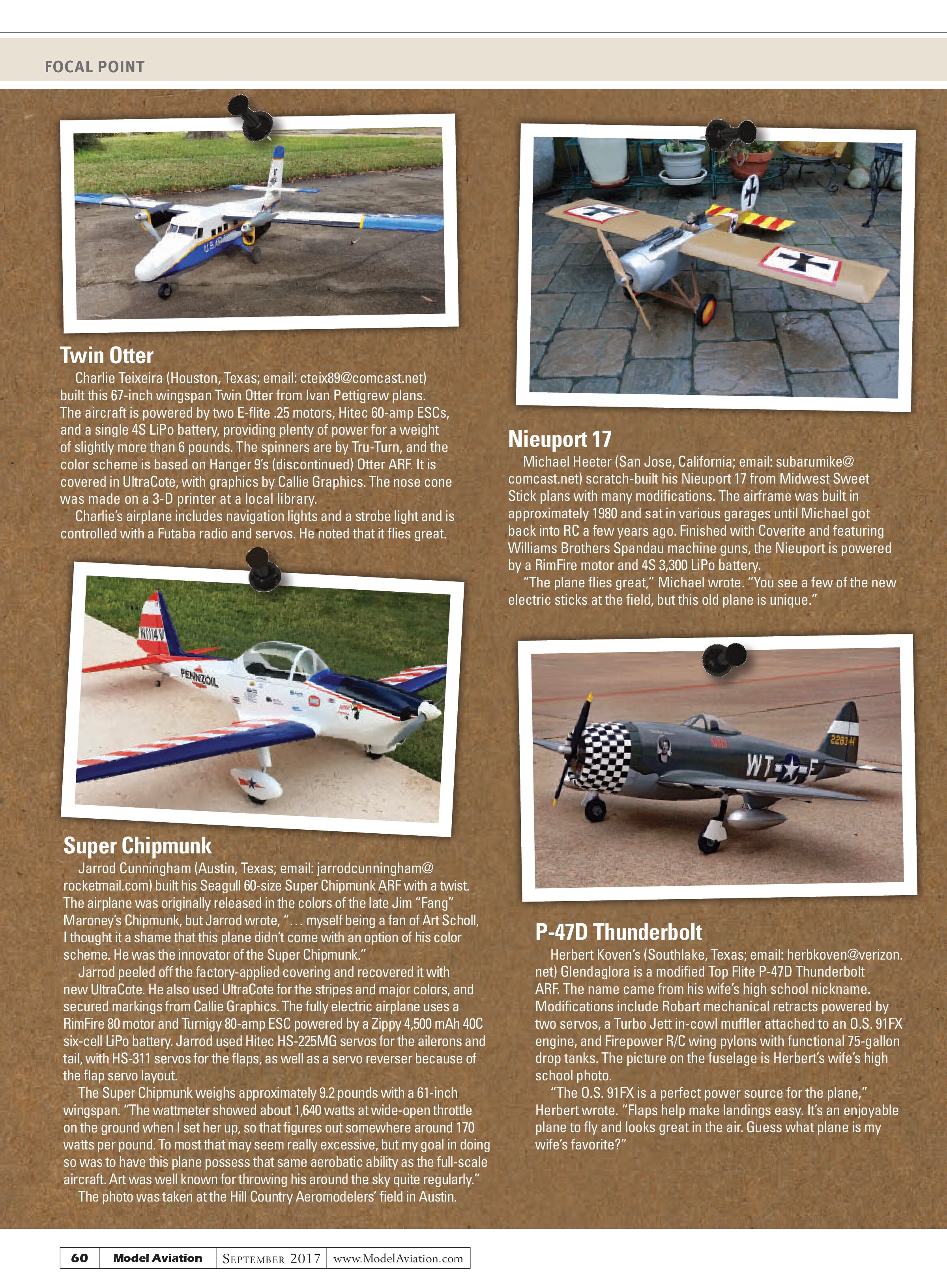
Michael Breton (Avon Lake, Ohio; email: gypsytoo@aol.com) submitted this photo of his Top Flite red box Grumman Bearcat F8F-2. He built in 2° of washout, along with inner-retracting gear doors. Power is an O.S. .61FX engine. The airplane is covered in MonoKote with hand-painted/airbrushed nose art. He used Robart retracts and controls the aircraft with a JR radio.
Great Planes Ultra Sport 1000

Corey Chevalier (Middleburg, Florida; email: chevalier@comcast.net) has wanted to build a Great Planes Ultra Sport 1000 ever since he first saw one as a young modeler in the 1980s. He found an old, unopened kit and he couldn’t resist building it.
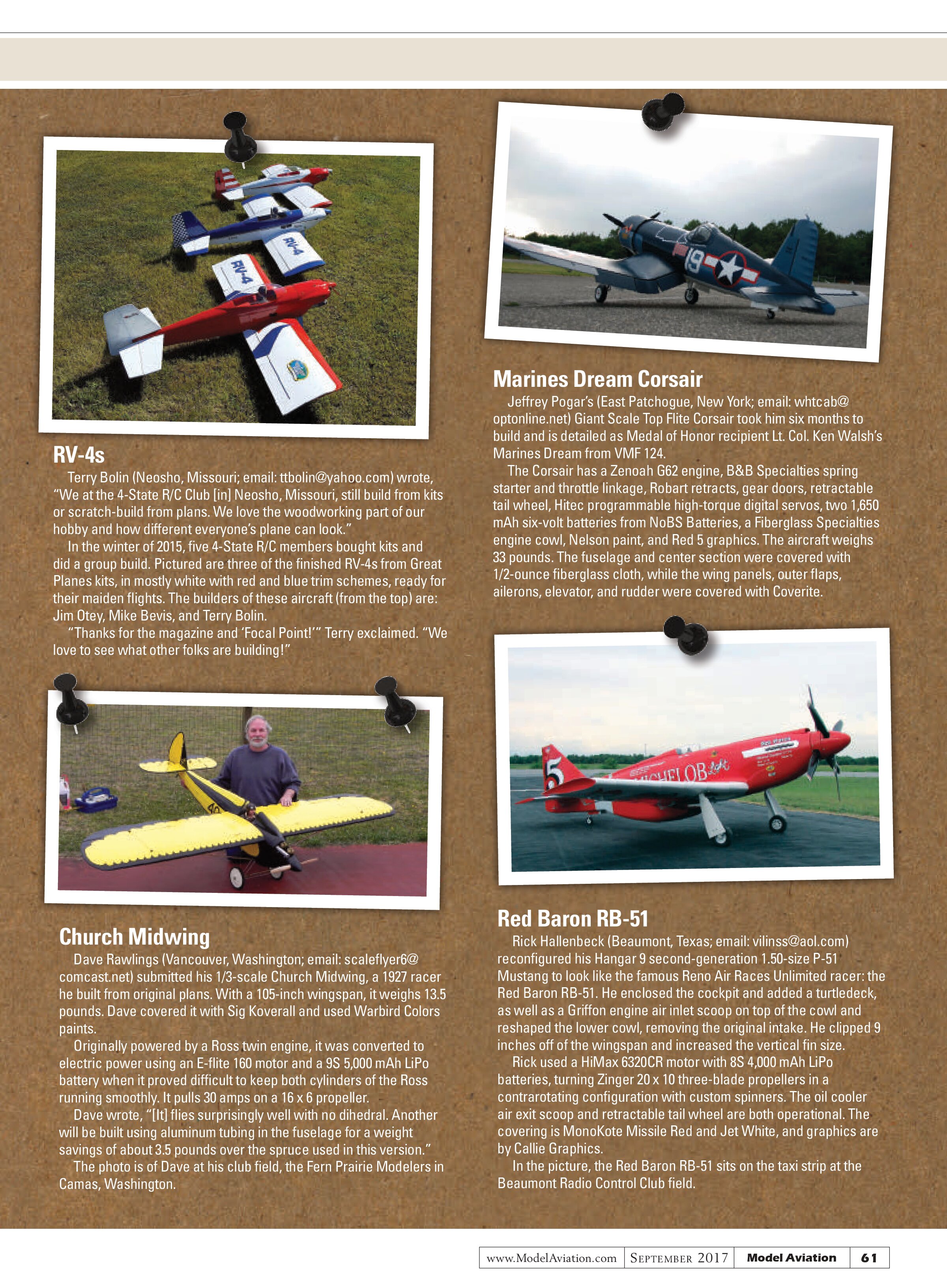
The build took 10 months to complete, “though I must admit several ARF models cut in line,” he wrote. The airplane was modified for electric power, which comes from an E-flite Power 110 motor, Castle Creations Edge 75 ESC, and a 3,700 mAh 8S LiPo battery. Guidance comes from a six-channel Spektrum DX9 transmitter and Hitec digital servos.
The aircraft features HobbyKing electric retracts and functioning oleo struts. It is covered with UltraCote and the Red Bull graphics are 3M vinyl that was drawn in CorelDRAW software and cut with a Graphtec
Corey noted that the Ultra Sport holds true to its word in the air and flies as though it’s on rails, giving great presence as it makes passes. “This is one childhood dream I’m happy to say was well worth the wait,” he wrote.
Twin Otter
Charlie Teixeira (Houston, Texas; email: cteix89@comcast.net) built this 67-inch wingspan Twin Otter from Ivan Pettigrew plans. The aircraft is powered by two E-flite .25 motors, Hitec 60-amp ESCs, and a single 4S LiPo battery, providing plenty of power for a weight of slightly more than 6 pounds. The spinners are by Tru-Turn, and the color scheme is based on Hanger 9’s (discontinued) Otter ARF. It is covered in UltraCote, with graphics by Callie Graphics. The nose cone was made on a 3-D printer at a local library.
Charlie’s airplane includes navigation lights and a strobe light and is controlled with a Futaba radio and servos. He noted that it flies great.

Super Chipmunk
Jarrod Cunningham (Austin, Texas; email: jarrodcunningham@rocketmail.com) built his Seagull 60-size Super Chipmunk ARF with a twist. The airplane was originally released in the colors of the late Jim “Fang” Maroney’s Chipmunk, but Jarrod wrote, “. . . myself being a fan of Art Scholl, I thought it a shame that this plane didn’t come with an option of his color scheme. He was the innovator of the Super Chipmunk.”
Jarrod peeled off the factory-applied covering and recovered it with new UltraCote. He also used UltraCote for the stripes and major colors, and secured markings from Callie Graphics. The fully electric airplane uses a RimFire 80 motor and Turnigy 80-amp ESC powered by a Zippy 4,500 mAh 40C six-cell LiPo battery. Jarrod used Hitec HS-225MG servos for the ailerons and tail, with HS-311 servos for the flaps, as well as a servo reverser because of the flap servo layout.
The Super Chipmunk weighs approximately 9.2 pounds with a 61-inch wingspan. “The wattmeter showed about 1,640 watts at wide-open throttle on the ground when I set her up, so that figures out somewhere around 170 watts per pound. To most that may seem really excessive, but my goal in doing so was to have this plane possess that same aerobatic ability as the full-scale aircraft. Art was well known for throwing his around the sky quite regularly.”
The photo was taken at the Hill Country Aeromodelers’ field in Austin.

Nieuport 17
Michael Heeter (San Jose, California; email: subarumike@comcast.net) scratch-built his Nieuport 17 from Midwest Sweet Stick plans with many modifications. The airframe was built in approximately 1980 and sat in various garages until Michael got back into RC a few years ago. Finished with Coverite and featuring Williams Brothers Spandau machine guns, the Nieuport is powered by a RimFire motor and 4S 3,300 LiPo battery.
“The plane flies great,” Michael wrote. “You see a few of the new electric sticks at the field, but this old plane is unique.”

P-47D Thunderbolt
Herbert Koven’s (Southlake, Texas; email: herbkoven@verizon.net) Glendaglora is a modified Top Flite P-47D Thunderbolt ARF. The name came from his wife’s high school nickname. Modifications include Robart mechanical retracts powered by two servos, a Turbo Jett in-cowl muffler attached to an O.S. 91FX engine, and Firepower R/C wing pylons with functional 75-gallon drop tanks. The picture on the fuselage is Herbert’s wife’s high school photo.
“The O.S. 91FX is a perfect power source for the plane,” Herbert wrote. “Flaps help make landings easy. It’s an enjoyable plane to fly and looks great in the air. Guess what plane is my wife’s favorite?”

RV-4s
Terry Bolin (Neosho, Missouri; email: ttbolin@yahoo.com) wrote, “We at the 4-State R/C Club [in] Neosho, Missouri, still build from kits or scratch-build from plans. We love the woodworking part of our hobby and how different everyone’s plane can look.”
In the winter of 2015, five 4-State R/C members bought kits and did a group build. Pictured are three of the finished RV-4s from Great Planes kits, in mostly white with red and blue trim schemes, ready for their maiden flights. The builders of these aircraft (from the top) are: Jim Otey, Mike Bevis, and Terry Bolin.
“Thanks for the magazine and ‘Focal Point!’” Terry exclaimed. “We love to see what other folks are building!”

Church Midwing
Dave Rawlings (Vancouver, Washington; email: scaleflyer6@comcast.net) submitted his 1/3-scale Church Midwing, a 1927 racer he built from original plans. With a 105-inch wingspan, it weighs 13.5 pounds. Dave covered it with Sig Koverall and used Warbird Colors paints.
Originally powered by a Ross twin engine, it was converted to electric power using an E-flite 160 motor and a 9S 5,000 mAh LiPo battery when it proved difficult to keep both cylinders of the Ross running smoothly. It pulls 30 amps on a 16 x 6 propeller.
Dave wrote, “[It] flies surprisingly well with no dihedral. Another will be built using aluminum tubing in the fuselage for a weight savings of about 3.5 pounds over the spruce used in this version.”
The photo is of Dave at his club field, the Fern Prairie Modelers in Camas, Washington.

Marines Dream Corsair
Jeffrey Pogar’s (East Patchogue, New York; email: wh tcab@optonline.net) Giant Scale Top Flite Corsair took him six months to build and is detailed as Medal of Honor recipient Lt. Col. Ken Walsh’s Marines Dream from VMF 124.
The Corsair has a Zenoah G62 engine, B&B Specialties spring starter and throttle linkage, Robart retracts, gear doors, retractable tail wheel, Hitec programmable high-torque digital servos, two 1,650 mAh six-volt batteries from NoBS Batteries, a Fiberglass Specialties engine cowl, Nelson paint, and Red 5 graphics. The aircraft weighs 33 pounds. The fuselage and center section were covered with 1/2-ounce fiberglass cloth, while the wing panels, outer flaps, ailerons, elevator, and rudder were covered with Coverite.

Red Baron RB-51
Rick Hallenbeck (Beaumont, Texas; email: vilinss@aol.com) reconfigured his Hangar 9 second-generation 1.50-size P-51 Mustang to look like the famous Reno Air Races Unlimited racer: the Red Baron RB-51. He enclosed the cockpit and added a turtledeck, as well as a Griffon engine air inlet scoop on top of the cowl and reshaped the lower cowl, removing the original intake. He clipped 9 inches off of the wingspan and increased the vertical fin size.
Rick used a HiMax 6320CR motor with 8S 4,000 mAh LiPo batteries, turning Zinger 20 x 10 three-blade propellers in a contrarotating configuration with custom spinners. The oil cooler air exit scoop and retractable tail wheel are both operational. The covering is MonoKote Missile Red and Jet White, and graphics are by Callie Graphics.
In the picture, the Red Baron RB-51 sits on the taxi strip at the Beaumont Radio Control Club field.