The good and the bad
by Mark Rudner
rudner@mit.edu
For better or worse, it has been quite an eventful spring for Control Line (CL) Combat. I’ll start with the good news.
The season kicked off in the US with the biggest-ever March Madness F2D Challenge in Phoenix. At the time of this writing, the Kansas City Classic in Kansas City, Missouri, was coming up, and I know many people were deep into preparation for the CL Combat team trials in July.
Here in Europe, the Dreiländerpokal just wrapped up in Herning, Denmark. The Dreiländerpokal is a series of three World Cup competitions in Germany, Sweden, and Denmark, where prizes are awarded both for the three individual contests and for the overall best combined results.
The Swedish and Danish legs of this series are one week apart, being tied to the holidays of Kristi Himmelfartsdag (Ascension Day) and Pinse (the Pentecost). Because Easter fell quite late this year and the holidays are all linked, these last two legs of the Dreiländerpokal also came rather late; as an unfortunate consequence, the Danish Cup conflicted with the World Cup in Sebnitz, Germany (which is scheduled based on the solar calendar). Both are typically good contests, and this conflict forced pilots to choose one over the other (many usually attend both).
Several pilots from the US have flown in the Dreiländerpokal in the past. This year, the Danish Cup was moved to a new location in Herning (near the center of the country). The reason for this move was an unfortunate one, which I hope will not be repeated elsewhere. Perhaps we can all learn from this story as well.
Historically, the Danish World Cup has been held at the Aviators Model Airplane Club in Aalborg, Denmark. This is an old club that started out as a CL club, but eventually included RC

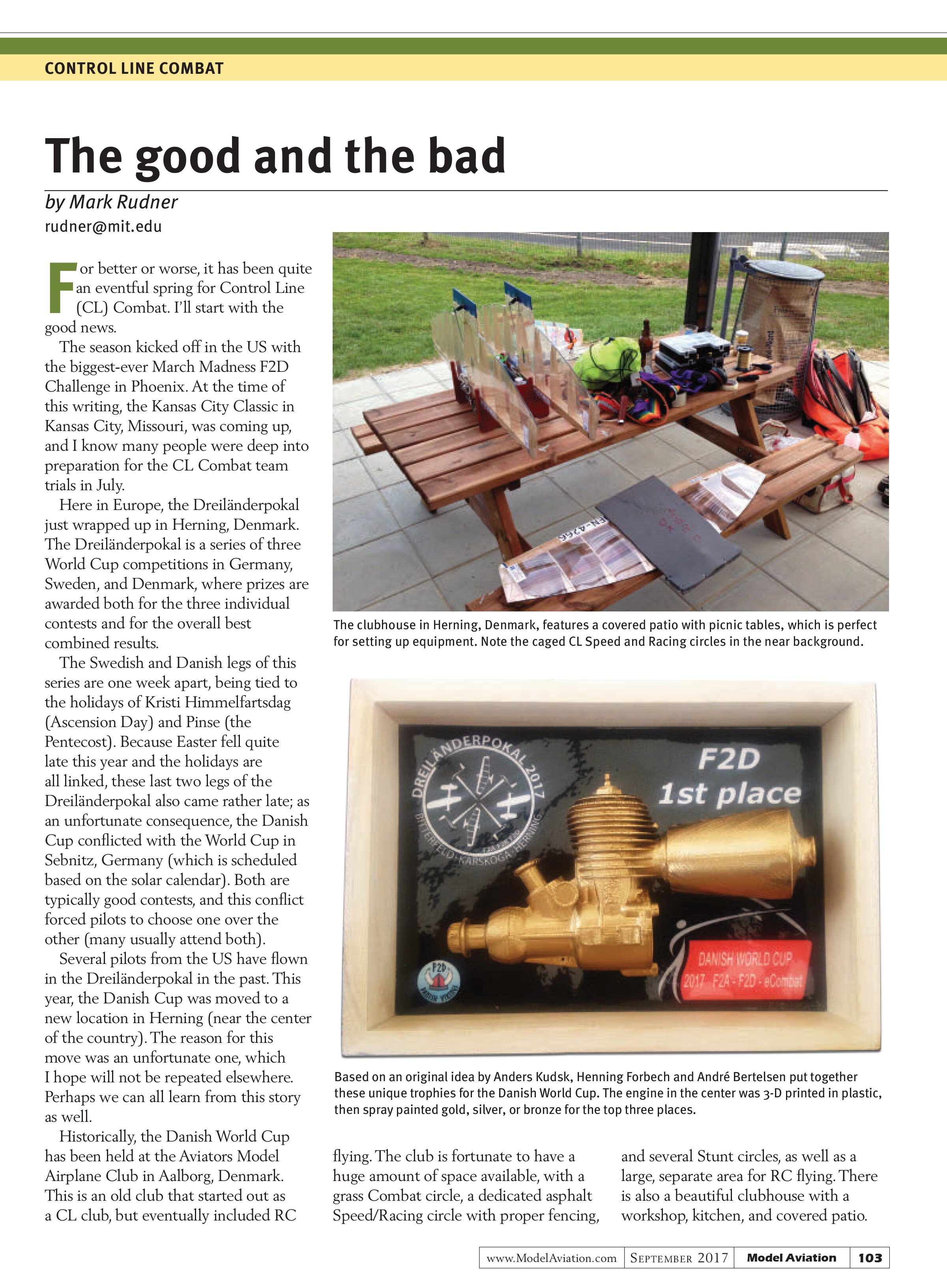
The clubhouse in Herning, Denmark, features a covered patio with picnic tables, which is perfect for setting up equipment. Note the caged CL Speed and Racing circles in the near background.

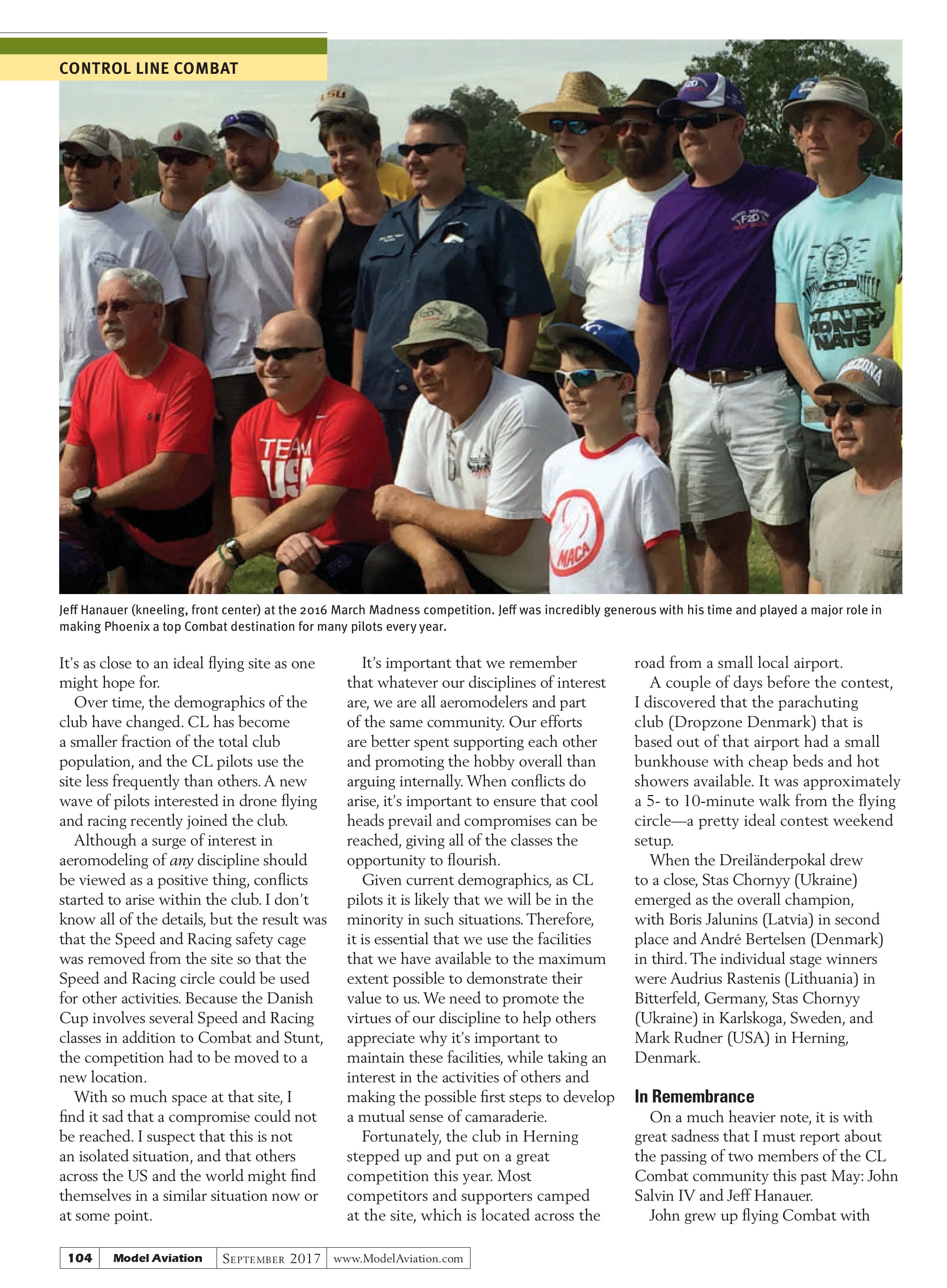
Based on an original idea by Anders Kudsk, Henning Forbech and André Bertelsen put together these unique trophies for the Danish World Cup. The engine in the center was 3-D printed in plastic, then spray painted gold, silver, or bronze for the top three places.
flying. The club is fortunate to have a huge amount of space available, with a grass Combat circle, a dedicated asphalt Speed/Racing circle with proper fencing, and several Stunt circles, as well as a large, separate area for RC flying. There is also a beautiful clubhouse with a workshop, kitchen, and covered patio.

It’s as close to an ideal flying site as one might hope for.
Over time, the demographics of the club have changed. CL has become a smaller fraction of the total club population, and the CL pilots use the site less frequently than others. A new wave of pilots interested in drone flying and racing recently joined the club.
Although a surge of interest in aeromodeling of any discipline should be viewed as a positive thing, conflicts started to arise within the club. I don’t know all of the details, but the result was that the Speed and Racing safety cage was removed from the site so that the Speed and Racing circle could be used for other activities. Because the Danish Cup involves several Speed and Racing classes in addition to Combat and Stunt, the competition had to be moved to a new location.
With so much space at that site, I find it sad that a compromise could not be reached. I suspect that this is not an isolated situation, and that others across the US and the world might find themselves in a similar situation now or at some point.
It’s important that we remember that whatever our disciplines of interest are, we are all aeromodelers and part of the same community. Our efforts are better spent supporting each other and promoting the hobby overall than arguing internally. When conflicts do arise, it’s important to ensure that cool heads prevail and compromises can be reached, giving all of the classes the opportunity to flourish.
Given current demographics, as CL pilots it is likely that we will be in the minority in such situations. Therefore, it is essential that we use the facilities that we have available to the maximum extent possible to demonstrate their value to us. We need to promote the virtues of our discipline to help others appreciate why it’s important to maintain these facilities, while taking an interest in the activities of others and making the possible first steps to develop a mutual sense of camaraderie.
Fortunately, the club in Herning stepped up and put on a great competition this year. Most competitors and supporters camped at the site, which is located across the road from a small local airport.
A couple of days before the contest, I discovered that the parachuting club (Dropzone Denmark) that is based out of that airport had a small bunkhouse with cheap beds and hot showers available. It was approximately a 5- to 10-minute walk from the flying circle—a pretty ideal contest weekend setup.
When the Dreiländerpokal drew to a close, Stas Chornyy (Ukraine) emerged as the overall champion, with Boris Jalunins (Latvia) in second place and André Bertelsen (Denmark) in third. The individual stage winners were Audrius Rastenis (Lithuania) in Bitterfeld, Germany, Stas Chornyy (Ukraine) in Karlskoga, Sweden, and Mark Rudner (USA) in Herning, Denmark.
In Remembrance
On a much heavier note, it is with great sadness that I must report about the passing of two members of the CL Combat community this past May: John Salvin IV and Jeff Hanauer.
John grew up flying Combat with his father, John Salvin III, as one of several father-and-son teams on the CL Combat circuit. John IV did most of his flying before I was active, but I very fondly remember one Bladder Grabber (probably in the late 1990s) when he climbed up a tall tree to try to recover someone’s model that had been cut away.
Many people urged him to let it go, but he was determined to help get that airplane down, Nelson engine and all. After quite some effort and vigorous shaking (I remember being worried he would shake himself right of the tree), the airplane came down and he was duly rewarded by its happy and grateful owner.
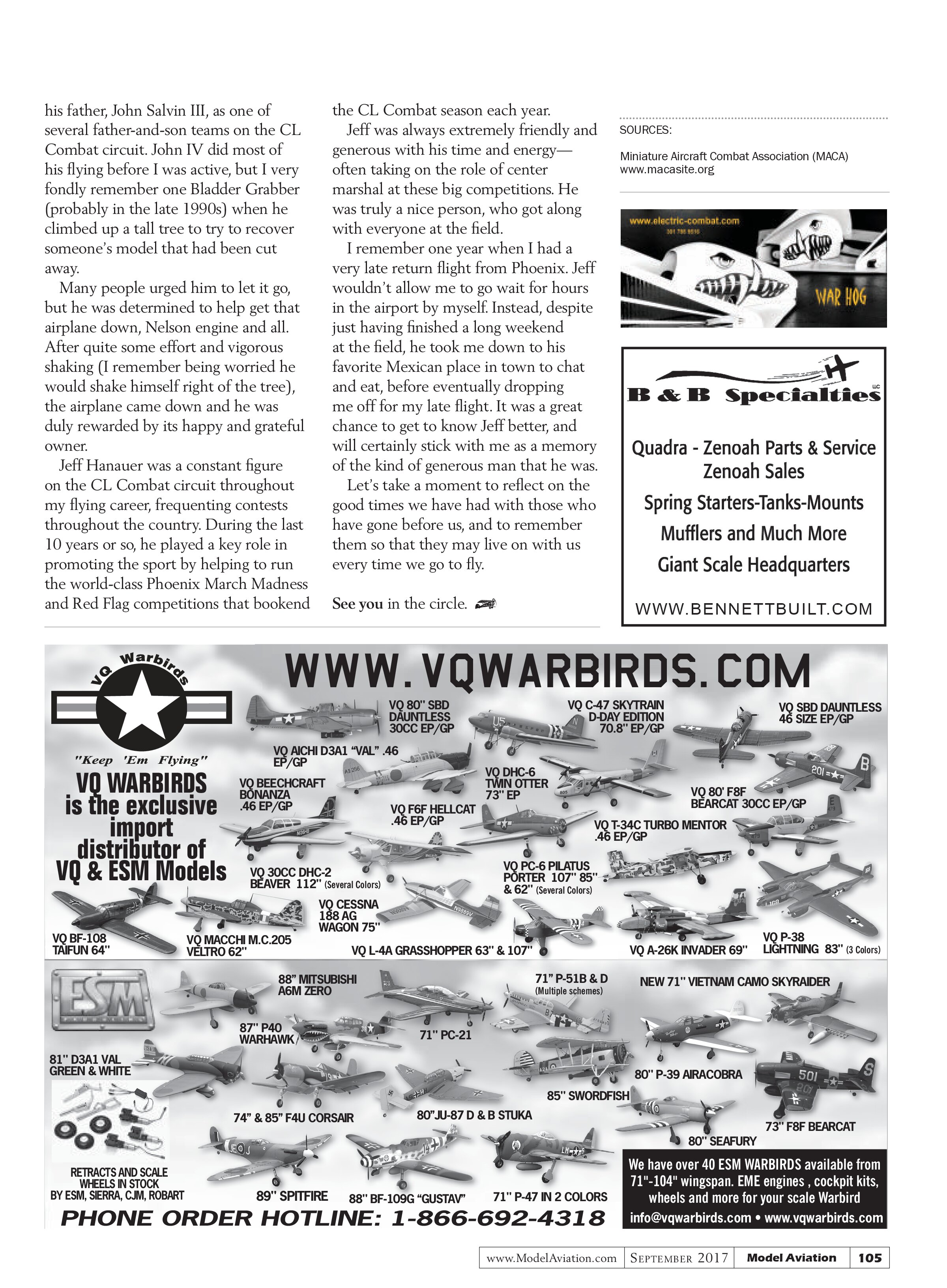
Jeff Hanauer was a constant figure on the CL Combat circuit throughout my flying career, frequenting contests throughout the country. During the last 10 years or so, he played a key role in promoting the sport by helping to run the world-class Phoenix March Madness and Red Flag competitions that bookend the CL Combat season each year.
Jeff was always extremely friendly and generous with his time and energy—often taking on the role of center marshal at these big competitions. He was truly a nice person, who got along with everyone at the field.
I remember one year when I had a very late return flight from Phoenix. Jeff wouldn’t allow me to go wait for hours in the airport by myself. Instead, despite just having finished a long weekend at the field, he took me down to his favorite Mexican place in town to chat and eat, before eventually dropping me off for my late flight. It was a great chance to get to know Jeff better, and will certainly stick with me as a memory of the kind of generous man that he was.
Let’s take a moment to reflect on the good times we have had with those who have gone before us, and to remember them so that they may live on with us every time we go to fly.
See you in the circle.
SOURCES:
Miniature Aircraft Combat Association (MACA)
www.macasite.org