2018 F2B Team Selection contest
by Bob Hunt
robinhunt@rcn.com

In my May “Control Line Aerobatics” column, I mentioned that the 2017 FAI Team Selection contest to determine the 2018 US F2B (Stunt) team would again be held in Houston. I promised to get more information about that contest and present it in my July column.
Unfortunately, the plans were not finalized by that deadline, but they are now. I’m pleased to report that the F2B Team Selection contest will be held October 14-15 at Scobee Field, which is a part of the George Bush Park complex in Houston.
The field will be open for practice the entire preceding week. The pilots’ meeting and model processing will happen on Friday, October 13, at a location to be announced. The qualifying rounds will be on Saturday, and the Top Ten finals will be flown on Sunday.
Frank Williams will again serve as the contest director, ably assisted by the Houston and Dallas Control Line (CL) members and the ad hoc group of women who call themselves the “Motormouth Gang.”
If you have any questions about this contest, please contact Frank. His information is listed in “Sources.”
Five Important Attributes
In my last column, I wrote about lightweight consciousness and how to achieve that method of thinking when building a Stunt model. I’ll write more about that subject in upcoming columns.
There is much more to the “good model equation” than simply light weight. Several years ago, I made nine consecutive trips to the Vintage Stunt Championships with Bill Werwage. On those trips, we discussed a lot of things

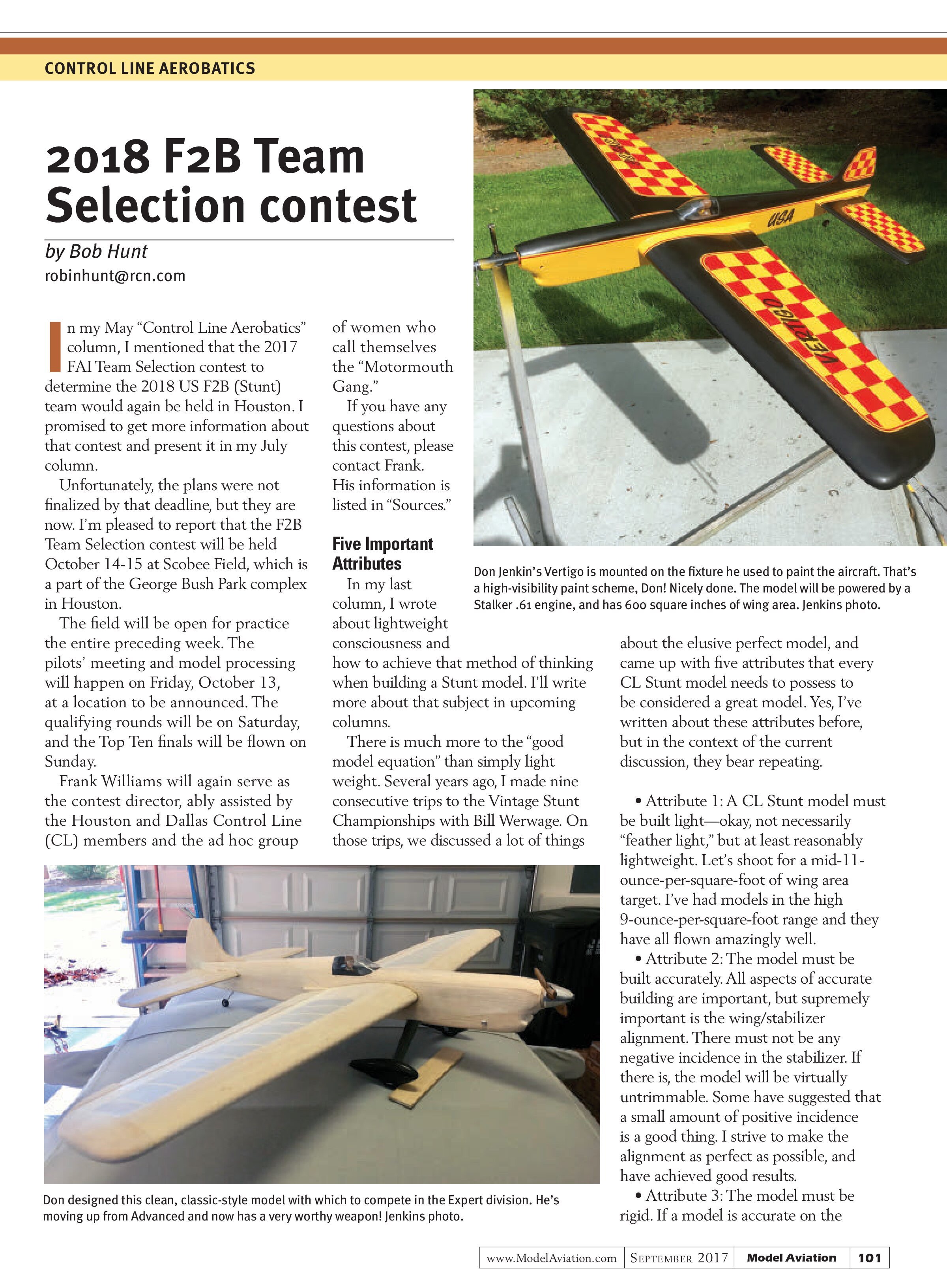
Don Jenkin’s Vertigo is mounted on the fixture he used to paint the aircraft. That’s a high-visibility paint scheme, Don! Nicely done. The model will be powered by a Stalker .61 engine, and has 600 square inches of wing area. Jenkins photo.
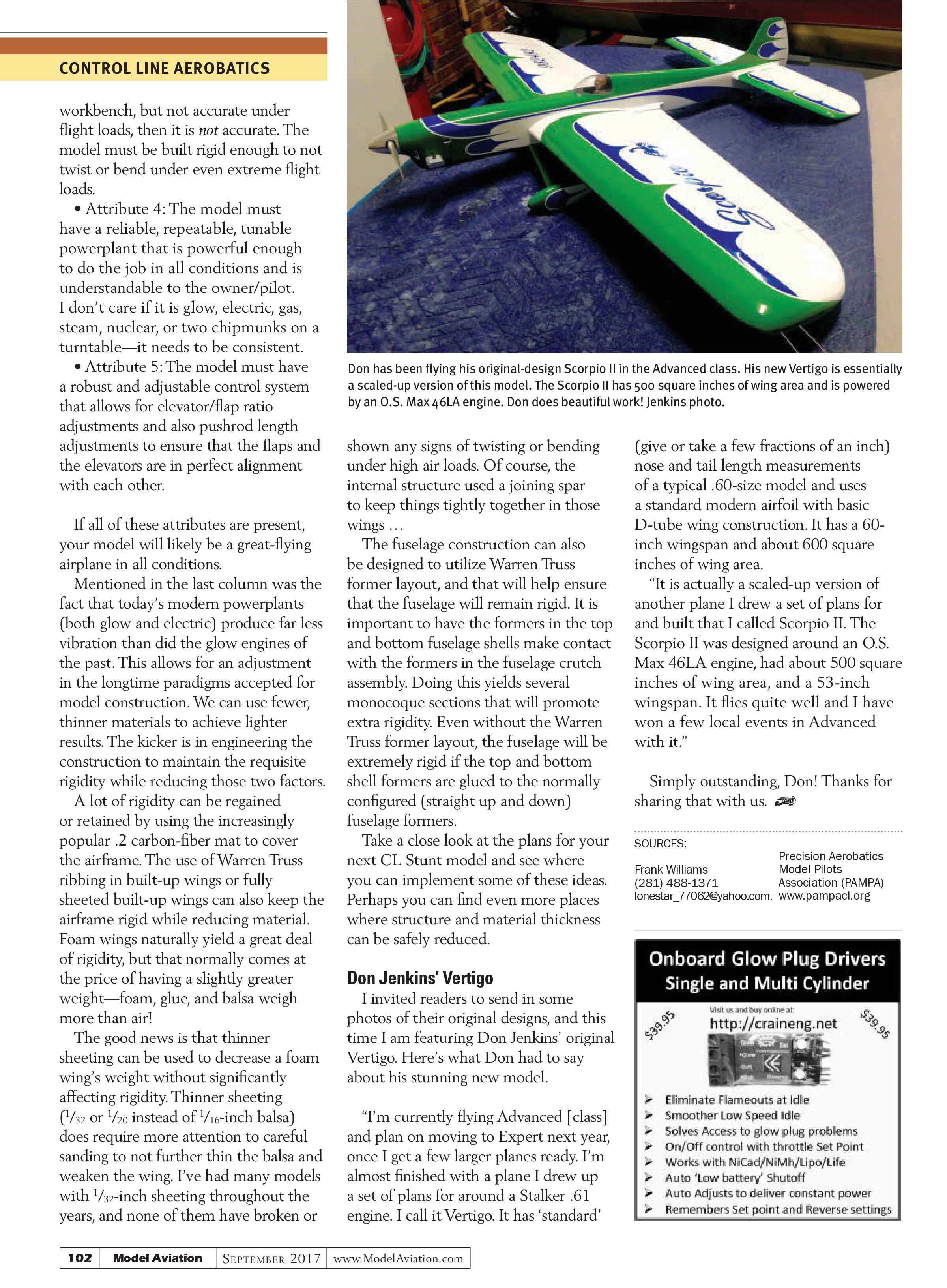
Don designed this clean, classic-style model with which to compete in the Expert division. He’s moving up from Advanced and now has a very worthy weapon! Jenkins photo.
about the elusive perfect model, and came up with five attributes that every CL Stunt model needs to possess to be considered a great model. Yes, I’ve written about these attributes before, but in the context of the current discussion, they bear repeating.
- Attribute 1: A CL Stunt model must be built light—okay, not necessarily “feather light,” but at least reasonably lightweight. Let’s shoot for a mid-11-ounce-per-square-foot of wing area target. I’ve had models in the high 9-ounce-per-square-foot range and they have all flown amazingly well.
- Attribute 2: The model must be built accurately. All aspects of accurate building are important, but supremely important is the wing/stabilizer alignment. There must not be any negative incidence in the stabilizer. If there is, the model will be virtually untrimmable. Some have suggested that a small amount of positive incidence is a good thing. I strive to make the alignment as perfect as possible, and have achieved good results.
- Attribute 3: The model must be rigid. If a model is accurate on the
workbench, but not accurate under flight loads, then it is not accurate. The model must be built rigid enough to not twist or bend under even extreme flight loads.
- Attribute 4: The model must have a reliable, repeatable, tunable powerplant that is powerful enough to do the job in all conditions and is understandable to the owner/pilot. I don’t care if it is glow, electric, gas, steam, nuclear, or two chipmunks on a turntable—it needs to be consistent.
- Attribute 5: The model must have a robust and adjustable control system that allows for elevator/flap ratio adjustments and also pushrod length adjustments to ensure that the flaps and the elevators are in perfect alignment with each other.
If all of these attributes are present, your model will likely be a great-flying airplane in all conditions.
Mentioned in the last column was the fact that today’s modern powerplants (both glow and electric) produce far less vibration than did the glow engines of the past. This allows for an adjustment in the longtime paradigms accepted for model construction. We can use fewer, thinner materials to achieve lighter results. The kicker is in engineering the construction to maintain the requisite rigidity while reducing those two factors.
A lot of rigidity can be regained or retained by using the increasingly popular .2 carbon-fiber mat to cover the airframe. The use of Warren Truss ribbing in built-up wings or fully sheeted built-up wings can also keep the airframe rigid while reducing material. Foam wings naturally yield a great deal of rigidity, but that normally comes at the price of having a slightly greater weight—foam, glue, and balsa weigh more than air!
The good news is that thinner sheeting can be used to decrease a foam wing’s weight without significantly affecting rigidity. Thinner sheeting (¹⁄₃₂ or ¹⁄₂₀ instead of ¹⁄₁₆-inch balsa) does require more attention to careful sanding to not further thin the balsa and weaken the wing. I’ve had many models with ¹⁄₃₂-inch sheeting throughout the years, and none of them have broken or

shown any signs of twisting or bending under high air loads. Of course, the internal structure used a joining spar to keep things tightly together in those wings …
The fuselage construction can also be designed to utilize Warren Truss former layout, and that will help ensure that the fuselage will remain rigid. It is important to have the formers in the top and bottom fuselage shells make contact with the formers in the fuselage crutch assembly. Doing this yields several monocoque sections that will promote extra rigidity. Even without the Warren Truss former layout, the fuselage will be extremely rigid if the top and bottom shell formers are glued to the normally configured (straight up and down) fuselage formers.
Take a close look at the plans for your next CL Stunt model and see where you can implement some of these ideas. Perhaps you can find even more places where structure and material thickness can be safely reduced.
Don Jenkins’ Vertigo
I invited readers to send in some photos of their original designs, and this time I am featuring Don Jenkins’ original Vertigo. Here’s what Don had to say about his stunning new model.
“I’m currently flying Advanced [class] and plan on moving to Expert next year, once I get a few larger planes ready. I’m almost finished with a plane I drew up a set of plans for around a Stalker .61 engine. I call it Vertigo. It has ‘standard’
(give or take a few fractions of an inch) nose and tail length measurements of a typical .60-size model and uses a standard modern airfoil with basic D-tube wing construction. It has a 60-inch wingspan and about 600 square inches of wing area.
“It is actually a scaled-up version of another plane I drew a set of plans for and built that I called Scorpio II. The Scorpio II was designed around an O.S. Max 46LA engine, had about 500 square inches of wing area, and a 53-inch wingspan. It flies quite well and I have won a few local events in Advanced with it.”
Simply outstanding, Don! Thanks for sharing that with us.
SOURCES:
Frank Williams
(281) 488-1371
lonestar_77062@yahoo.com.
Precision Aerobatics
Model Pilots
Association (PAMPA)
www.pampacl.org