Troop 9 and the Sheetcat
Thayer Syme
As you are likely aware, I have been making an effort to encourage my son’s Boy Scout troop to explore things that fly. Although some of the Scouts have built a few detailed projects, most don’t have a lot of experience with the kind of critical hand-eye coordination and sense of craftsmanship that we often take for granted.
Once a year we have a family camping weekend, and this informal get-together offers a good opportunity for the Scouts to send some creations skyward. During the last couple of years, we have launched Estes rockets, as well as compressed-air water rockets that were made with little more than soft drink bottles, corrugated plastic, and duct tape. Both projects were quite popular with the Scouts, so I received the nod to coordinate more aero fun for this year’s campout.
Mixing it up a bit, we have scheduled a couple of build sessions for the troop to assemble some rubber-powered airplanes. They have seen me fly the Pussycat and Akro airplanes (that I wrote about in previous columns) in the school yard during their meetings, and thought it looked fun.
I figured a traditional stick-and-tissue-type model might prove too challenging for some of the Scouts, and more so because I would be trying to guide 10 to 15 of them through the process with limited available time. Yet, I still wanted to give them some actual building and flying experience. As an alternative, I worked up a new version of Dick Baxter’s Pussycat that incorporates some revisions described by Gary Hinze on his Endless Lift website, and some ideas of my own.
Gary Hinze had previously reworked Baxter’s “forced-circle” geometry for the wing and tail to give it a larger, flatter orbit for more duration when flying outside. My contribution was to redraw the design to allow laser cutting of all of the sticks needed for the flying surfaces, as well as the components for a sheet-box fuselage instead of Baxter’s original stick-and-stringer construction. A couple of test builds and a trimming session later showed that my laser-cut Sheetcat offered a quick build and was an easy-flying model.
To date, 14 Scouts have started their own Sheetcats, and at this point, most are nearing flight-ready status. Given that these are the first flying airplanes that most of these kids have built, the project has been quite successful, and I will report back in a future column to let you know the results.
In the meantime, take a look at the photos and shoot me an email if you, or someone you know, might be interested in a kit. I still have the laser-cut files and plans.
Roads Less Traveled
The endless variety of our models has to be one of the greatest joys that this hobby offers. It would be easy to assume that with the numerous ARFs, kits, and plans available, nearly all of the options have been covered throughout the years. Yet despite all of the available designs,


we sometimes still get the urge to strike out and roll our own.
Creating a new design might be as simple as the Sheetcat that I worked up for our Boy Scouts, or it could mean pulling out a truly fresh sheet and drawing something that the world has never seen.
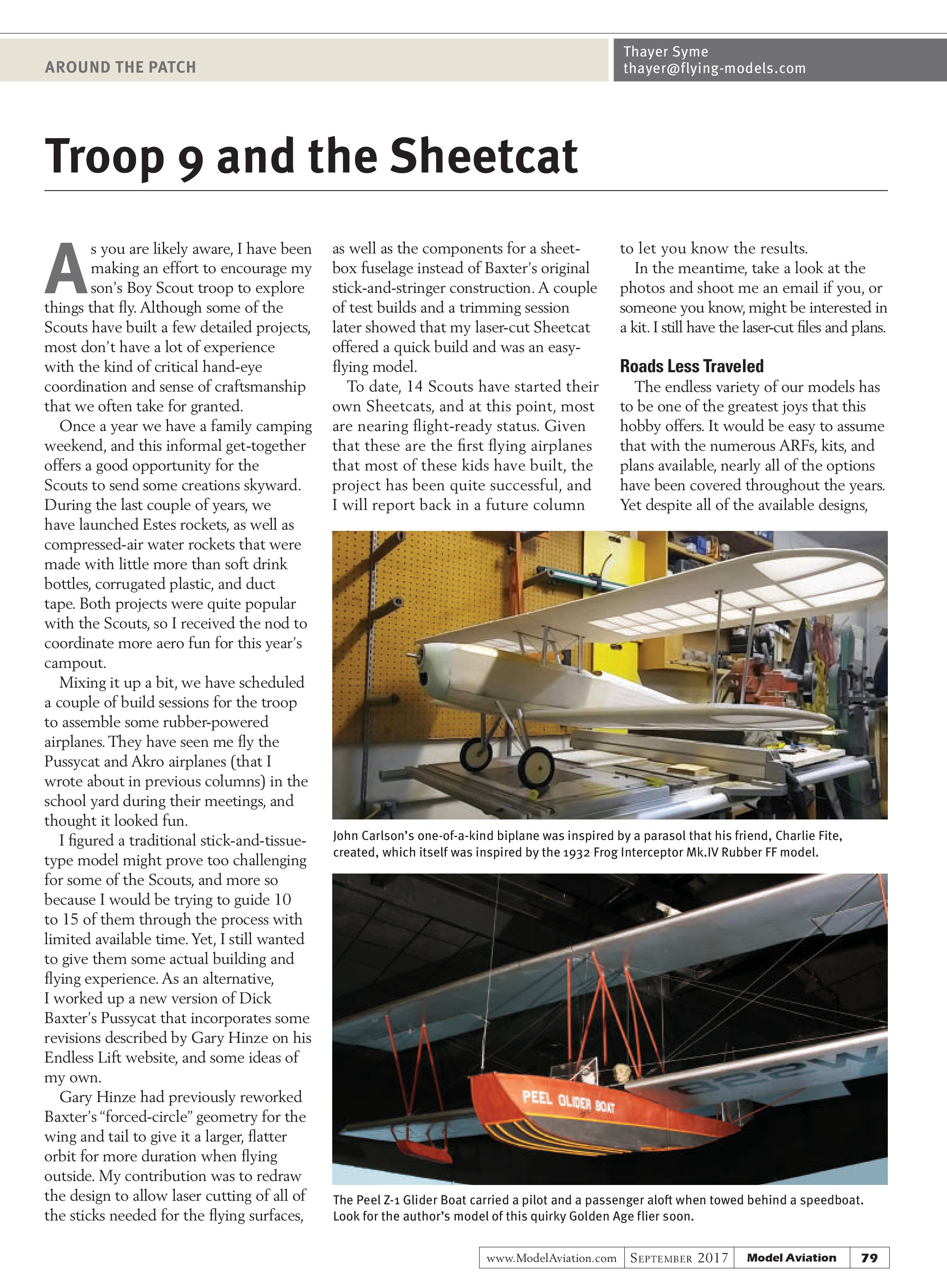
There is plenty of room between these options. John Carlson sent me a few photos of his latest designs from his home in Tulsa, Oklahoma. His buddy, Charlie Fite, found inspiration in the old Frog Interceptor Free Flight (FF) model and enlarged the basic design to a roughly 60-inch wingspan for electric RC. I’ll let John tell some of the story from here.
“Charlie soon thought, ‘Why not a parasol version?’ About this time, I got involved and mentioned that since he was over halfway done, he should go ahead and make it a biplane! So that’s what I have just finished building.
“I am doing it smart this time, having decided to fly it before I load it down with paint. This will mainly be to double-check our figures for the CG [center of gravity] and surface incidences.”
Links to the first few flights of John’s Interceptor biplane are in the “Sources” list. Despite being slightly tail-heavy for the first attempt, it improved as they worked through the test flights. I look forward to seeing it fully dressed soon. John is planning a scheme based on the Hawker Fury Mk.I K5674, the only known survivor of its type. With its long tail arm and graceful lines, I expect the Interceptor will soon be a favorite in Tulsa.
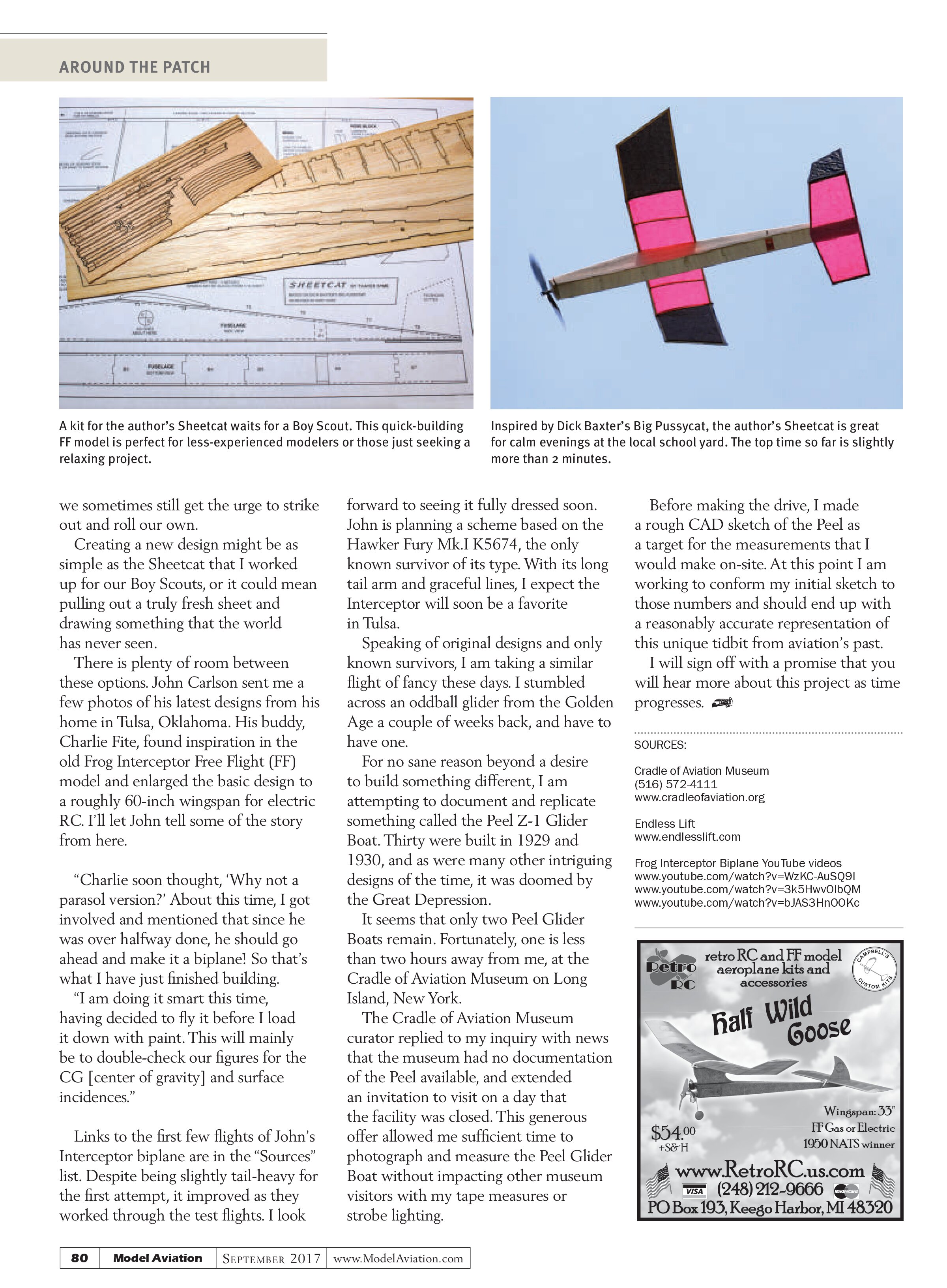
Speaking of original designs and only known survivors, I am taking a similar flight of fancy these days. I stumbled across an oddball glider from the Golden Age a couple of weeks back, and have to have one.
For no sane reason beyond a desire to build something different, I am attempting to document and replicate something called the Peel Z-1 Glider Boat. Thirty were built in 1929 and 1930, and as were many other intriguing designs of the time, it was doomed by the Great Depression.
It seems that only two Peel Glider Boats remain. Fortunately, one is less than two hours away from me, at the Cradle of Aviation Museum on Long Island, New York.
The Cradle of Aviation Museum curator replied to my inquiry with news that the museum had no documentation of the Peel available, and extended an invitation to visit on a day that the facility was closed. This generous offer allowed me sufficient time to photograph and measure the Peel Glider Boat without impacting other museum visitors with my tape measures or strobe lighting.
Before making the drive, I made a rough CAD sketch of the Peel as a target for the measurements that I would make on-site. At this point I am working to conform my initial sketch to those numbers and should end up with a reasonably accurate representation of this unique tidbit from aviation’s past.
I will sign off with a promise that you will hear more about this project as time progresses.
SOURCES:
Cradle of Aviation Museum
(516) 572-4111
www.cradleofaviation.org
Endless Lift
www.endlesslift.com
Frog Interceptor Biplane YouTube videos
www.youtube.com/watch?v=WzKC-AuSQ9I
www.youtube.com/watch?v=3k5HwOlbQM
www.youtube.com/watch?v=bJAS3HnO0Kc