In the Air
Membership news and updates
from AMA Headquarters
Collegiate Challenge
AMA and the University Aviation Association have partnered to offer a joint UAS contest for college students.
The new UAS4STEM Collegiate Challenge will encourage teamwork, competition, and success through a STEM-based education platform. Similar to the UAS4STEM program currently available to high schools, the UAS4STEM Collegiate Challenge will provide university student teams access to training, insurance, licensing, and equipment. The teams must complete an online curriculum to ensure that they have learned about multirotor safety and the National Airspace System.
The UAS4STEM Collegiate Challenge competitions will be held in spring 2018 at regional flying locations across the country. These contests will be hosted by AMA University Model Aviation Student Clubs.
The team registration fees include licenses for each student, a Quadzilla quadcopter kit, all necessary support equipment (except a laptop computer), the online curriculum, an online instructional video series, AMA membership for students, and competition entry fees.
For more information, visit www.uas4stem.org.

AMA Thanks Its Lifetime Supporters!
The Academy of Model Aeronautics recently welcomed Life Members Robert Studinski, Benton KY, and Patrick M. O’Connor, Landing NY.
For information about becoming a Life Member, contact AMA Headquarters at (800) 435-9262.
—AMA Membership Department
The Northrop Files

The AMA Plans Service now houses all plans formerly sold through Model Builder magazine, Bill Northrop’s Plan Service, and the Scratch Builder’s Almanac. There are more than 1,000 plans in the collection.
The Focke Aghelis FA-61, designed by Skip Ruff, is a twin-rotor autogyro model. The 70-inch aircraft weighs 3½ pounds and is powered by a .35 glow engine. You can order the Focke Aghelis FA-61, plans number 4751, for $16 by calling AMA Plans Service at (800) 435-9262, extension 507.
National Model Aviation Museum
Drone Nationals
When the donation of artifacts representing the 2015 US Drone Nationals arrived at the National Model Aviation Museum, it wasn’t immediately clear what two of the large banners were. Printed on heavy vinyl fabric, they were large, had dirt and grass stains, and showed signs of wear.
Unlike the other banners included in the donation that featured the name of a sponsor, or two identical banners that proclaimed that the event was the “US National Drone Racing Championships,” the large banners carried the names of at least four companies. Each manufacturer was listed in a numbered circle that looked like a thought bubble. A black and white checkered pattern was across the top. These two large banners didn’t seem to be sponsorship banners.
Online research turned up the article, “The first US national drone-racing competition was won by an Australian,” by Mike Murphy on Quartz (https://qz.com) that showed a picture of the banners in use. It turned out that these two banners were used as the starting and finishing locations for the multirotors that flew in each heat.
More investigation showed that the banners told an even larger story. The 2015 US Drone Nationals was the first professionally run, large-scale FPV event in the US. It brought together approximately 120 pilots competing for $25,000 in prize money, but it also created the challenge of how to organize an event of this type and size.
One of the biggest challenges was that flying only four multirotors at a time simply wouldn’t be enough. To overcome this, the event organizers worked with FPV drone racing company ImmersionRC. According to Scot Refsland of the Drone Sports Association, who organized and directed the event, the result was something called the Race Band. After making modifications to the already approved frequency band, Race Band allowed eight aircraft to fly at the same time. Eight aircraft equaled eight numbered starting points on the two banners.
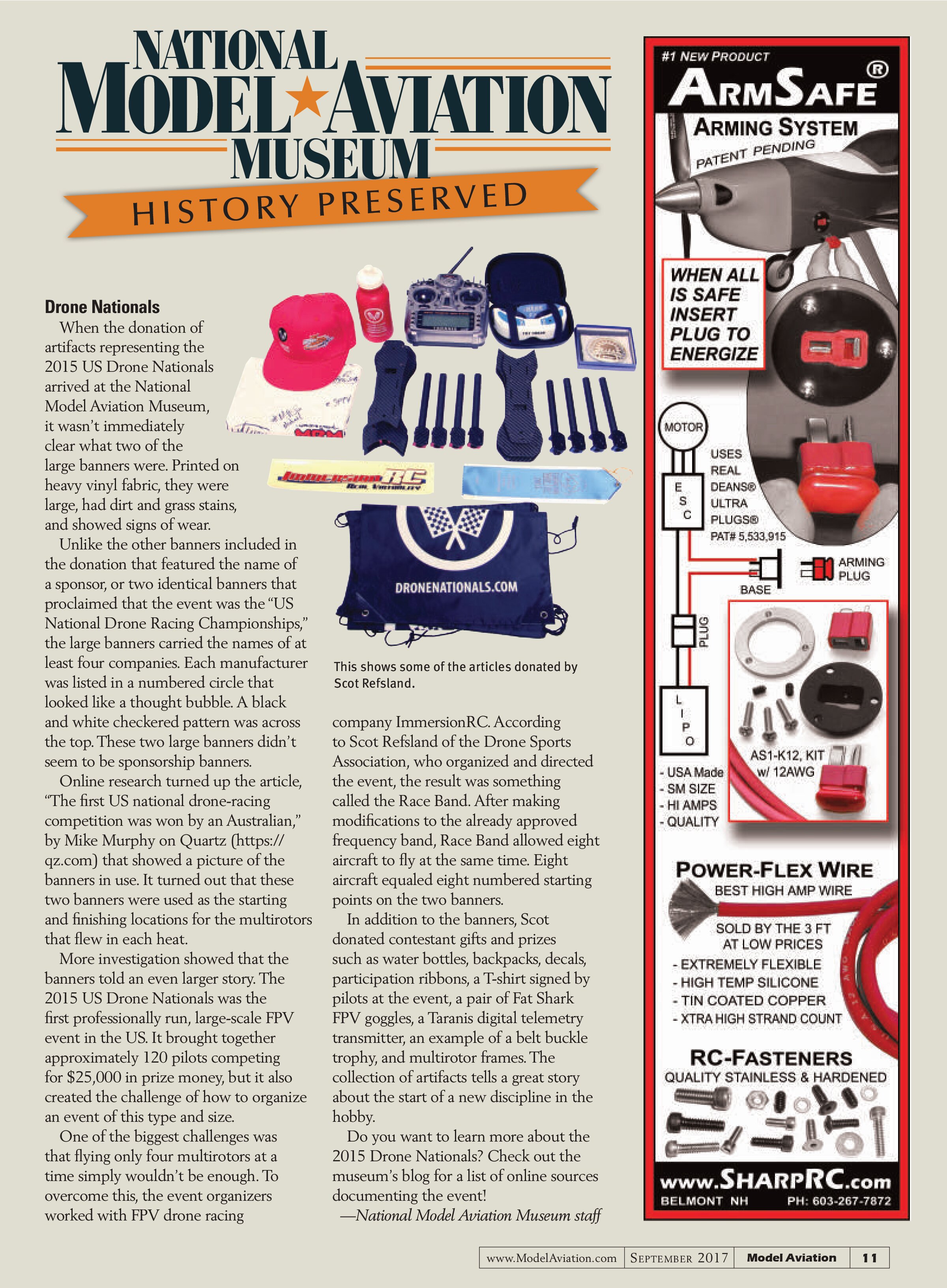
In addition to the banners, Scot donated contestant gifts and prizes such as water bottles, backpacks, decals, participation ribbons, a T-shirt signed by pilots at the event, a pair of Fat Shark FPV goggles, a Taranis digital telemetry transmitter, an example of a belt buckle trophy, and multirotor frames. The collection of artifacts tells a great story about the start of a new discipline in the hobby.
Do you want to learn more about the 2015 Drone Nationals? Check out the museum’s blog for a list of online sources documenting the event!
—National Model Aviation Museum staff