Build new or restore?
Pat Tritle
patscustommodels@gmail.com

Before I get started, it was brought to my attention that in my April column, I not only misspelled Ron Sims’ name, but also referred to Ron’s B-17E as an F model. I wish to offer my sincere apologies and to set the record straight. With that hopefully cleared up, let’s press on.
For many of us in the modeling community, building the models that we fly is pretty much the norm. Within that community, the skill levels of the pilots undoubtedly range from rank beginners to seasoned veterans and virtually all points in between.
Because flying model airplanes is a learned skill, it stands to reason that the models are going to get damaged and need to be repaired, but as our piloting skills improve, the need for repair seems to taper off over time and drift out of the realm of repair and more into the realm of maintenance.
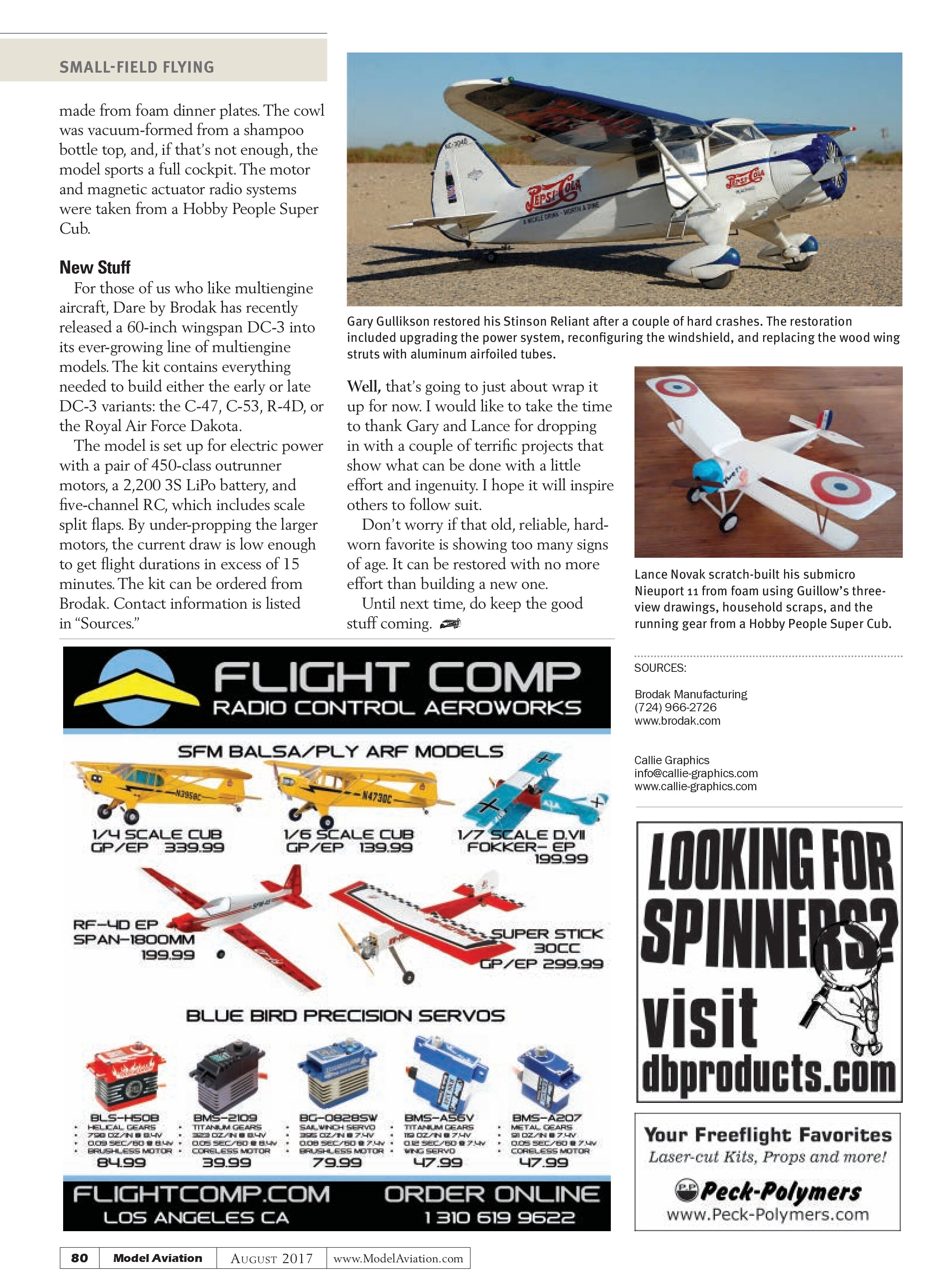
During our modeling careers, many of us come across a model or two that we really like and fly a lot during a long period of time. Unfortunately, airplanes are machines, and machines by nature wear out. Case in point: my first 60-inch J-3 Cub was built in 1998 and is still flying today.
Throughout its 19 years of faithful service, although it has never crashed, it slowly deteriorated to the point that the cover was so brittle it would shatter at the touch. The tail was so warped out of shape that the model literally became unflyable. At that point, there were only two options: build new or do a full restoration.
Let’s talk about the restoration, which was no more difficult than building new—it was just different. In the case of the Cub, the restoration could be looked upon as literally “from the wheels up.”
The model was disassembled, the old cover stripped, and the major components and flight controls removed. Peeling the cover off was fairly easy, but the adhesive residue had to be removed from the structure. I’ve tried several methods, but good old-fashioned hand sanding was by far the easiest.
After the frames were cleaned up, the internal damage was repaired, and, in the worst case, warped components were replaced. Some areas that I looked at closely were the landing gear mounts, wingtips, and wing trailing edges (TEs). Fortunately, oil soaking in a park flyer is not an issue, so after the airframe was cleaned up and the internal damage repaired, the recovering process was the same as on a new model.
Where the hinges were concerned, I simply cut them at the hinge line and replaced them with new ones next to the existing hinges, rather than trying to dig out the old ones.
If you have an old model that’s showing its age and you like it well enough to keep it, restoration is a great alternative. You’ll still have a “new” model when it’s finished, but at the same time, you still have that faithful, old model that has served you well.
To prove the concept, Gary Gullikson dropped me a line with a photo of his recently restored Stinson Reliant. The Reliant has always been one of Gary’s favorites, and after a couple of hard crashes, Gary decided to resurrect the model and put it back on the front line.
While the model was undergoing restoration, the windshield was modified to the SR-7 configuration. The motor was upgraded to a Scorpion 3008-32 outrunner and the wood lift struts were replaced with K & S streamlined tubing attached to plywood plates with small screws. The model was then re-covered and the Pepsi graphics from Callie Graphics were reapplied. The model also features a full cockpit layout.
For those who like them small, Lance Novak built his 10-inch wingspan Nieuport 11 from foam using three-view drawings from the Guillow’s 24-inch kit plans. The fuselage was hot-wire cut from a block, with the wings and the tail

made from foam dinner plates. The cowl was vacuum-formed from a shampoo bottle top, and, if that’s not enough, the model sports a full cockpit. The motor and magnetic actuator radio systems were taken from a Hobby People Super Cub.
New Stuff
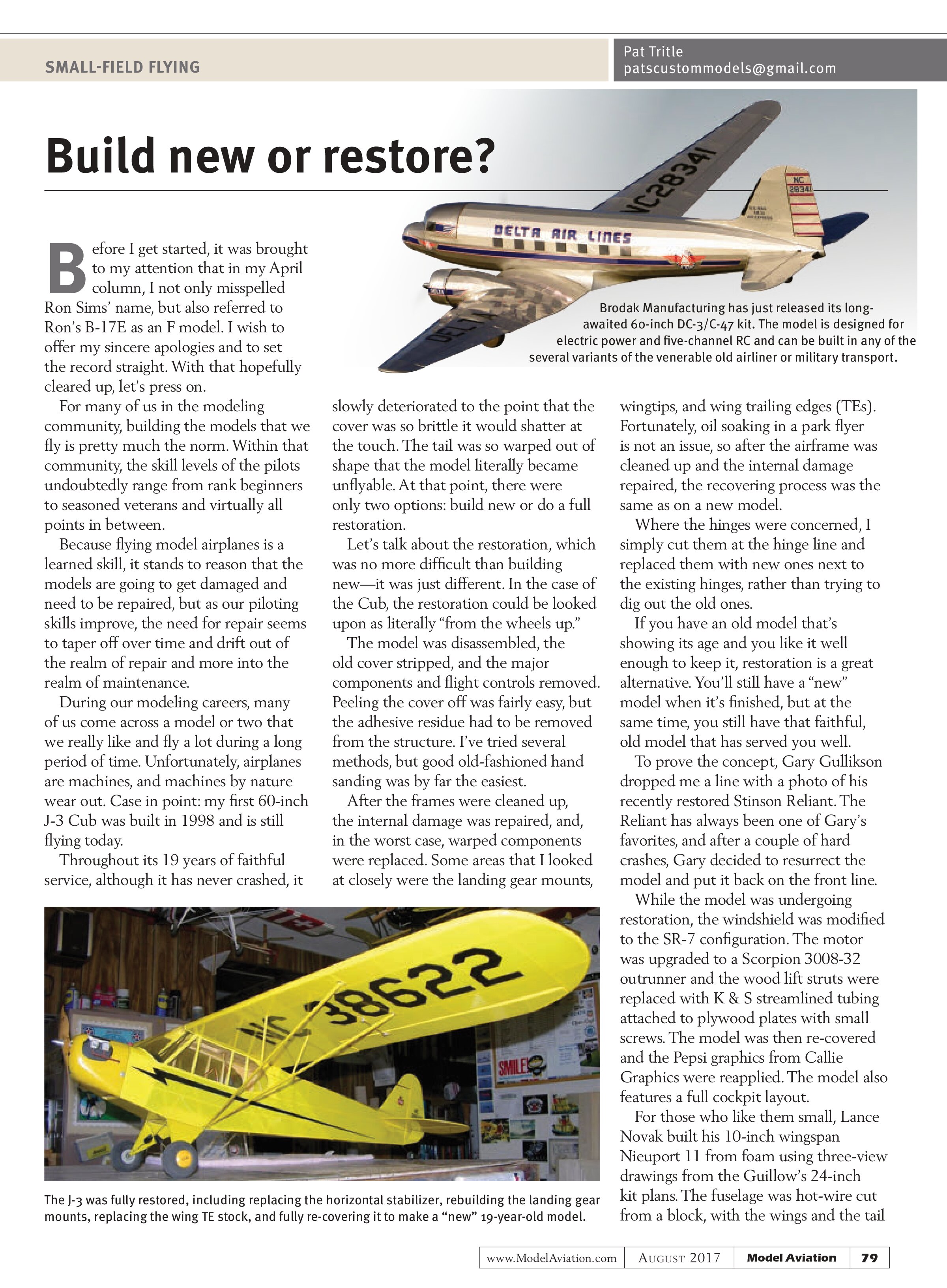
For those of us who like multiengine aircraft, Dare by Brodak has recently released a 60-inch wingspan DC-3 into its ever-growing line of multiengine models. The kit contains everything needed to build either the early or late DC-3 variants: the C-47, C-53, R-4D, or the Royal Air Force Dakota.
The model is set up for electric power with a pair of 450-class outrunner motors, a 2,200 3S LiPo battery, and five-channel RC, which includes scale split flaps. By under-propping the larger motors, the current draw is low enough to get flight durations in excess of 15 minutes. The kit can be ordered from Brodak. Contact information is listed in “Sources.”

Well, that’s going to just about wrap it up for now. I would like to take the time to thank Gary and Lance for dropping in with a couple of terrific projects that show what can be done with a little effort and ingenuity. I hope it will inspire others to follow suit.
Don’t worry if that old, reliable, hard-worn favorite is showing too many signs of age. It can be restored with no more effort than building a new one.
Until next time, do keep the good stuff coming.

Sources:
Brodak Manufacturing
(724) 966-2726
www.brodak.com
Callie Graphics
info@callie-graphics.com
www.callie-graphics.com