Air shows—ruined forever
Dave Gee
safetycolumn@cs.com

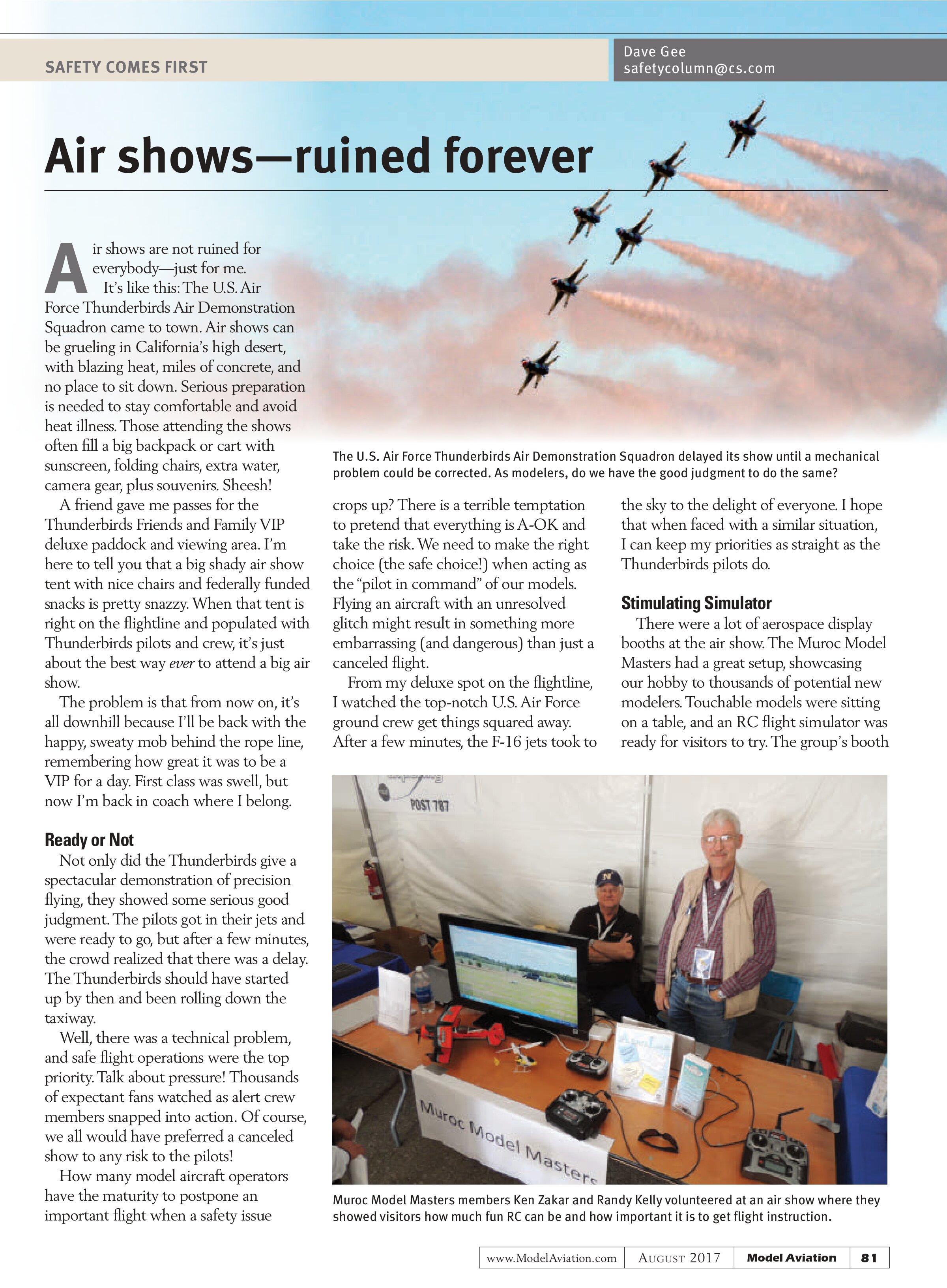
Air shows are not ruined for everybody—just for me. It’s like this: The U.S. Air Force Thunderbirds Air Demonstration Squadron came to town. Air shows can be grueling in California’s high desert, with blazing heat, miles of concrete, and no place to sit down. Serious preparation is needed to stay comfortable and avoid heat illness. Those attending the shows often fill a big backpack or cart with sunscreen, folding chairs, extra water, camera gear, plus souvenirs. Sheesh!
A friend gave me passes for the Thunderbirds Friends and Family VIP deluxe paddock and viewing area. I’m here to tell you that a big shady air show tent with nice chairs and federally funded snacks is pretty snazzy. When that tent is right on the flightline and populated with Thunderbirds pilots and crew, it’s just about the best way ever to attend a big air show.
The problem is that from now on, it’s all downhill because I’ll be back with the happy, sweaty mob behind the rope line, remembering how great it was to be a VIP for a day. First class was swell, but now I’m back in coach where I belong.
Ready or Not
Not only did the Thunderbirds give a spectacular demonstration of precision flying, they showed some serious good judgment. The pilots got in their jets and were ready to go, but after a few minutes, the crowd realized that there was a delay. The Thunderbirds should have started up by then and been rolling down the taxiway.
Well, there was a technical problem, and safe flight operations were the top priority. Talk about pressure! Thousands of expectant fans watched as alert crew members snapped into action. Of course, we all would have preferred a canceled show to any risk to the pilots!
How many model aircraft operators have the maturity to postpone an important flight when a safety issue crops up? There is a terrible temptation to pretend that everything is A-OK and take the risk. We need to make the right choice (the safe choice!) when acting as the “pilot in command” of our models. Flying an aircraft with an unresolved glitch might result in something more embarrassing (and dangerous) than just a canceled flight.
From my deluxe spot on the flightline, I watched the top-notch U.S. Air Force ground crew get things squared away. After a few minutes, the F-16 jets took to the sky to the delight of everyone. I hope that when faced with a similar situation, I can keep my priorities as straight as the Thunderbirds pilots do.
Stimulating Simulator
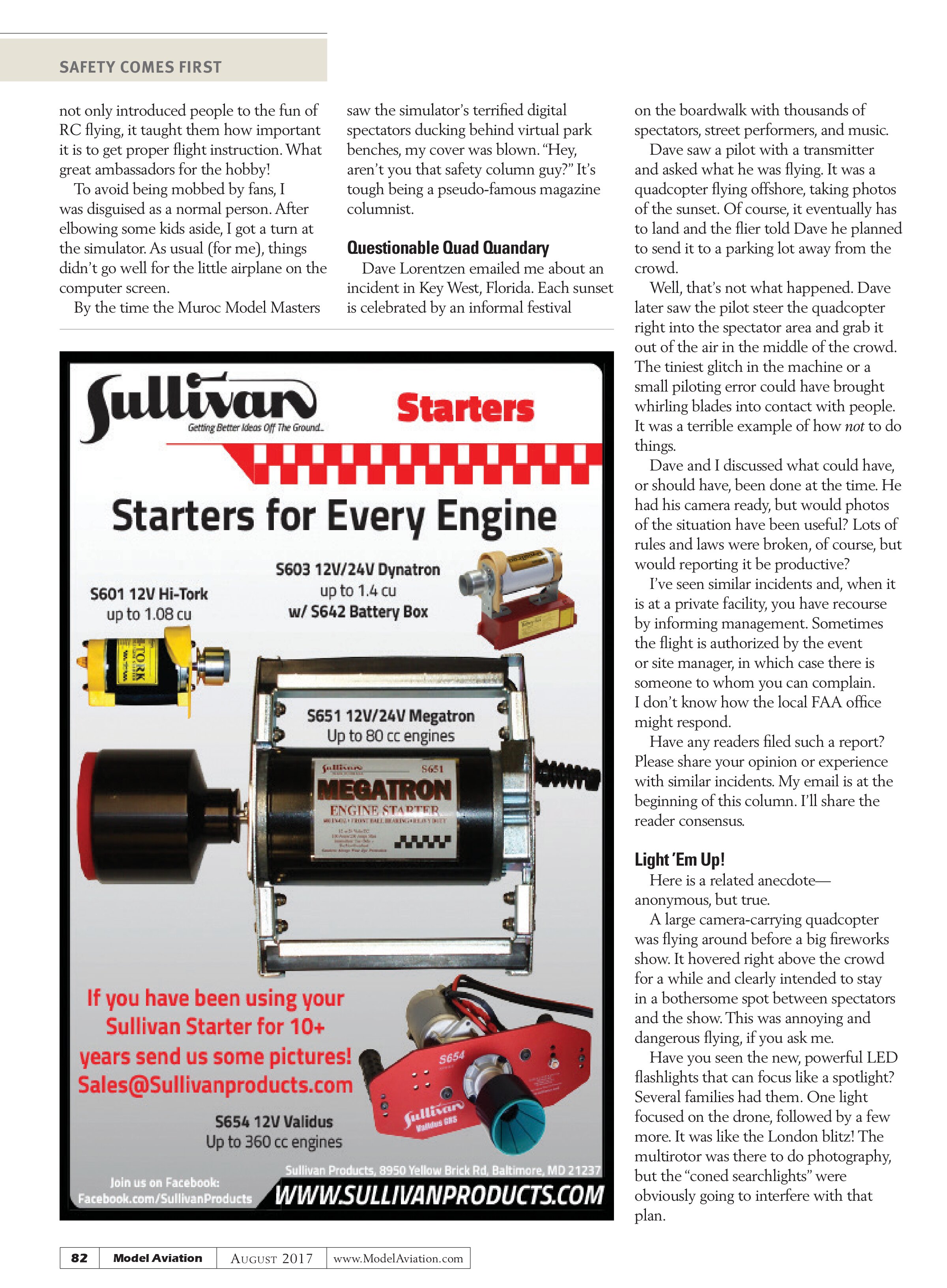
There were a lot of aerospace display booths at the air show. The Muroc Model Masters had a great setup, showcasing our hobby to thousands of potential new modelers. Touchable models were sitting on a table, and an RC flight simulator was ready for visitors to try. The group’s booth

not only introduced people to the fun of RC flying, it taught them how important it is to get proper flight instruction. What great ambassadors for the hobby!
To avoid being mobbed by fans, I was disguised as a normal person. After elbowing some kids aside, I got a turn at the simulator. As usual (for me), things didn’t go well for the little airplane on the computer screen.
By the time the Muroc Model Masters saw the simulator’s terrified digital spectators ducking behind virtual park benches, my cover was blown. “Hey, aren’t you that safety column guy?” It’s tough being a pseudo-famous magazine columnist.
Questionable Quad Quandary
Dave Lorentzen emailed me about an incident in Key West, Florida. Each sunset is celebrated by an informal festival on the boardwalk with thousands of spectators, street performers, and music. Dave saw a pilot with a transmitter and asked what he was flying. It was a quadcopter flying offshore, taking photos of the sunset. Of course, it eventually has to land and the flier told Dave he planned to send it to a parking lot away from the crowd.
Well, that’s not what happened. Dave later saw the pilot steer the quadcopter right into the spectator area and grab it out of the air in the middle of the crowd. The tiniest glitch in the machine or a small piloting error could have brought whirling blades into contact with people. It was a terrible example of how not to do things.
Dave and I discussed what could have, or should have, been done at the time. He had his camera ready, but would photos of the situation have been useful? Lots of rules and laws were broken, of course, but would reporting it be productive?
I’ve seen similar incidents and, when it is at a private facility, you have recourse by informing management. Sometimes the flight is authorized by the event or site manager, in which case there is someone to whom you can complain. I don’t know how the local FAA office might respond.
Have any readers filed such a report? Please share your opinion or experience with similar incidents. My email is at the beginning of this column. I’ll share the reader consensus.
Light ’Em Up!
Here is a related anecdote—anonymous, but true.
A large camera-carrying quadcopter was flying around before a big fireworks show. It hovered right above the crowd for a while and clearly intended to stay in a bothersome spot between spectators and the show. This was annoying and dangerous flying, if you ask me.
Have you seen the new, powerful LED flashlights that can focus like a spotlight? Several families had them. One light focused on the drone, followed by a few more. It was like the London blitz! The multirotor was there to do photography, but the “coned searchlights” were obviously going to interfere with that plan.

The pilot (who remained hidden) eventually gave up and moved the aircraft out of the way. I thought it was a fine example of technological democracy.
Light Me Up!
Laser-cut parts are a great leap forward for model airplane building. Laser cutters are becoming common in hobby workshops, but they can be as dangerous as any conventional power tool. Working with a powerful, but invisible, beam that can instantly hurt a careless user? Count me in, baby!
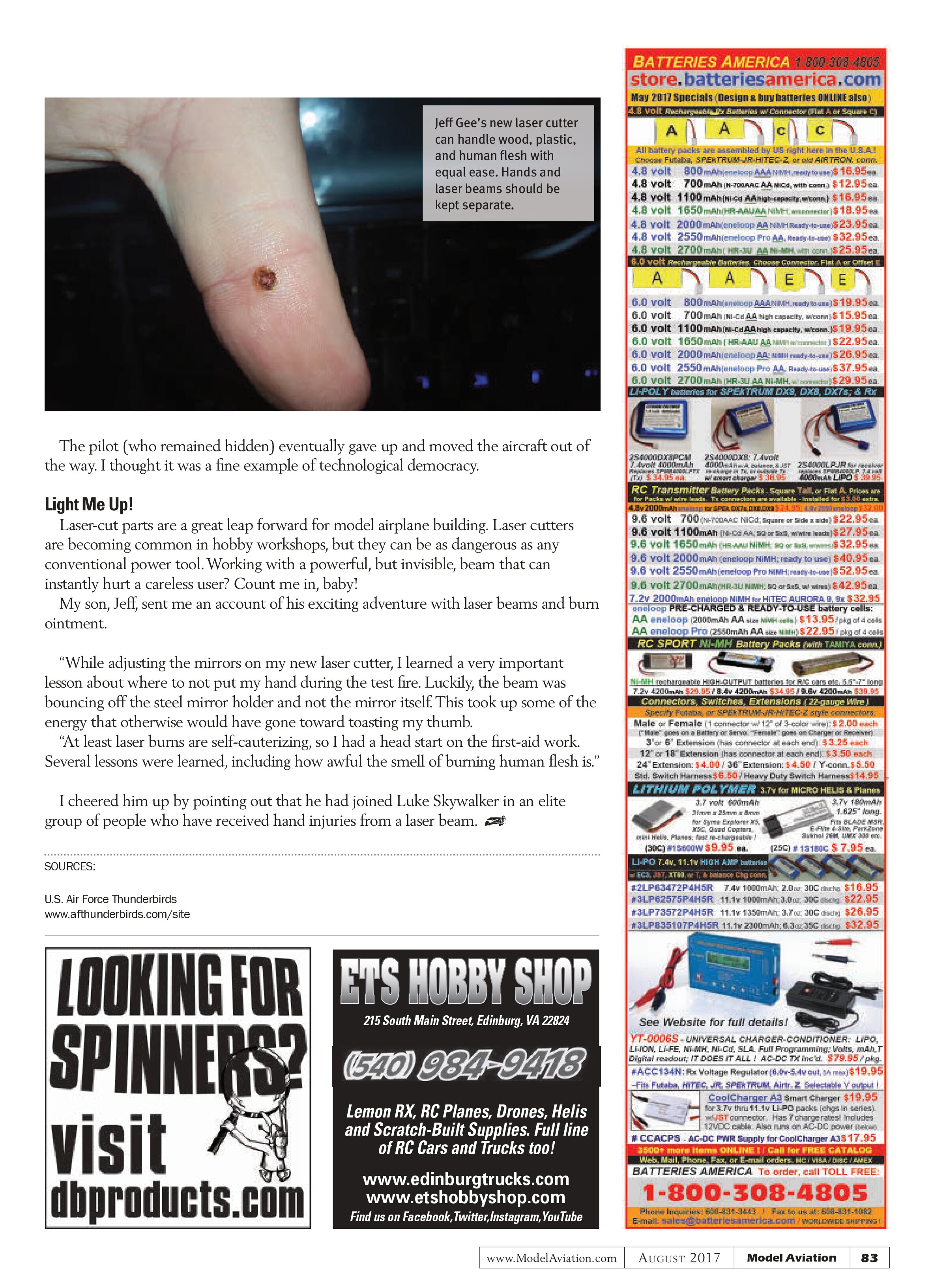
My son, Jeff, sent me an account of his exciting adventure with laser beams and burn ointment.
“While adjusting the mirrors on my new laser cutter, I learned a very important lesson about where to not put my hand during the test fire. Luckily, the beam was bouncing off the steel mirror holder and not the mirror itself. This took up some of the energy that otherwise would have gone toward coasting my thumb.
“At least laser burns are self-cauterizing, so I had a head start on the first-aid work. Several lessons were learned, including how awful the smell of burning human flesh is.”
I cheered him up by pointing out that he had joined Luke Skywalker in an elite group of people who have received hand injuries from a laser beam.
SOURCES:
U.S. Air Force Thunderbirds
www.afthunderbirds.com/site