Reviving Essential Control Setup Fundamentals in an Era of Elaborate Programming
By Dave Scott | Illustrations by the author
This month continues the series aimed at consolidating the fundamental control setup principles that are often overshadowed by the amount of effort that goes into learning how to program today’s elaborate radios. Once again, these setup rules-of-thumb are aimed at maximizing “precision” flight control on low rates, as opposed to the entirely different setup required to perform extreme 3-D stunts.
The main thing to keep in mind is that no amount of elaborate programming can overcome a fundamentally flawed airplane setup. It is only after correctly addressing the fundamentals (in Part 1, July 2017) that you can begin to take advantage of the more sophisticated capabilities of today’s radios to achieve the best-handling airplane possible.
Exponential Tips
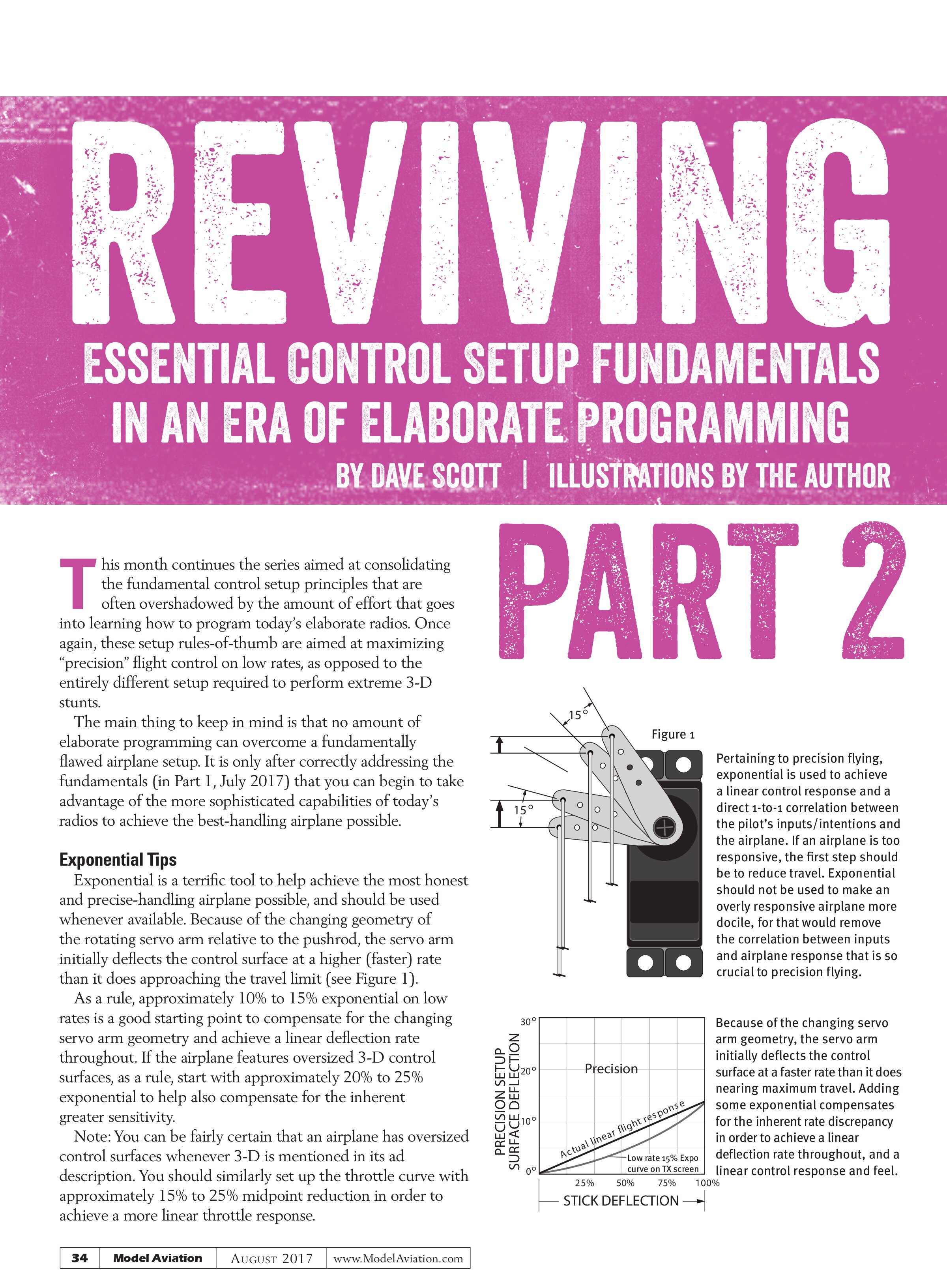
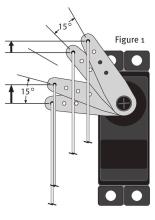
Exponential is a terrific tool to help achieve the most honest and precise-handling airplane possible, and should be used whenever available. Because of the changing geometry of the rotating servo arm relative to the pushrod, the servo arm initially deflects the control surface at a higher (faster) rate than it does approaching the travel limit (see Figure 1).
As a rule, approximately 10% to 15% exponential on low rates is a good starting point to compensate for the changing servo arm geometry and achieve a linear deflection rate throughout. If the airplane features oversized 3-D control surfaces, as a rule, start with approximately 20% to 25% exponential to help also compensate for the inherent greater sensitivity.
Note: You can be fairly certain that an airplane has oversized control surfaces whenever 3-D is mentioned in its ad description. You should similarly set up the throttle curve with approximately 15% to 25% midpoint reduction in order to achieve a more linear throttle response.


Ultimately, when low rates have been optimized for takeoff, landing, and general flying, the objective is to use just enough exponential to achieve a linear (predictable) control response. That is, the low-rate exponential objective is to achieve a comfortable “connected to the airplane” control feel, similar to the feel of a new car, but not to make the airplane docile or to compensate for a poor setup or over-controlling tendencies.
If the airplane is too responsive, the correct response is to reduce the low-rate percentage before you start adding more exponential. Later, when your flying has progressed to a point of needing to add more travel, add more exponential as well to maintain the same general handling.
If you start sensing a lag or “wet noodle” control feel between your inputs and the airplane, you’ve gone too far with the exponential and will need to reduce it, or you will find it difficult to take off, maneuver, and land with any great precision. YouTube is a great source for countless roller coaster-landing examples.

Aileron-Rudder Mixing and Differential Aileron Travel
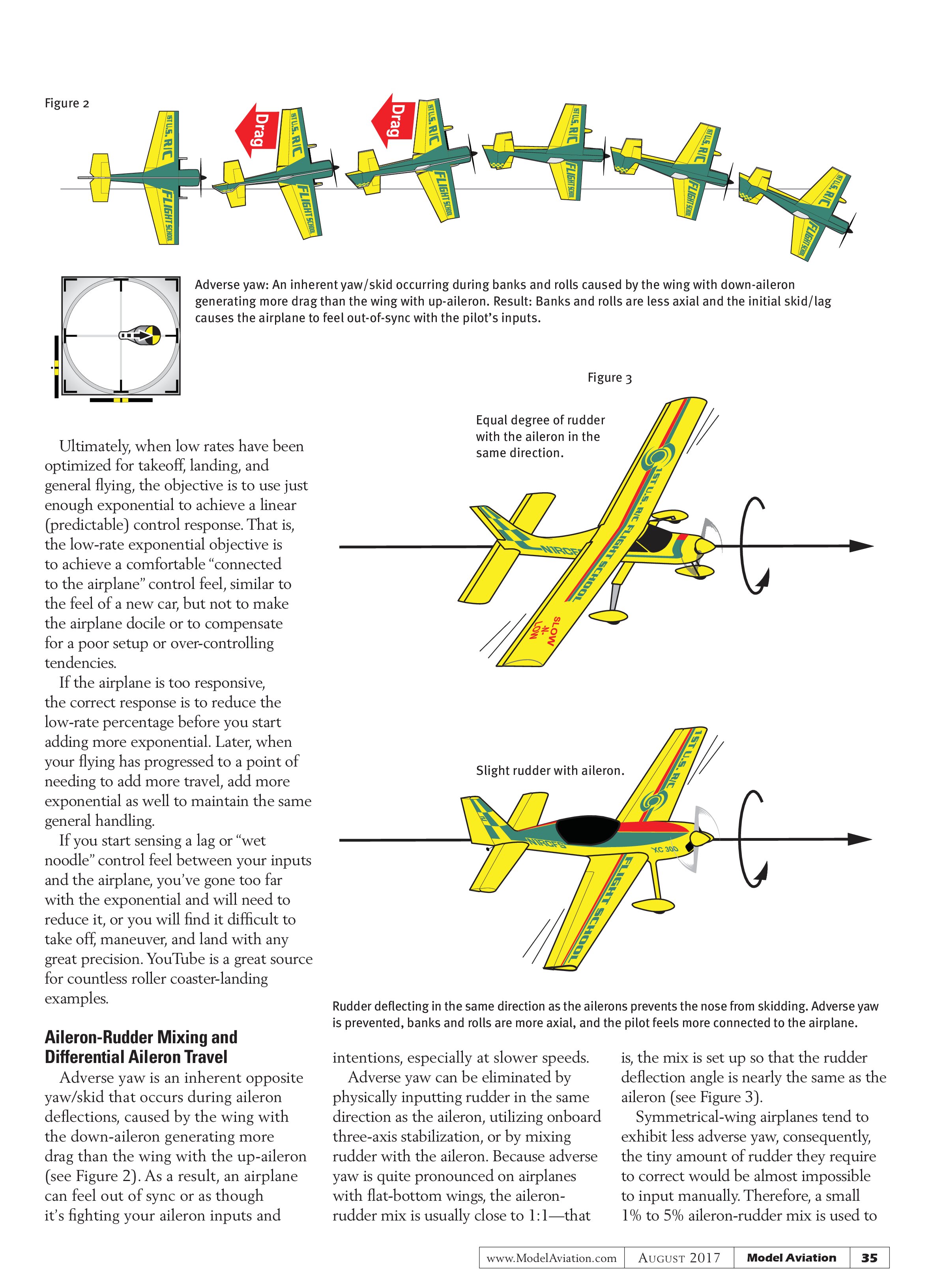
Adverse yaw is an inherent opposite yaw/skid that occurs during aileron deflections, caused by the wing with the down-aileron generating more drag than the wing with the up-aileron (see Figure 2). As a result, an airplane can feel out of sync or as though it’s fighting your aileron inputs and intentions, especially at slower speeds.
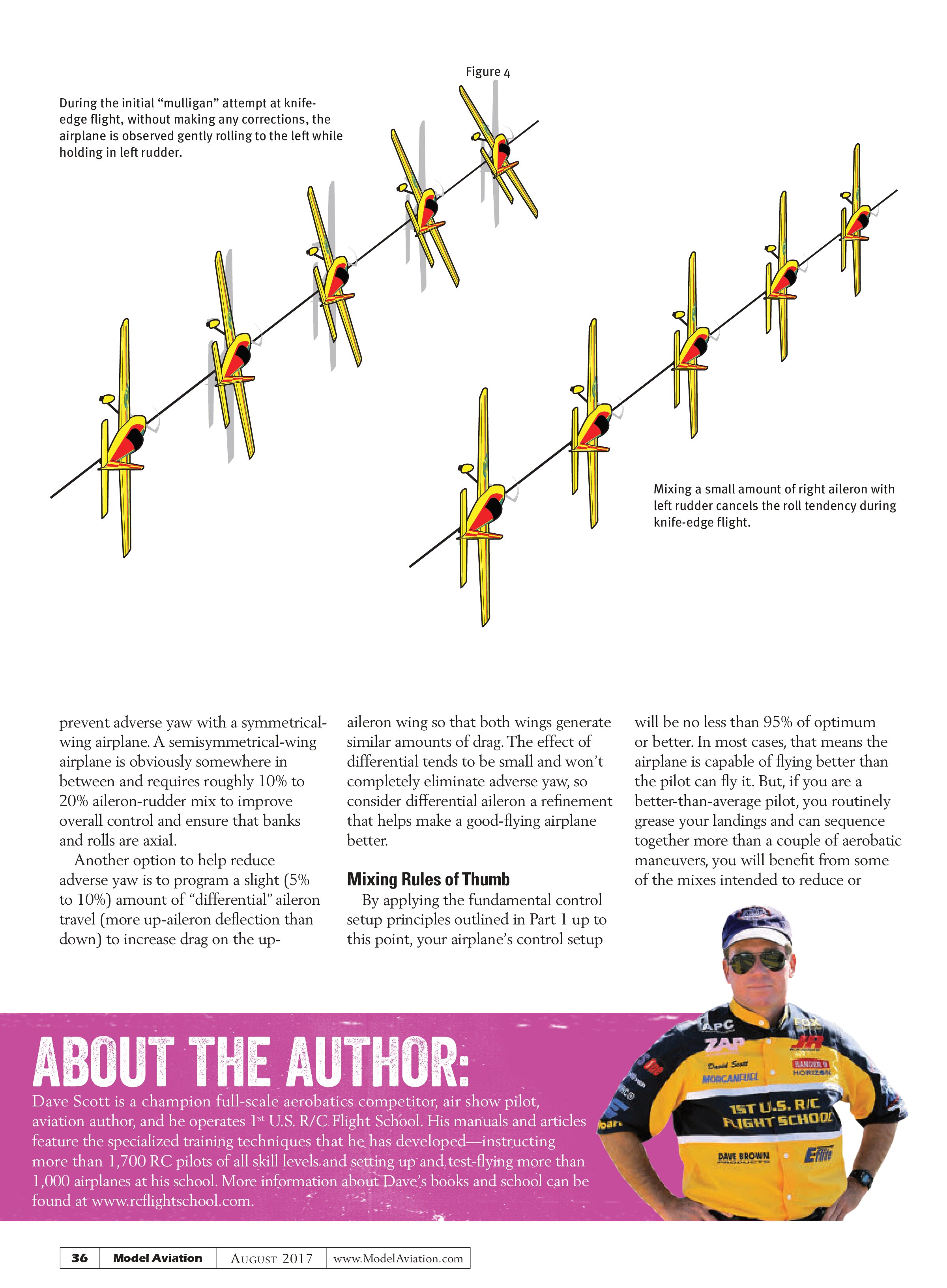
Adverse yaw can be eliminated by physically inputting rudder in the same direction as the aileron, utilizing onboard three-axis stabilization, or by mixing rudder with the aileron. Because adverse yaw is quite pronounced on airplanes with flat-bottom wings, the aileron-rudder mix is usually close to 1:1—that is, the mix is set up so that the rudder deflection angle is nearly the same as the aileron (see Figure 3).
Symmetrical-wing airplanes tend to exhibit less adverse yaw, consequently, the tiny amount of rudder they require to correct would be almost impossible to input manually. Therefore, a small 1% to 5% aileron-rudder mix is used to

Another option to help reduce adverse yaw is to program a slight (5% to 10%) amount of “differential” aileron travel (more up-aileron deflection than down) to increase drag on the up-aileron wing so that both wings generate similar amounts of drag. The effect of differential tends to be small and won’t completely eliminate adverse yaw, so consider differential aileron a refinement that helps make a good-flying airplane better.
Mixing Rules of Thumb
By applying the fundamental control setup principles outlined in Part 1 up to this point, your airplane’s control setup will be no less than 95% of optimum or better. In most cases, that means the airplane is capable of flying better than the pilot can fly it. But, if you are a better-than-average pilot, you routinely grease your landings and can sequence together more than a couple of aerobatic maneuvers, you will benefit from some of the mixes intended to reduce or eliminate the unwanted tendencies that occur during aerobatics.
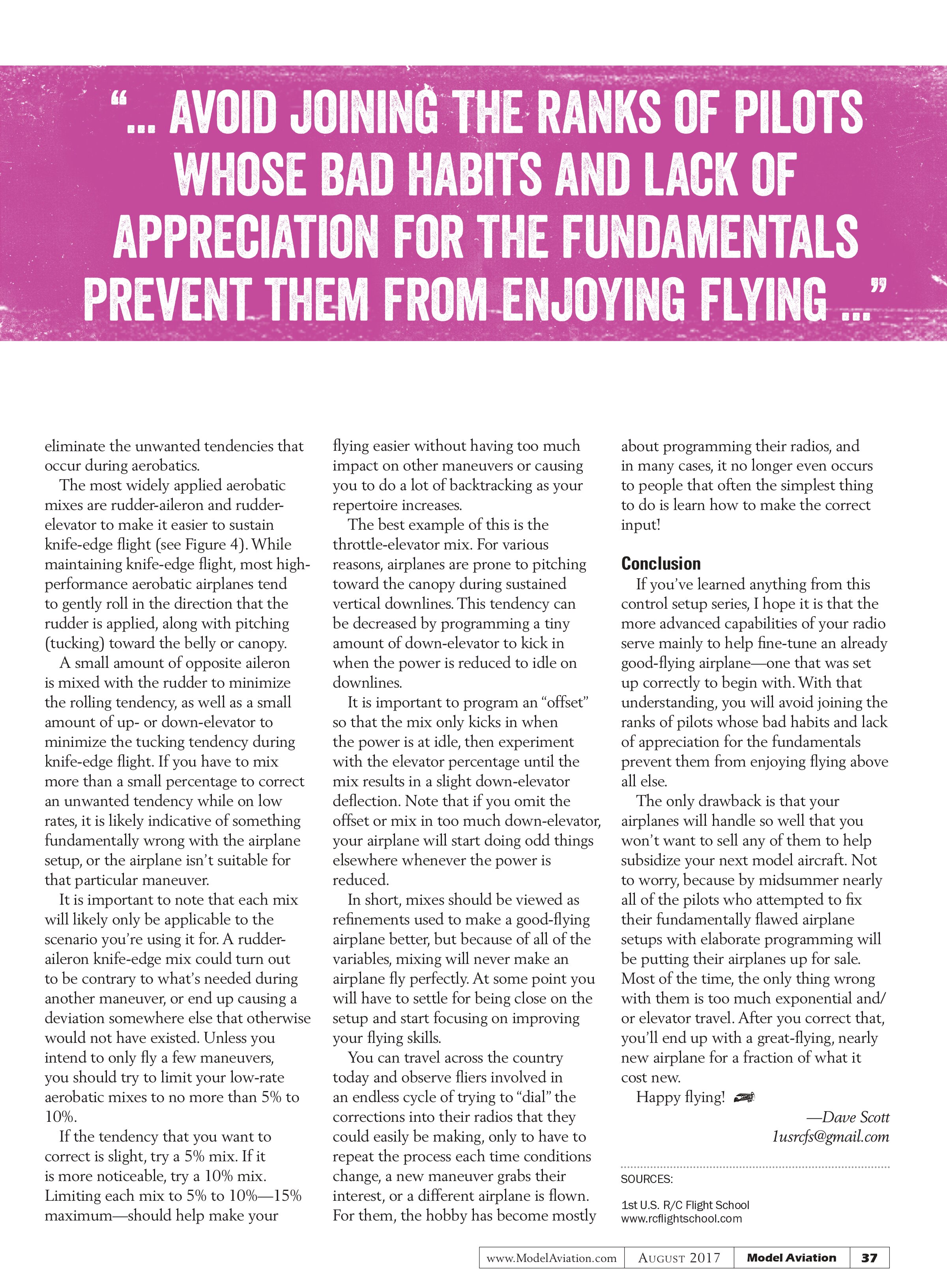
The most widely applied aerobatic mixes are rudder-aileron and rudder-elevator to make it easier to sustain knife-edge flight (see Figure 4). While maintaining knife-edge flight, most high-performance aerobatic airplanes tend to gently roll in the direction that the rudder is applied, along with pitching (tucking) toward the belly or canopy.
A small amount of opposite aileron is mixed with the rudder to minimize the rolling tendency, as well as a small amount of up- or down-elevator to minimize the tucking tendency during knife-edge flight. If you have to mix more than a small percentage to correct an unwanted tendency while on low rates, it is likely indicative of something fundamentally wrong with the airplane setup, or the airplane isn’t suitable for that particular maneuver.
It is important to note that each mix will likely only be applicable to the scenario you’re using it for. A rudder-aileron knife-edge mix could turn out to be contrary to what’s needed during another maneuver, or end up causing a deviation somewhere else that otherwise would not have existed. Unless you intend to only fly a few maneuvers, you should try to limit your low-rate aerobatic mixes to no more than 5% to 10%.
If the tendency that you want to correct is slight, try a 5% mix. If it is more noticeable, try a 10% mix. Limiting each mix to 5% to 10%—15% maximum—should help make your airplane fly easier without having too much impact on other maneuvers or causing you to do a lot of backtracking as your repertoire increases.
The best example of this is the throttle-elevator mix. For various reasons, airplanes are prone to pitching toward the canopy during sustained vertical downlines. This tendency can be decreased by programming a tiny amount of down-elevator to kick in when the power is reduced to idle on downlines.
It is important to program an “offset” so that the mix only kicks in when the power is at idle, then experiment with the elevator percentage until the mix results in a slight down-elevator deflection. Note that if you omit the offset or mix in too much down-elevator, your airplane will start doing odd things elsewhere whenever the power is reduced.
In short, mixes should be viewed as refinements used to make a good-flying airplane better, but because of all of the variables, mixing will never make an airplane fly perfectly. At some point you will have to settle for being close on the setup and start focusing on improving your flying skills.
You can travel across the country today and observe fliers involved in an endless cycle of trying to “dial” the corrections into their radios that they could easily be making, only to have to repeat the process each time conditions change, a new maneuver grabs their interest, or a different airplane is flown. For them, the hobby has become mostly about programming their radios, and in many cases, it no longer even occurs to people that often the simplest thing to do is learn how to make the correct input!
Conclusion
If you’ve learned anything from this control setup series, I hope it is that the more advanced capabilities of your radio serve mainly to help fine-tune an already good-flying airplane—one that was set up correctly to begin with. With that understanding, you will avoid joining the ranks of pilots whose bad habits and lack of appreciation for the fundamentals prevent them from enjoying flying above all else.
The only drawback is that your airplanes will handle so well that you won’t want to sell any of them to help subsidize your next model aircraft. Not to worry, because by midsummer nearly all of the pilots who attempted to fix their fundamentally flawed airplane setups with elaborate programming will be putting their airplanes up for sale. Most of the time, the only thing wrong with them is too much exponential and/or elevator travel. After you correct that, you’ll end up with a great-flying, nearly new airplane for a fraction of what it cost new.
Happy flying!
—Dave Scott
1usrcfs@gmail.com
SOURCES:
1st U.S. R/C Flight School
www.rcflightschool.com