2007 Nats FF 1/2A Classic Gas winner
Marvin Mace designed the A/B Marval in the mid-1980s, integrating the experience and success of Mark Valerius’ Rum Runner model series. The name came from a combination of their first and last names.
The evolution of the Marval influenced some of the country’s top AMA Power fliers, and it was named the Large Gas Model of the Year in the National Free Flight Society’s (NFFS) 1993 Ten Models of the Year competition. The Super Marval was named the NFFS Large Gas Model of the Year in 2007.
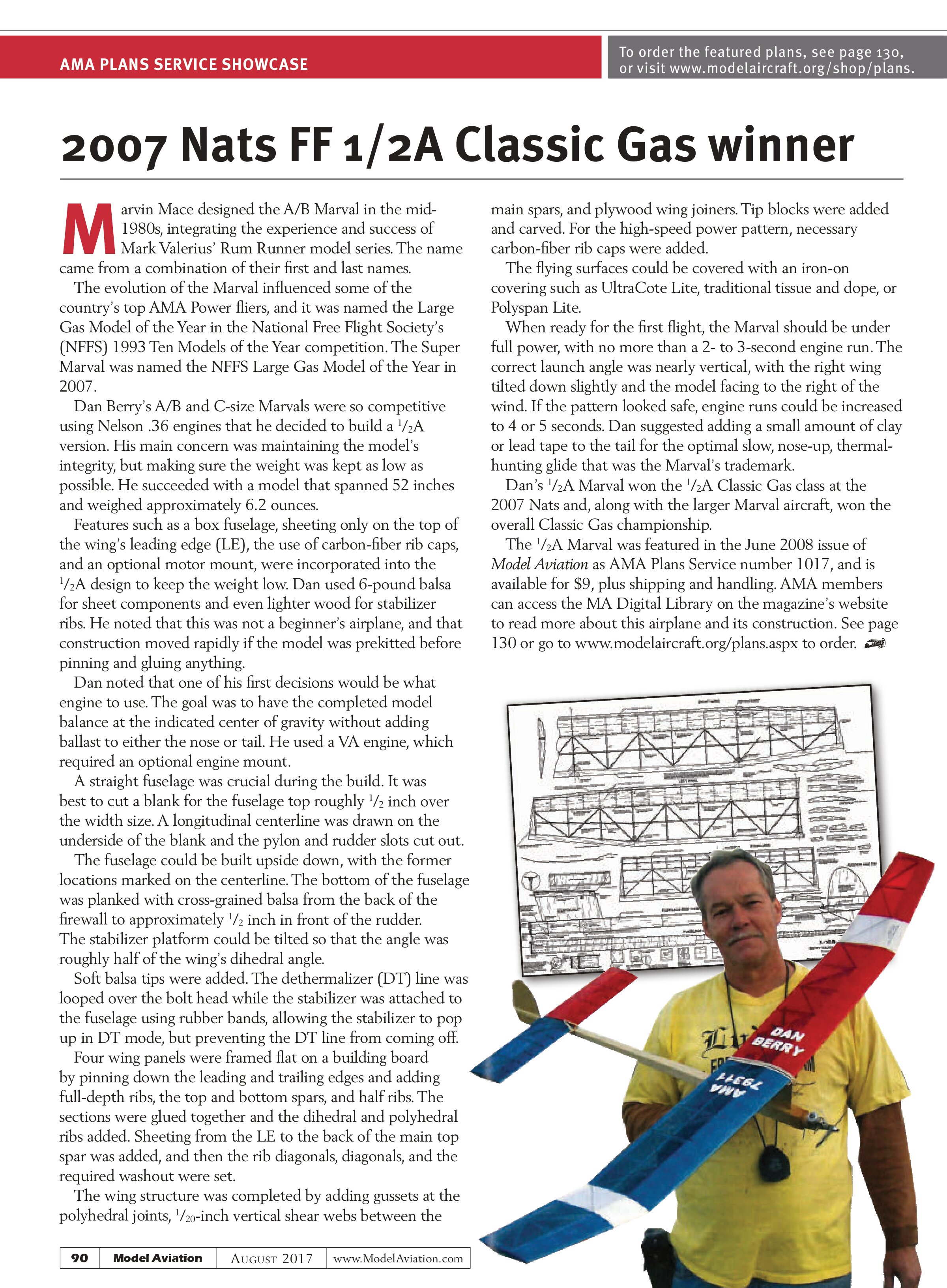
Dan Berry’s A/B and C-size Marvals were so competitive using Nelson .36 engines that he decided to build a 1/2A version. His main concern was maintaining the model’s integrity, but making sure the weight was kept as low as possible. He succeeded with a model that spanned 52 inches and weighed approximately 6.2 ounces.
Features such as a box fuselage, sheeting only on the top of the wing’s leading edge (LE), the use of carbon-fiber rib caps, and an optional motor mount, were incorporated into the 1/2A design to keep the weight low. Dan used 6-pound balsa for sheet components and even lighter wood for stabilizer ribs. He noted that this was not a beginner’s airplane, and that construction moved rapidly if the model was prekitted before pinning and gluing anything.
Dan noted that one of his first decisions would be what engine to use. The goal was to have the completed model balance at the indicated center of gravity without adding ballast to either the nose or tail. He used a VA engine, which required an optional engine mount.
A straight fuselage was crucial during the build. It was best to cut a blank for the fuselage top roughly 1/2 inch over the width size. A longitudinal centerline was drawn on the underside of the blank and the pylon and rudder slots cut out.
The fuselage could be built upside down, with the former locations marked on the centerline. The bottom of the fuselage was planked with cross-grained balsa from the back of the firewall to approximately 1/2 inch in front of the rudder. The stabilizer platform could be tilted so that the angle was roughly half of the wing’s dihedral angle.
Soft balsa tips were added. The dethermalizer (DT) line was looped over the bolt head while the stabilizer was attached to the fuselage using rubber bands, allowing the stabilizer to pop up in DT mode, but preventing the DT line from coming off.
Four wing panels were framed flat on a building board by pinning down the leading and trailing edges and adding full-depth ribs, the top and bottom spars, and half ribs. The sections were glued together and the dihedral and polyhedral ribs added. Sheeting from the LE to the back of the main top spar was added, and then the rib diagonals, diagonals, and the required washout were set.
The wing structure was completed by adding gussets at the polyhedral joints, 1/20-inch vertical shear webs between the main spars, and plywood wing joiners. Tip blocks were added and carved. For the high-speed power pattern, necessary carbon-fiber rib caps were added.
The flying surfaces could be covered with an iron-on covering such as UltraCote Lite, traditional tissue and dope, or Polyspan Lite.
When ready for the first flight, the Marval should be under full power, with no more than a 2- to 3-second engine run. The correct launch angle was nearly vertical, with the right wing tilted down slightly and the model facing to the right of the wind. If the pattern looked safe, engine runs could be increased to 4 or 5 seconds. Dan suggested adding a small amount of clay or lead tape to the tail for the optimal slow, nose-up, thermal-hunting glide that was the Marval’s trademark.
Dan’s 1/2A Marval won the 1/2A Classic Gas class at the 2007 Nats and, along with the larger Marval aircraft, won the overall Classic Gas championship.
The 1/2A Marval was featured in the June 2008 issue of Model Aviation as AMA Plans Service number 1017, and is available for $9, plus shipping and handling. AMA members can access the MA Digital Library on the magazine’s website to read more about this airplane and its construction. See page 130 or go to www.modelaircraft.org/plans.aspx to order.