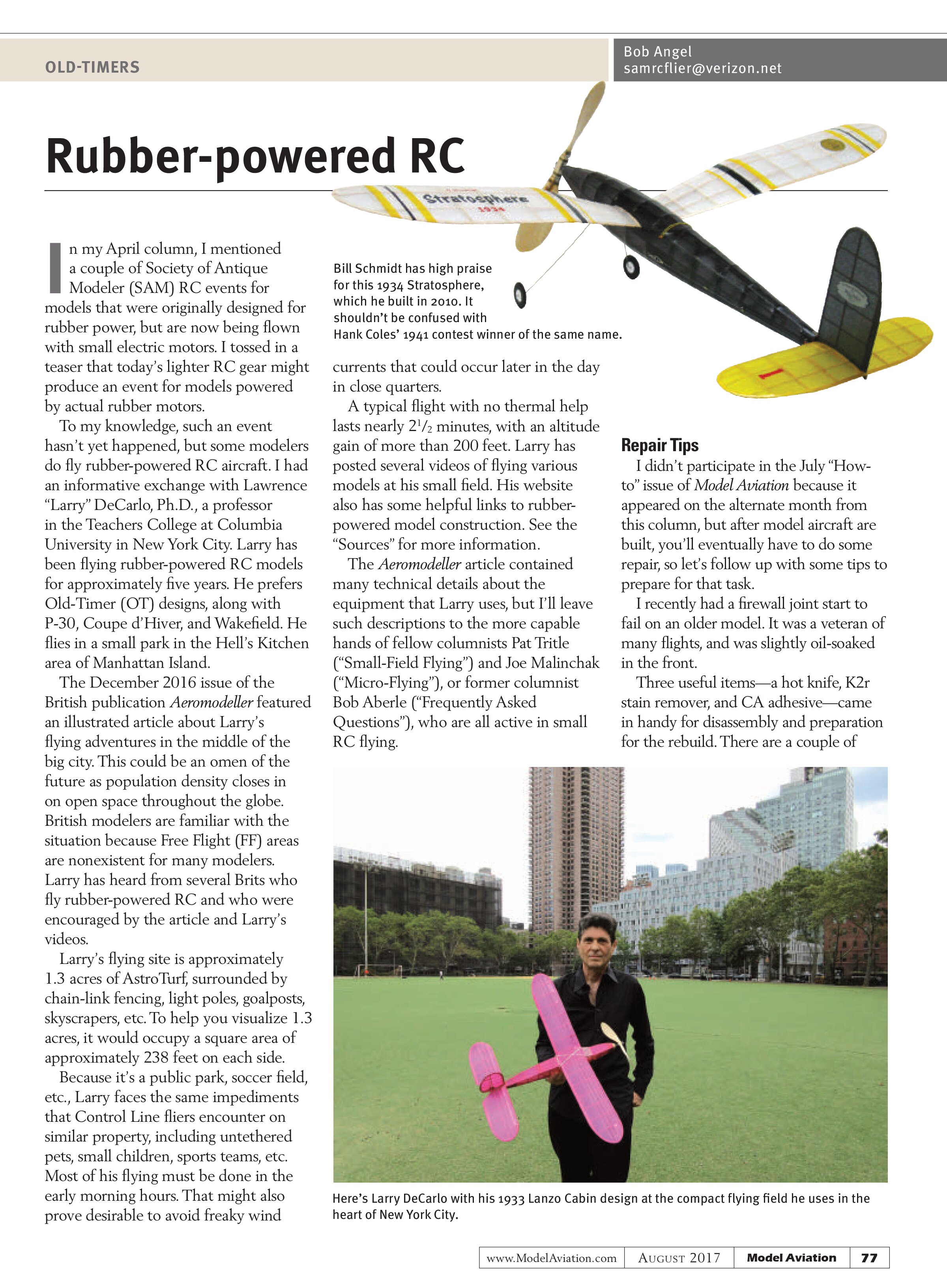
Rubber-powered RC
In my April column, I mentioned a couple of Society of Antique Modeler (SAM) RC events for models that were originally designed for rubber power, but are now being flown with small electric motors. I tossed in a teaser that today’s lighter RC gear might produce an event for models powered by actual rubber motors.
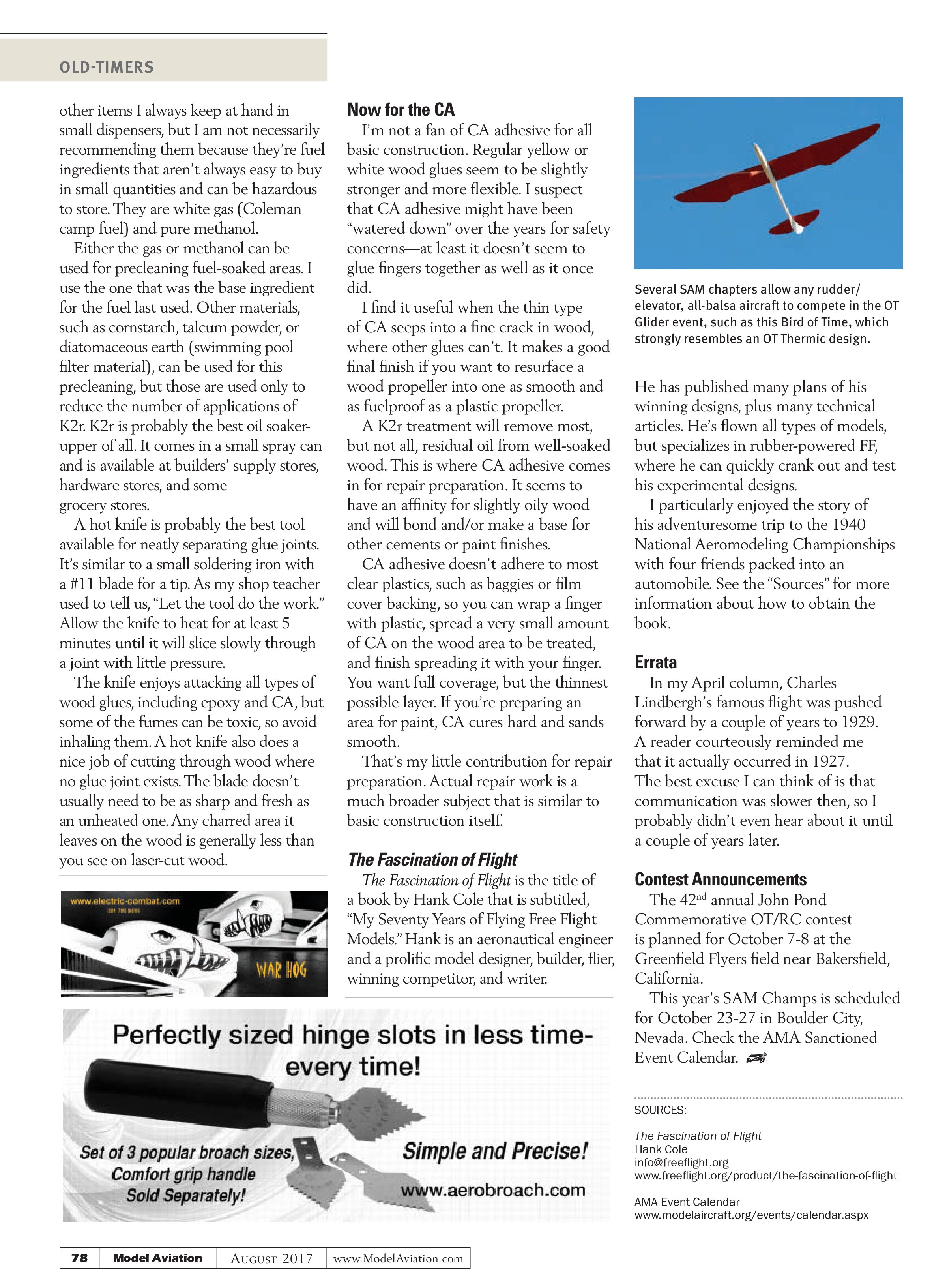
To my knowledge, such an event hasn’t yet happened, but some modelers do fly rubber-powered RC aircraft. I had an informative exchange with Lawrence “Larry” DeCarlo, Ph.D., a professor in the Teachers College at Columbia University in New York City. Larry has been flying rubber-powered RC models for approximately five years. He prefers Old-Timer (OT) designs, along with P-30, Coupe d’Hiver, and Wakefield. He flies in a small park in the Hell’s Kitchen area of Manhattan Island.
The December 2016 issue of the British publication Aeromodeller featured an illustrated article about Larry’s flying adventures in the middle of the big city. This could be an omen of the future as population density closes in on open space throughout the globe. British modelers are familiar with the situation because Free Flight (FF) areas are nonexistent for many modelers. Larry has heard from several Brits who fly rubber-powered RC and who were encouraged by the article and Larry’s videos.
Larry’s flying site is approximately 1.3 acres of AstroTurf, surrounded by chain-link fencing, light poles, goalposts, skyscrapers, etc. To help you visualize 1.3 acres, it would occupy a square area of approximately 238 feet on each side.
Because it’s a public park, soccer field, etc., Larry faces the same impediments that Control Line fliers encounter on similar property, including untethered pets, small children, sports teams, etc. Most of his flying must be done in the early morning hours. That might also prove desirable to avoid freaky wind currents that could occur later in the day in close quarters.

A typical flight with no thermal help lasts nearly 2½ minutes, with an altitude gain of more than 200 feet. Larry has posted several videos of flying various models at his small field. His website also has some helpful links to rubber-powered model construction. See the “Sources” for more information.
The Aeromodeller article contained many technical details about the equipment that Larry uses, but I’ll leave such descriptions to the more capable hands of fellow columnists Pat Trittle (“Small-Field Flying”) and Joe Malinchak (“Micro-Flying”), or former columnist Bob Aberle (“Frequently Asked Questions”), who are all active in small RC flying.
Repair Tips
I didn’t participate in the July “How-to” issue of Model Aviation because it appeared on the alternate month from this column, but after model aircraft are built, you’ll eventually have to do some repair, so let’s follow up with some tips to prepare for that task.
I recently had a firewall joint start to fail on an older model. It was a veteran of many flights, and was slightly oil-soaked in the front.
Three useful items—a hot knife, K2r stain remover, and CA adhesive—came in handy for disassembly and preparation for the rebuild. There are a couple of

other items I always keep at hand in small dispensers, but I am not necessarily recommending them because they’re fuel ingredients that aren’t always easy to buy in small quantities and can be hazardous to store. They are white gas (Coleman camp fuel) and pure methanol.
Either the gas or methanol can be used for precleaning fuel-soaked areas. I use the one that was the base ingredient for the fuel last used. Other materials, such as cornstarch, talcum powder, or diatomaceous earth (swimming pool filter material), can be used for this precleaning, but those are used only to reduce the number of applications of K2r. K2r is probably the best oil soaker-upper of all. It comes in a small spray can and is available at builders’ supply stores, hardware stores, and some grocery stores.
A hot knife is probably the best tool available for neatly separating glue joints. It’s similar to a small soldering iron with a #11 blade for a tip. As my shop teacher used to tell us, “Let the tool do the work.” Allow the knife to heat for at least 5 minutes until it will slice slowly through a joint with little pressure.
The knife enjoys attacking all types of wood glues, including epoxy and CA, but some of the fumes can be toxic, so avoid inhaling them. A hot knife also does a nice job of cutting through wood where no glue joint exists. The blade doesn’t usually need to be as sharp and fresh as an unheated one. Any charred area it leaves on the wood is generally less than you see on laser-cut wood.
Now for the CA
I’m not a fan of CA adhesive for all basic construction. Regular yellow or white wood glues seem to be slightly stronger and more flexible. I suspect that CA adhesive might have been “watered down” over the years for safety concerns—at least it doesn’t seem to glue fingers together as well as it once did.
I find it useful when the thin type of CA seeps into a fine crack in wood, where other glues can’t. It makes a good final finish if you want to resurface a wood propeller into one as smooth and as fuelproof as a plastic propeller.
A K2r treatment will remove most, but not all, residual oil from well-soaked wood. This is where CA adhesive comes in for repair preparation. It seems to have an affinity for slightly oily wood and will bond and/or make a base for other cements or paint finishes.
CA adhesive doesn’t adhere to most clear plastics, such as baggies or film cover backing, so you can wrap a finger with plastic, spread a very small amount of CA on the wood area to be treated, and finish spreading it with your finger. You want full coverage, but the thinnest possible layer. If you’re preparing an area for paint, CA cures hard and sands smooth.
That’s my little contribution for repair preparation. Actual repair work is a much broader subject that is similar to basic construction itself.
The Fascination of Flight
The Fascination of Flight is the title of a book by Hank Cole that is subtitled, “My Seventy Years of Flying Free Flight Models.” Hank is an aeronautical engineer and a prolific model designer, builder, flier, winning competitor, and writer.

He has published many plans of his winning designs, plus many technical articles. He’s flown all types of models, but specializes in rubber-powered FF, where he can quickly crank out and test his experimental designs.
I particularly enjoyed the story of his adventuresome trip to the 1940 National Aeromodeling Championships with four friends packed into an automobile. See the “Sources” for more information about how to obtain the book.
Errata
In my April column, Charles Lindbergh’s famous flight was pushed forward by a couple of years to 1929. A reader courteously reminded me that it actually occurred in 1927. The best excuse I can think of is that communication was slower then, so I probably didn’t even hear about it until a couple of years later.
Contest Announcements
The 42nd annual John Pond Commemorative OT/RC contest is planned for October 7-8 at the Greenfield Flyers field near Bakersfield, California.
This year’s SAM Champs is scheduled for October 23-27 in Boulder City, Nevada. Check the AMA Sanctioned Event Calendar.
SOURCES:
The Fascination of Flight
Hank Cole
info@freeflight.org
www.freeflight.org/product/the-fascination-of-flight
AMA Event Calendar
www.modelaircraft.org/events/calendar.aspx