US FF World Championships Team
by Louis Joyner
joynerduration@gmail.com
The 2017 Free Flight (FF) World Championships will be held August 6-12, in Szentes, Hungary. The US will field an experienced team that includes two former world champions and several others with podium finishes. The team members are:
- F1A Glider: Rene Limberger, Brian Van Nest, and Mike McKeever
- F1B Wakefield Rubber: Alexander Andriukov, Blake Jensen, and Charlie Jones
- F1C Power: Faust Parker, Ed Carroll, and Richard Mathis

Jim Parker is the team manager, with Randy Secor assisting. Jace Povinka will be the junior assistant. The official website, listed in “Sources,” will have the names of all countries and fliers participating, as well as contest results.
Over and Over
For many of us, there is that favorite design, often from our youth, that we build in multiples. How many modelers do you know who have built Ram Rods, Satellites, or T-Birds in every size from ¹/₂A to D Gas? Even building the same design, of the same size, in multiples makes sense. Hand Launch and Catapult Gliders lend themselves to mass production by using templates and jigs for faster and more accurate construction. Starting with a good design and making small changes and improvements with each subsequent model should lead to better-built and better-flying models.
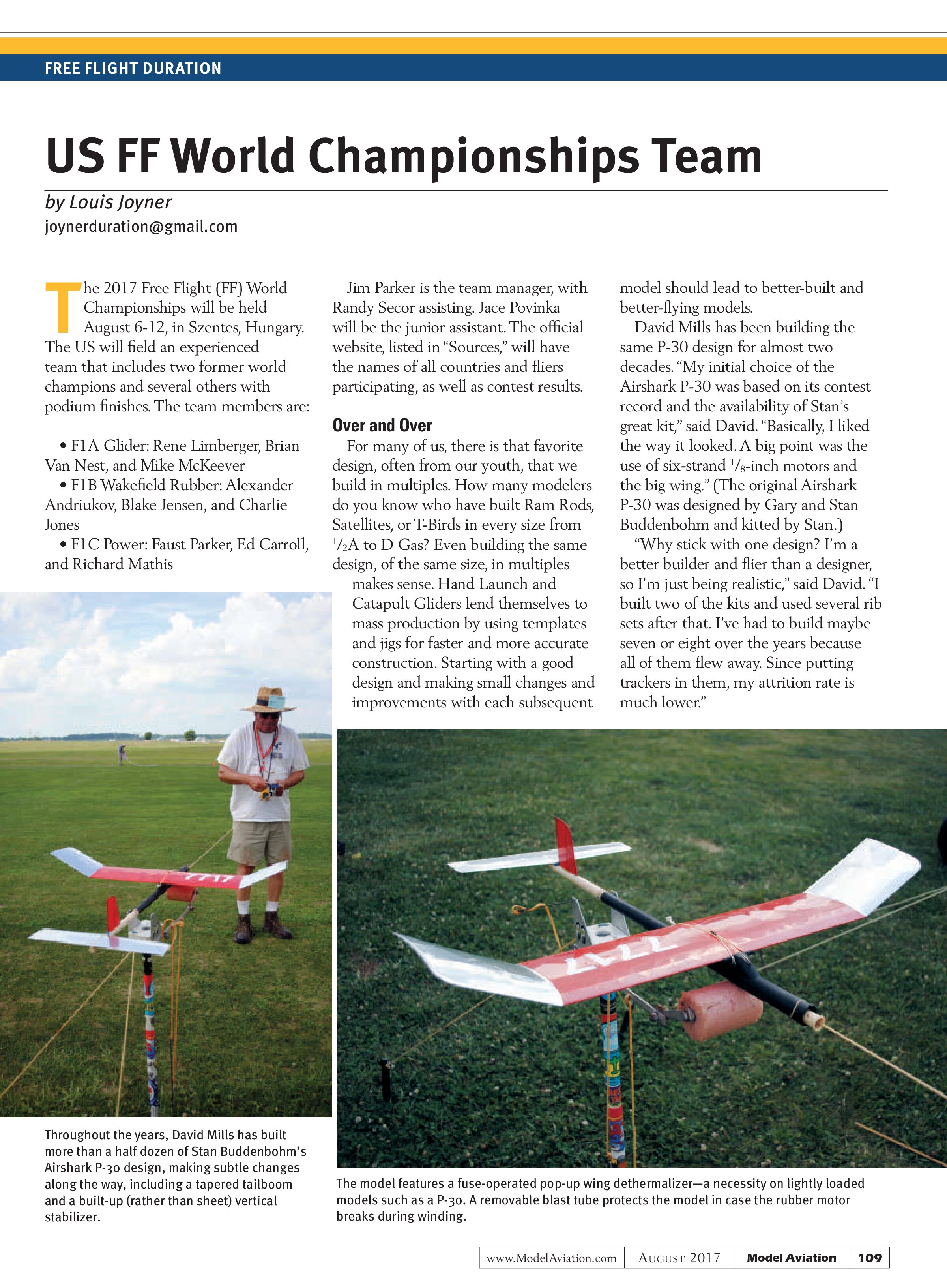
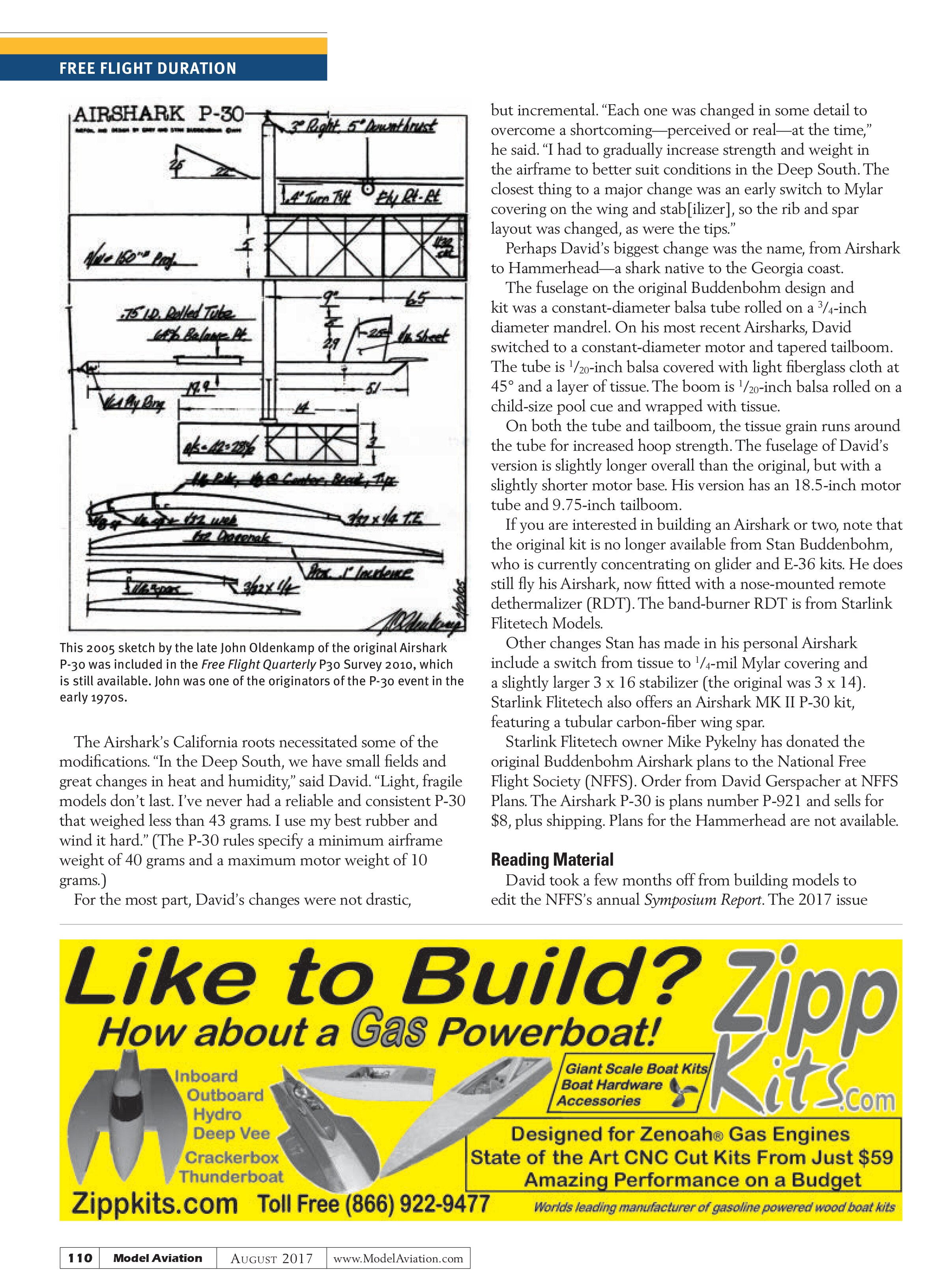
David Mills has been building the same P-30 design for almost two decades. “My initial choice of the Airshark P-30 was based on its contest record and the availability of Stan’s great kit,” said David. “Basically, I liked the way it looked. A big point was the use of six-strand ¹/₈-inch motors and the big wing.” (The original Airshark P-30 was designed by Gary and Stan Buddenbohm and kitted by Stan.)
“Why stick with one design? I’m a better builder and flier than a designer, so I’m just being realistic,” said David. “I built two of the kits and used several rib sets after that. I’ve had to build maybe seven or eight over the years because all of them flew away. Since putting trackers in them, my attrition rate is much lower.”


The Airshark’s California roots necessitated some of the modifications. “In the Deep South, we have small fields and great changes in heat and humidity,” said David. “Light, fragile models don’t last. I’ve never had a reliable and consistent P-30 that weighed less than 43 grams. I use my best rubber and wind it hard.” (The P-30 rules specify a minimum airframe weight of 40 grams and a maximum motor weight of 10 grams.)
For the most part, David’s changes were not drastic, but incremental. “Each one was changed in some detail to overcome a shortcoming—perceived or real—at the time,” he said. “I had to gradually increase strength and weight in the airframe to better suit conditions in the Deep South. The closest thing to a major change was an early switch to Mylar covering on the wing and stab[ilizer], so the rib and spar layout was changed, as were the tips.”
Perhaps David’s biggest change was the name, from Airshark to Hammerhead—a shark native to the Georgia coast.
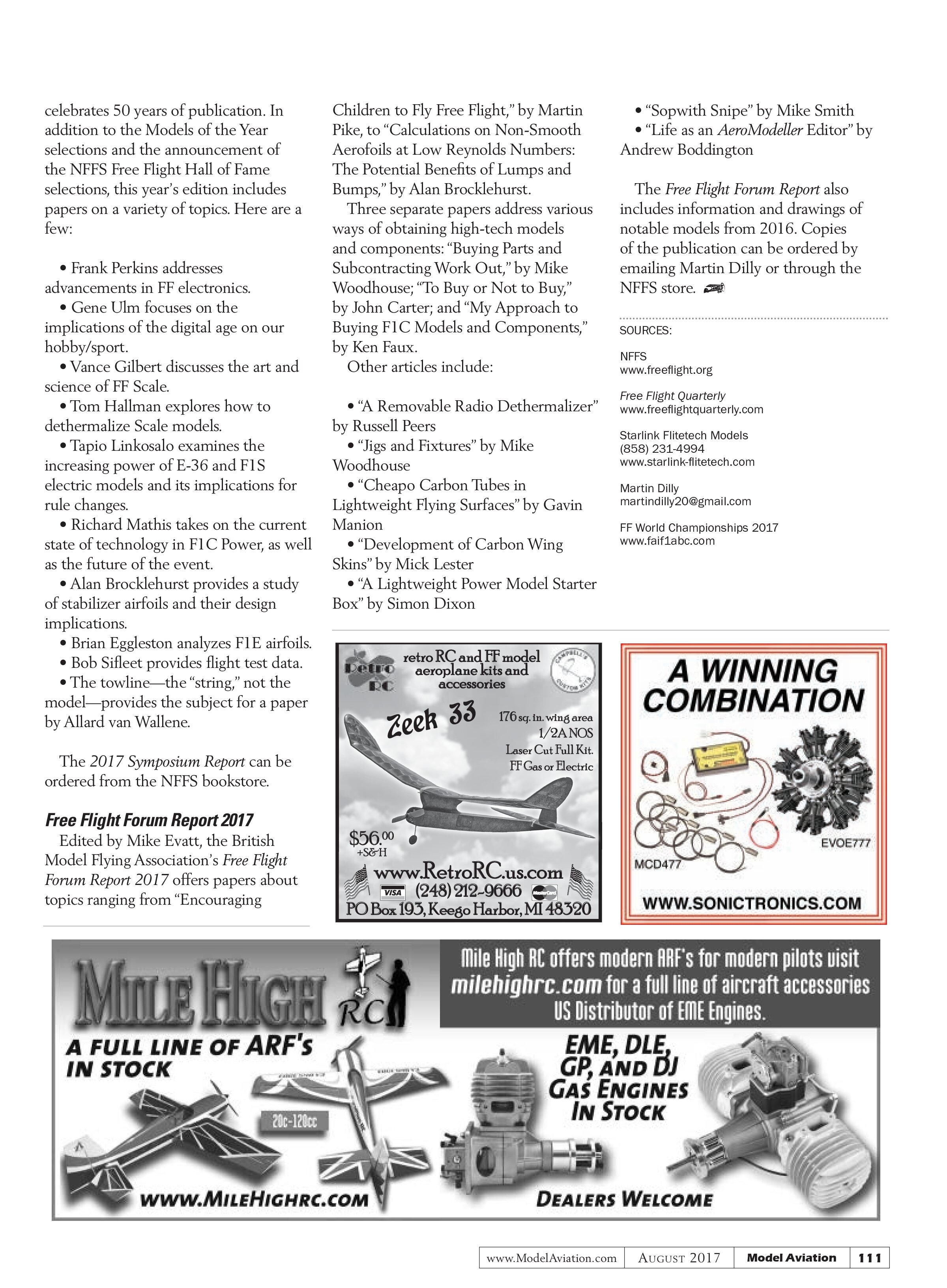
The fuselage on the original Buddenbohm design and kit was a constant-diameter balsa tube rolled on a ³/₄-inch diameter mandrel. On his most recent Airsharks, David switched to a constant-diameter motor and tapered tailboom. The tube is ¹/₂₀-inch balsa covered with light fiberglass cloth at 45° and a layer of tissue. The boom is ¹/₂₀-inch balsa rolled on a child-size pool cue and wrapped with tissue.
On both the tube and tailboom, the tissue grain runs around the tube for increased hoop strength. The fuselage of David’s version is slightly longer overall than the original, but with a slightly shorter motor base. His version has an 18.5-inch motor tube and 9.75-inch tailboom.
If you are interested in building an Airshark or two, note that the original kit is no longer available from Stan Buddenbohm, who is currently concentrating on glider and E-36 kits. He does still fly his Airshark, now fitted with a nose-mounted remote dethermalizer (RDT). The band-burner RDT is from Starlink Flitetech Models.
Other changes Stan has made in his personal Airshark include a switch from tissue to ¹/₄-mil Mylar covering and a slightly larger 3 x 16 stabilizer (the original was 3 x 14). Starlink Flitetech also offers an Airshark MK II P-30 kit, featuring a tubular carbon-fiber wing spar.
Starlink Flitetech owner Mike Pykelny has donated the original Buddenbohm Airshark plans to the National Free Flight Society (NFFS). Order from David Gerspacher at NFFS Plans. The Airshark P-30 is plans number P-92 and sells for $8, plus shipping. Plans for the Hammerhead are not available.
Reading Material
David took a few months off from building models to edit the NFFS’s annual Symposium Report. The 2017 issue celebrates 50 years of publication. In addition to the Models of the Year selections and the announcement of the NFFS Free Flight Hall of Fame selections, this year’s edition includes papers on a variety of topics. Here are a few:
- Frank Perkins addresses advancements in FF electronics.
- Gene Ulm focuses on the implications of the digital age on our hobby/sport.
- Vance Gilbert discusses the art and science of FF Scale.
- Tom Hallman explores how to dethermalize Scale models.
- Tapio Linkosalo examines the increasing power of E-36 and F1S electric models and its implications for rule changes.
- Richard Mathis takes on the current state of technology in F1C Power, as well as the future of the event.
- Alan Brocklehurst provides a study of stabilizer airfoils and their design implications.
- Brian Eggleston analyzes F1E airfoils.
- Bob Sifleet provides flight test data.
- The towline—the “string,” not the model—provides the subject for a paper by Allard van Wallene.
The 2017 Symposium Report can be ordered from the NFFS bookstore.
Free Flight Forum Report 2017
Edited by Mike Evatt, the British Model Flying Association’s Free Flight Forum Report 2017 offers papers about topics ranging from “Encouraging Children to Fly Free Flight,” by Martin Pike, to “Calculations on Non-Smooth Aerofoils at Low Reynolds Numbers: The Potential Benefits of Lumps and Bumps,” by Alan Brocklehurst.
Three separate papers address various ways of obtaining high-tech models and components: “Buying Parts and Subcontracting Work Out,” by Mike Woodhouse; “To Buy or Not to Buy,” by John Carter; and “My Approach to Buying F1C Models and Components,” by Ken Faux.
Other articles include:
- “A Removable Radio Dethermalizer” by Russell Peers
- “Jigs and Fixtures” by Mike Woodhouse
- “Cheapo Carbon Tubes in Lightweight Flying Surfaces” by Gavin Manion
- “Development of Carbon Wing Skins” by Mick Lester
- “A Lightweight Power Model Starter Box” by Simon Dixon
- “Sopwith Snipe” by Mike Smith
- “Life as an AeroModeller Editor” by Andrew Boddington
The Free Flight Forum Report also includes information and drawings of notable models from 2016. Copies of the publication can be ordered by emailing Martin Dilly or through the NFFS store. ✈
SOURCES:
NFFS
www.freeflight.org
Free Flight Quarterly
www.freeflightquarterly.com
Starlink Flitetech Models
(858) 231-4994
www.starlink-flitetech.com
Martin Dilly
martindilly20@gmail.com
FF World Championships 2017
www.faif1abc.com