Focal Point
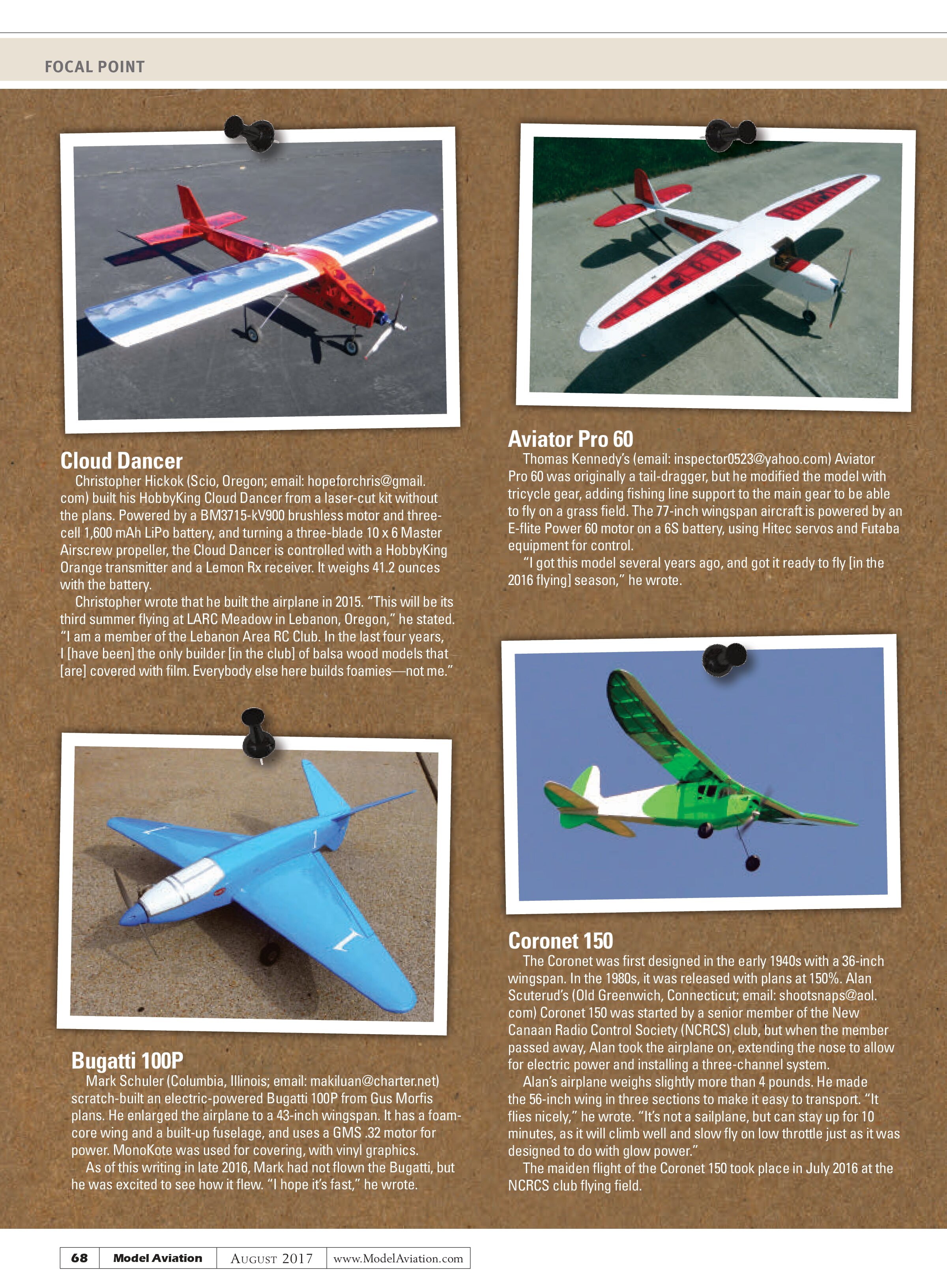
Cloud Dancer

Christopher Hickok (Scio, Oregon; email: hopeforchris@gmail.com) built his HobbyKing Cloud Dancer from a laser-cut kit without the plans. Powered by a BM3715-kV900 brushless motor and three-cell 1,600 mAh LiPo battery, and turning a three-blade 10 x 6 Master Airscrew propeller, the Cloud Dancer is controlled with a HobbyKing Orange transmitter and a Lemon Rx receiver. It weighs 41.2 ounces with the battery.
Christopher wrote that he built the airplane in 2015. “This will be its third summer flying at LARC Meadow in Lebanon, Oregon,” he stated. “I am a member of the Lebanon Area RC Club. In the last four years, I [have been] the only builder [in the club] of balsa wood models that [are] covered with film. Everybody else here builds foamies—not me.”
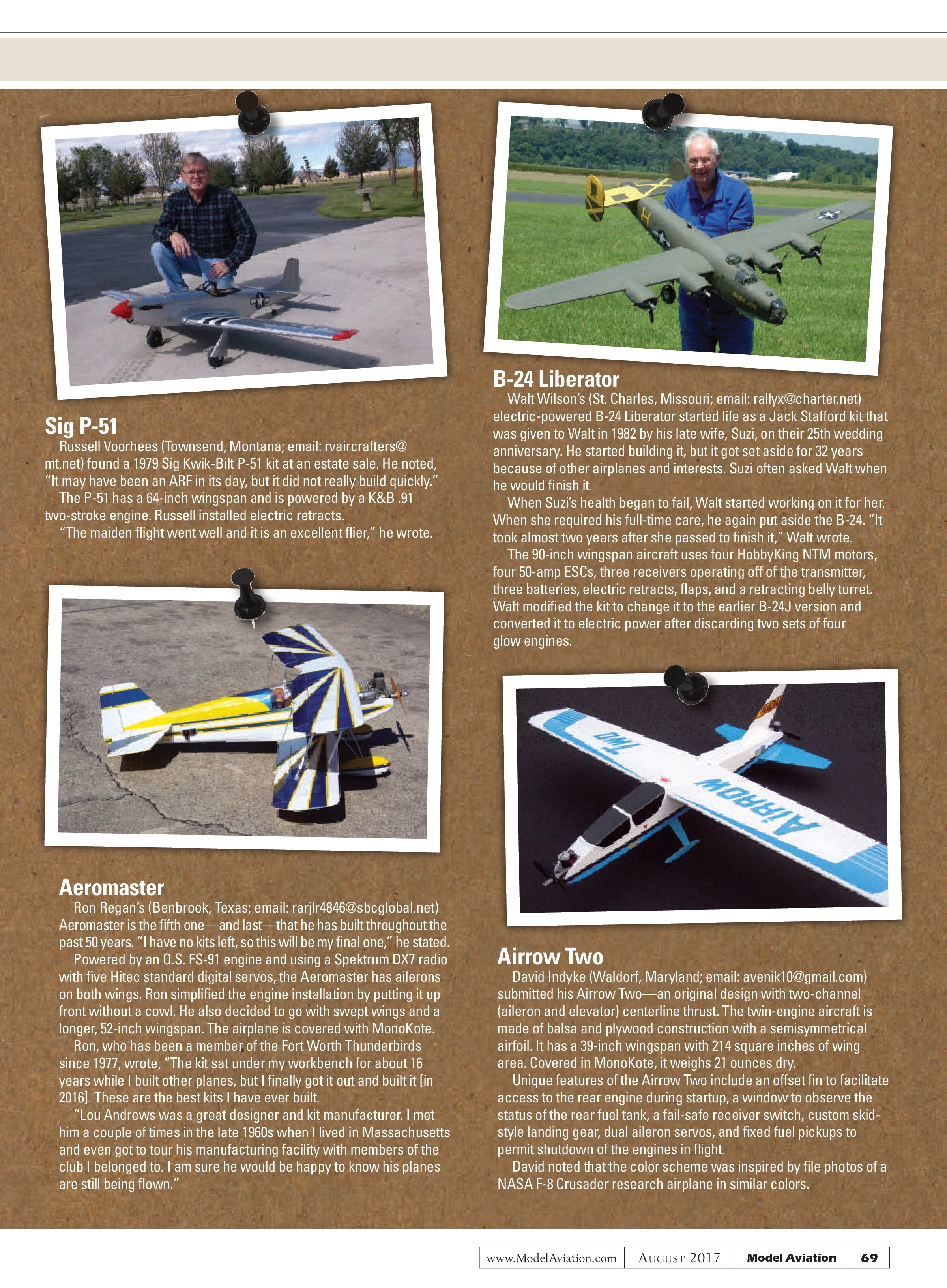
Bugatti 100P

Mark Schuler (Columbia, Illinois; email: makiluan@charter.net) scratch-built an electric-powered Bugatti 100P from Gus Morfis plans. He enlarged the airplane to a 43-inch wingspan. It has a foam-core wing and a built-up fuselage, and uses a GMS .32 motor for power. MonoKote was used for covering, with vinyl graphics.
As of this writing in late 2016, Mark had not flown the Bugatti, but he was excited to see how it flew. “I hope it’s fast,” he wrote.
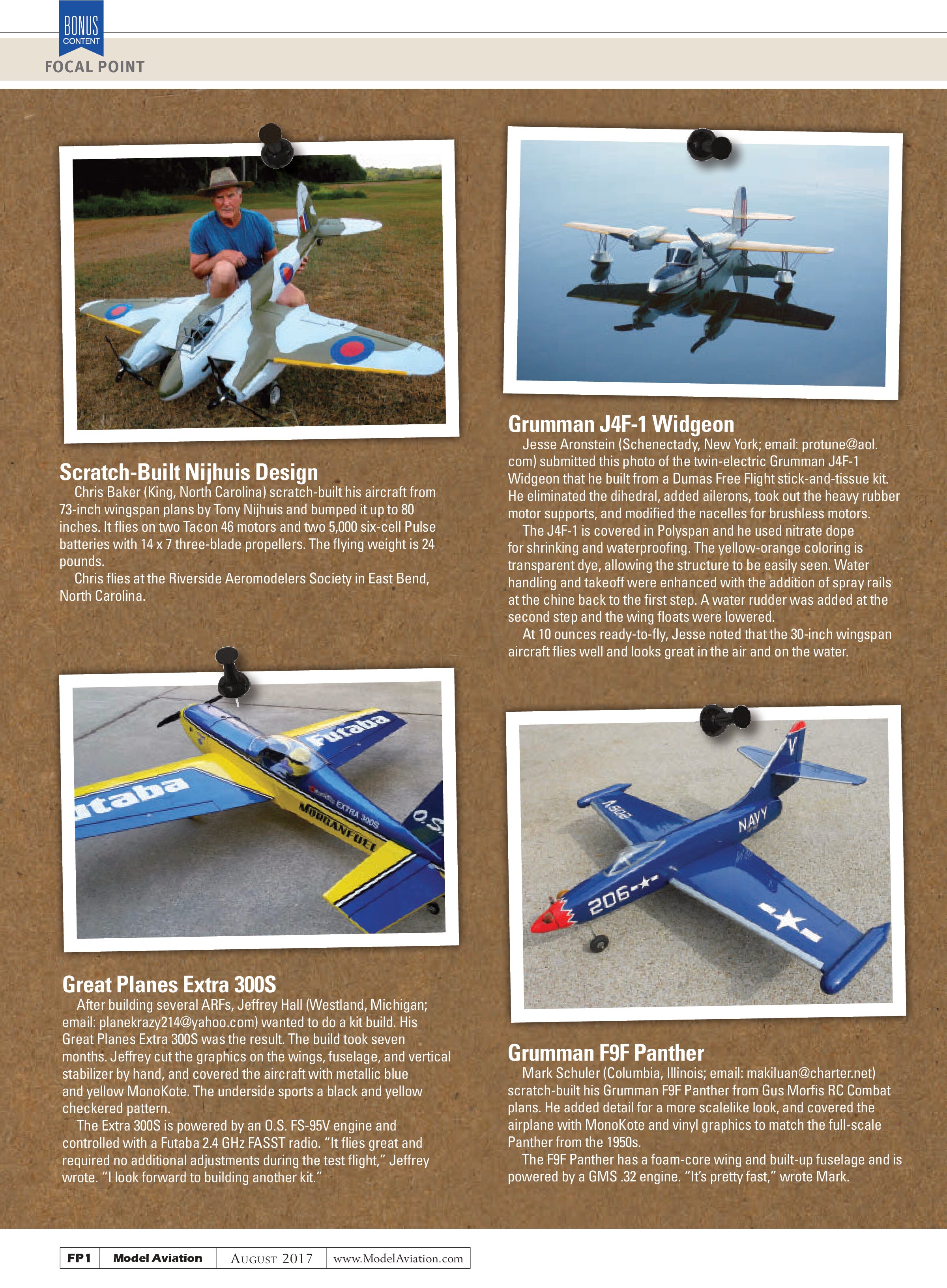
Aviator Pro 60

Thomas Kennedy’s (email: inspector0523@yahoo.com) Aviator Pro 60 was originally a tail-dragger, but he modified the model with tricycle gear, adding fishing line support to the main gear to be able to fly on a grass field. The 77-inch wingspan aircraft is powered by an E-flite Power 60 motor on a 6S battery, using Hitec servos and Futaba equipment for control.
“I got this model several years ago, and got it ready to fly [in the 2016 flying] season,” he wrote.
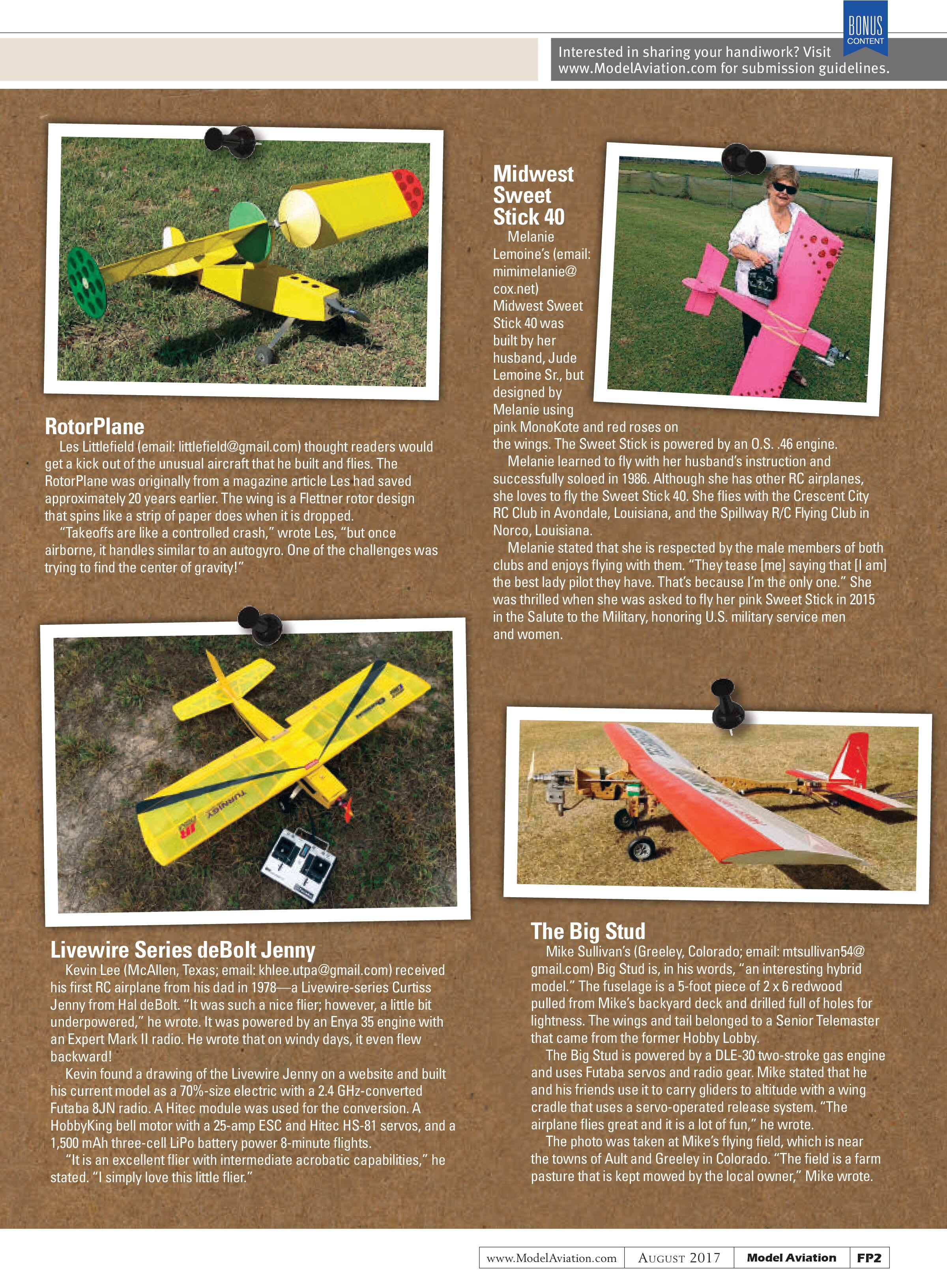
Coronet 150

The Coronet was first designed in the early 1940s with a 36-inch wingspan. In the 1980s, it was released with plans at 150%. Alan Scuterud’s (Old Greenwich, Connecticut; email: shootsnap s@aol.com) Coronet 150 was started by a senior member of the New Canaan Radio Control Society (NCRCS) club, but when the member passed away, Alan took the airplane on, extending the nose to allow for electric power and installing a three-channel system.
Alan’s airplane weighs slightly more than 4 pounds. He made the 56-inch wing in three sections to make it easy to transport. “It flies nicely,” he wrote. “It’s not a sailplane, but can stay up for 10 minutes, as it will climb well and slow fly on low throttle just as it was designed to do with glow power.”
The maiden flight of the Coronet 150 took place in July 2016 at the NCRCS club flying field.
Sig P-51

Russell Voorhees (Townsend, Montana; email: rvaircrafters@mt.net) found a 1979 Sig Kwik-Bilt P-51 kit at an estate sale. He noted, “It may have been an ARF in its day, but it did not really build quickly.”
The P-51 has a 64-inch wingspan and is powered by a K&B .91 two-stroke engine. Russell installed electric retracts.
“The maiden flight went well and it is an excellent flier,” he wrote.
Aeromaster

Ron Regan’s (Benbrook, Texas; email: rarjlr4846@sbcglobal.net) Aeromaster is the fifth one—and last—that he has built throughout the past 50 years. “I have no kits left, so this will be my final one,” he stated.
Powered by an O.S. FS-91 engine and using a Spektrum DX7 radio with five Hitec standard digital servos, the Aeromaster has ailerons on both wings. Ron simplified the engine installation by putting it up front without a cowl. He also decided to go with swept wings and a longer, 52-inch wingspan. The airplane is covered with MonoKote.
Ron, who has been a member of the Fort Worth Thunderbirds since 1977, wrote, “The kit sat under my workbench for about 16 years while I built other planes, but I finally got it out and built it [in 2016]. These are the best kits I have ever built.”
“Lou Andrews was a great designer and kit manufacturer. I met him a couple of times in the late 1960s when I lived in Massachusetts and even got to tour his manufacturing facility with members of the club I belonged to. I am sure he would be happy to know his planes are still being flown.”
B-24 Liberator

Walt Wilson’s (St. Charles, Missouri; email: rallyx@charter.net) electric-powered B-24 Liberator started life as a Jack Stafford kit that was given to Walt in 1982 by his late wife, Suzi, on their 25th wedding anniversary. He started building it, but it got set aside for 32 years because of other airplanes and interests. Suzi often asked Walt when he would finish it.
When Suzi’s health began to fail, Walt started working on it for her. When she required his full-time care, he again put aside the B-24. “It took almost two years after she passed to finish it,” Walt wrote.
The 90-inch wingspan aircraft uses four HobbyKing NTM motors, four 50-amp ESCs, three receivers operating off of the transmitter, three batteries, electric retracts, flaps, and a retracting belly turret. Walt modified the kit to change it to the earlier B-24J version and converted it to electric power after discarding two sets of four glow engines.
Airrow Two

David Indyke (Waldorf, Maryland; email: avenik10@gmail.com) submitted his Airrow Two—an original design with two-channel (aileron and elevator) centerline thrust. The twin-engine aircraft is made of balsa and plywood construction with a semisymmetrical airfoil. It has a 39-inch wingspan with 214 square inches of wing area. Covered in MonoKote, it weighs 21 ounces dry.
Unique features of the Airrow Two include an offset fin to facilitate access to the rear engine during startup, a window to observe the status of the rear fuel tank, a fail-safe receiver switch, custom skid-style landing gear, dual aileron servos, and fixed fuel pickups to permit shutdown of the engines in flight.
David noted that the color scheme was inspired by file photos of a NASA F-8 Crusader research airplane in similar colors.
Scratch-Built Nijhuis Design
Chris Baker (King, North Carolina) scratch-built his aircraft from 73-inch wingspan plans by Tony Nijhuis and bumped it up to 80 inches. It flies on two Tacon 46 motors and two 5,000 six-cell Pulse batteries with 14 x 7 three-blade propellers. The flying weight is 24 pounds.
Chris flies at the Riverside Aeromodelers Society in East Bend, North Carolina.

Grumman J4F-1 Widgeon
Jesse Aronstein (Schenectady, New York; email: protune@aol.com) submitted this photo of the twin-electric Grumman J4F-1 Widgeon that he built from a Dumas Free Flight stick-and-tissue kit. He eliminated the dihedral, added ailerons, took out the heavy rubber motor supports, and modified the nacelles for brushless motors.
The J4F-1 is covered in Polyspan and he used nitrate dope for shrinking and waterproofing. The yellow-orange coloring is transparent dye, allowing the structure to be easily seen. Water handling and takeoff were enhanced with the addition of spray rails at the chine back to the first step. A water rudder was added at the second step and the wing floats were lowered.
At 10 ounces ready-to-fly, Jesse noted that the 30-inch wingspan aircraft flies well and looks great in the air and on the water.

Great Planes Extra 300S
After building several ARFs, Jeffrey Hall (Westland, Michigan; email: planekrazy214@yahoo.com) wanted to do a kit build. His Great Planes Extra 300S was the result. The build took seven months. Jeffrey cut the graphics on the wings, fuselage, and vertical stabilizer by hand, and covered the aircraft with metallic blue and yellow MonoKote. The underside sports a black and yellow checkered pattern.
The Extra 300S is powered by an O.S. FS-95V engine and controlled with a Futaba 2.4 GHz FAST radio. “It flies great and required no additional adjustments during the test flight,” Jeffrey wrote. “I look forward to building another kit.”

Grumman F9F Panther
Mark Schuler (Columbia, Illinois; email: makiluan@charter.net) scratch-built his Grumman F9F Panther from Gus Morfis RC Combat plans. He added detail for a more scalelike look, and covered the airplane with MonoKote and vinyl graphics to match the full-scale Panther from the 1950s.
The F9F Panther has a foam-core wing and built-up fuselage and is powered by a GMS .32 engine. “It’s pretty fast,” wrote Mark.


RotorPlane
Les Littlefield (email: littlefield@gmail.com) thought readers would get a kick out of the unusual aircraft that he built and flies. The RotorPlane was originally from a magazine article Les had saved approximately 20 years earlier. The wing is a Flettner rotor design that spins like a strip of paper does when it is dropped.
“Takeoffs are like a controlled crash,” wrote Les, “but once airborne, it handles similar to an autogyro. One of the challenges was trying to find the center of gravity.”

Livewire Series deBolt Jenny
Kevin Lee (McAllen, Texas; email: khlee.utpa@gmail.com) received his first RC airplane from his dad in 1978—a Livewire-series Curtiss Jenny from Hal deBolt. “It was such a nice flier; however, a little bit underpowered,” he wrote. It was powered by an Enya 35 engine with an Expert Mark II radio. He wrote that on windy days, it even flew backward!
Kevin found a drawing of the Livewire Jenny on a website and built his current model as a 70%-size electric with a 2.4 GHz-converted Futaba 8JN radio. A Hitec module was used for the conversion. A HobbyKing bell motor with a 25-amp ESC and Hitec HS-81 servos, and a 1,500 mAh three-cell LiPo battery power 8-minute flights.
“It is an excellent flier with intermediate acrobatic capabilities,” he stated. “I simply love this little flier.”

Midwest Sweet Stick 40
Melanie Lemoine’s (email: mimimelanie@cox.net) Midwest Sweet Stick 40 was built by her husband, Jude Lemoine Sr., but designed by Melanie using pink MonoKote and red roses on the wings. The Sweet Stick is powered by an O.S. .46 engine.
Melanie learned to fly with her husband’s instruction and successfully soloed in 1986. Although she has other RC airplanes, she loves to fly the Sweet Stick 40. She flies with the Crescent City RC Club in Avondale, Louisiana, and the Spillway R/C Flying Club in Norco, Louisiana.
Melanie stated that she is respected by the male members of both clubs and enjoys flying with them. “They tease [me] saying that [I am] the best lady pilot they have. That’s because I’m the only one.” She was thrilled when she was asked to fly her pink Sweet Stick in 2015 in the Salute to the Military, honoring U.S. military service men and women.

The Big Stud
Mike Sullivan’s (Greeley, Colorado; email: mtsullivan54@gmail.com) Big Stud is, in his words, “an interesting hybrid model.” The fuselage is a 5-foot piece of 2 x 6 redwood pulled from Mike’s backyard deck and drilled full of holes for lightness. The wings and tail belonged to a Senior Telemaster that came from the former Hobby Lobby.
The Big Stud is powered by a DLE-30 two-stroke gas engine and uses Futaba servos and radio gear. Mike stated that he and his friends use it to carry gliders to altitude with a wing cradle that uses a servo-operated release system. “The airplane flies great and it is a lot of fun,” he wrote.
The photo was taken at Mike’s flying field, which is near the towns of Ault and Greeley in Colorado. “The field is a farm pasture that is kept mowed by the local owner,” Mike wrote.

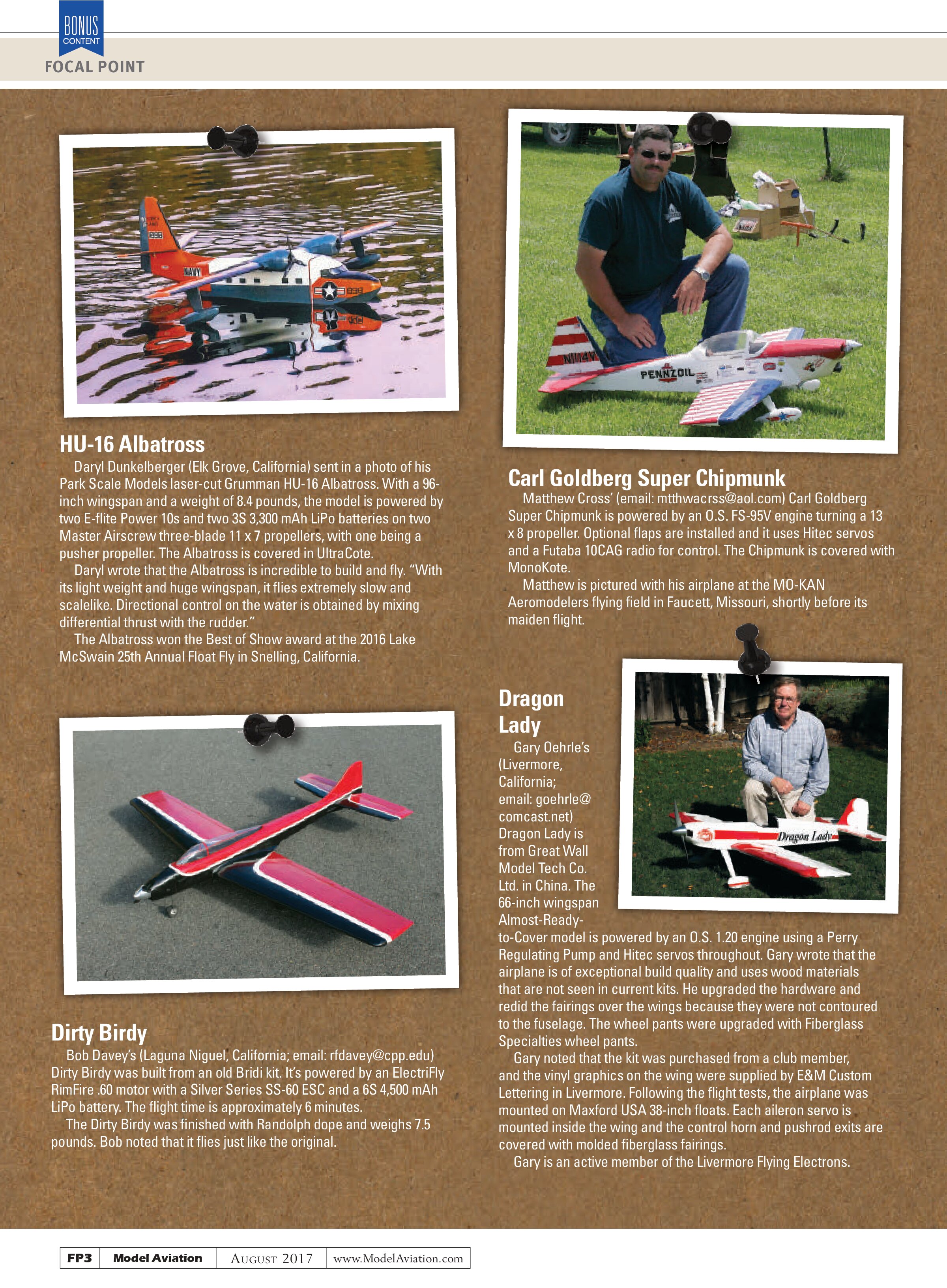
HU-16 Albatross
Daryl Dunkelberger (Elk Grove, California) sent in a photo of his Park Scale Models laser-cut Grumman HU-16 Albatross. With a 96-inch wingspan and a weight of 8.4 pounds, the model is powered by two E-flite Power 10s and two 3S 3,300 mAh LiPo batteries on two Master Airscrew three-blade 11 x 7 propellers, with one being a pusher propeller. The Albatross is covered in UltraCote.
Daryl wrote that the Albatross is incredible to build and fly. “With its light weight and huge wingspan, it flies extremely slow and scalelike. Directional control on the water is obtained by mixing differential thrust with the rudder.”
The Albatross won the Best of Show award at the 2016 Lake McSwain 25th Annual Float Fly in Snelling, California.

Dirty Birdy
Bob Davey’s (Laguna Niguel, California; email: rfdavey@cpp.edu) Dirty Birdy was built from an old Bridi kit. It’s powered by an ElectriFly RimFire .60 motor with a Silver Series SS-60 ESC and a 6S 4,500 mAh LiPo battery. The flight time is approximately 6 minutes.
The Dirty Birdy was finished with Randolph dope and weighs 7.5 pounds. Bob noted that it flies just like the original.

Carl Goldberg Super Chipmunk
Matthew Cross’ (email: mtthwacrs@aol.com) Carl Goldberg Super Chipmunk is powered by an O.S. FS-95V engine turning a 13 x 8 propeller. Optional flaps are installed and it uses Hitec servos and a Futaba 10CAG radio for control. The Chipmunk is covered with MonoKote.
Matthew is pictured with his airplane at the MO-KAN Aeromodelers flying field in Faucett, Missouri, shortly before its maiden flight.

Dragon Lady
Gary Oehrle’s (Livermore, California; email: goehrle@comcast.net) Dragon Lady is from Great Wall Model Tech Co. Ltd. in China. The 66-inch wingspan Almost-Ready-to-Cover model is powered by an O.S. 1.20 engine using a Perry Regulating Pump and Hitec servos throughout. Gary wrote that the airplane is of exceptional build quality and uses wood materials that are not seen in current kits. He upgraded the hardware and redid the fairings over the wings because they were not contoured to the fuselage. The wheel pants were upgraded with Fiberglass Specialties wheel pants.
Gary noted that the kit was purchased from a club member, and the vinyl graphics on the wing were supplied by E&M Custom Lettering in Livermore. Following the flight tests, the airplane was mounted on Maxford USA 38-inch floats. Each aileron servo is mounted inside the wing and the control horn and pushrod exits are covered with molded fiberglass fairings.
Gary is an active member of the Livermore Flying Electrons.

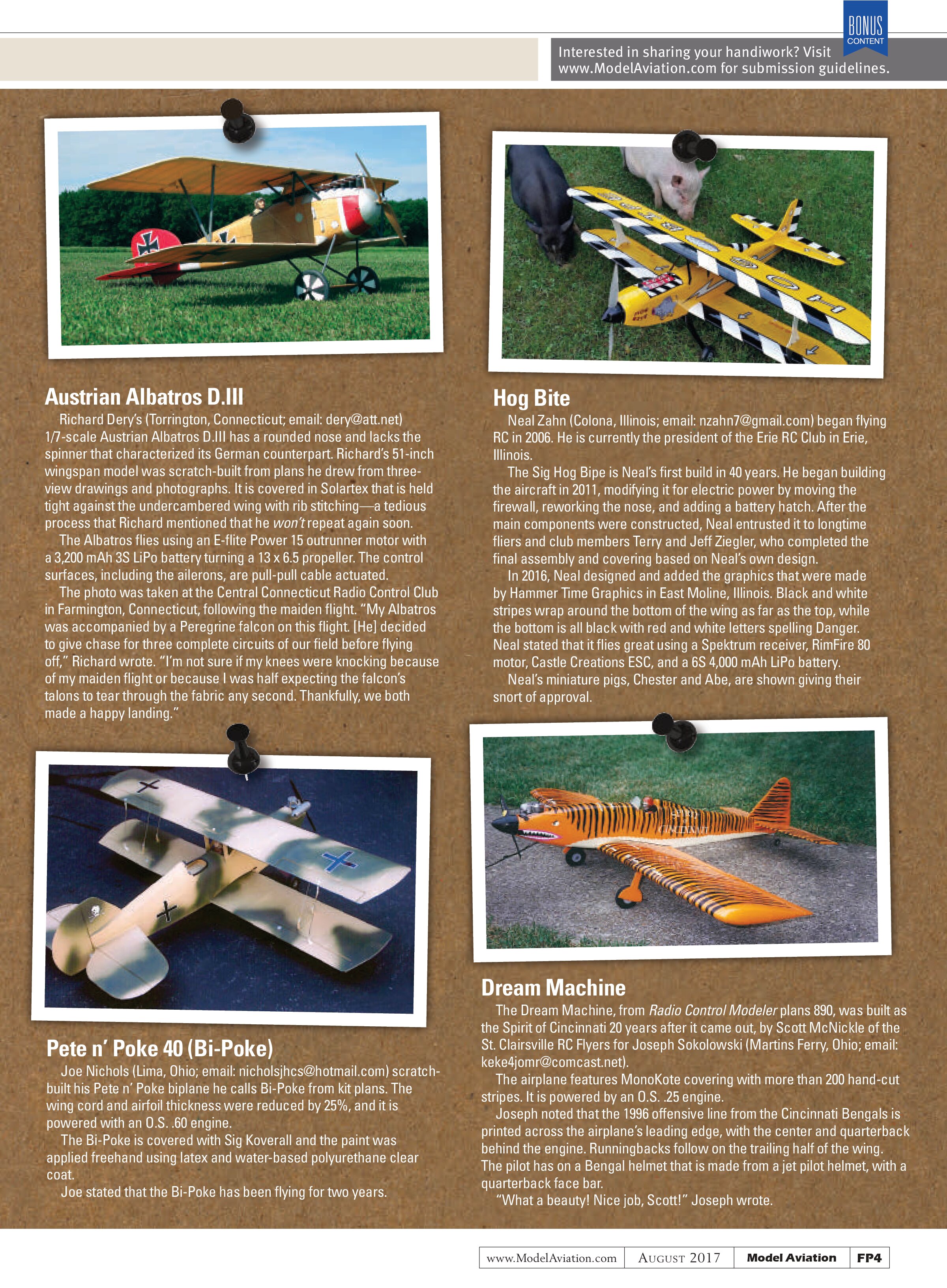
Austrian Albatros D.III
Richard Dery’s (Torrington, Connecticut; email: dery@att.net) 1/7-scale Austrian Albatros D.III has a rounded nose and lacks the spinner that characterized its German counterpart. Richard’s 51-inch wingspan model was scratch-built from plans he drew from three-view drawings and photographs. It is covered in Solartex that is held tight against the undercambered wing with rib stitching—a tedious process that Richard mentioned that he won’t repeat again soon.
The Albatros flies using an E-flite Power 15 outrunner motor with a 3,200 mAh 3S LiPo battery turning a 13 x 6.5 propeller. The control surfaces, including the ailerons, are pull-pull cable actuated.
The photo was taken at the Central Connecticut Radio Control Club in Farmington, Connecticut, following the maiden flight. “My Albatros was accompanied by a Peregrine falcon on this flight. [He] decided to give chase for three complete circuits of our field before flying off,” Richard wrote. “I’m not sure if my knees were knocking because of my maiden flight or because I was half expecting the falcon’s talons to tear through the fabric any second. Thankfully, we both made a happy landing.”

Pete n’ Poke 40 (Bi-Poke)
Joe Nichols (Lima, Ohio; email: nicholsjhcs@hotmail.com) scratch-built his Pete n’ Poke biplane he calls Bi-Poke from kit plans. The wing cord and airfoil thickness were reduced by 25%, and it is powered with an O.S. .60 engine.
The Bi-Poke is covered with Sig Koverall and the paint was applied freehand using latex and water-based polyurethane clear coat.
Joe stated that the Bi-Poke has been flying for two years.

Hog Bite
Neal Zahn (Colona, Illinois; email: nzahn7@gmail.com) began flying RC in 2006. He is currently the president of the Erie RC Club in Erie, Illinois.
The Sig Hog Bipe is Neal’s first build in 40 years. He began building the aircraft in 2011, modifying it for electric power by moving the firewall, reworking the nose, and adding a battery hatch. After the main components were constructed, Neal entrusted it to longtime fliers and club members Terry and Jeff Ziegler, who completed the final assembly and covering based on Neal’s own design.
In 2016, Neal designed and added the graphics that were made by Hammer Time Graphics in East Moline, Illinois. Black and white stripes wrap around the bottom of the wing as far as the top, while the bottom is all black with red and white letters spelling Danger. Neal stated that it flies great using a Spektrum receiver, RimFire 80 motor, Castle Creations ESC, and a 6S 4,000 mAh LiPo battery.
Neal’s miniature pigs, Chester and Abe, are shown giving their snort of approval.

Dream Machine
The Dream Machine, from Radio Control Modeler plans 890, was built as the Spirit of Cincinnati 20 years after it came out, by Scott McNickle of the St. Clairsville RC Flyers for Joseph Sokolowski (Martins Ferry, Ohio; email: keke4jom@comcast.net).
The airplane features MonoKote covering with more than 200 hand-cut stripes. It is powered by an O.S. .25 engine.
Joseph noted that the 1996 offensive line from the Cincinnati Bengals is printed across the airplane’s leading edge, with the center and quarterback behind the engine. Runningbacks follow on the trailing half of the wing. The pilot has on a Bengal helmet that is made from a jet pilot helmet, with a quarterback face bar.
“What a beauty! Nice job, Scott!” Joseph wrote.