Durafly T-28 Trojan
Jon Barnes

An excellent addition to a warbird lover’s hangar
In last few years, Durafly has released an entire hangar’s worth of warbirds with the popular and conveniently sized 1,100mm wingspan. Previously released models include several iterations of the venerable Supermarine Spitfire and the infrequently modeled Douglas A-1 Skyraider.
The original version of the Durafly T-28 Trojan featured the popular red and white US Navy scheme. It gained a reputation as a solid, predictable flier.
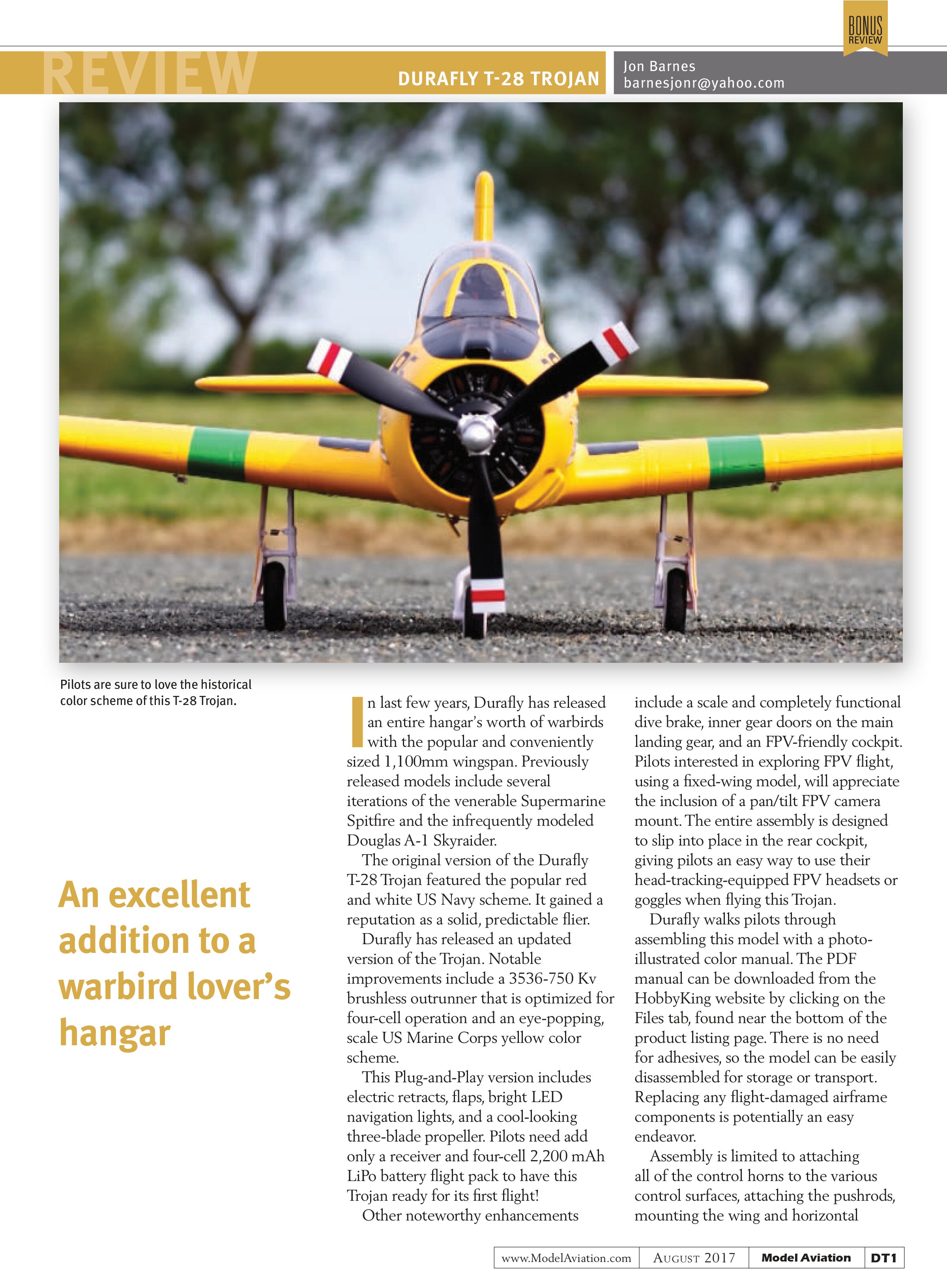
Durafly has released an updated version of the Trojan. Notable improvements include a 3536-750 Kv brushless outrunner that is optimized for four-cell operation and an eye-popping, scale US Marine Corps yellow color scheme.
This Plug-and-Play version includes electric retracts, flaps, bright LED navigation lights, and a cool-looking three-blade propeller. Pilots need add only a receiver and four-cell 2,200 mAh LiPo battery flight pack to have this Trojan ready for its first flight!
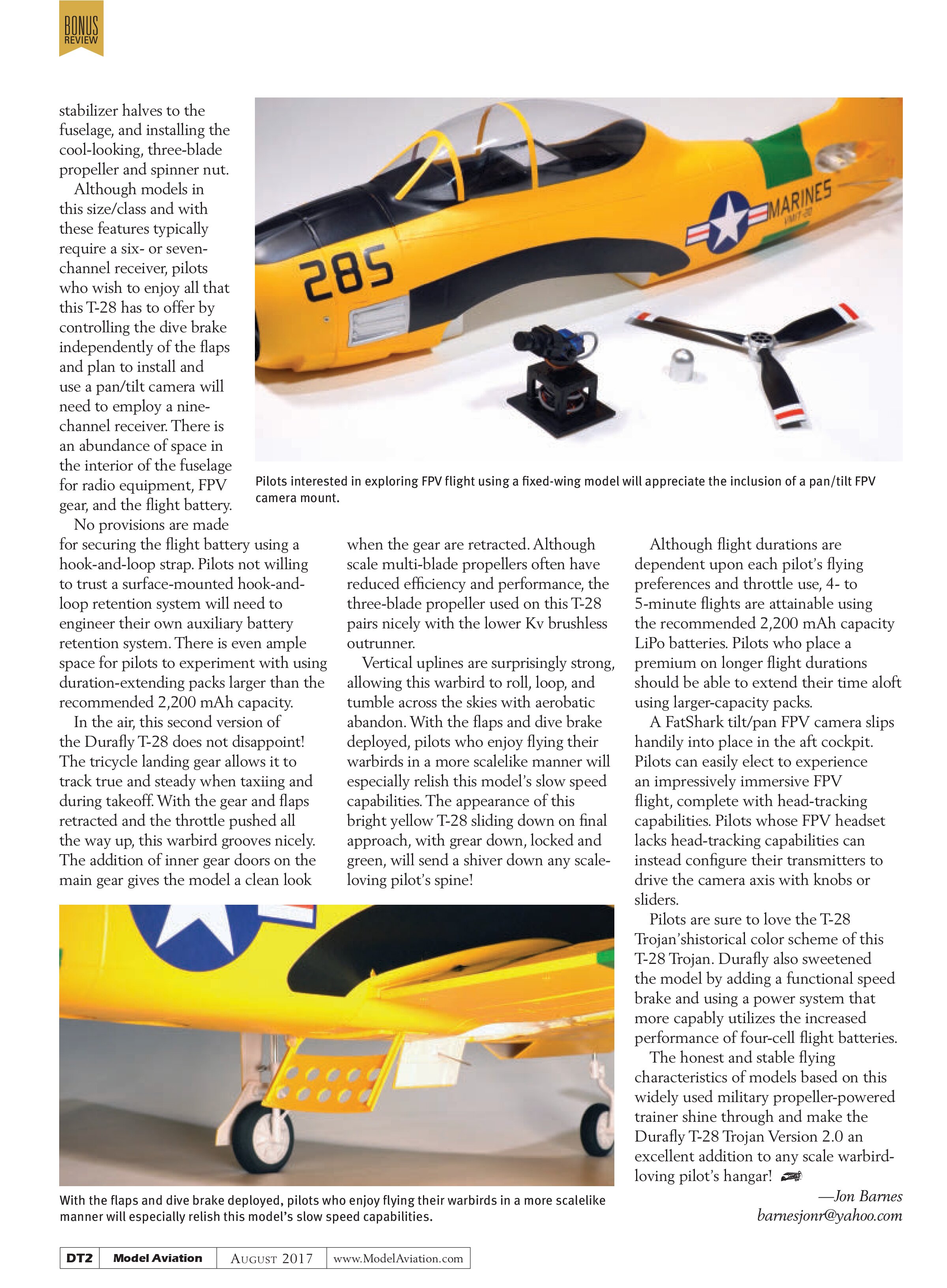
Other noteworthy enhancements include a scale and completely functional dive brake, inner gear doors on the main landing gear, and an FPV-friendly cockpit. Pilots interested in exploring FPV flight, using a fixed-wing model, will appreciate the inclusion of a pan/tilt FPV camera mount. The entire assembly is designed to slip into place in the rear cockpit, giving pilots an easy way to use their head-tracking-equipped FPV headsets or goggles when flying this Trojan.
Durafly walks pilots through assembling this model with a photo-illustrated color manual. The PDF manual can be downloaded from the HobbyKing website by clicking on the Files tab, found near the bottom of the product listing page. There is no need for adhesives, so the model can be easily disassembled for storage or transport. Replacing any flight-damaged airframe components is potentially an easy endeavor.
Assembly is limited to attaching all of the control horns to the various control surfaces, attaching the pushrods, mounting the wing and horizontal
stabilizer halves to the fuselage, and installing the cool-looking, three-blade propeller and spinner nut. Although models in this size/class and with these features typically require a six- or seven-channel receiver, pilots who wish to enjoy all that this T-28 has to offer by controlling the dive brake independently of the flaps and plan to install and use a pan/tilt camera will need to employ a nine-channel receiver. There is an abundance of space in the interior of the fuselage for radio equipment, FPV gear, and the flight battery.
No provisions are made for securing the flight battery using a hook-and-loop strap. Pilots not willing to trust a surface-mounted hook-and-loop retention system will need to engineer their own auxiliary battery retention system. There is even ample space for pilots to experiment with using duration-extending packs larger than the recommended 2,200 mAh capacity.
In the air, this second version of the Durafly T-28 does not disappoint! The tricycle landing gear allows it to track true and steady when taxiing and during takeoff. With the gear and flaps retracted and the throttle pushed all the way up, this warbird grooves nicely. The addition of inner gear doors on the main gear gives the model a clean look

when the gear are retracted. Although scale multi-blade propellers often have reduced efficiency and performance, the three-blade propeller used on this T-28 pairs nicely with the lower Kv brushless outrunner.
Vertical uplines are surprisingly strong, allowing this warbird to roll, loop, and tumble across the skies with aerobatic abandon. With the flaps and dive brake deployed, pilots who enjoy flying their warbirds in a more scalelike manner will especially relish this model’s slow speed capabilities. The appearance of this bright yellow T-28 sliding down on final approach, with gear down, locked and green, will send a shiver down any scale-loving pilot’s spine!

Although flight durations are dependent upon each pilot’s flying preferences and throttle use, 4- to 5-minute flights are attainable using the recommended 2,200 mAh capacity LiPo batteries. Pilots who place a premium on longer flight durations should be able to extend their time aloft using larger-capacity packs.
A FatShark tilt/pan FPV camera slips handily into place in the aft cockpit. Pilots can easily elect to experience an impressively immersive FPV flight, complete with head-tracking capabilities. Pilots whose FPV headset lacks head-tracking capabilities can instead configure their transmitters to drive the camera axis with knobs or sliders.
Pilots are sure to love the T-28 Trojan’s historical color scheme of this T-28 Trojan. Durafly also sweetened the model by adding a functional speed brake and using a power system that more capably utilizes the increased performance of four-cell flight batteries.
The honest and stable flying characteristics of models based on this widely used military propeller-powered trainer shine through and make the Durafly T-28 Trojan Version 2.0 an excellent addition to any scale warbird-loving pilot’s hangar!
—Jon Barnes
barnesjonr@yahoo.com