Registration requirement likely to be reintroduced

On May 19, 2017, the U.S. District Court struck down the FAA’s registration requirement for recreational model aircraft. As such, you are no longer required by law to register or label your aircraft with the FAA.
Although some hobbyists were quick to remove their FAA registration labels, AMA members should recognize that this is a fluid situation. This approach to resolve registration through the courts will most likely be short-lived and is creating unintended consequences.
As a result of the District Court ruling, Congress is drafting language to reimplement registration by removing some of the protections in the Special Rule for Model Aircraft (Section 336). By the time you read this article, it is possible that a bill to transfer more authority over our hobby to the FAA and to reintroduce registration might be public or ready for a vote.
It is important to understand what exactly the Special Rule for Model Aircraft is. In 2010, the AMA worked
feverishly with Congress to protect hobbyists from unnecessary regulations. The Special Rule allows hobbyists to follow the programming and operate within community-based organizations (CBOs) such as the AMA. By no means is Section 336 intended to give hobbyists a free pass; rather, Congress’ intent with the Special Rule was to allow for private-public partnerships to manage a community of model aviation hobbyists.
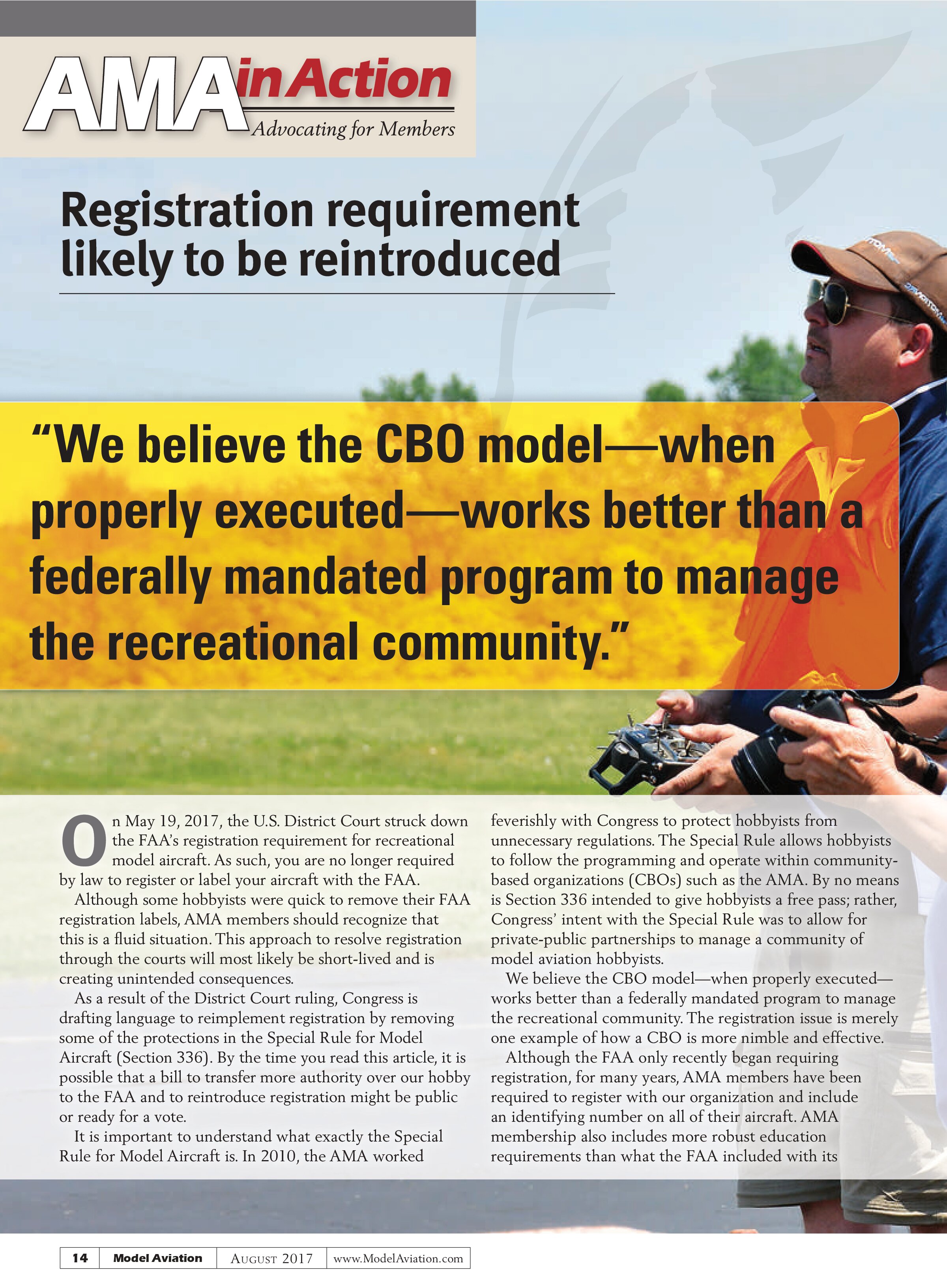
We believe the CBO model—when properly executed—works better than a federally mandated program to manage the recreational community. The registration issue is merely one example of how a CBO is more nimble and effective.
Although the FAA only recently began requiring registration, for many years, AMA members have been required to register with our organization and include an identifying number on all of their aircraft. AMA membership also includes more robust education requirements than what the FAA included with its registration rule. AMA was ahead of the curve on registration.
We will continue to engage Congress, the FAA, and other stakeholders to address registration. I encourage you to visit www.modelaviation.com/gov and check social media and your emails for the latest news and information about registration.
In addition to efforts in Congress to remove protections in Section 336, Congress is considering a piece of legislation known as the Drone Federalism Act of 2017. This bill would give state and local governments some authority to restrict drone and model aircraft flights below 200 feet. If enacted, this proposal could also make life more complicated for our members, leading to a patchwork of confusing and restrictive state and local laws. We take this proposal seriously and are actively working to counter it.
AMA is also meeting directly with members of Congress and their staffs to express our concerns about the pending federal legislation. Our hope is that Congress will table the bill and defer to the consensus recommendations of model aviation and drone industry stakeholders who have been working collaboratively for some time on this issue.
AMA, along with 13 other organizations, also sent a letter to members of Congress urging them not to pass legislation relating to the governance of the national airspace until the FAA’s Drone Advisory Committee (DAC) has reached consensus recommendations on the proper role of state and local governments. AMA is a member of the DAC and an integral part of this collaborative effort to provide guidance to the federal government on state and local authority. You can read the letter at www.modelaircraft.org/gov.
This will be an active summer in Congress. There is the possibility that we might need your help to weigh in with your members of Congress.
—Chad Budreau
Public Relations & Government Affairs Director
chadb@modelaircraft.org