Plus F5J: A performance explosion!
by Gordon Buckland
gordon@gatorf3b.com
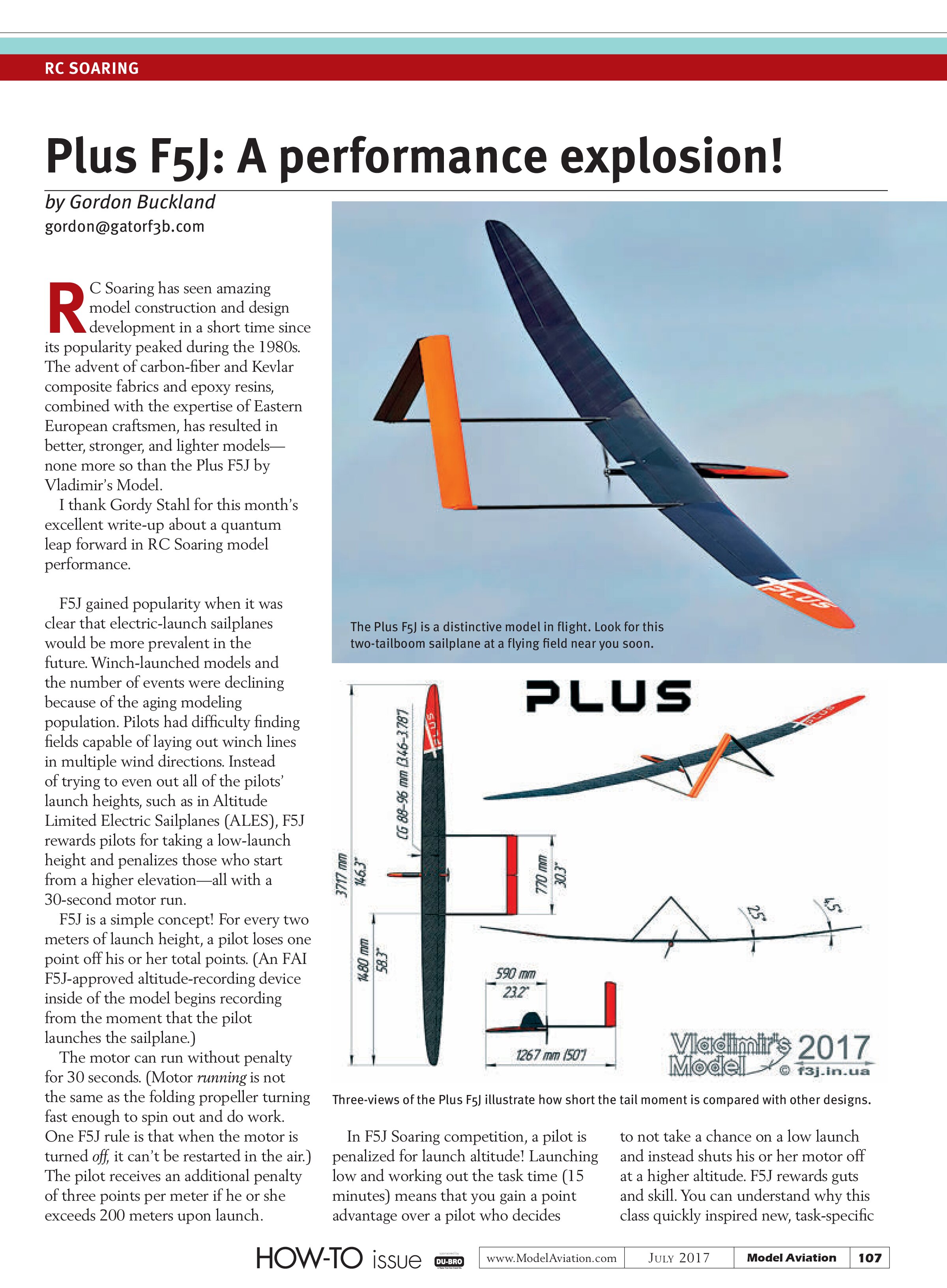
RC Soaring has seen amazing model construction and design development in a short time since its popularity peaked during the 1980s. The advent of carbon-fiber and Kevlar composite fabrics and epoxy resins, combined with the expertise of Eastern European craftsmen, has resulted in better, stronger, and lighter models—none more so than the Plus F5J by Vladimir’s Model.
I thank Gordy Stahl for this month’s excellent write-up about a quantum leap forward in RC Soaring model performance.

F5J gained popularity when it was clear that electric-launch sailplanes would be more prevalent in the future. Winch-launched models and the number of events were declining because of the aging modeling population. Pilots had difficulty finding fields capable of laying out winch lines in multiple wind directions. Instead of trying to even out all of the pilots’ launch heights, such as in Altitude Limited Electric Sailplanes (ALES), F5J rewards pilots for taking a low-launch height and penalizes those who start from a higher elevation—all with a 30-second motor run.
F5J is a simple concept! For every two meters of launch height, a pilot loses one point off his or her total points. (An FAI F5J-approved altitude-recording device inside of the model begins recording from the moment that the pilot launches the sailplane.)
The motor can run without penalty for 30 seconds. (Motor running is not the same as the folding propeller turning fast enough to spin out and do work. One F5J rule is that when the motor is turned off, it can’t be restarted in the air.) The pilot receives an additional penalty of three points per meter if he or she exceeds 200 meters upon launch.

In F5J Soaring competition, a pilot is penalized for launch altitude! Launching low and working out the task time (15 minutes) means that you gain a point advantage over a pilot who decides to not take a chance on a low launch and instead shuts his or her motor off at a higher altitude. F5J rewards guts and skill. You can understand why this class quickly inspired new, task-specific
airframes, but none have come close to the Plus F5J.
Plus F5J by Vladimir’s Model
The Plus F5J seems to be a radical design, but it is simply a smart design. It incorporates leading-edge technology in almost every component, even in its collaborative creation with one of the world’s all-time top RC Soaring modelers and multidiscipline world champions, Joe Wurts.
• Vladimir’s Model has taken the wing-molding process to a new level by ensuring a harder, stronger-bonded, and more durable skin using techniques and materials only available through its company.
• The wing consists of five panels and a center with a flap. On each side are large main panels and large, long surfaces that share brake flaps with the center and aileron function with the tips.
• The multhedral wing form ensures stable and efficient turning and straight tracking with little pilot management.
• The two tailbooms key through carbon-fiber loops at the trailing edges of the wing’s main panel, then forward through holes in the main wing joiners—each retained with a simple clip.
• Each tailboom has a molded servo mount created for an inexpensive

KST X08 micro servo to operate each ruddervator.
• Also included in the kit are plastic drum servo horns to actuate pull strings that end in loops at the ruddervator horns, easily allowing removal or adjustment.
• Each half of the A-tail is molded to slide onto a tailboom when assembled (no tools needed) to create the A shape.
• The kit comes with two ruddervator torsion springs that slide into pockets in the surfaces. They are preloaded to the surfaces so that only the single pull strings on the side need to pull.
• The ruddervator surface horns are slotted so the pull-string loops can be removed, then each half of the A-tail can slide off its tailboom. The tailbooms are removable from their wing panel mountings (no tools needed).
• All wing servo electrical connectors are molded into each panel. The connections area is made during assembly.
• The main wing panel has a molded-in receiver pocket to keep the radio components separate from the pod. The wing servo and ruddervator servo connectors are also there, and there are fewer wires to tangle during setup.
• Two small screws hold the pod to the main wing panel (the only hardware needed for assembly).
• The predrilled launch motor mount fits a 22mm Scorpion outrunner motor, which costs less than $60.
• The kit comes with the driveshaft components, propeller, and spinner and is ready to connect to the motor shaft.
• The propeller is a standard 12 x 8 folding propeller. Simply run it in reverse.
Pusher-Propeller Configuration and Safety
The flight-tested design proves that the propeller is not in the path of the launcher’s body or hand. To launch the sailplane, the pilot’s hand should simultaneously go forward and arc downward. The model’s path is an arc forward and upward, away from the pilot’s launch hand. The use of a programmed three-position-launch motor switch ensures motor and propeller safety.
• Motor position 1: Off!
• Motor position 2: According to FAI F5J rules, the motor must be running when the model is released to start the round. Position 2 starts with the motor and propeller rotating slowly. The propeller is still in its stored position, so it’s not a threat to anything passing near its blades. The pilot tosses the model and it easily glides away.
• Motor position 3: At this point, the pilot engages motor position 3, which is full rpm, and the propeller blades are deployed away from the pilot.
Keep in mind when launching a Plus F5J that the motor is almost the same size as your thumb (from the first knuckle to the tip of your thumbnail). It’s not much bigger than a motor in an electric toothbrush, so there is little speed or torque to damage skin and bones.
This marvelous design is also relatively inexpensive! Priced at less than $2,500 from Kennedy Composites, the Plus F5J (as well as other Vladimir’s Model designs) comes with nearly all of the difficult assembly and installations completed! I have heard that from box to flight, the build can take one evening to complete. Other low-weight F5J kits that range from $1,600 to $2,200 need a substantial amount of pilot fabrication, fitting, and mounting to get the models into the air.
Here are some specifications:
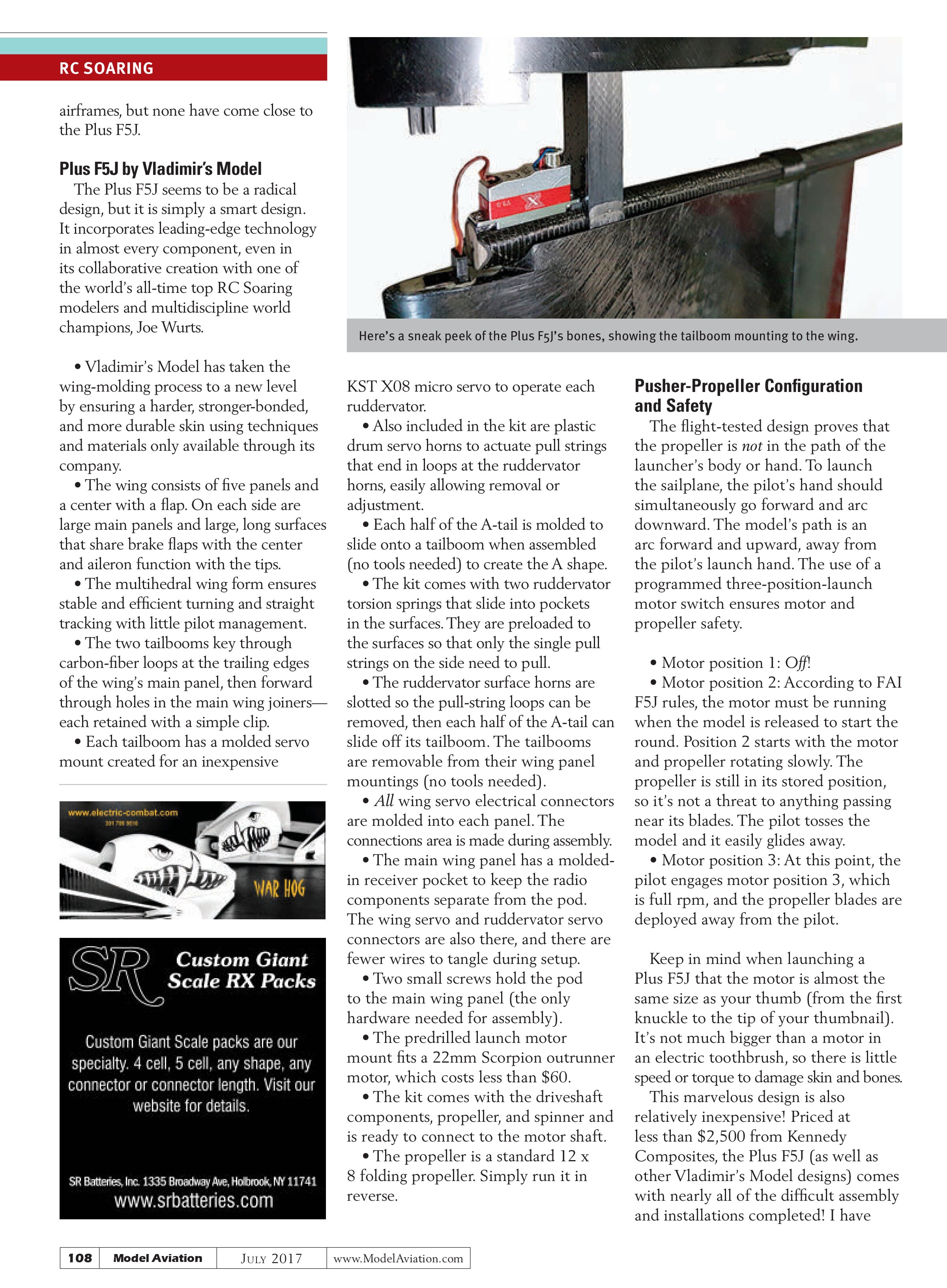
Wingspan: 149.6 inches
Wing area: 1,028 square inches
Weight: 35.27 ounces
Motor: Scorpion SII-2215-1127KV (V2) with 3S 450 mAh LiPo battery
Control surfaces: Five wing servos (two ailerons, two outboard flaps, one center panel flap); two tailbooms with ruddervators (a combination of multiple surface functions into one surface; in this case, rudder and elevator. It’s the same as any V-tail model that also has ailerons.) Both halves of the A-tail act as rudder and elevator.
The Plus F5J has moved the bar a nearly impossible distance for other manufacturers to match. Joe doesn’t play around when it comes to contest models, especially for world-class events. He recognized that the first world F5J competition was near, and his collaboration with Vladimir’s Model has produced winning designs such as the Snipe DLG, the Supra, and the Maxa. All have cutting-edge performance technology and durability. You can find more Plus F5J construction and component details on the Vladimir’s Model website, listed in “Sources.”
The Plus F5J model debuted in the US at the April 23-24, 2017, F5J contest in Las Vegas. Thank you again, Gordy, for a well-written article about a model that is sure to be seen more in the future.
Go downwind and soar.
SOURCES:
League of Silent Flight (LSF)
www.silentflight.org
Vladimir’s Model
vladimir@airplane-model.com
www.f3j.in.ua
Kennedy Composites
(972) 602-3144
www.kennedycomposites.com