Making reliable and rugged landing gear doors
by Jim Hiller
jetmodeler@earthlink.net

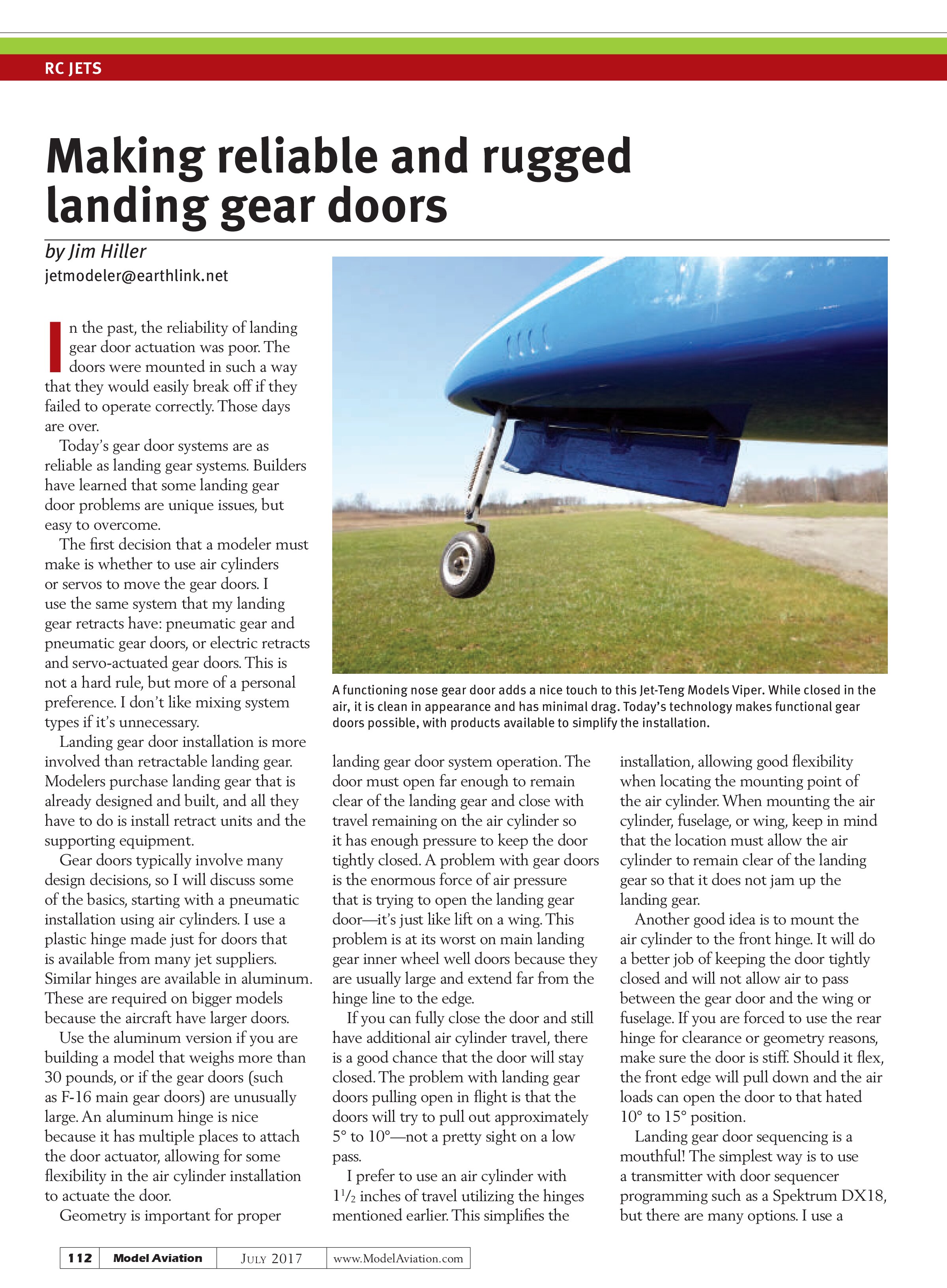
In the past, the reliability of landing gear door actuation was poor. The doors were mounted in such a way that they would easily break off if they failed to operate correctly. Those days are over.
Today’s gear door systems are as reliable as landing gear systems. Builders have learned that some landing gear door problems are unique issues, but easy to overcome.
The first decision that a modeler must make is whether to use air cylinders or servos to move the gear doors. I use the same system that my landing gear retracts have: pneumatic gear and pneumatic gear doors, or electric retracts and servo-actuated gear doors. This is not a hard rule, but more of a personal preference. I don’t like mixing system types if it’s unnecessary.
Landing gear door installation is more involved than retractable landing gear. Modelers purchase landing gear that is already designed and built, and all they have to do is install retract units and the supporting equipment.
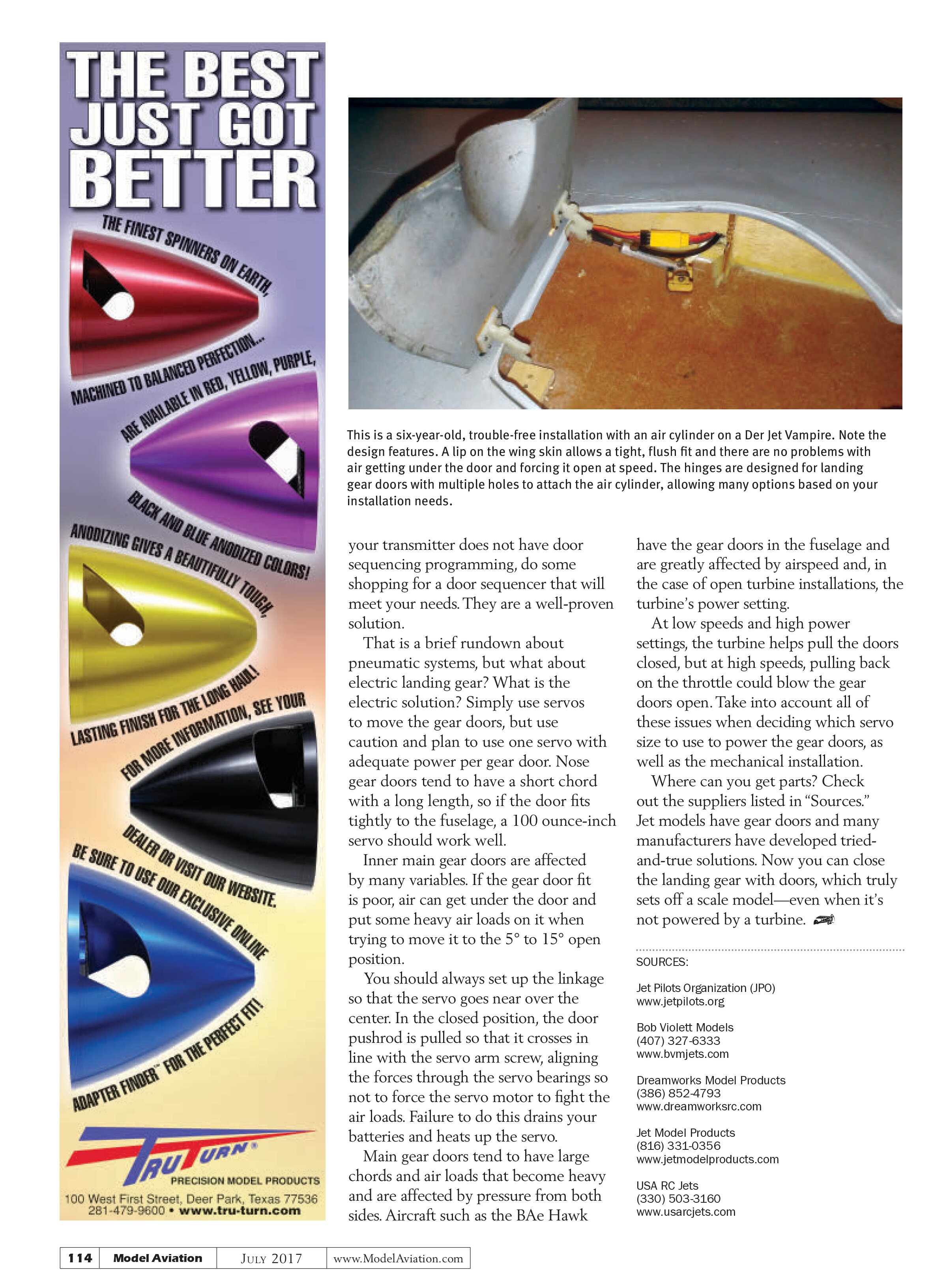
Gear doors typically involve many design decisions, so I will discuss some of the basics, starting with a pneumatic installation using air cylinders. I use a plastic hinge made just for doors that is available from many jet suppliers. Similar hinges are available in aluminum. These are required on bigger models because the aircraft have larger doors.
Use the aluminum version if you are building a model that weighs more than 30 pounds, or if the gear doors (such as F-16 main gear doors) are unusually large. An aluminum hinge is nice because it has multiple places to attach the door actuator, allowing for some flexibility in the air cylinder installation to actuate the door.
Geometry is important for proper landing gear door system operation. The door must open far enough to remain clear of the landing gear and close with travel remaining on the air cylinder so it has enough pressure to keep the door tightly closed. A problem with gear doors is the enormous force of air pressure that is trying to open the landing gear door—it’s just like lift on a wing. This problem is at its worst on main landing gear inner wheel well doors because they are usually large and extend far from the hinge line to the edge.
If you can fully close the door and still have additional air cylinder travel, there is a good chance that the door will stay closed. The problem with landing gear doors pulling open in flight is that the doors will try to pull out approximately 5° to 10°—not a pretty sight on a low pass.
I prefer to use an air cylinder with 1½ inches of travel utilizing the hinges mentioned earlier. This simplifies the installation, allowing good flexibility when locating the mounting point of the air cylinder. When mounting the air cylinder, fuselage, or wing, keep in mind that the location must allow the air cylinder to remain clear of the landing gear so that it does not jam up the landing gear.
Another good idea is to mount the air cylinder to the front hinge. It will do a better job of keeping the door tightly closed and will not allow air to pass between the gear door and the wing or fuselage. If you are forced to use the rear hinge for clearance or geometry reasons, make sure the door is stiff. Should it flex, the front edge will pull down and the air loads can open the door to that hated 10° to 15° position.
Landing gear door sequencing is a mouthful! The simplest way is to use a transmitter with door sequencer programming such as a Spektrum DX18, but there are many options. I use a variety of techniques on my models, so let’s go through them.
First is a simple button air micro switch that should be located so that the landing gear strut will hit the button and pull up the gear door. The door air cylinder is tied into the down retract air line. This will open the door and lower the landing gear together.
For the gear to go up, the door air cylinder is tied into the up air line, but this time the air micro switch is located between the “T” and the door air cylinder. When the button is pushed, the air opens the gear door.
This is a simple and reliable system, but it limits you to only having the gear doors open whenever the gear is down. This is not very scalelike for a P-51 or a BAe Hawk because their inner gear doors are normally closed after the gear is extended.
A second option is a gear door sequencer and there are many units available that work well. I have an airplane equipped with an Assan gear sequencer that provides many programming features at a reasonable price. I have used it successfully for several years.
I switched to this unit from an early Jet Model Products sequencer to take advantage of the timing and end-point programming that the unit offers. If

your transmitter does not have door sequencing programming, do some shopping for a door sequencer that will meet your needs. They are a well-proven solution.
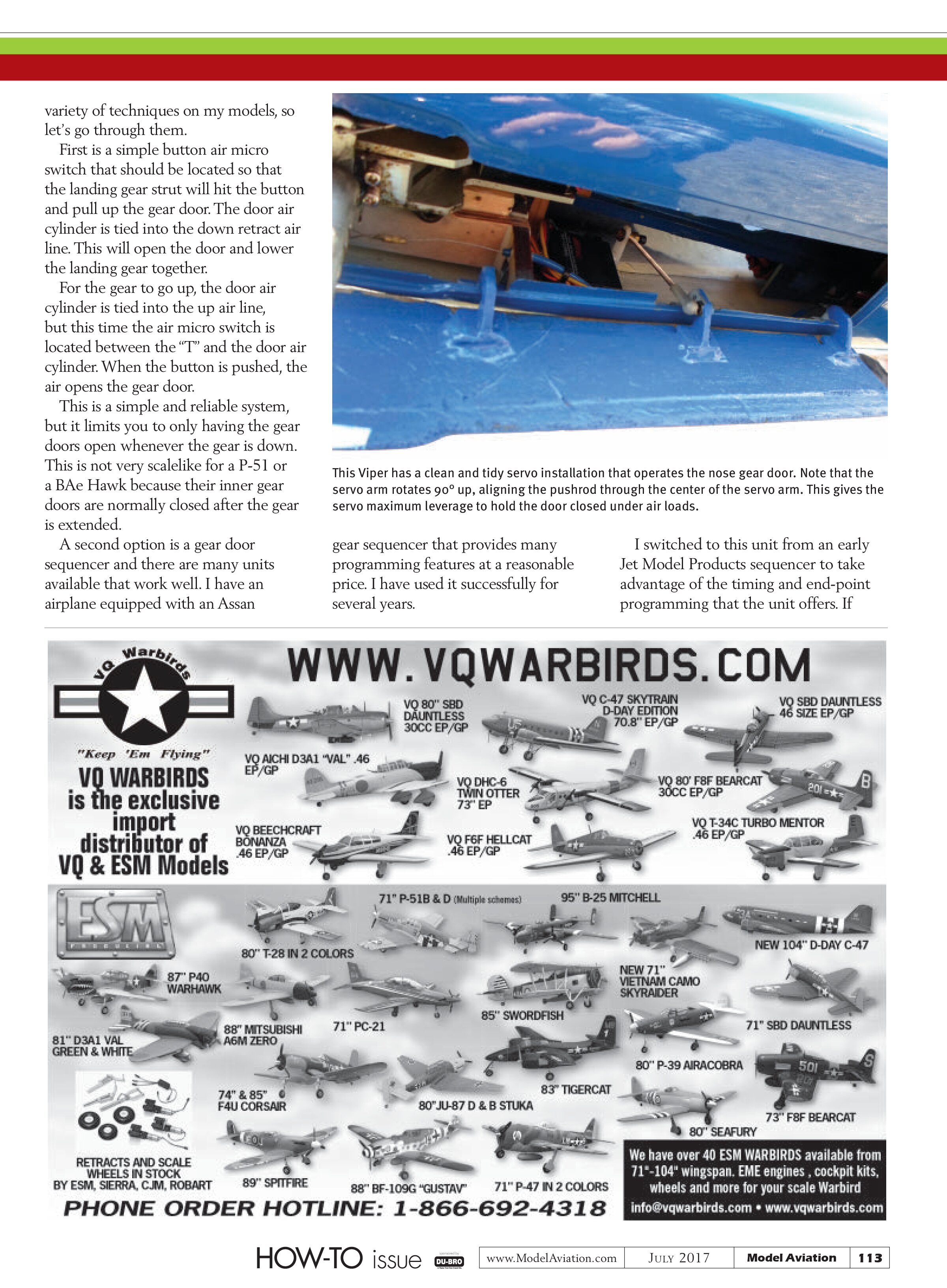
That is a brief rundown about pneumatic systems, but what about electric landing gear? What is the electric solution? Simply use servos to move the gear doors, but use caution and plan to use one servo with adequate power per gear door. Nose gear doors tend to have a short chord with a long length, so if the door fits tightly to the fuselage, a 100 ounce-inch servo should work well.
Inner main gear doors are affected by many variables. If the gear door fit is poor, air can get under the door and put some heavy air loads on it when trying to move it to the 5° to 15° open position.
You should always set up the linkage so that the servo goes near over the center. In the closed position, the door pushrod is pulled so that it crosses in line with the servo arm screw, aligning the forces through the servo bearings so not to force the servo motor to fight the air loads. Failure to do this drains your batteries and heats up the servo.
Main gear doors tend to have large chords and air loads that become heavy and are affected by pressure from both sides. Aircraft such as the BAe Hawk have the gear doors in the fuselage and are greatly affected by airspeed and, in the case of open turbine installations, the turbine’s power setting.
At low speeds and high power settings, the turbine helps pull the doors closed, but at high speeds, pulling back on the throttle could blow the gear doors open. Take into account all of these issues when deciding which servo size to use to power the gear doors, as well as the mechanical installation.
Where can you get parts? Check out the suppliers listed in “Sources.” Jet models have gear doors and many manufacturers have developed tried-and-true solutions. Now you can close the landing gear with doors, which truly sets off a scale model—even when it’s not powered by a turbine.

Sources:
Jet Pilots Organization (JPO)
www.jetpilots.org
Bob Violett Models
(407) 327-6333
www.bvmjets.com
Dreamworks Model Products
(386) 852-4793
www.dreamworksr.com
Jet Model Products
(816) 331-0356
www.jetmodelproducts.com
USA RC Jets
(330) 503-3160
www.usarcjets.com