Solar power at the field
Chris Mulcahy
<REDACTED>
Charging at a flying field can be challenging unless you are lucky enough to belong to a club that already has power installed. My local club, County Line R/C in Summerfield, North Carolina, convened a meeting of its members to explore options for installing power. We decided to look into having a line run from the street to the club shelter for AC power.
For weeks, our club president, Mark Holmes, chased down all of the right people and filled out all of the right paperwork. Things were looking great for having a power line run to the shelter. The installation was free with a negligible monthly bill, but unfortunately, we ran into a small problem. In the event that the club left the property, there would be a large fee for having the line removed. Without going into more detail, an agreement could not be reached and we had to abandon that option.

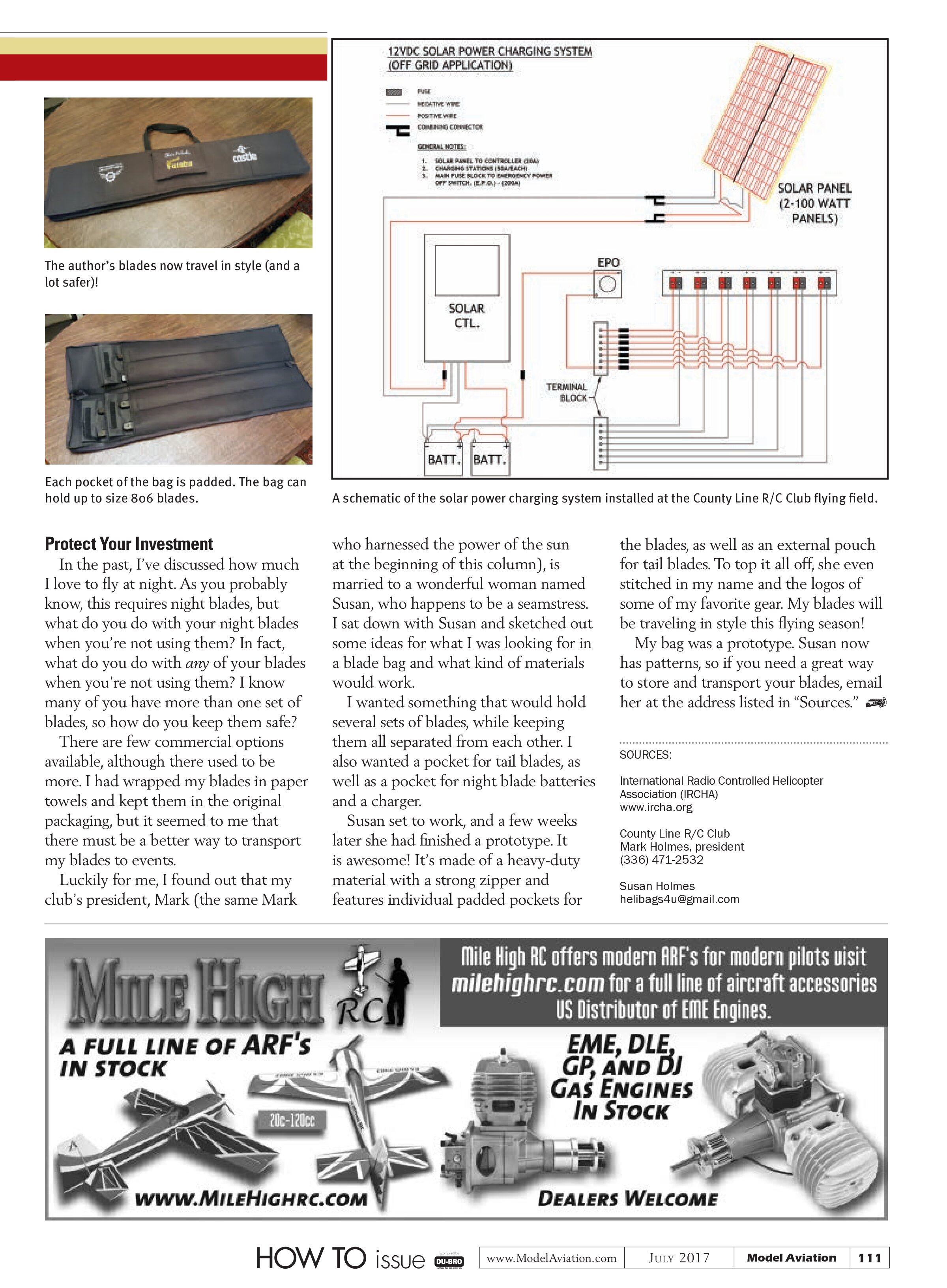
Our second option was solar power. Again, Mark stepped up. The club approved a budget and Mark went ahead with the research and ordered the parts we needed. For approximately $1,400, we ended up with two 100-watt solar panels, a 40-amp solar controller, two 100 Ah deep-discharge batteries, seven charging stations, an emergency cutoff switch, and all of the wiring, fuses, wood, and miscellaneous hardware needed to get the job done.
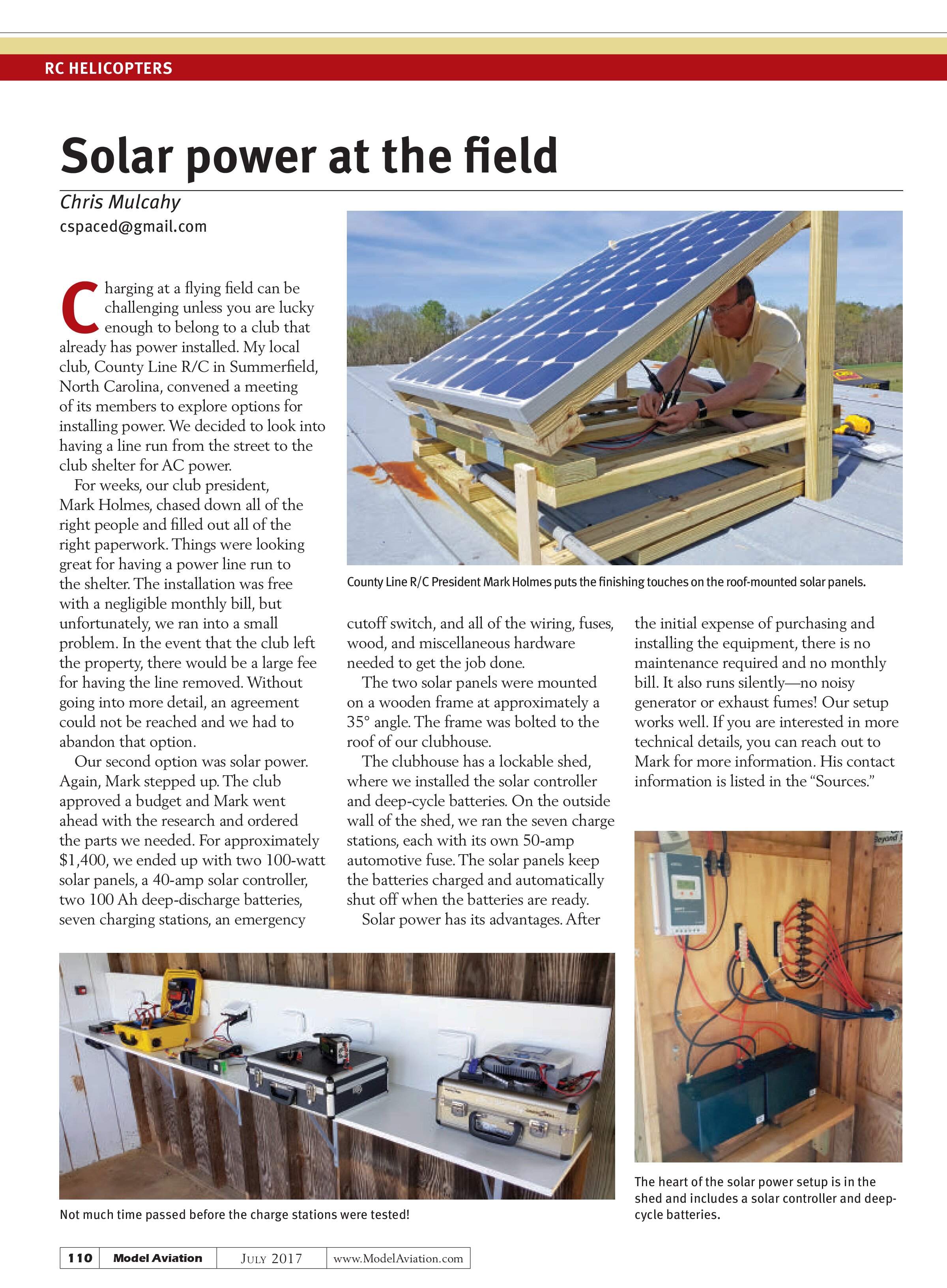
The two solar panels were mounted on a wooden frame at approximately a 35° angle. The frame was bolted to the roof of our clubhouse.
The clubhouse has a lockable shed, where we installed the solar controller and deep-cycle batteries. On the outside wall of the shed, we ran the seven charge stations, each with its own 50-amp automotive fuse. The solar panels keep the batteries charged and automatically shut off when the batteries are ready.
Solar power has its advantages. After the initial expense of purchasing and installing the equipment, there is no maintenance required and no monthly bill. It also runs silently—no noisy generator or exhaust fumes! Our setup works well. If you are interested in more technical details, you can reach out to Mark for more information. His contact information is listed in the “Sources.”


Protect Your Investment
In the past, I’ve discussed how much I love to fly at night. As you probably know, this requires night blades, but what do you do with your night blades when you’re not using them? In fact, what do you do with any of your blades when you’re not using them? I know many of you have more than one set of blades, so how do you keep them safe?
There are few commercial options available, although there used to be more. I had wrapped my blades in paper towels and kept them in the original packaging, but it seemed to me that there must be a better way to transport my blades to events.
Luckily for me, I found out that my club’s president, Mark (the same Mark who harnessed the power of the sun at the beginning of this column), is married to a wonderful woman named Susan, who happens to be a seamstress. I sat down with Susan and sketched out some ideas for what I was looking for in a blade bag and what kind of materials would work.
I wanted something that would hold several sets of blades, while keeping them all separated from each other. I also wanted a pocket for tail blades, as well as a pocket for night blade batteries and a charger.
Susan set to work, and a few weeks later she had finished a prototype. It is awesome! It’s made of a heavy-duty material with a strong zipper and features individual padded pockets for the blades, as well as an external pouch for tail blades. To top it all off, she even stitched in my name and the logos of some of my favorite gear. My blades will be traveling in style this flying season!
My bag was a prototype. Susan now has patterns, so if you need a great way to store and transport your blades, email her at the address listed in “Sources.”


SOURCES:
International Radio Controlled Helicopter Association (IRCHA)
www.ircha.org
County Line R/C Club
Mark Holmes, president
(336) 471-2532
Susan Holmes
<REDACTED>