How to fly the Sportsman sequence
by Peter Vogel
vogel.peter@gmail.com
The theme for this month’s Model Aviation is “how-to.” Most of the articles that I’ve written since taking on the “RC Aerobatics” column have been about how to fly the Sportsman sequence. I should have no trouble fitting that in with the how-to theme!
In my last column, I left off with the first reentry to the aerobatic box and one horizontal roll on center, which is maneuver seven in the sequence. Maneuver eight is a Half-Reverse Cuban 8, which I covered in-depth in my September 2016 column, so I’ll skip ahead to maneuver nine—the Cobra without Rolls.
I’d like to take a timeout and go back to the basics of how to fly the aerobatic box because I’ve now sat in the judge’s chair for the Sportsman sequence on several occasions during the 2017 season, and I have seen many easily corrected centering errors.
Back to Basics
When you stand at the pilot’s station during an RC Aerobatics contest, you should see three key guidelines on the runway. One angles away from you at 60° to your left, another at 60° to your right, and one extends straight out from where you stand. The first two extend out to infinity and indicate the left and right box boundary. All scored maneuvers should happen between those lines!
Although we tend to be forgiving to Sportsman pilots, you lose points based on the percentage of a maneuver that takes place outside of that box. If you fly 50% of the maneuver out of the box, that’s -5 points immediately, before the judges start taking off points for any errors!
There are two factors that you can control to improve your ability to keep your maneuvers in the box. The first one is your speed. Virtually every Sportsman pilot I watch is flying way too fast! A typical Sportsman flight is done in a little more than 4 minutes from takeoff to landing. The goal is to fly well, not get done fast! The rules allow you 8 minutes; you have almost twice as much time as what you are using!
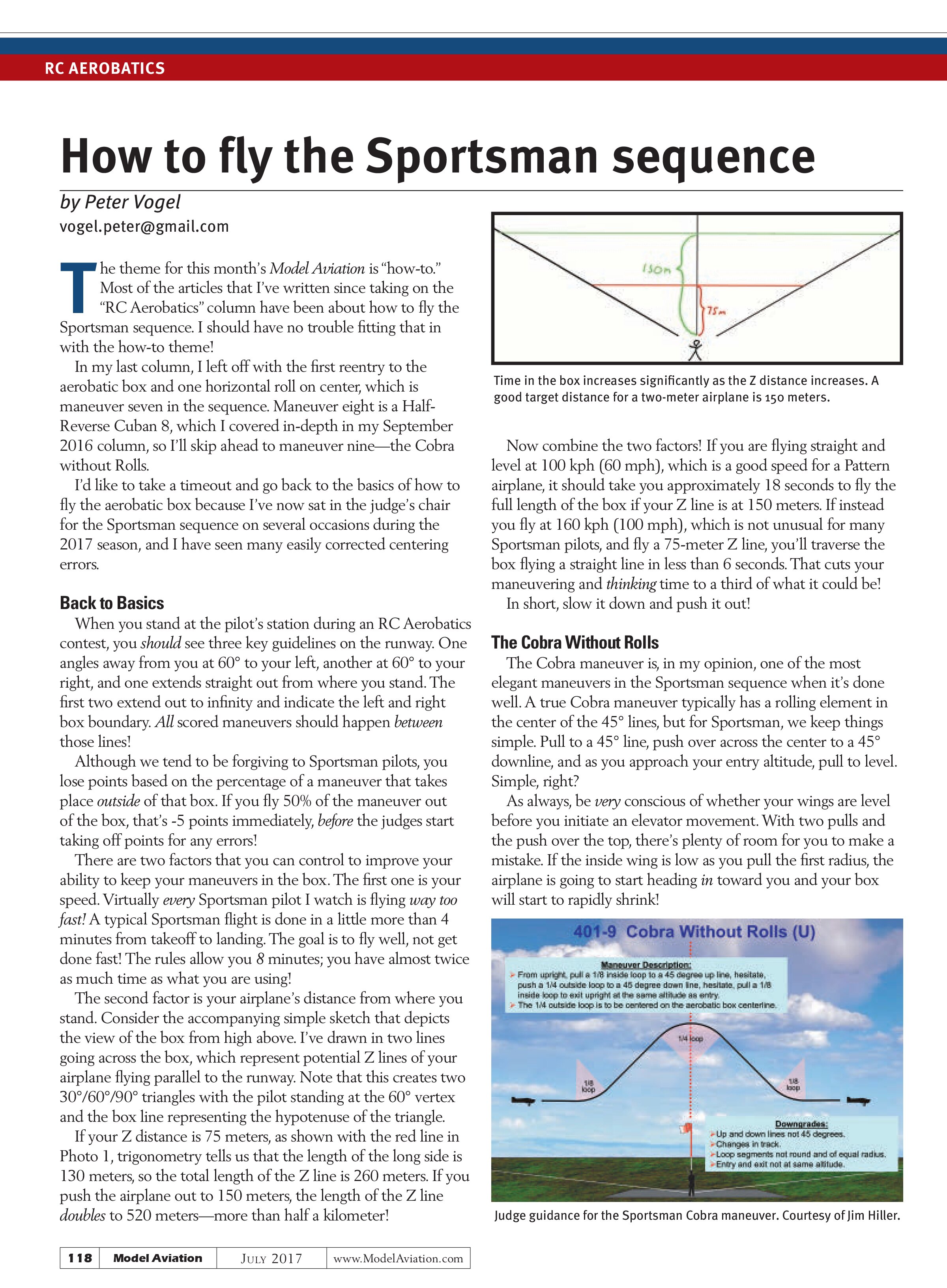
The second factor is your airplane’s distance from where you stand. Consider the accompanying simple sketch that depicts the view of the box from high above. I’ve drawn in two lines going across the box, which represent potential Z lines of your airplane flying parallel to the runway. Note that this creates two 30°/60°/90° triangles with the pilot standing at the 60° vertex and the box line representing the hypotenuse of the triangle.
If your Z distance is 75 meters, as shown with the red line in Photo 1, trigonometry tells us that the length of the long side is 130 meters, so the total length of the Z line is 260 meters. If you push the airplane out to 150 meters, the length of the Z line doubles to 520 meters—more than half a kilometer!

Now combine the two factors! If you are flying straight and level at 100 kph (60 mph), which is a good speed for a Pattern airplane, it should take you approximately 18 seconds to fly the full length of the box if your Z line is at 150 meters. If instead you fly at 160 kph (100 mph), which is not unusual for many Sportsman pilots, and fly a 75-meter Z line, you’ll traverse the box flying a straight line in less than 6 seconds. That cuts your maneuvering and thinking time to a third of what it could be!
In short, slow it down and push it out!
The Cobra Without Rolls
The Cobra maneuver is, in my opinion, one of the most elegant maneuvers in the Sportsman sequence when it’s done well. A true Cobra maneuver typically has a rolling element in the center of the 45° lines, but for Sportsman, we keep things simple. Pull to a 45° line, push over across the center to a 45° downline, and as you approach your entry altitude, pull to level. Simple, right?
As always, be very conscious of whether your wings are level before you initiate an elevator movement. With two pulls and the push over the top, there’s plenty of room for you to make a mistake. If the inside wing is low as you pull the first radius, the airplane is going to start heading in toward you and your box will start to rapidly shrink!

Beyond wing positioning, the most common error I see here is failure to center the maneuver. The center of this maneuver is the center of the radius as you push the airplane over the top. The apex of your airplane’s flight should be dead center in front of you. Most pilots wait too long to begin this maneuver, so they fly well past center on the 45° upline.
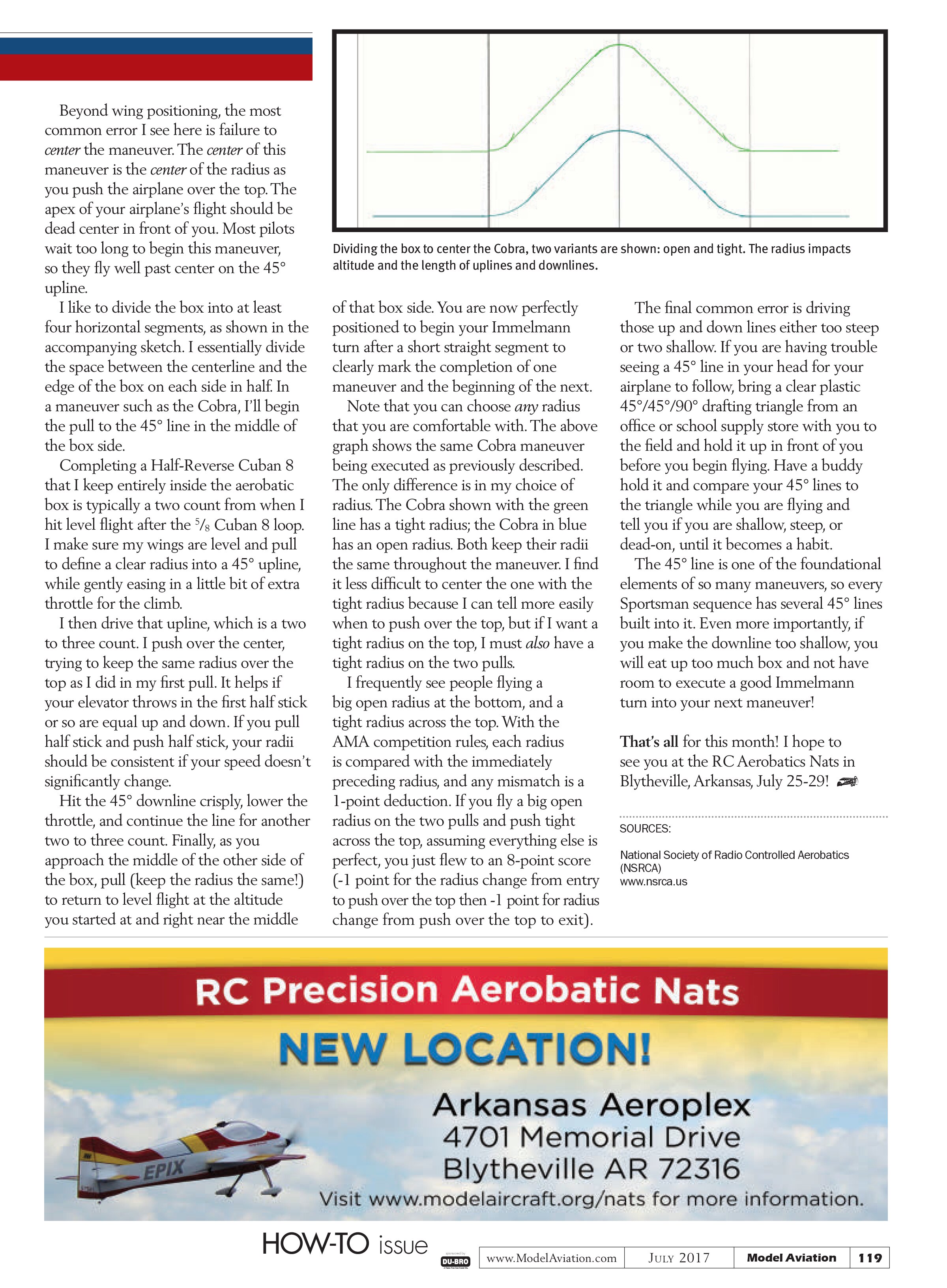
I like to divide the box into at least four horizontal segments, as shown in the accompanying sketch. I essentially divide the space between the centerline and the edge of the box on each side in half. In a maneuver such as the Cobra, I’ll begin the pull to the 45° line in the middle of the box side.
Completing a Half-Reverse Cuban 8 that I keep entirely inside the aerobatic box is typically a two count from when I hit level flight after the ⁵⁄₈ Cuban 8 loop. I make sure my wings are level and pull to define a clear radius into a 45° upline, while gently easing in a little bit of extra throttle for the climb.
I then drive that upline, which is a two to three count. I push over the center, trying to keep the same radius over the top as I did in my first pull. It helps if your elevator throws in the first half stick or so are equal up and down. If you pull half stick and push half stick, your radii should be consistent if your speed doesn’t significantly change.
Hit the 45° downline crisply, lower the throttle, and continue the line for another two to three count. Finally, as you approach the middle of the other side of the box, pull (keep the radius the same!) to return to level flight at the altitude you started at and right near the middle of that box side. You are now perfectly positioned to begin your Immelmann turn after a short straight segment to clearly mark the completion of one maneuver and the beginning of the next.
Note that you can choose any radius that you are comfortable with. The above graph shows the same Cobra maneuver being executed as previously described. The only difference is in my choice of radius. The Cobra shown with the green line has a tight radius; the Cobra in blue has an open radius. Both keep their radii the same throughout the maneuver. I find it less difficult to center the one with the tight radius because I can tell more easily when to push over the top, but if I want a tight radius on the top, I must also have a tight radius on the two pulls.
I frequently see people flying a big open radius at the bottom, and a tight radius across the top. With the AMA competition rules, each radius is compared with the immediately preceding radius, and any mismatch is a 1-point deduction. If you fly a big open radius on the two pulls and push tight across the top, assuming everything else is perfect, you just flew to an 8-point score (-1 point for the radius change from entry to push over the top then -1 point for radius change from push over the top to exit).

The final common error is driving those up and down lines either too steep or two shallow. If you are having trouble seeing a 45° line in your head for your airplane to follow, bring a clear plastic 45°/45°/90° drafting triangle from an office or school supply store with you to the field and hold it up in front of you before you begin flying. Have a buddy hold it and compare your 45° lines to the triangle while you are flying and tell you if you are shallow, steep, or dead-on, until it becomes a habit.
The 45° line is one of the foundational elements of so many maneuvers, so every Sportsman sequence has several 45° lines built into it. Even more importantly, if you make the downline too shallow, you will eat up too much box and not have room to execute a good Immelmann turn into your next maneuver!
That’s all for this month! I hope to see you at the RC Aerobatics Nats in Blytheville, Arkansas, July 25-29!
SOURCES:
National Society of Radio Controlled Aerobatics (NSRCA)
www.nsrca.us