Simple ShyFox racer is great for beginners to CL Racing


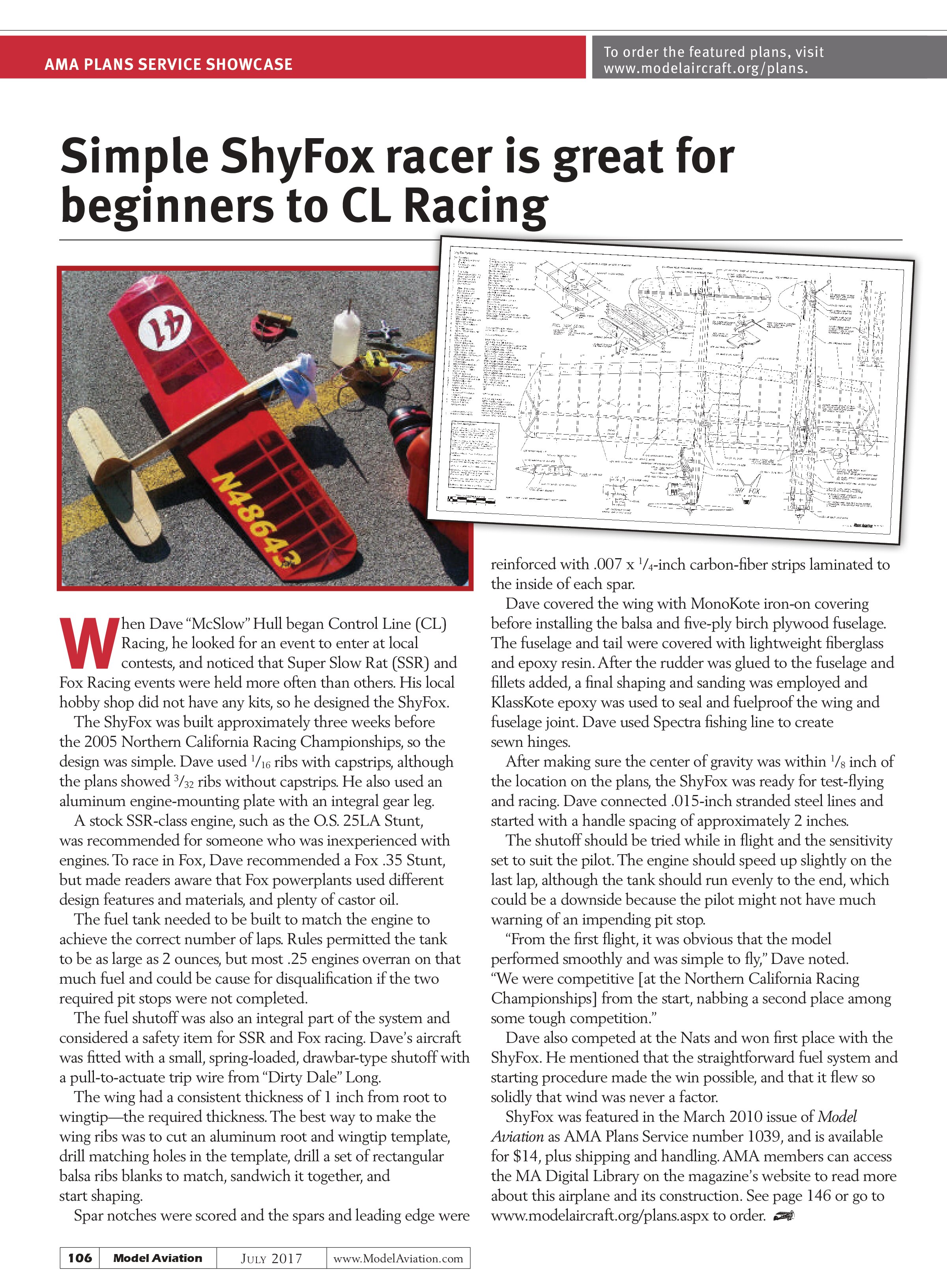
When Dave “McSlow” Hull began Control Line (CL) Racing, he looked for an event to enter at local contests, and noticed that Super Slow Rat (SSR) and Fox Racing events were held more often than others. His local hobby shop did not have any kits, so he designed the ShyFox.
The ShyFox was built approximately three weeks before the 2005 Northern California Racing Championships, so the design was simple. Dave used ¹⁄₁₆ ribs with capstrips, although the plans showed ³⁄₃₂ ribs without capstrips. He also used an aluminum engine-mounting plate with an integral gear leg.
A stock SSR-class engine, such as the O.S. 25LA Stunt, was recommended for someone who was inexperienced with engines. To race in Fox, Dave recommended a Fox .35 Stunt, but made readers aware that Fox powerplants used different design features and materials, and plenty of castor oil.
The fuel tank needed to be built to match the engine to achieve the correct number of laps. Rules permitted the tank to be as large as 2 ounces, but most .25 engines overran on that much fuel and could be cause for disqualification if the two required pit stops were not completed.
The fuel shutoff was also an integral part of the system and considered a safety item for SSR and Fox racing. Dave’s aircraft was fitted with a small, spring-loaded, drawbar-type shutoff with a pull-to-actuate trip wire from “Dirty Dale” Long.
The wing had a consistent thickness of 1 inch from root to wingtip—the required thickness. The best way to make the wing ribs was to cut an aluminum root and wingtip template, drill matching holes in the template, drill a set of rectangular balsa ribs blanks to match, sandwich it together, and start shaping.
Spar notches were scored and the spars and leading edge were reinforced with .007 x ¼-inch carbon-fiber strips laminated to the inside of each spar.
Dave covered the wing with MonoKote iron-on covering before installing the balsa and five-ply birch plywood fuselage. The fuselage and tail were covered with lightweight fiberglass and epoxy resin. After the rudder was glued to the fuselage and fillets added, a final shaping and sanding was employed and KlassKote epoxy was used to seal and fuelproof the wing and fuselage joint. Dave used Spectra fishing line to create sewn hinges.
After making sure the center of gravity was within ⅛ inch of the location on the plans, the ShyFox was ready for test-flying and racing. Dave connected .015-inch stranded steel lines and started with a handle spacing of approximately 2 inches.
The shutoff should be tried while in flight and the sensitivity set to suit the pilot. The engine should speed up slightly on the last lap, although the tank should run evenly to the end, which could be a downside because the pilot might not have much warning of an impending pit stop.
“From the first flight, it was obvious that the model performed smoothly and was simple to fly,” Dave noted. “We were competitive [at the Northern California Racing Championships] from the start, nabbing a second place among some tough competition.”
Dave also competed at the Nats and won first place with the ShyFox. He mentioned that the straightforward fuel system and starting procedure made the win possible, and that it flew so solidly that wind was never a factor.
ShyFox was featured in the March 2010 issue of Model Aviation as AMA Plans Service number 1039, and is available for $14, plus shipping and handling. AMA members can access the MA Digital Library on the magazine’s website to read more about this airplane and its construction. See page 146 or go to www.modelaircraft.org/plans.aspx to order.