Adding color and detail to propellers
In my September 2016 “Micro-Flying” column, I discussed how I make some of the propellers that I use on my micro RC designs. In this column, I would like to discuss how to add some color and detail to your propellers.
The color and look of the propeller on your scale micro RC airplane are as important as adding a pilot or other scalelike details. Seeing an RTF scale model with a plain black propeller or a scale model with an orange plastic propeller just doesn’t look right! However, it is easy to add some color and detail to your propellers to make your aircraft stand out.
Coloring Plastic Propellers
The basic orange plastic propellers from GWS or other manufacturers are easy to color. I use a brown Sharpie permanent marker to color the propeller and give it the look of a wooden propeller. I might also use a paint marker on the tips, depending on the aircraft I am modeling.
To color propellers black, I have used a black Sharpie with good results, but airbrushing a flat black color produces a more realistic appearance. Before airbrushing, I lightly sand the propeller and clean it before applying paint. I also normally give the propeller a coat of silver as a primer.
After adding the final color, you can sand or lightly scrape some paint off the edges to show some metal like a worn propeller would. I like to use Testors Model Master or Tamiya plastic model paints for most of my work.
World War I Propellers
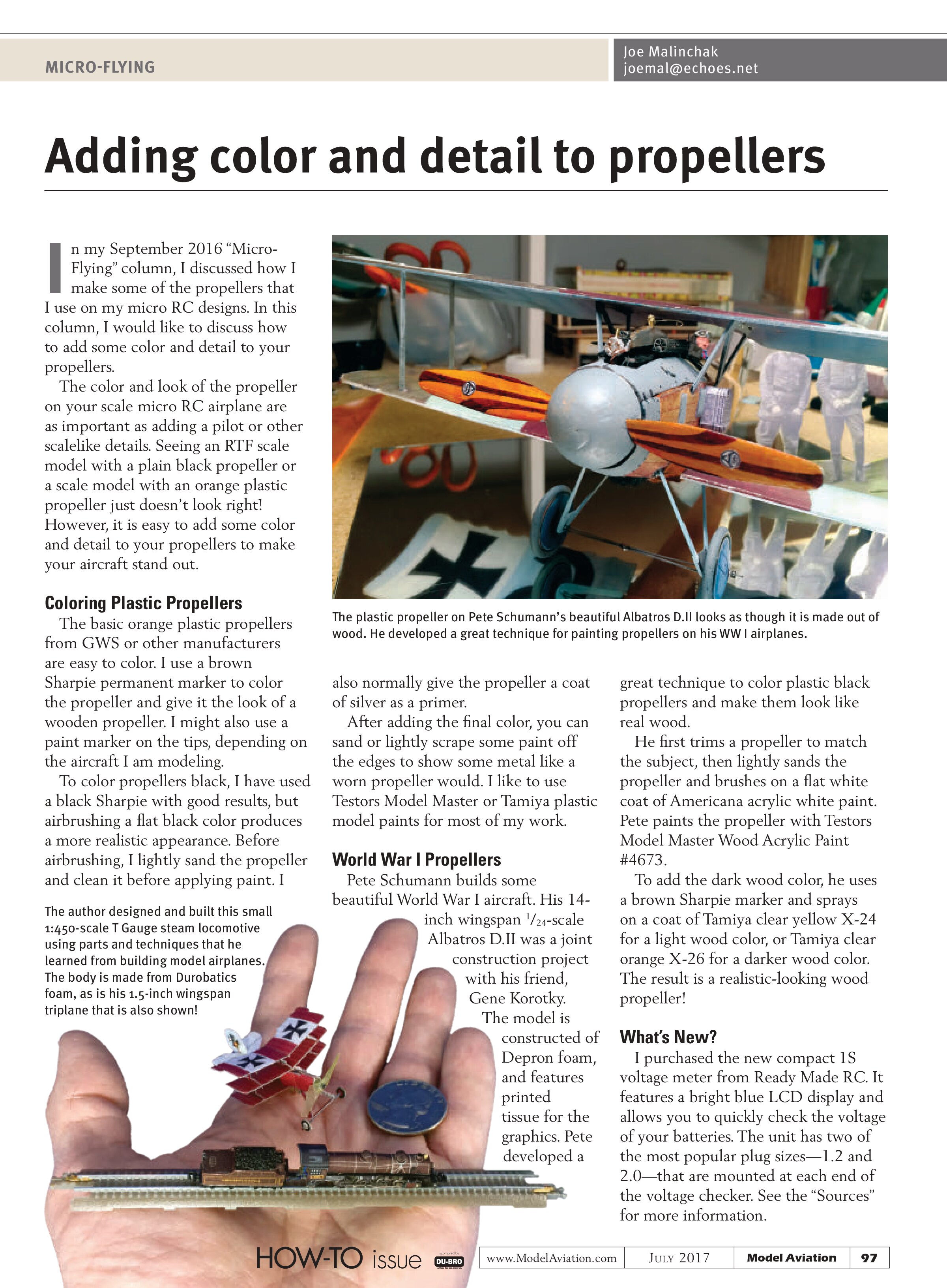
Pete Schumann builds some beautiful World War I aircraft. His 14-inch wingspan 1/24-scale Albatros D.II was a joint construction project with his friend, Gene Korotky. The model is constructed of Depron foam, and features printed tissue for the graphics. Pete developed a great technique to color plastic black propellers and make them look like real wood.
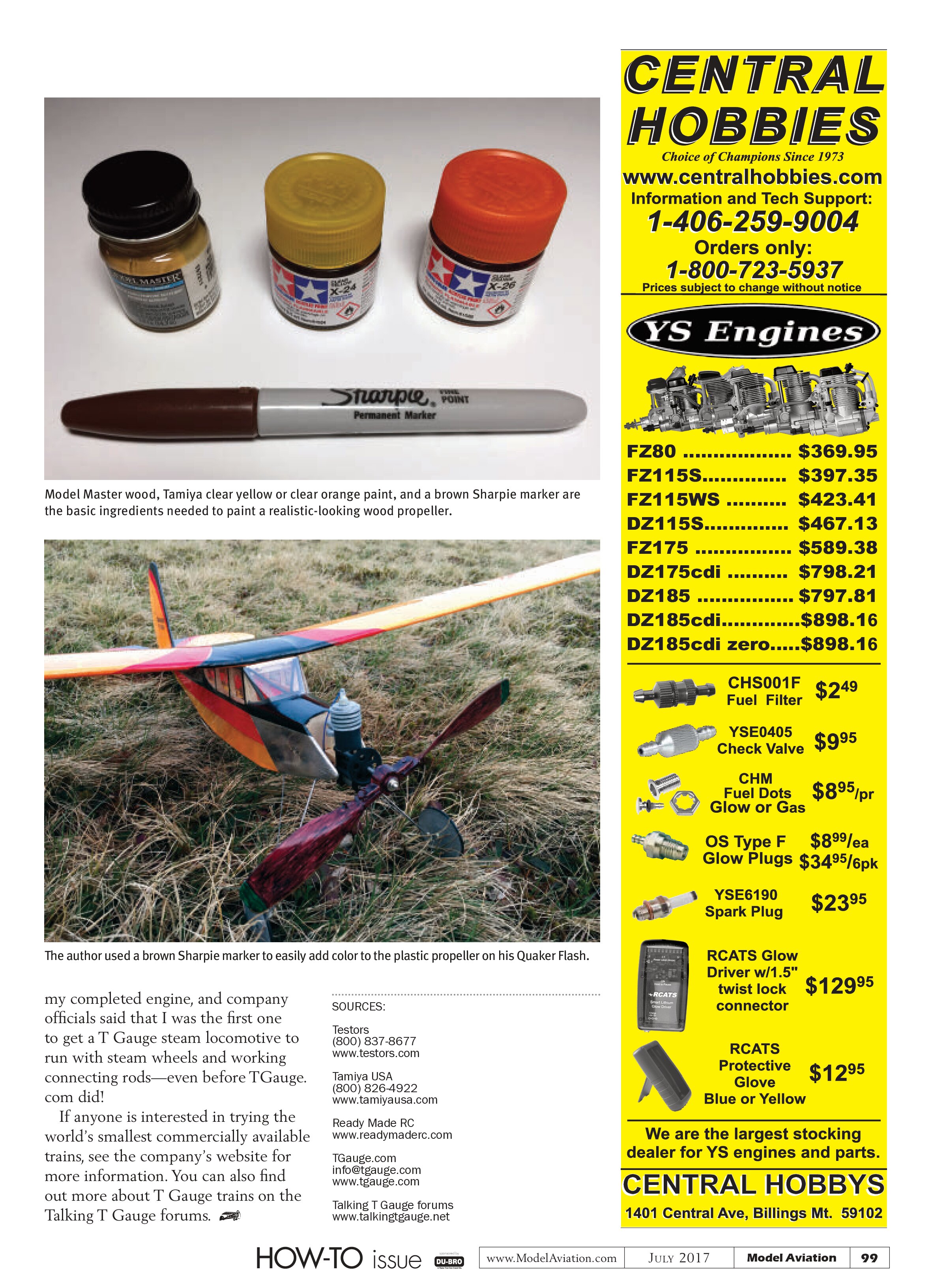
He first trims a propeller to match the subject, then lightly sands the propeller and brushes on a flat white coat of Americana acrylic white paint. Pete paints the propeller with Testors Model Master Wood Acrylic Paint #4673.
To add the dark wood color, he uses a brown Sharpie marker and sprays on a coat of Tamiya clear yellow X-24 for a light wood color, or Tamiya clear orange X-26 for a darker wood color. The result is a realistic-looking wood propeller!
What’s New?
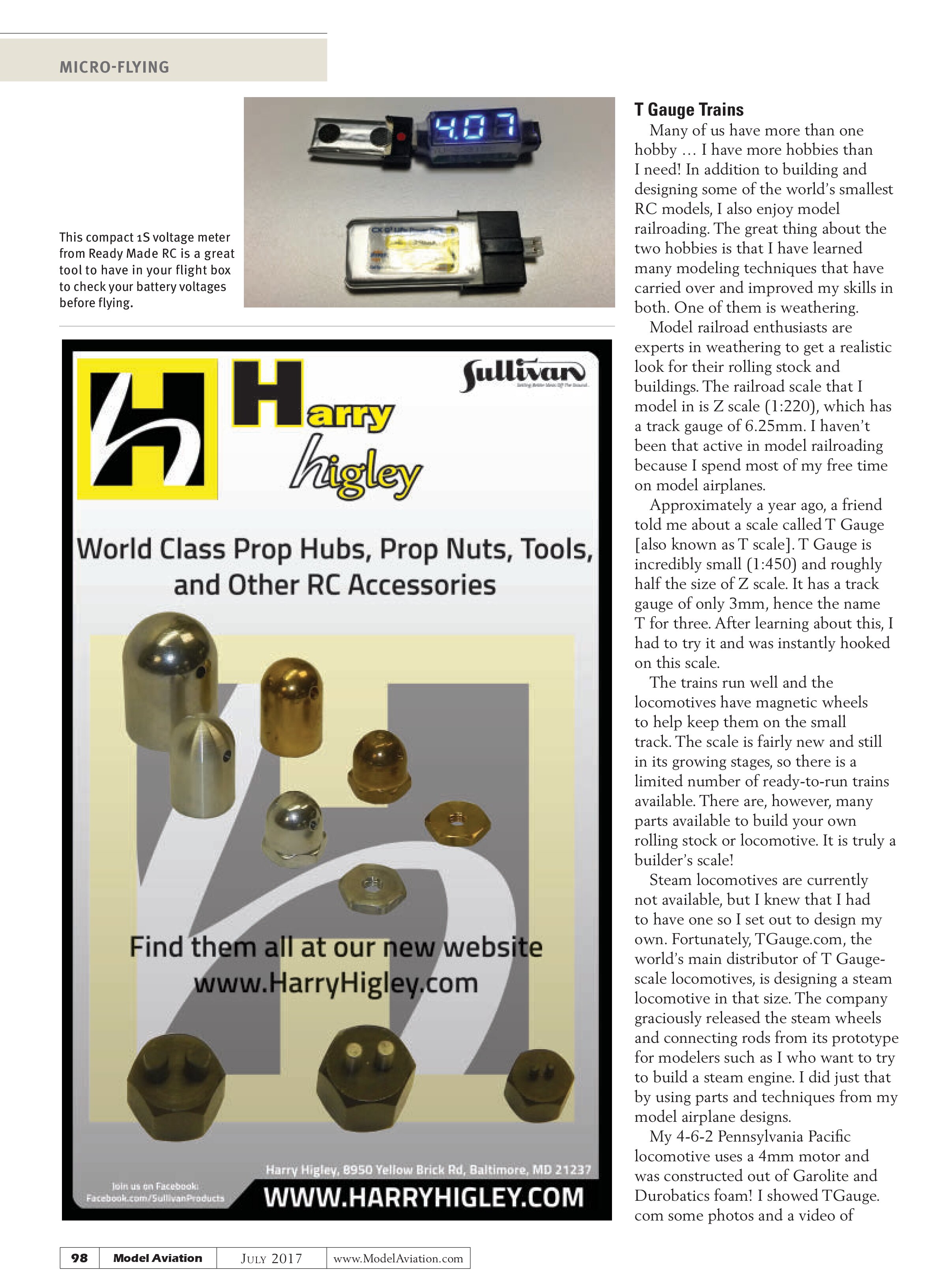
I purchased the new compact 1S voltage meter from Ready Made RC. It features a bright blue LCD display and allows you to quickly check the voltage of your batteries. The unit has two of the most popular plug sizes—1.2 and 2.0—that are mounted at each end of the voltage checker. See the “Sources” for more information.


T Gauge Trains
Many of us have more than one hobby ... I have more hobbies than I need! In addition to building and designing some of the world’s smallest RC models, I also enjoy model railroading. The great thing about the two hobbies is that I have learned many modeling techniques that have carried over and improved my skills in both. One of them is weathering.
Model railroad enthusiasts are experts in weathering to get a realistic look for their rolling stock and buildings. The railroad scale that I model in is Z scale (1:220), which has a track gauge of 6.25mm. I haven’t been that active in model railroading because I spend most of my free time on model airplanes.
Approximately a year ago, a friend told me about a scale called T Gauge [also known as T scale]. T Gauge is incredibly small (1:450) and roughly half the size of Z scale. It has a track gauge of only 3mm, hence the name T for three. After learning about this, I had to try it and was instantly hooked on this scale.
The trains run well and the locomotives have magnetic wheels to help keep them on the small track. The scale is fairly new and still in its growing stages, so there is a limited number of ready-to-run trains available. There are, however, many parts available to build your own rolling stock or locomotive. It is truly a builder’s scale!
Steam locomotives are currently not available, but I knew that I had to have one so I set out to design my own. Fortunately, TGauge.com, the world’s main distributor of T Gauge-scale locomotives, is designing a steam locomotive in that size. The company graciously released the steam wheels and connecting rods from its prototype for modelers such as I who want to try to build a steam engine. I did just that by using parts and techniques from my model airplane designs.
My 4-6-2 Pennsylvania Pacific locomotive uses a 4mm motor and was constructed out of Garolite and Durobatics foam! I showed TGauge.com some photos and a video of my completed engine, and company officials said that I was the first one to get a T Gauge steam locomotive to run with steam wheels and working connecting rods—even before TGauge.com did!
If anyone is interested in trying the world’s smallest commercially available trains, see the company’s website for more information. You can also find out more about T Gauge trains on the Talking T Gauge forums.


SOURCES:
Testors
(800) 837-8677
www.testors.com
Tamiya USA
(800) 826-4922
www.tamiyausa.com
Ready Made RC
www.readymaderc.com
TGauge.com
info@tgauge.com
www.tgauge.com
Talking T Gauge forums
www.talkingtgauge.net