One-Design is three
by Gene Smith
grwhiskey@brightok.net

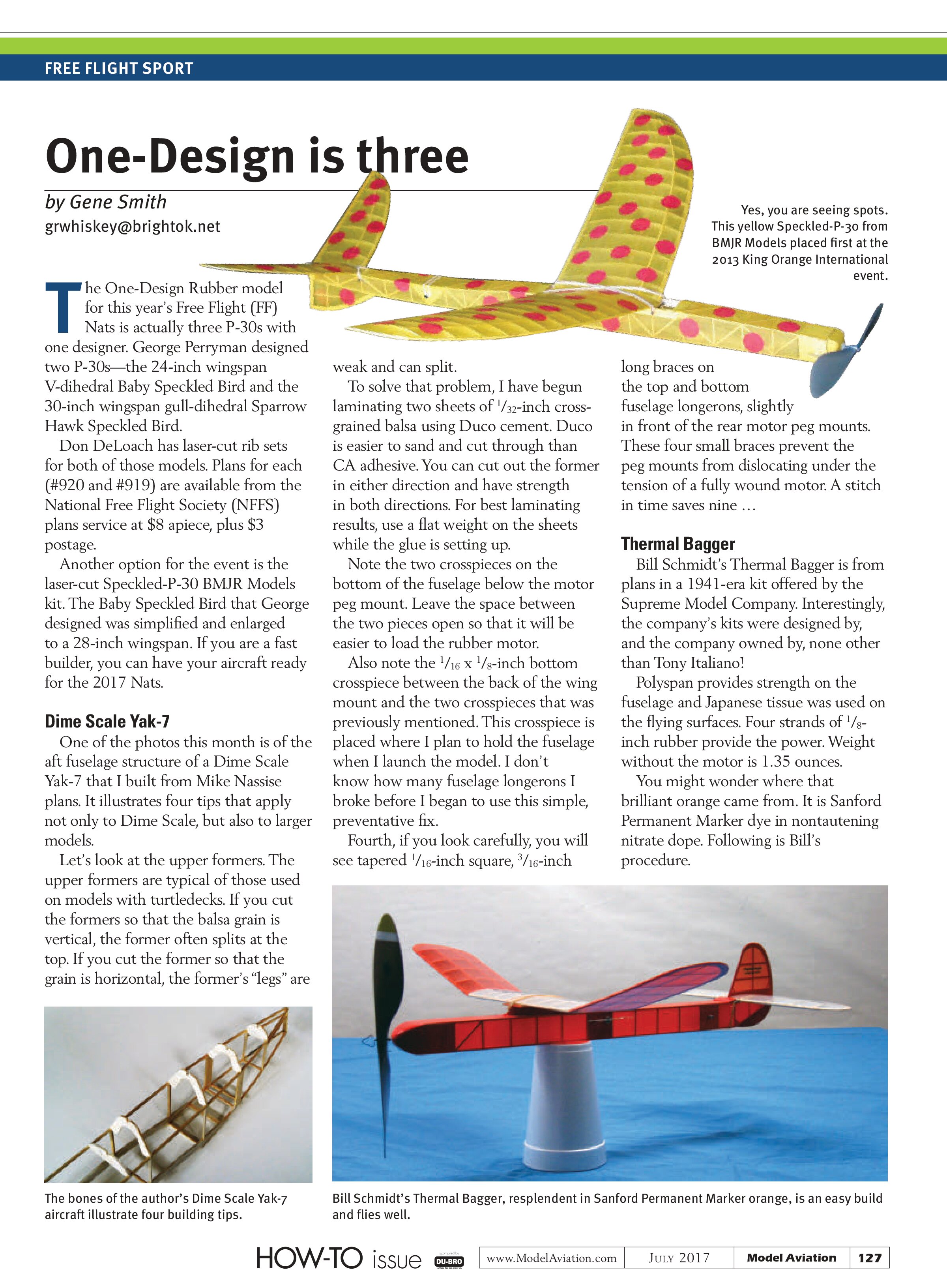
The One-Design Rubber model for this year’s Free Flight (FF) Nats is actually three P-30s with one designer. George Perryman designed two P-30s—the 24-inch wingspan V-dihedral Baby Speckled Bird and the 30-inch wingspan gull-dihedral Sparrow Hawk Speckled Bird.
Don DeLoach has laser-cut rib sets for both of those models. Plans for each (#920 and #919) are available from the National Free Flight Society (NFFS) plans service at $8 apiece, plus $3 postage.
Another option for the event is the laser-cut Speckled-P-30 BMJR Models kit. The Baby Speckled Bird that George designed was simplified and enlarged to a 28-inch wingspan. If you are a fast builder, you can have your aircraft ready for the 2017 Nats.
Dime Scale Yak-7
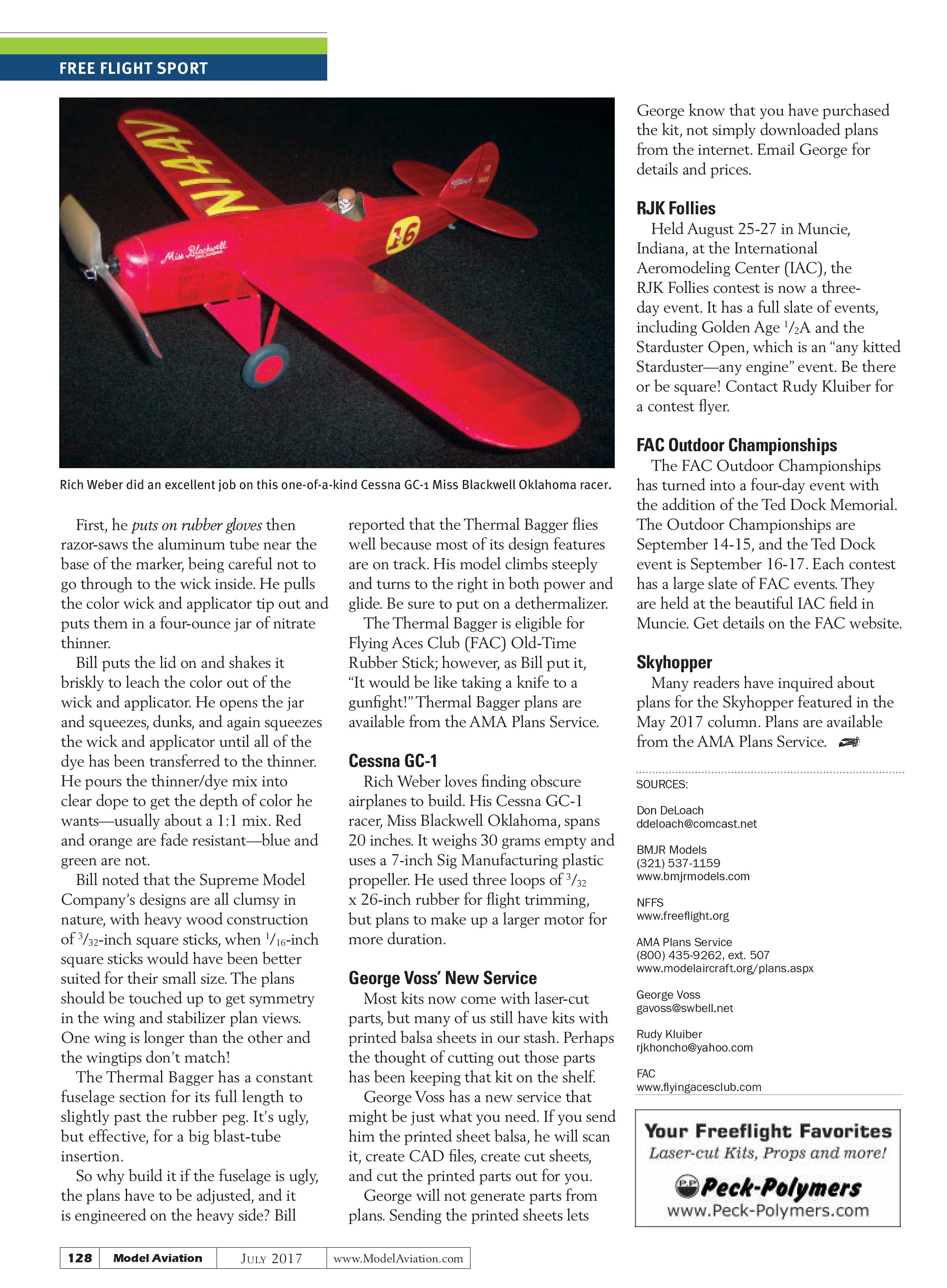
One of the photos this month is of the aft fuselage structure of a Dime Scale Yak-7 that I built from Mike Nassise plans. It illustrates four tips that apply not only to Dime Scale, but also to larger models.
Let’s look at the upper formers. The upper formers are typical of those used on models with turtledecks. If you cut the formers so that the balsa grain is vertical, the former often splits at the top. If you cut the former so that the grain is horizontal, the former’s “legs” are weak and can split.
To solve that problem, I have begun laminating two sheets of 1/32-inch cross-grained balsa using Duco cement. Duco is easier to sand and cut through than CA adhesive. You can cut out the former in either direction and have strength in both directions. For best laminating results, use a flat weight on the sheets while the glue is setting up.
Note the two crosspieces on the bottom of the fuselage below the motor peg mount. Leave the space between the two pieces open so that it will be easier to load the rubber motor.
Also note the 1/16 x 1/8-inch bottom crosspiece between the back of the wing mount and the two crosspieces that was previously mentioned. This crosspiece is placed where I plan to hold the fuselage when I launch the model. I don’t know how many fuselage longerons I broke before I began to use this simple, preventative fix.
Fourth, if you look carefully, you will see tapered 1/16-inch square, 3/16-inch long braces on the top and bottom fuselage longerons, slightly in front of the rear motor peg mounts. These four small braces prevent the peg mounts from dislocating under the tension of a fully wound motor. A stitch in time saves nine …
Thermal Bagger
Bill Schmidt’s Thermal Bagger is from plans in a 1941-era kit offered by the Supreme Model Company. Interestingly, the company’s kits were designed by, and the company owned by, none other than Tony Italiano!
Polyspan provides strength on the fuselage and Japanese tissue was used on the flying surfaces. Four strands of 1/8-inch rubber provide the power. Weight without the motor is 1.35 ounces.
You might wonder where that brilliant orange came from. It is Sanford Permanent Marker dye in nontautening nitrate dope. Following is Bill’s procedure.


First, he puts on rubber gloves then razor-saws the aluminum tube near the base of the marker, being careful not to go through to the wick inside. He pulls the color wick and applicator tip out and puts them in a four-ounce jar of nitrate thinner.
Bill puts the lid on and shakes it briskly to leach the color out of the wick and applicator. He opens the jar and squeezes, dunks, and again squeezes the wick and applicator until all of the dye has been transferred to the thinner. He pours the thinner/dye mix into clear dope to get the depth of color he wants—usually about a 1:1 mix. Red and orange are fade resistant—blue and green are not.
Bill noted that the Supreme Model Company’s designs are all clumsy in nature, with heavy wood construction of 3/32-inch square sticks, when 1/16-inch square sticks would have been better suited for their small size. The plans should be touched up to get symmetry in the wing and stabilizer plan views. One wing is longer than the other and the wingtips don’t match!
The Thermal Bagger has a constant fuselage section for its full length to slightly past the rubber peg. It’s ugly, but effective, for a big blast-tube insertion.
So why build it if the fuselage is ugly, the plans have to be adjusted, and it is engineered on the heavy side? Bill reported that the Thermal Bagger flies well because most of its design features are on track. His model climbs steeply and turns to the right in both power and glide. Be sure to put on a dethermalizer.
The Thermal Bagger is eligible for Flying Aces Club (FAC) Old-Time Rubber Stick; however, as Bill put it, “It would be like taking a knife to a gunfight!” Thermal Bagger plans are available from the AMA Plans Service.
Cessna GC-1
Rich Weber loves finding obscure airplanes to build. His Cessna GC-1 racer, Miss Blackwell Oklahoma, spans 20 inches. It weighs 30 grams empty and uses a 7-inch Sig Manufacturing plastic propeller. He used three loops of 3/32 x 26-inch rubber for flight trimming, but plans to make up a larger motor for more duration.
George Voss’ New Service
Most kits now come with laser-cut parts, but many of us still have kits with printed balsa sheets in our stash. Perhaps the thought of cutting out those parts has been keeping that kit on the shelf.
George Voss has a new service that might be just what you need. If you send him the printed sheet balsa, he will scan it, create CAD files, create cut sheets, and cut the printed parts out for you. George will not generate parts from plans. Sending the printed sheets lets George know that you have purchased the kit, not simply downloaded plans from the internet. Email George for details and prices.
RJK Follies
Held August 25-27 in Muncie, Indiana, at the International Aeromodeling Center (IAC), the RJK Follies contest is now a three-day event. It has a full slate of events, including Golden Age 1/2A and the Starduster Open, which is an “any kitted Starduster—any engine” event. Be there or be square! Contact Rudy Kluiber for a contest flyer.
FAC Outdoor Championships
The FAC Outdoor Championships has turned into a four-day event with the addition of the Ted Dock Memorial. The Outdoor Championships are September 14-15, and the Ted Dock event is September 16-17. Each contest has a large slate of FAC events. They are held at the beautiful IAC field in Muncie. Get details on the FAC website.
Skyhopper
Many readers have inquired about plans for the Skyhopper featured in the May 2017 column. Plans are available from the AMA Plans Service.
SOURCES:
Don DeLoach
ddeloach@comcast.net
BMJR Models
(321) 537-1159
www.bjm rmodels.com
AMA Plans Service
(800) 435-9262, ext. 507
www.modelaircraft.org/plans.aspx
George Voss
gavoss@swbell.net
Rudy Kluiber
rjkhoncho@yahoo.com