Focal Point
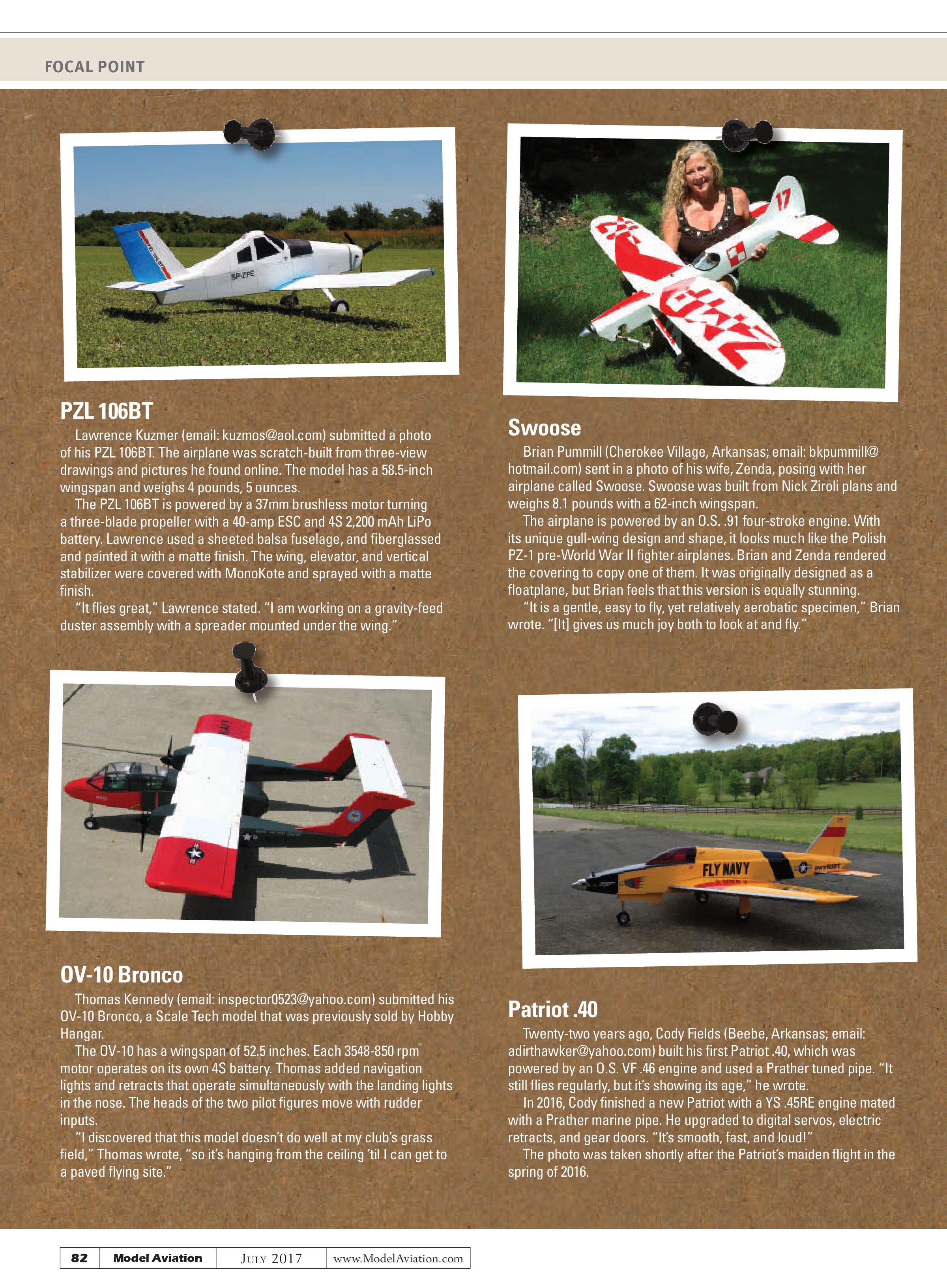
PZL 106BT

Lawrence Kuzmer (email: kuzmos@aol.com) submitted a photo of his PZL 106BT. The airplane was scratch-built from three-view drawings and pictures he found online. The model has a 58.5-inch wingspan and weighs 4 pounds, 5 ounces.
The PZL 106BT is powered by a 37mm brushless motor turning a three-blade propeller with a 40-amp ESC and 4S 2,200 mAh LiPo battery. Lawrence used a sheeted balsa fuselage, fiberglassed and painted it with a matte finish. The wing, elevator, and vertical stabilizer were covered with MonoKote and sprayed with a matte finish.
“It flies great,” Lawrence stated. “I am working on a gravity-feed duster assembly with a spreader mounted under the wing.”
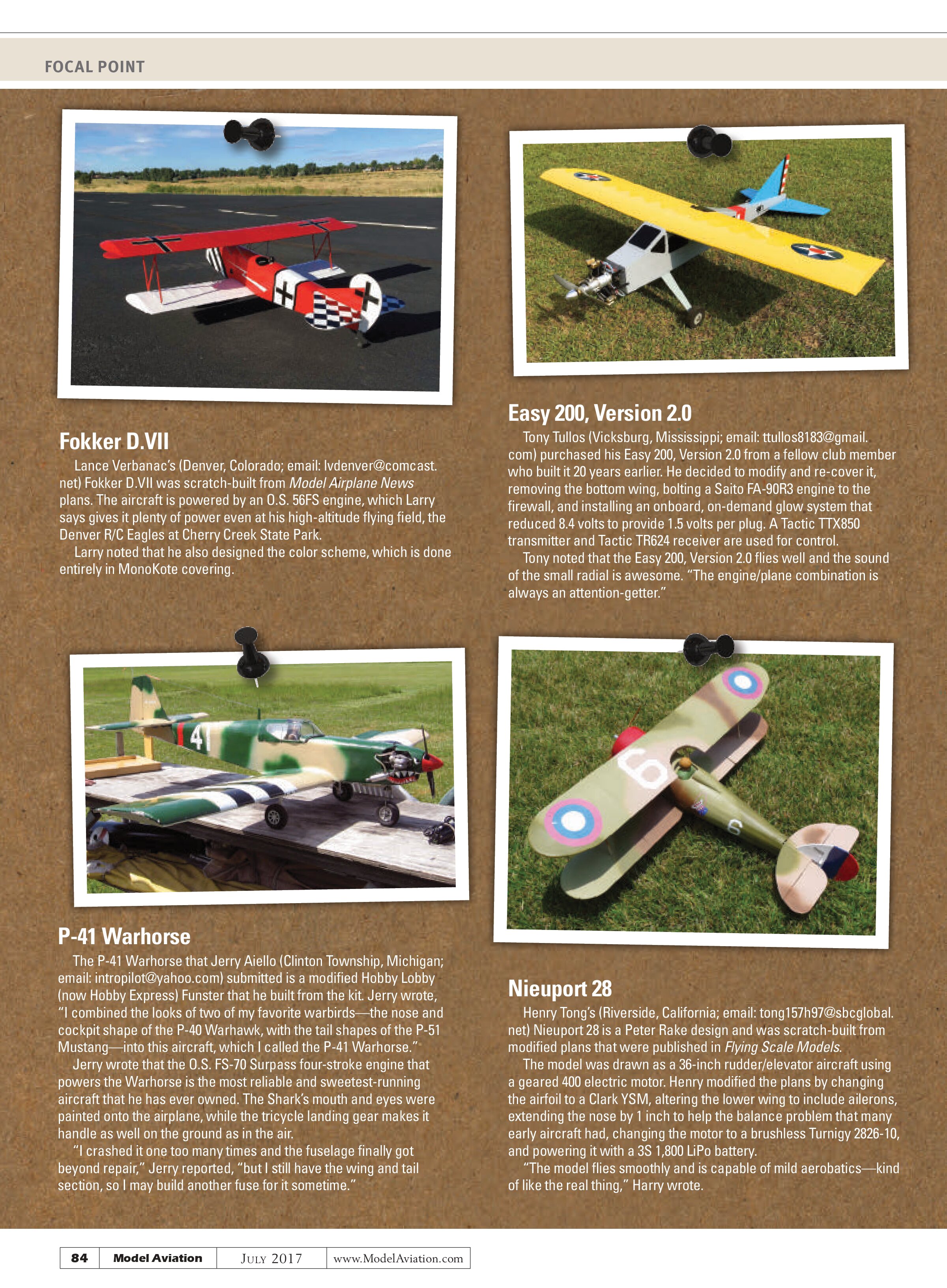
OV-10 Bronco

Thomas Kennedy (email: inspector0523@yahoo.com) submitted his OV-10 Bronco, a Scale Tech model that was previously sold by Hobby Hangar.
The OV-10 has a wingspan of 52.5 inches. Each 3548-850 rpm motor operates on its own 4S battery. Thomas added navigation lights and retracts that operate simultaneously with the landing lights in the nose. The heads of the two pilot figures move with rudder inputs.
“I discovered that this model doesn’t do well at my club’s grass field,” Thomas wrote, “so it’s hanging from the ceiling ’til I can get to a paved flying site.”
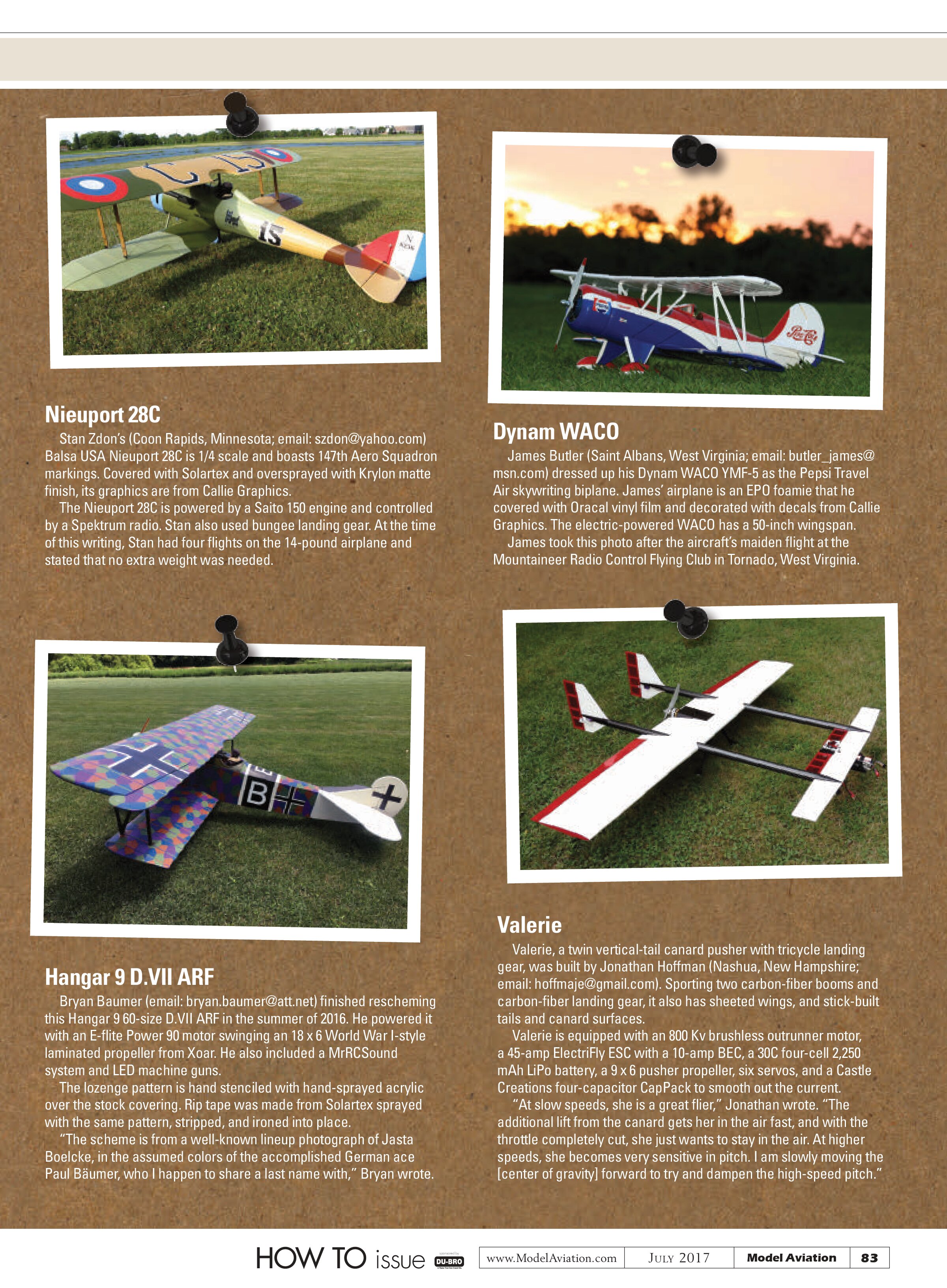
Swoose

Brian Pummill (Cherokee Village, Arkansas; email: bkpummill@hotmail.com) sent in a photo of his wife, Zenda, posing with her airplane called Swoose. Swoose was built from Nick Ziroli plans and weighs 8.1 pounds with a 62-inch wingspan.
The airplane is powered by an O.S. .91 four-stroke engine. With its unique gull-wing design and shape, it looks much like the Polish PZ-1 pre-World War II fighter airplanes. Brian and Zenda rendered the covering to copy one of them. It was originally designed as a floatplane, but Brian feels that this version is equally stunning.
“It is a gentle, easy to fly, yet relatively aerobatic specimen,” Brian wrote. “[It] gives us much joy both to look at and fly.”
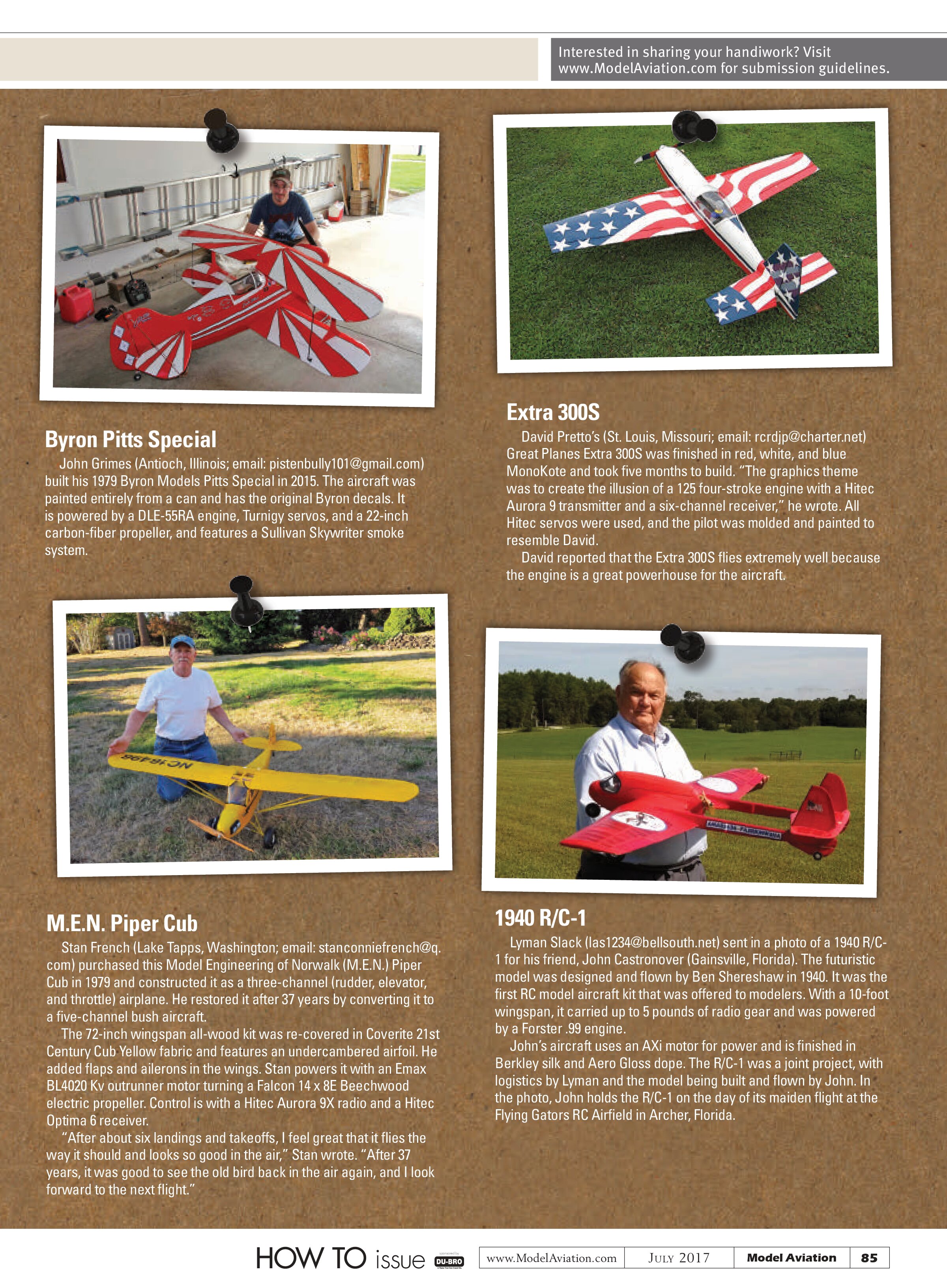
Patriot .40

Twenty-two years ago, Cody Fields (Beebe, Arkansas; email: adirthawker@yahoo.com) built his first Patriot .40, which was powered by an O.S. VF .46 engine and used a Prather tuned pipe. “It still flies regularly, but it’s showing its age,” he wrote.
In 2016, Cody finished a new Patriot with a YS .45RE engine mated with a Prather marine pipe. He upgraded to digital servos, electric retracts, and gear doors. “It’s smooth, fast, and loud!”
The photo was taken shortly after the Patriot’s maiden flight in the spring of 2016.
Nieuport 28C

Stan Zdon’s (Coon Rapids, Minnesota; email: szdon@yahoo.com) Balsa USA Nieuport 28C is 1/4 scale and boasts 147th Aero Squadron markings. Covered with Solartex and oversprayed with Krylon matte finish, its graphics are from Callie Graphics.
The Nieuport 28C is powered by a Saito 150 engine and controlled by a Spektrum radio. Stan also used bungee landing gear. At the time of this writing, Stan had four flights on the 14-pound airplane and stated that no extra weight was needed.
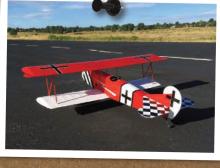
Hangar 9 D.VII ARF

Bryan Baumer (email: bryan.baumer@att.net) finished rescheming this Hangar 9 60-size D.VII ARF in the summer of 2016. He powered it with an E-flite Power 90 motor swinging an 18 x 6 World War I-style laminated propeller from Xoar. He also included a MrRCSound system and LED machine guns.
The lozenge pattern is hand stenciled with hand-sprayed acrylic over the stock covering. Rip tape was made from Solartex sprayed with the same pattern, stripped, and ironed into place.
“The scheme is from a well-known lineup photograph of Jasta Boelcke, in the assumed colors of the accomplished German ace Paul Bäumer, who I happen to share a last name with,” Bryan wrote.
Dynam WACO

James Butler (Saint Albans, West Virginia; email: butler_james@msn.com) dressed up his Dynam WACO YMF-5 as the Pepsi Travel Air skywriting biplane. James’ airplane is an EPO foamie that he covered with Oracal vinyl film and decorated with decals from Callie Graphics. The electric-powered WACO has a 50-inch wingspan.
James took this photo after the aircraft’s maiden flight at the Mountaineer Radio Control Flying Club in Tornado, West Virginia.
Valerie

Valerie, a twin vertical-tail canard pusher with tricycle landing gear, was built by Jonathan Hoffman (Nashua, New Hampshire; email: hoffmaje@gmail.com). Sporting two carbon-fiber booms and carbon-fiber landing gear, it also has sheeted wings, and stick-built tails and canard surfaces.
Valerie is equipped with an 800 Kv brushless outrunner motor, a 45-amp ElectriFly ESC with a 10-amp BEC, a 30C four-cell 2,250 mAh LiPo battery, a 9 x 6 pusher propeller, six servos, and a Castle Creations four-capacitor CapPack to smooth out the current.
“At slow speeds, she is a great flier,” Jonathan wrote. “The additional lift from the canard gets her in the air fast, and with the throttle completely cut, she just wants to stay in the air. At higher speeds, she becomes very sensitive in pitch. I am slowly moving the [center of gravity] forward to try and dampen the high-speed pitch.”
Fokker D.VII
Lance Verbanac’s (Denver, Colorado; email: lvdenver@comcast.net) Fokker D.VII was scratch-built from Model Airplane News plans. The aircraft is powered by an O.S. 56FS engine, which Larry says gives it plenty of power even at his high-altitude flying field, the Denver R/C Eagles at Cherry Creek State Park.
Larry noted that he also designed the color scheme, which is done entirely in MonoKote covering.

P-41 Warhorse
The P-41 Warhorse that Jerry Aiello (Clinton Township, Michigan; email: intropilot@yahoo.com) submitted is a modified Hobby Lobby (now Hobby Express) Funster that he built from the kit. Jerry wrote, “I combined the looks of two of my favorite warbirds—the nose and cockpit shape of the P-40 Warhawk, with the tail shapes of the P-51 Mustang—into this aircraft, which I called the P-41 Warhorse.”
Jerry wrote that the O.S. FS-70 Surpass four-stroke engine that powers the Warhorse is the most reliable and sweetest-running aircraft that he has ever owned. The Shark’s mouth and eyes were painted onto the airplane, while the tricycle landing gear makes it handle as well on the ground as in the air.
“I crashed it one too many times and the fuselage finally got beyond repair,” Jerry reported, “but I still have the wing and tail section, so I may build another fuse for it sometime.”

Easy 200, Version 2.0
Tony Tullos (Vicksburg, Mississippi; email: tullos8183@gmail.com) purchased his Easy 200, Version 2.0 from a fellow club member who built it 20 years earlier. He decided to modify and re-cover it, removing the bottom wing, bolting a Saito FA-90R3 engine to the firewall, and installing an onboard, on-demand glow system that reduced 8.4 volts to provide 1.5 volts per plug. A Tactic TTX850 transmitter and Tactic TR624 receiver are used for control.
Tony noted that the Easy 200, Version 2.0 flies well and the sound of the small radial is awesome. “The engine/plane combination is always an attention-getter.”

Nieuport 28
Henry Tong’s (Riverside, California; email: tong157h97@sbcglobal.net) Nieuport 28 is a Peter Rake design and was scratch-built from modified plans that were published in Flying Scale Models.
The model was drawn as a 36-inch rudder/elevator aircraft using a geared 400 electric motor. Henry modified the plans by changing the airfoil to a Clark YSM, altering the lower wing to include ailerons, extending the nose by 1 inch to help the balance problem that many early aircraft had, changing the motor to a brushless Turnigy 2826-10, and powering it with a 3S 1,800 LiPo battery.
“The model flies smoothly and is capable of mild aerobatics—kind of like the real thing,” Harry wrote.

Byron Pitts Special
John Grimes (Antioch, Illinois; email: pistenbully101@gmail.com) built his 1979 Byron Models Pitts Special in 2015. The aircraft was painted entirely from a can and has the original Byron decals. It is powered by a DLE-55RA engine, Turnigy servos, and a 22-inch carbon-fiber propeller, and features a Sullivan Skywriter smoke system.

M.E.N. Piper Cub
Stan French (Lake Tapps, Washington; email: stanconniefrench@q.com) purchased this Model Engineering of Norwalk (M.E.N.) Piper Cub in 1979 and constructed it as a three-channel (rudder, elevator, and throttle) airplane. He restored it after 37 years by converting it to a five-channel bush aircraft.
The 72-inch wingspan all-wood kit was re-covered in Coverite 21st Century Cub Yellow fabric and features an undercambered airfoil. He added flaps and ailerons in the wings. Stan powers it with an Emax BL4020 Kv outrunner motor turning a Falcon 14 x 8E Beechwood electric propeller. Control is with a Hitec Aurora 9X radio and a Hitec Optim 6 receiver.
“After about six landings and takeoffs, I feel great that it flies the way it should and looks so good in the air,” Stan wrote. “After 37 years, it was good to see the old bird back in the air again, and I look forward to the next flight.”

Extra 300S
David Pretto’s (St. Louis, Missouri; email: rcrdjp@charter.net) Great Planes Extra 300S was finished in red, white, and blue MonoKote and took five months to build. “The graphics theme was to create the illusion of a 125 four-stroke engine with a Hitec Aurora 9 transmitter and a six-channel receiver,” he wrote. All Hitec servos were used, and the pilot was molded and painted to resemble David.
David reported that the Extra 300S flies extremely well because the engine is a great powerhouse for the aircraft.

1940 R/C-1
Lyman Slack (las1234@bellsouth.net) sent in a photo of a 1940 R/C-1 for his friend, John Castronover (Gainsville, Florida). The futuristic model was designed and flown by Ben Shereshaw in 1940. It was the first RC model aircraft kit that was offered to modelers. With a 10-foot wingspan, it carried up to 5 pounds of radio gear and was powered by a Forster .99 engine.
John’s aircraft uses an AXi motor for power and is finished in Berkley silk and Aero Gloss dope. The R/C-1 was a joint project, with logistics by Lyman and the model being built and flown by John. In the photo, John holds the R/C-1 on the day of its maiden flight at the Flying Gators RC Airfield in Archer, Florida.

1911 Avro
Patrick Welsch (Plano Illinois; email: rcdusterspat@yahoo.com) felt the need to scratch build something for the first time after 30 years of flying RC. His 1911 Avro biplane is a sport scale aircraft with a 60-inch wingspan that weighs 4.6 pounds. It is powered by a Magnum four-stroke .52 engine and is covered with Hangar 9 covering that Patrick sprayed with clear matte paint. He noted that the wing warping only made the airplane yaw, so he added ailerons. “I have had lots of compliments on how great it looks in the air,” he wrote.
The R/C Dusters’ flying field in Sandwich, Illinois, was the backdrop for the Avro’s maiden flight.

Unusual Electric Airplane
Bill Leppek’s (email: western1004@gmail.com) aircraft is something unusual. Homebuilt and designed as a 36-wingspan electric model, it initially flew with a three-cell LiPo battery and a 600-watt motor with a 10 x 7 APC electric propeller. When a ducted-fan unit from a long-retired Warthog became available, Bill grafted it into the fuselage, and the first two-motor propeller/ducted-fan airplane was born.
The airplane had to be rebalanced, according to Bill, but now it flies great and is very fast and lands like a trainer. “The sound is unlike anything heard before in the RC community,” he wrote. Control is via a Futaba 2.4 GHz FASST system.

Snafuey II
The Snafuey II, built by Paul Lindewall (Boiling Springs, South Carolina; email: plindewall@outlook.com) is a 48-inch wingspan model weighing 3 pounds ready to fly. Power is via an Emax BL2815/09 brushless motor swinging a Graupner 10 x 5 propeller. The Snafuey II is covered with UltraCote, with custom graphics courtesy of Paul’s wife and her crafting machine skills.
Paul noted, “The Snafuey II represents my first attempt at an aircraft of my own design. Plans were drawn in CAD, and all major parts were sent out to be laser cut. It features a wing mount that allows different airfoils to be fitted to the same fuselage. A build thread can be found on RCGroups at www.rcgroups.com/forums/showthread.php?t=2421573.”

SPAD XIII
Paul Richardson (Annandale, Virginia; email: pavlsvmax@gmail.com) submitted a photo of his Great Planes Electrifly SPAD XIII. “I stripped and re-covered the Great Planes Electrifly SPAD to wear Capt. Reed Chambers’ colors of the famous Hat in the Ring squadron. Of course, I had to make sure Capt. Chambers had the proper headgear,” he wrote.
Paul mentioned that the airplane cruises like a trainer, but dogfights like a true predator. He dogfights with his brother’s S.E.5 every chance he gets.
The photo was taken on the 18th green of the Bryce Country Club in Basye, Virginia.

Utter Kaos

Mark Poulin’s (Auburn, Maine; email: haljohn2814@gmail.com) Utter Kaos was built from a kit by his father, “Shorty” Poulin. The 60-size Pattern aircraft sports an O.S. Max .60. “It maneuvers well and lands like a dream, settling in very nicely when power is cut,” he wrote.
The photo was taken at the Kennebec Valley Model Association field in Sydney, Maine,
before the first flight. A Ziroli Saulnier Mark built in 2000 is also visible in this photo.
Dopple Stik

Brian Kelly (Issaquah, Washington; email: bkfishon@live.com) scratch-built his own design of the Dopple Stik. Powered by two Turnigy G-60 500 Kv motors swinging 16 x 12 propellers and using a Futaba 14SG with eight Hitec 645 servos, the Dopple Stik spans 6 feet and weighs approximately 15.5 pounds with two 5,000 mAh six-cell LiPo batteries.
“She flies beautifully and very fast!” Brian wrote. “When the flaps drop, both rudders kick out as airbrakes—[there is] lots of creative radio mixing. [It] looks similar to a P-38 in flight—sounds really cool in flight!”
Brian’s granddaughter, Taylor, is shown at the Marymoor R/C Club field at Marymoor Park in Redmond, Washington.
SweePee

William Landis (York, Pennsylvania; email: 01flyingbill@comcast.net) became interested in the SweePee in August 1989 after it appeared in Model Aviation magazine. He purchased the plans from AMA. Slightly more than two years ago, William had a company in Texas produce the ribs and the fuselage. The plans called for this airplane to be glow powered, but he converted it to electric. His wife chose the colors and he boasted that “they look excellent in the air!” The electric motor is a BP Hobbies 3520-6; the battery is a five-cell 4,000 mAh LiPo.
“I finished it in June of 2015 and can now fly it. I probably have about 15 flights on it so far. It flies great!” he wrote. William and SweePee are shown at the York Area Radio Control Club field in York, Pennsylvania.
U-Can-Do

Ken Shockey (Sarasota, Florida; email: shockman@cocast.net) did not have the rest of his U-Can-Do aircraft, so he decided to make a flying wing, which turned out great and was lighter than the original airplane. He noted, “It flies straight hands off and is easy to control. I just had to move the center of gravity up farther on the wing [because] it is from a .40-size plane, and I am using an O.S. .46 two-stroke [engine] to power it.”
The photo was taken at the Sarasota R.C. Squadron flying field in Florida. The club has approximately 300 members who fly electric, glow, gas, and turbines on a 100 x 500-foot runway.