District XI—Alaska, Idaho, Montana, Oregon, Washington

Chuck Bower
Vice President
cbower@whidbey.com
6075 S. Coles Rd., Langley WA 98260
Tel.: (360) 632-9211; www.amadistrict-xi.org
I have heard reports of brutal winter weather around our district for flying model airplanes this year, with record amounts of precipitation. I’m ready for summer! How about you? Do you have something new to fly?
It’s always good to see friends bring their projects to the field to show off and for some shaky-knee first flights. It’s also the time of year to complete field cleanup projects and add new upgrades to the field. Are your field rules up to date and posted with your emergency information?
Here is something I look forward to every spring that makes my knees rubbery. For the past dozen years, I have been one of the volunteers for the University of Washington AA410, SLN 10011 Aircraft Design Class. Eli Livne, the professor, has gathered a small team to assist the class with its design.
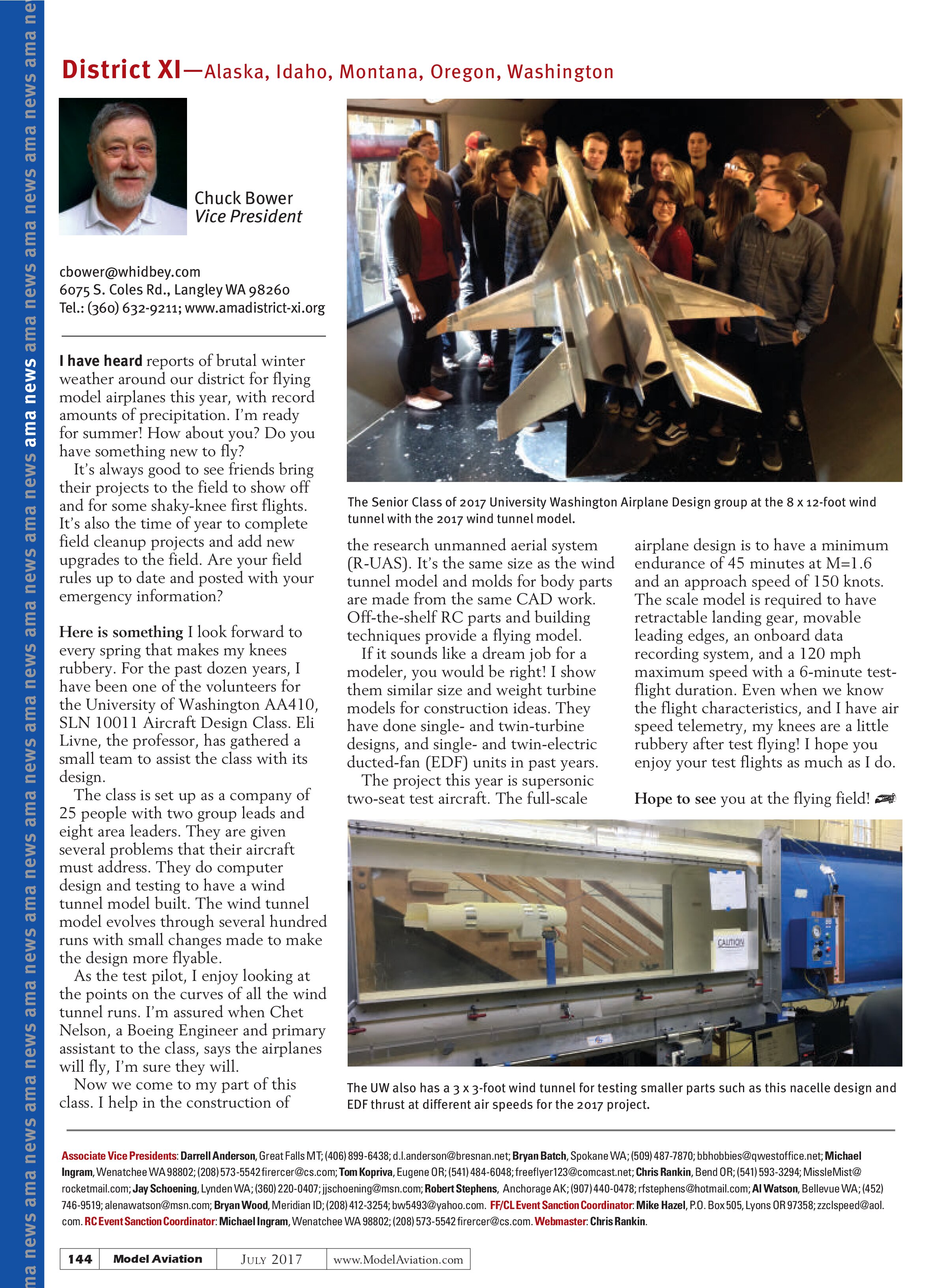
The class is set up as a company of 25 people with two group leads and eight area leaders. They are given several problems that their aircraft must address. They do computer design and testing to have a wind tunnel model built. The wind tunnel model evolves through several hundred runs with small changes made to make the design more flyable.
As the test pilot, I enjoy looking at the points on the curves of all the wind tunnel runs. I’m assured when Chet Nelson, a Boeing Engineer and primary assistant to the class, says the airplanes will fly, I’m sure they will.
Now we come to my part of this class. I help in the construction of

the research unmanned aerial system (R-UAS). It’s the same size as the wind tunnel model and molds for body parts are made from the same CAD work. Off-the-shelf RC parts and building techniques provide a flying model.
If it sounds like a dream job for a modeler, you would be right! I show them similar size and weight turbine models for construction ideas. They have done single- and twin-turbine designs, and single- and twin-electric ducted-fan (EDF) units in past years.
The project this year is supersonic two-seat test aircraft. The full-scale airplane design is to have a minimum endurance of 45 minutes at M=1.6 and an approach speed of 150 knots. The scale model is required to have retractable landing gear, movable leading edges, an onboard data recording system, and a 120 mph maximum speed with a 6-minute test-flight duration. Even when we know the flight characteristics, and I have air speed telemetry, my knees are a little rubbery after test flying! I hope you enjoy your test flights as much as I do.
Hope to see you at the flying field!

Associate Vice Presidents: Darrell Anderson, Great Falls MT; (406) 899-6438; d.l.anderson@bresnan.net; Bryan Batch, Spokane WA; (509) 487-7870; bhobbies@qwestoffice.net; Michael Ingram, Wenatchee WA 98802; (208) 573-5542 firercer@cs.com; Tom Kopriva, Eugene OR; (541) 484-6048; freeflyer123@comcast.net; Chris Rankin, Bend OR; (541) 593-3294; MissleMist@rocketmail.com; Jay Schoening, Lynden WA; (360) 220-0407; jjschoening@msn.com; Robert Stephens, Anchorage AK; (907) 440-0478; rfstephens@hotmail.com; Al Watson, Bellevue WA; (452) 746-9519; alanwatson@msn.com; Bryan Wood, Meridian ID; (208) 412-3254; bw5493@yahoo.com. FF/CL Event Sanction Coordinator: Mike Hazel, P.O. Box 505, Lyons OR 97358; zzclspeed@aol.com. RC Event Sanction Coordinator: Michael Ingram, Wenatchee WA 98802; (208) 573-5542 firercer@cs.com. Webmaster: Chris Rankin.