Stretch your legs this summer

The 2017 flying season is now in full swing, with a host of AMA sanctioned events peppering the countryside every weekend. With such a bounty before us, it is unfortunate that we tend to be creatures of habit, often relying on only a few (or several) favorite events each season that we do our best not to miss.
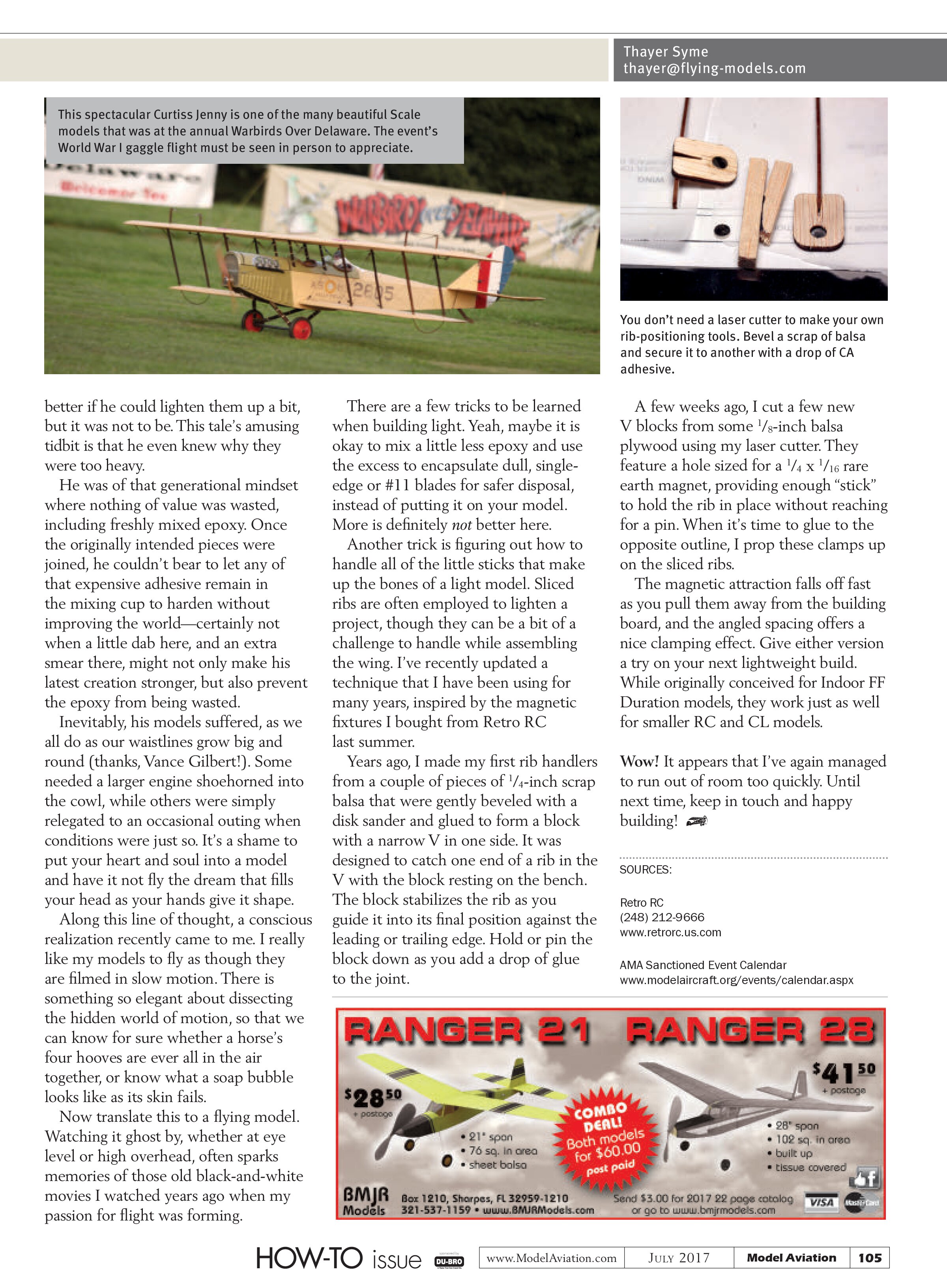
Of course, that has a lot to do with the desire to see old friends and relive enjoyable past experiences. Still, much can be said for trying a new event or discipline. Have you been tempted to try your hand at Scale competition? Or what about a good, old-fashioned fly-in? These low-pressure gatherings are designed simply to get together and spend a day or two living the dream with old friends and new.
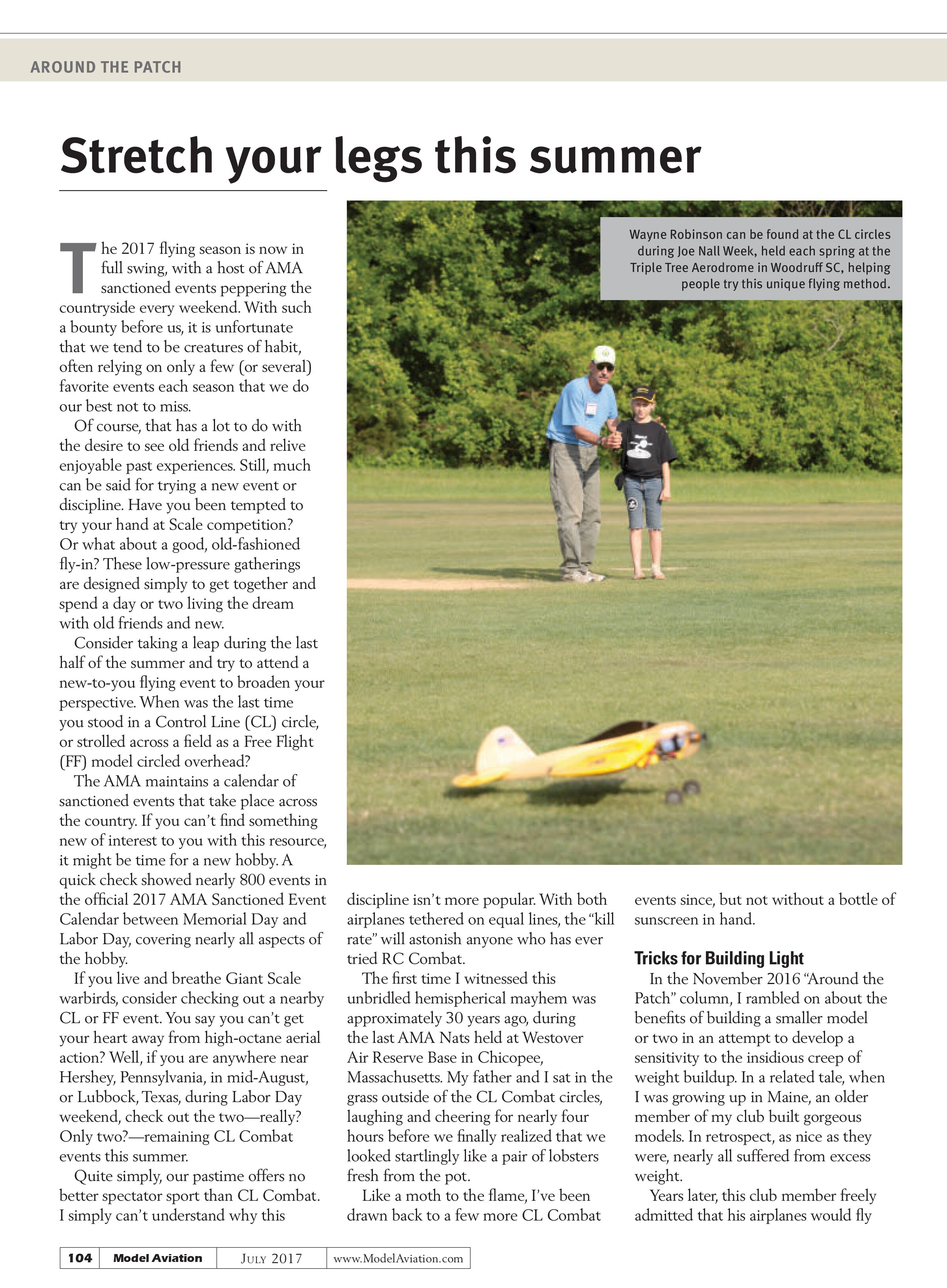
Consider taking a leap during the last half of the summer and try to attend a new-to-you flying event to broaden your perspective. When was the last time you stood in a Control Line (CL) circle, or strolled across a field as a Free Flight (FF) model circled overhead?
The AMA maintains a calendar of sanctioned events that take place across the country. If you can’t find something new of interest to you with this resource, it might be time for a new hobby. A quick check showed nearly 800 events in the official 2017 AMA Sanctioned Event Calendar between Memorial Day and Labor Day, covering nearly all aspects of the hobby.
If you live and breathe Giant Scale warbirds, consider checking out a nearby CL or FF event. You say you can’t get your heart away from high-octane aerial action? Well, if you are anywhere near Hershey, Pennsylvania, in mid-August, or Lubbock, Texas, during Labor Day weekend, check out the two—really? Only two?—remaining CL Combat events this summer.
Quite simply, our pastime offers no better spectator sport than CL Combat. I simply can’t understand why this discipline isn’t more popular. With both airplanes tethered on equal lines, the “kill rate” will astonish anyone who has ever tried RC Combat.
The first time I witnessed this unbridled hemispherical mayhem was approximately 30 years ago, during the last AMA Nats held at Westover Air Reserve Base in Chicopee, Massachusetts. My father and I sat in the grass outside of the CL Combat circles, laughing and cheering for nearly four hours before we finally realized that we looked startlingly like a pair of lobsters fresh from the pot.
Like a moth to the flame, I’ve been drawn back to a few more CL Combat events since, but not without a bottle of sunscreen in hand.
Tricks for Building Light
In the November 2016 “Around the Patch” column, I rambled on about the benefits of building a smaller model or two in an attempt to develop a sensitivity to the insidious creep of weight buildup. In a related tale, when I was growing up in Maine, an older member of my club built gorgeous models. In retrospect, as nice as they were, nearly all suffered from excess weight.
Years later, this club member freely admitted that his airplanes would fly better if he could lighten them up a bit, but it was not to be. This tale’s amusing tidbit is that he even knew why they were too heavy.
He was of that generational mindset where nothing of value was wasted, including freshly mixed epoxy. Once the originally intended pieces were joined, he couldn’t bear to let any of that expensive adhesive remain in the mixing cup to harden without improving the world—certainly not when a little dab here, and an extra smear there, might not only make his latest creation stronger, but also prevent the epoxy from being wasted.
Inevitably, his models suffered, as we all do as our waistlines grow big and round (thanks, Vance Gilbert!). Some needed a larger engine shoehorned into the cowl, while others were simply relegated to an occasional outing when conditions were just so. It’s a shame to put your heart and soul into a model and have it not fly the dream that fills your head as your hands give it shape.
Along this line of thought, a conscious realization recently came to me. I really like my models to fly as though they are filmed in slow motion. There is something so elegant about dissecting the hidden world of motion, so that we can know for sure whether a horse’s four hooves are ever all in the air together, or know what a soap bubble looks like as its skin fails.
Now translate this to a flying model. Watching it ghost by, whether at eye level or high overhead, often sparks memories of those old black-and-white movies I watched years ago when my passion for flight was forming.
There are a few tricks to be learned when building light. Yeah, maybe it is okay to mix a little less epoxy and use the excess to encapsulate dull, single-edge or #11 blades for safer disposal, instead of putting it on your model. More is definitely not better here.
Another trick is figuring out how to handle all of the little sticks that make up the bones of a light model. Sliced ribs are often employed to lighten a project, though they can be a bit of a challenge to handle while assembling the wing. I’ve recently updated a technique that I have been using for many years, inspired by the magnetic fixtures I bought from Retro RC last summer.
Years ago, I made my first rib handlers from a couple of pieces of ¼-inch scrap balsa that were gently beveled with a disk sander and glued to form a block with a narrow V in one side. It was designed to catch one end of a rib in the V with the block resting on the bench. The block stabilizes the rib as you guide it into its final position against the leading or trailing edge. Hold or pin the block down as you add a drop of glue to the joint.


A few weeks ago, I cut a few new V blocks from some ⅛-inch balsa plywood using my laser cutter. They feature a hole sized for a ¼ x ¹⁄₁₆ rare earth magnet, providing enough “stick” to hold the rib in place without reaching for a pin. When it’s time to glue to the opposite outline, I prop these clamps up on the sliced ribs.
The magnetic attraction falls off fast as you pull them away from the building board, and the angled spacing offers a nice clamping effect. Give either version a try on your next lightweight build. While originally conceived for Indoor FF Duration models, they work just as well for smaller RC and CL models.
Wow! It appears that I’ve again managed to run out of room too quickly. Until next time, keep in touch and happy building!
SOURCES:
Retro RC
(248) 212-9666
www.retrorc.us.com
AMA Sanctioned Event Calendar
www.modelaircraft.org/events/calendar.aspx