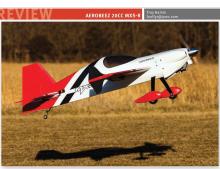
AEROBEEZ 20CC MXS-R
An economical and fun aerobat
Troy Hamm

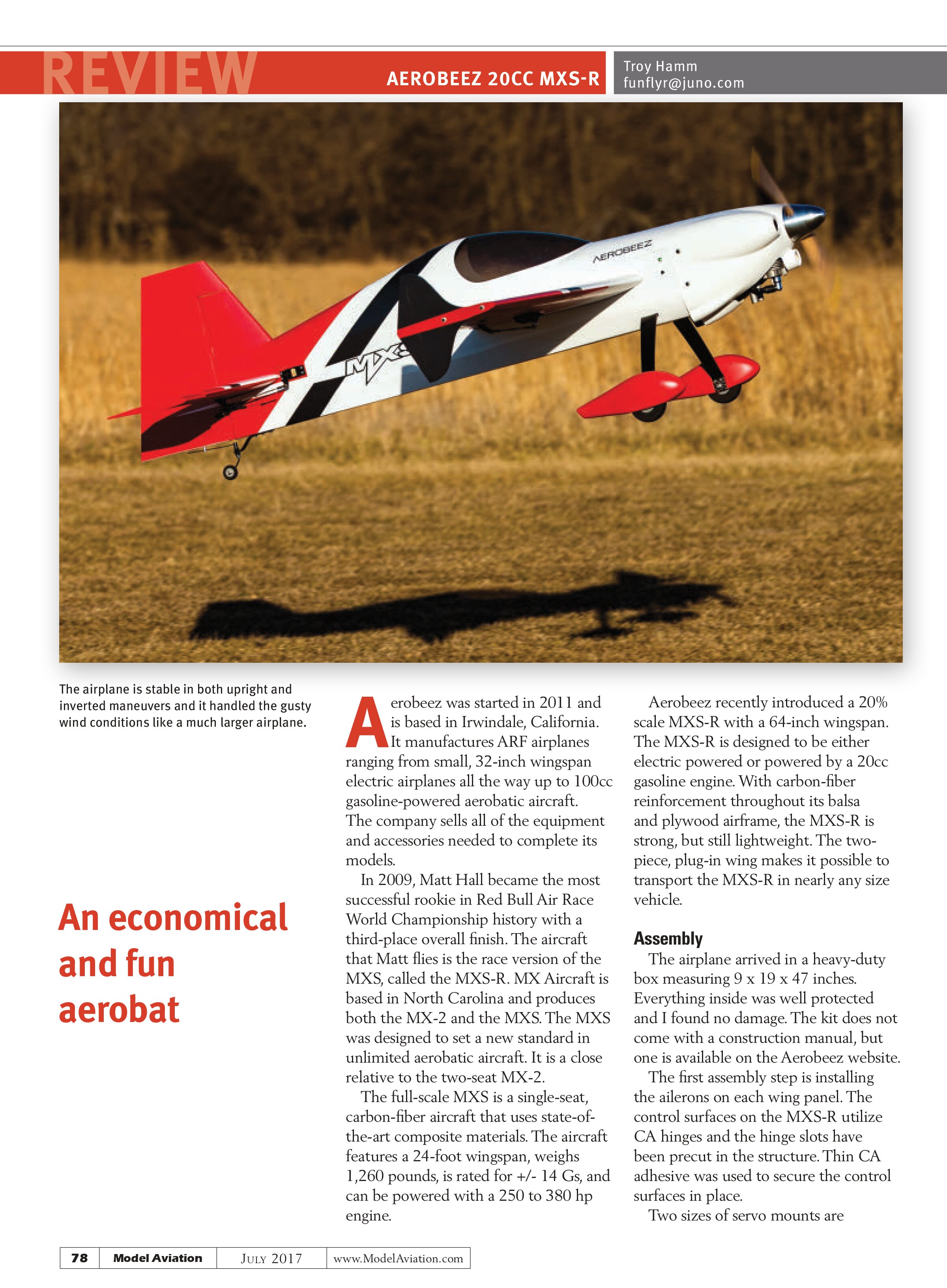
The airplane is stable in both upright and inverted maneuvers and it handled the gusty wind conditions like a much larger airplane.
Aerobeez was started in 2011 and is based in Irwindale, California. It manufactures ARF airplanes ranging from small, 32-inch wingspan electric airplanes all the way up to 100cc gasoline-powered aerobatic aircraft. The company sells all of the equipment and accessories needed to complete its models.
In 2009, Matt Hall became the most successful rookie in Red Bull Air Race World Championship history with a third-place overall finish. The aircraft that Matt flies is the race version of the MXS, called the MXS-R. MX Aircraft is based in North Carolina and produces both the MX-2 and the MXS. The MXS was designed to set a new standard in unlimited aerobatic aircraft. It is a close relative to the two-seat MX-2.
The full-scale MXS is a single-seat, carbon-fiber aircraft that uses state-of-the-art composite materials. The aircraft features a 24-foot wingspan, weighs 1,260 pounds, is rated for +/- 14 Gs, and can be powered with a 250 to 380 hp engine.
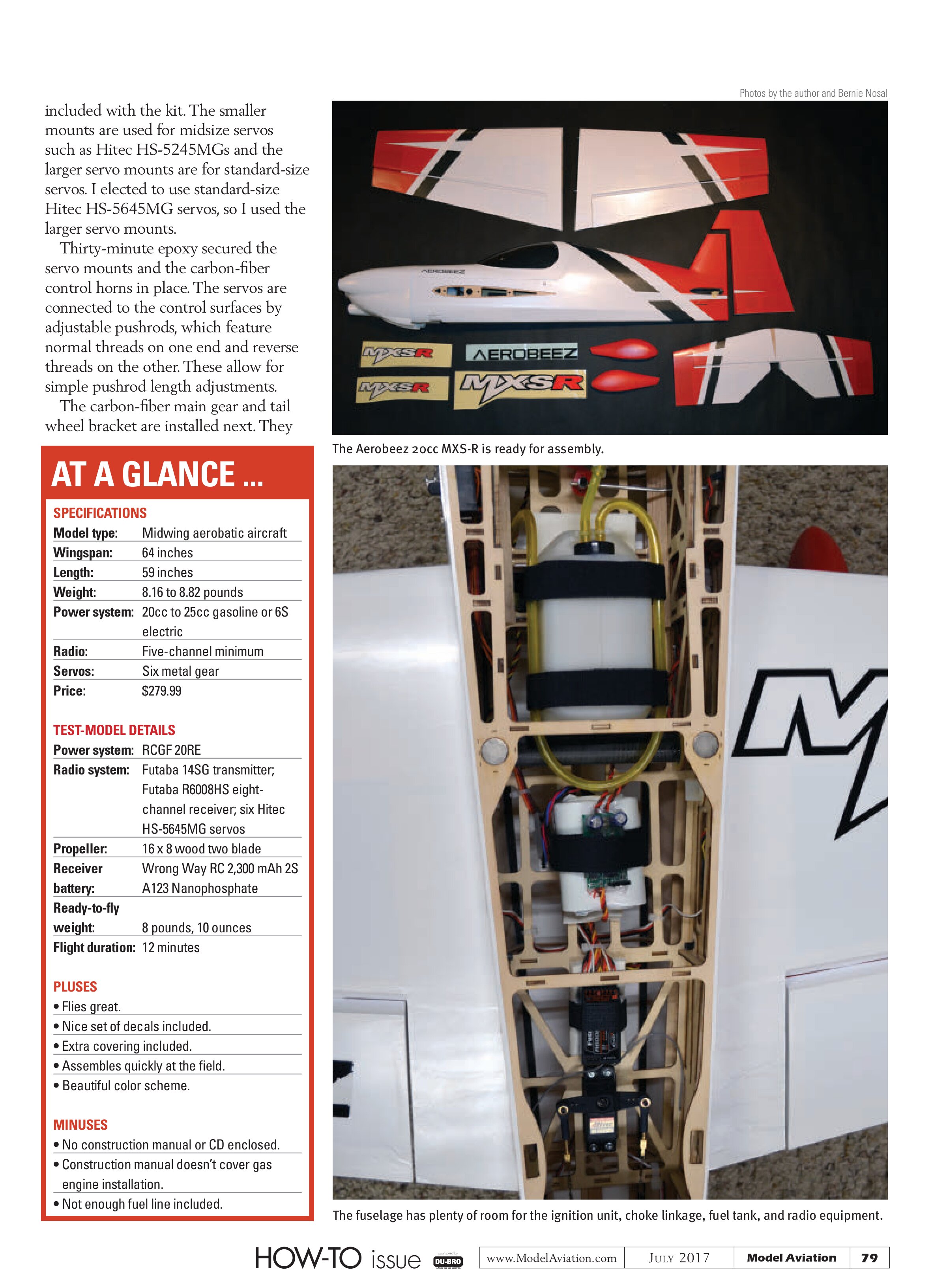
Aerobeez recently introduced a 20% scale MXS-R with a 64-inch wingspan. The MXS-R is designed to be either electric powered or powered by a 20cc gasoline engine. With carbon-fiber reinforcement throughout its balsa and plywood airframe, the MXS-R is strong, but still lightweight. The two-piece, plug-in wing makes it possible to transport the MXS-R in nearly any size vehicle.
Assembly
The airplane arrived in a heavy-duty box measuring 9 x 19 x 47 inches. Everything inside was well protected and I found no damage. The kit does not come with a construction manual, but one is available on the Aerobeez website.
The first assembly step is installing the ailerons on each wing panel. The control surfaces on the MXS-R utilize CA hinges and the hinge slots have been precut in the structure. Thin CA adhesive was used to secure the control surfaces in place.
Two sizes of servo mounts are included with the kit. The smaller mounts are used for midsize servos such as Hitec HS-5245MGs and the larger servo mounts are for standard-size servos. I elected to use standard-size Hitec HS-5645MG servos, so I used the larger servo mounts.
Thirty-minute epoxy secured the servo mounts and the carbon-fiber control horns in place. The servos are connected to the control surfaces by adjustable pushrods, which feature normal threads on one end and reverse threads on the other. These allow for simple pushrod length adjustments.
The carbon-fiber main gear and tail wheel bracket are installed next. They
AT A GLANCE ...
SPECIFICATIONS
Model type: Midwing aerobatic aircraft
Wingspan: 64 inches
Length: 59 inches
Weight: 8.16 to 8.82 pounds
Power system: 20cc to 25cc gasoline or 6S electric
Radio: Five-channel minimum
Servos: Six metal gear
Price: $279.99
TEST-MODEL DETAILS
Power system: RCGF 20RE
Radio system: Futaba 14SG transmitter; Futaba R6008HS eight-channel receiver; six Hitec HS-5645MG servos
Propeller: 16 x 8 wood two blade
Receiver battery: Wrong Way RC 2,300 mAh 2S A123 Nanophosphate
Ready-to-fly weight: 8 pounds, 10 ounces
Flight duration: 12 minutes
PLUSES
• Flies great.
• Nice set of decals included.
• Extra covering included.
• Assembles quickly at the field.
• Beautiful color scheme.
MINUSES
• No construction manual or CD enclosed.
• Construction manual doesn’t cover gas engine installation.
• Not enough fuel line included.


both bolt in place with socket-head cap screws. I elected to install the axles, wheels, and wheel pants at the conclusion of the build to help keep the airplane from rolling on the workbench during assembly.
The manual recommends securing the horizontal stabilizer with thin CA adhesive. I used 30-minute epoxy instead, to allow more curing time to ensure that the stabilizer was centered and square to the fuselage. When the epoxy was fully cured, the elevator halves were secured in place.
The rudder installation was next. The pull-pull cables come preinstalled in the fuselage. After the cables are attached to the rudder servo, the rudder installation is complete.
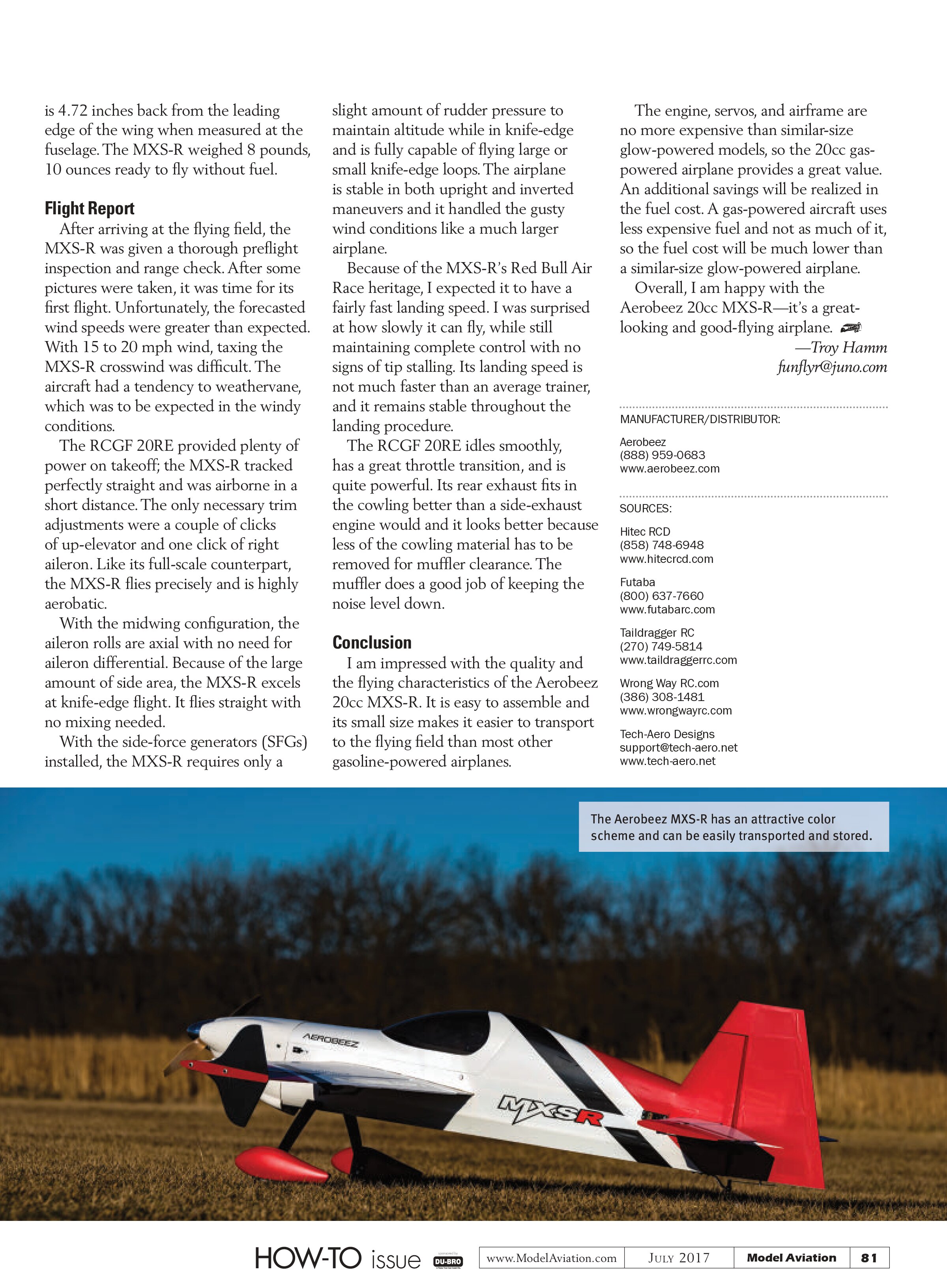
Next was installing the engine and muffler. The manual only shows an electric motor installation. The kit recommends a 20cc to 25cc gasoline engine. I ordered a RCGF 20 RE (rear exhaust) engine from Taildragger RC. The engine mounts and mounting hardware that were included with the engine were used to mount the engine in place on the firewall.
The engine motor mounts were centered on the premarked lines on the firewall. The throttle servo was mounted inside the fuselage and connected to the carburetor with the included pushrod and ball links. A simple choke linkage was fashioned out of a servo arm and two pieces of 4-40 pushrod material.
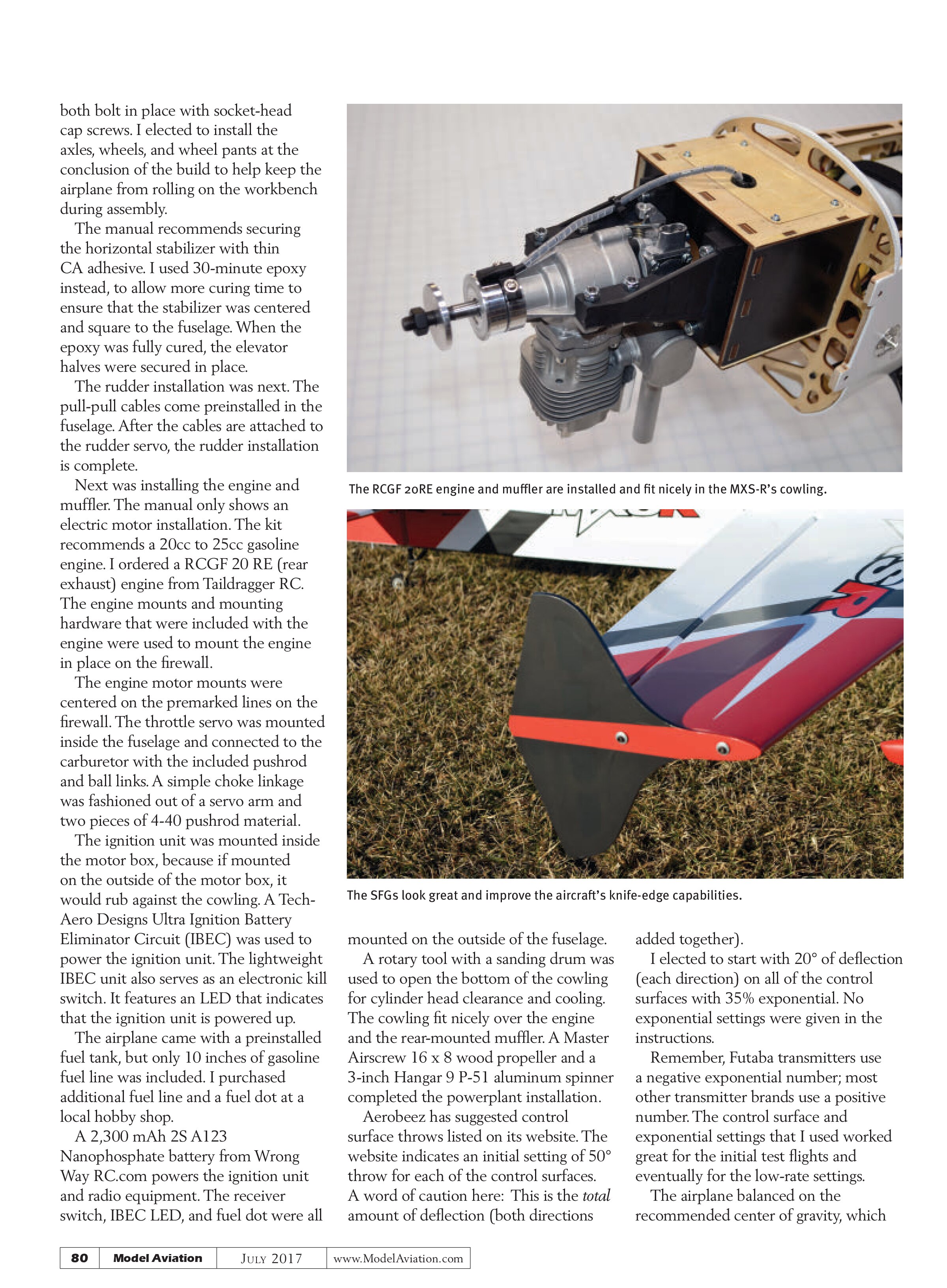
The ignition unit was mounted inside the motor box, because if mounted on the outside of the motor box, it would rub against the cowling. A Tech-Aero Designs Ultra Ignition Battery Eliminator Circuit (IBEC) was used to power the ignition unit. The lightweight IBEC unit also serves as an electronic kill switch. It features an LED that indicates that the ignition unit is powered up.
The airplane came with a preinstalled fuel tank, but only 10 inches of gasoline fuel line was included. I purchased additional fuel line and a fuel dot at a local hobby shop.
A 2,300 mAh 2S A123 Nanophosphate battery from Wrong Way RC.com powers the ignition unit and radio equipment. The receiver switch, IBEC LED, and fuel dot were all mounted on the outside of the fuselage.
A rotary tool with a sanding drum was used to open the bottom of the cowling for cylinder head clearance and cooling. The cowling fit nicely over the engine and the rear-mounted muffler. A Master Airscrew 16 x 8 wood propeller and a 3-inch Hangar 9 P-51 aluminum spinner completed the powerplant installation.
Aerobeez has suggested control surface throws listed on its website. The website indicates an initial setting of 50° throw for each of the control surfaces. A word of caution here: This is the total amount of deflection (both directions added together).
I elected to start with 20° of deflection (each direction) on all of the control surfaces with 35% exponential. No exponential settings were given in the instructions.
Remember, Futaba transmitters use a negative exponential number; most other transmitter brands use a positive number. The control surface and exponential settings that I used worked great for the initial test flights and eventually for the low-rate settings.
The airplane balanced on the recommended center of gravity, which is 4.72 inches back from the leading edge of the wing when measured at the fuselage. The MXS-R weighed 8 pounds, 10 ounces ready to fly without fuel.
Flight Report
After arriving at the flying field, the MXS-R was given a thorough preflight inspection and range check. After some pictures were taken, it was time for its first flight. Unfortunately, the forecasted wind speeds were greater than expected. With 15 to 20 mph wind, taxing the MXS-R crosswind was difficult. The aircraft had a tendency to weathervane, which was to be expected in the windy conditions.
The RCGF 20RE provided plenty of power on takeoff; the MXS-R tracked perfectly straight and was airborne in a short distance. The only necessary trim adjustments were a couple of clicks of up-elevator and one click of right aileron. Like its full-scale counterpart, the MXS-R flies precisely and is highly aerobatic.
With the midwing configuration, the aileron rolls are axial with no need for aileron differential. Because of the large amount of side area, the MXS-R excels at knife-edge flight. It flies straight with no mixing needed.
With the side-force generators (SFGs) installed, the MXS-R requires only a slight amount of rudder pressure to maintain altitude while in knife-edge and is fully capable of flying large or small knife-edge loops. The airplane is stable in both upright and inverted maneuvers and it handled the gusty wind conditions like a much larger airplane.
Because of the MXS-R’s Red Bull Air Race heritage, I expected it to have a fairly fast landing speed. I was surprised at how slowly it can fly, while still maintaining complete control with no signs of tip stalling. Its landing speed is not much faster than an average trainer, and it remains stable throughout the landing procedure.
The RCGF 20RE idles smoothly, has a great throttle transition, and is quite powerful. Its rear exhaust fits in the cowling better than a side-exhaust engine would and it looks better because less of the cowling material has to be removed for muffler clearance. The muffler does a good job of keeping the noise level down.
Conclusion
I am impressed with the quality and the flying characteristics of the Aerobeez 20cc MXS-R. It is easy to assemble and its small size makes it easier to transport to the flying field than most other gasoline-powered airplanes.
The engine, servos, and airframe are no more expensive than similar-size glow-powered models, so the 20cc gas-powered airplane provides a great value. An additional savings will be realized in the fuel cost. A gas-powered aircraft uses less expensive fuel and not as much of it, so the fuel cost will be much lower than a similar-size glow-powered airplane.
Overall, I am happy with the Aerobeez 20cc MXS-R—it’s a great-looking and good-flying airplane.
—Troy Hamm
funflyr@juno.com