On the other hand ...
“After a small workshop incident, I have a thought … I’d like to plant a size 12 brogan [shoe] right in the naughty bits of whomever made adhesive bandages so difficult to open with one hand!”
This quote from Jean Andrews raises several questions. First off, who knew Jean wore such big shoes? And since he is a highly experienced and expert modeler, doesn’t he make sure to have someone else around when working with dangerous tools?
Okay, that’s not always possible, especially at home in the workshop, but treating a minor cut is sure easier with an extra pair of hands.
After you wash the wound and dry it (not with the good towels!), the challenges begin. Just opening the box of bandages is a trick with only one hand. Keep pressure on the wound, and don’t let it start bleeding again! Dump the bandages out and choose the right size, and then figure out how to get the plastic backing off or maybe tear open the paper envelope. The use of teeth and toes might be required.
Say, this is looking like it would have been easier to just avoid getting hurt in the first place!
A dab of antibiotic cream (good luck unscrewing the tube with one hand) makes things slippery until you get the adhesive part anchored. Oops, now it’s off-center and the other side is folded against itself! Back to square one.
Expensive, name-brand bandages are usually easier to deploy than cheapo products. Cloth types beat plastic for one-handed installation. Novelty-print strips from the dollar store seem to be the worst—apparently because they are meant to be seen more than used. I buy them anyway for people at the field who come to me for minor first aid. “Come on Dave, do you really expect me to wear a SpongeBob bandage?” Well, it’s that or the Smurfs—you pick.

Gender Preference?
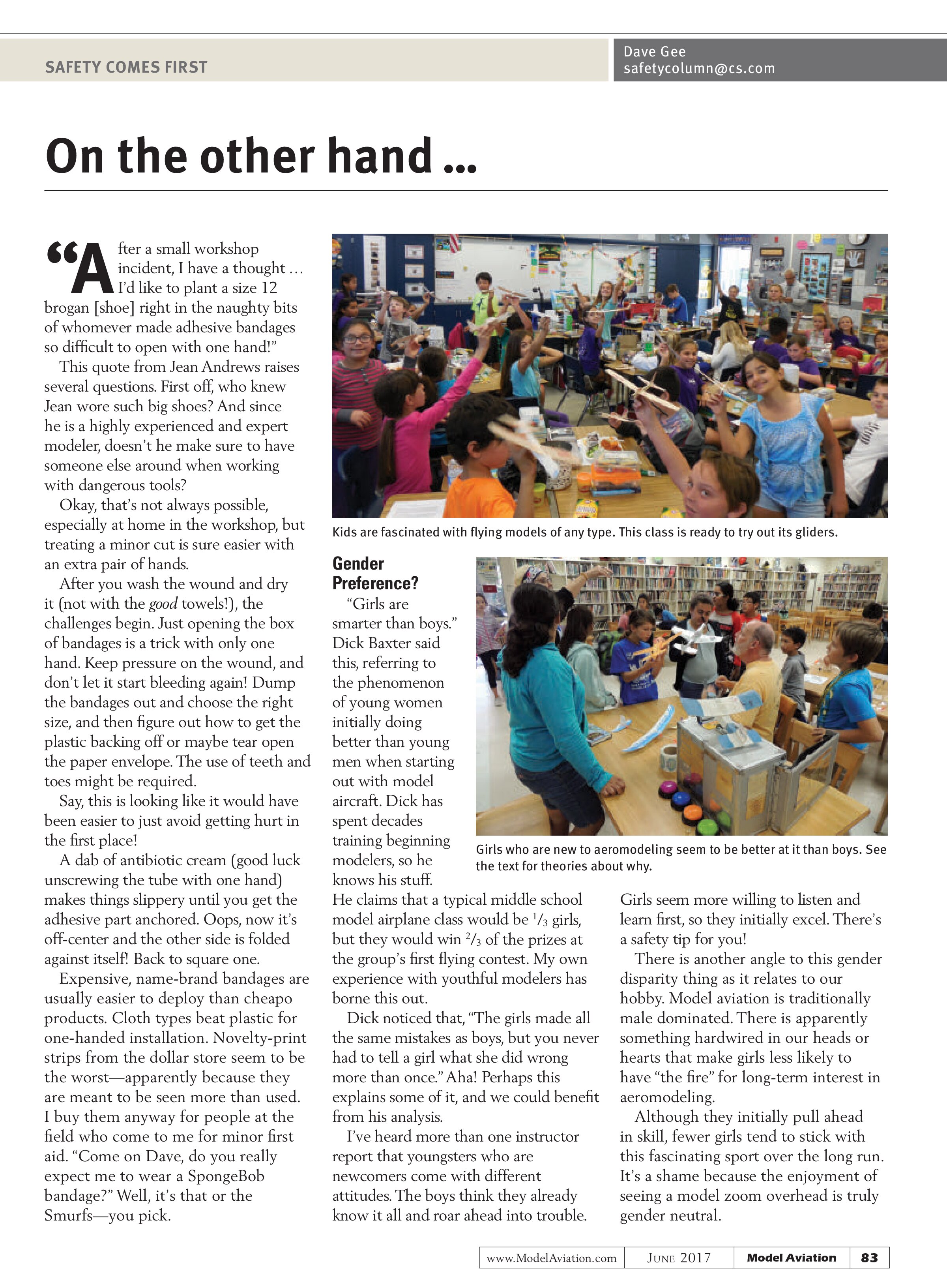
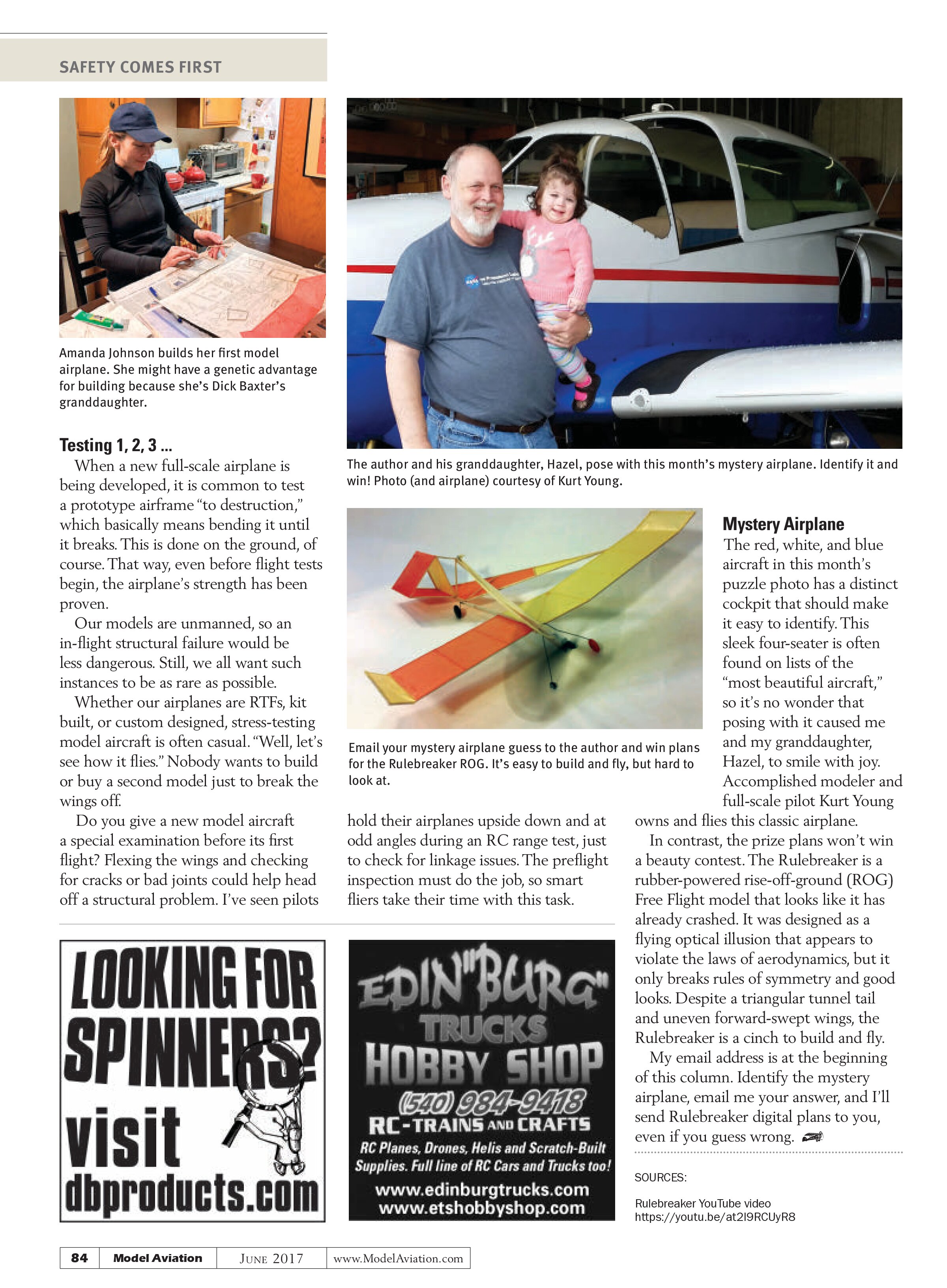
“Girls are smarter than boys.” Dick Baxter said this, referring to the phenomenon of young women initially doing better than young men when starting out with model aircraft. Dick has spent decades training beginning modelers, so he knows his stuff.
He claims that a typical middle school model airplane class would be ⅓ girls, but they would win ⅔ of the prizes at the group’s first flying contest. My own experience with youthful modelers has borne this out.
Dick noticed that, “The girls made all the same mistakes as boys, but you never had to tell a girl what she did wrong more than once.” Aha! Perhaps this explains some of it, and we could benefit from his analysis.
I’ve heard more than one instructor report that youngsters who are newcomers come with different attitudes. The boys think they already know it all and roar ahead into trouble.

Girls seem more willing to listen and learn first, so they initially excel. There’s a safety tip for you!
There is another angle to this gender disparity thing as it relates to our hobby. Model aviation is traditionally male dominated. There is apparently something hardwired in our heads or hearts that make girls less likely to have “the fire” for long-term interest in aeromodeling.
Although they initially pull ahead in skill, fewer girls tend to stick with this fascinating sport over the long run. It’s a shame because the enjoyment of seeing a model zoom overhead is truly gender neutral.

Amanda Johnson builds her first model airplane. She might have a genetic advantage for building because she’s Dick Baxter’s granddaughter.
Testing 1, 2, 3 ...
When a new full-scale airplane is being developed, it is common to test a prototype airframe “to destruction,” which basically means bending it until it breaks. This is done on the ground, of course. That way, even before flight tests begin, the airplane’s strength has been proven.
Our models are unmanned, so an in-flight structural failure would be less dangerous. Still, we all want such instances to be as rare as possible.
Whether our airplanes are RTFs, kit built, or custom designed, stress-testing model aircraft is often casual. “Well, let’s see how it flies.” Nobody wants to build or buy a second model just to break the wings off.
Do you give a new model aircraft a special examination before its first flight? Flexing the wings and checking for cracks or bad joints could help head off a structural problem. I’ve seen pilots

The author and his granddaughter, Hazel, pose with this month’s mystery airplane. Identify it and win!

Email your mystery airplane guess to the author and win plans for the Rulebreaker ROG. It’s easy to build and fly, but hard to look at.
hold their airplanes upside down and at odd angles during an RC range test, just to check for linkage issues. The preflight inspection must do the job, so smart fliers take their time with this task.
Mystery Airplane
The red, white, and blue aircraft in this month’s puzzle photo has a distinct cockpit that should make it easy to identify. This sleek four-seater is often found on lists of the “most beautiful aircraft,” so it’s no wonder that posing with it caused me and my granddaughter, Hazel, to smile with joy. Accomplished modeler and full-scale pilot Kurt Young owns and flies this classic airplane.
In contrast, the prize plans won’t win a beauty contest. The Rulebreaker is a rubber-powered rise-off-ground (ROG) Free Flight model that looks like it has already crashed. It was designed as a flying optical illusion that appears to violate the laws of aerodynamics, but it only breaks rules of symmetry and good looks. Despite a triangular tunnel tail and uneven forward-swept wings, the Rulebreaker is a cinch to build and fly.
My email address is at the beginning of this column. Identify the mystery airplane, email me your answer, and I’ll send Rulebreaker digital plans to you, even if you guess wrong.
SOURCES:
Rulebreaker YouTube video
https://youtu.be/at2I9RCUyR8