1/2A RC model allows maximum fun with minimal effort


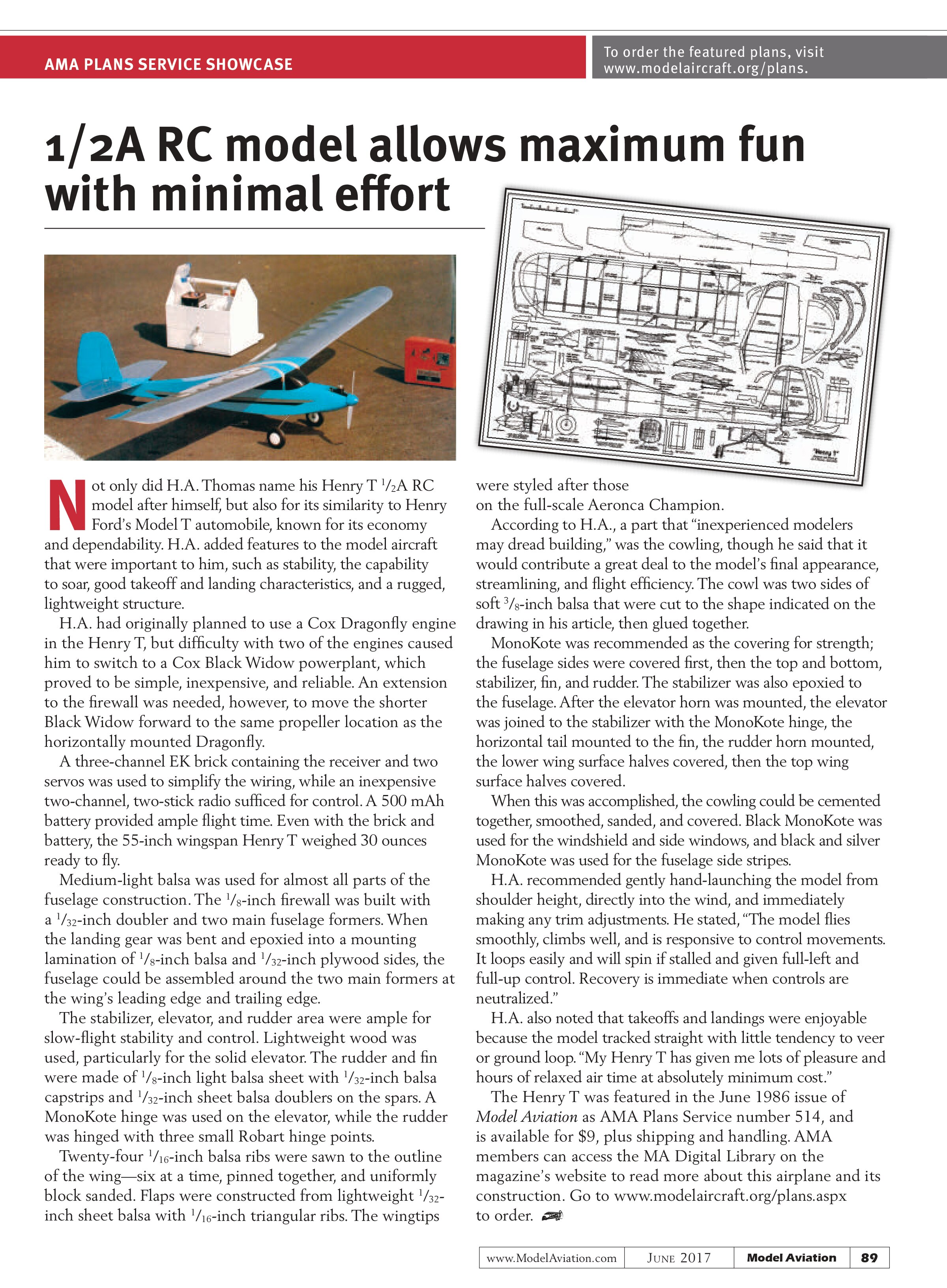
Not only did H.A. Thomas name his Henry T ½A RC model after himself, but also for its similarity to Henry Ford’s Model T automobile, known for its economy and dependability. H.A. added features to the model aircraft that were important to him, such as stability, the capability to soar, good takeoff and landing characteristics, and a rugged, lightweight structure.
H.A. had originally planned to use a Cox Dragonfly engine in the Henry T, but difficulty with two of the engines caused him to switch to a Cox Black Widow powerplant, which proved to be simple, inexpensive, and reliable. An extension to the firewall was needed, however, to move the shorter Black Widow forward to the same propeller location as the horizontally mounted Dragonfly.
A three-channel EK brick containing the receiver and two servos was used to simplify the wiring, while an inexpensive two-channel, two-stick radio sufficed for control. A 500 mAh battery provided ample flight time. Even with the brick and battery, the 55-inch wingspan Henry T weighed 30 ounces ready to fly.
Medium-light balsa was used for almost all parts of the fuselage construction. The ⅛-inch firewall was built with a 1/32-inch doubler and two main fuselage formers. When the landing gear was bent and epoxied into a mounting lamination of ⅛-inch balsa and 1/32-inch plywood sides, the fuselage could be assembled around the two main formers at the wing’s leading edge and trailing edge.
The stabilizer, elevator, and rudder area were ample for slow-flight stability and control. Lightweight wood was used, particularly for the solid elevator. The rudder and fin were made of ⅛-inch light balsa sheet with 1/32-inch balsa capstrips and 1/32-inch sheet balsa doublers on the spars. A MonoKote hinge was used on the elevator, while the rudder was hinged with three small Robart hinge points.
Twenty-four 1/16-inch balsa ribs were sawn to the outline of the wing—six at a time, pinned together, and uniformly block sanded. Flaps were constructed from lightweight 1/32-inch sheet balsa with 1/16-inch triangular ribs. The wingtips were styled after those on the full-scale Aeronca Champion.
According to H.A., a part that “inexperienced modelers may dread building,” was the cowling, though he said that it would contribute a great deal to the model’s final appearance, streamlining, and flight efficiency. The cowl was two sides of soft ⅜-inch balsa that were cut to the shape indicated on the drawing in his article, then glued together.
MonoKote was recommended as the covering for strength; the fuselage sides were covered first, then the top and bottom, stabilizer, fin, and rudder. The stabilizer was also epoxied to the fuselage. After the elevator horn was mounted, the elevator was joined to the stabilizer with the MonoKote hinge, the horizontal tail mounted to the fin, the rudder horn mounted, the lower wing surface halves covered, then the top wing surface halves covered.
When this was accomplished, the cowling could be cemented together, smoothed, sanded, and covered. Black MonoKote was used for the windshield and side windows, and black and silver MonoKote was used for the fuselage side stripes.
H.A. recommended gently hand-launching the model from shoulder height, directly into the wind, and immediately making any trim adjustments. He stated, “The model flies smoothly, climbs well, and is responsive to control movements. It loops easily and will spin if stalled and given full-left and full-up control. Recovery is immediate when controls are neutralized.”
H.A. also noted that takeoffs and landings were enjoyable because the model tracked straight with little tendency to veer or ground loop. “My Henry T has given me lots of pleasure and hours of relaxed air time at absolutely minimum cost.”
The Henry T was featured in the June 1986 issue of Model Aviation as AMA Plans Service number 514, and is available for $9, plus shipping and handling. AMA members can access the MA Digital Library on the magazine’s website to read more about this airplane and its construction. Go to www.modelaircraft.org/plans.aspx to order.