Modeling evolution
Bob Angel
samrcflier@verizon.net

Evolution occurs in aeromodeling just as it does in the world of flora and fauna. Here is a brief summary of modeling evolution.
Real modelers (usually self-defined) always built their own models. The original real modelers flew only Free Flight (FF) because nothing else was available. Attitudes also evolved as each generation adjusted to one infringement after another into their part of the hobby. Some bad-mouthed each new movement, others resisted quietly, and some stoically accepted, while still others quickly joined the latest fad. Unfortunately, for those left behind, it often turned out to be more than a fad.
First it was Control Line (CL) flying, which became dominant after World War II. FF fliers quickly condemned the aircraft as bricks on a string that didn’t really fly, but were kept off the ground by centrifugal force. As more people moved into cities, and large open flying spaces were overtaken by progress, many FF participants had to accept that choice if they wanted to continue modeling.
As RC matured, it was eagerly embraced by most CL pilots and a few FF fliers. I held out on that one, capitulating to fly RC only after the local CL club had dried up. At the same time, city parks and school grounds were methodically banning noisy CL airplanes.
RC required more space than CL, but less than FF. It also accelerated muffler development, and the high-tech status sometimes associated with RC brought greater tolerance among the nonmodeling community. The pendulum swung back, and space for RC flying could soon be found in most areas.
For some Old-Timers (OT) though, the introduction of ARFs became a final point of resentment that separated the real modelers from those newcomers. I’m no psychiatrist, nor do I play one on TV, but here’s an idea for peace of mind. If you don’t happen to play golf, go whitewater rafting, or collect stamps, do you hold animosity toward those who do? I didn’t think so.
Why not adopt that same attitude toward those who enjoy other branches of our hobby? In fact, why not make friends with a drone FPV pilot and invite him or her to your OT contest? He or she is unlikely to begin building models, but the person might be happy to demonstrate his or her technology by locating an aircraft or two that have disappeared into the cornfield.
Glider Hassles
OT RC gliders have been in the Society of Antique Modelers (SAM) rule books for years. They are regularly flown in contests, but never in large numbers. There are reasons for this, many having to do with the inconvenience of our launching systems.
The rules allow hand-tow, hi-start, or winches, but by a gentlemen’s agreement, we don’t use winches because of the high cost, maintenance requirements, and storage and transportation space needed. Even hi-starts are a hassle for the contest directors (CDs) and contestants to transport, lay out, and retrieve.
The problems show up often at many of our dirt flying fields, where rain can produce weeds and snagging hazards for the towlines. Wind drift on those long lines often causes an interference hazard for the powered models. If a glider gets slightly out of control at launch, a hi-start can drag it to an unmerciful death.
Drone-Towed Gliders
Because I’ve already made one blasphemous suggestion about drones, let’s examine another—I’ll take both punishments together.
One of our regular fliers picked up on a recent article about using a quadcopter drone to lift and launch gliders. After digesting the information, it occurred to me that after startup pains, it could become a better hassle-free launch solution than a hi-start.
A glider is lifted tail first then released from that position for a short drop and stall-free recovery. For contests, release should be from a uniform height for all. A programmable altitude-cutoff unit, such as what we use for Altitude Limited Old-Timer (ALOT) or the Altitude Limited Electric Soaring (ALES) competition, could operate the release servo. The overall hassle and turnaround time between launches could be greatly reduced compared to one with a hi-start.
FF Rescue Program
The FF Rescue Program is the theme of a new activity being shepherded by Dick Bertrand. Here’s a synopsis from Dick.
“Our FF hobby is fading as practitioners age and new generations have diminishing interest. Aviation is now taken for granted and the glory no longer permeates the media.
“We’re starting a volunteer-based program. It’s not the only one that has [been] and is being tried. We’re beginning by working with orphanages to provide structure that can help large numbers of kids anywhere in the world to start following their constructive building instincts and enjoying the outdoors instead of just electronic screen entertainment.”
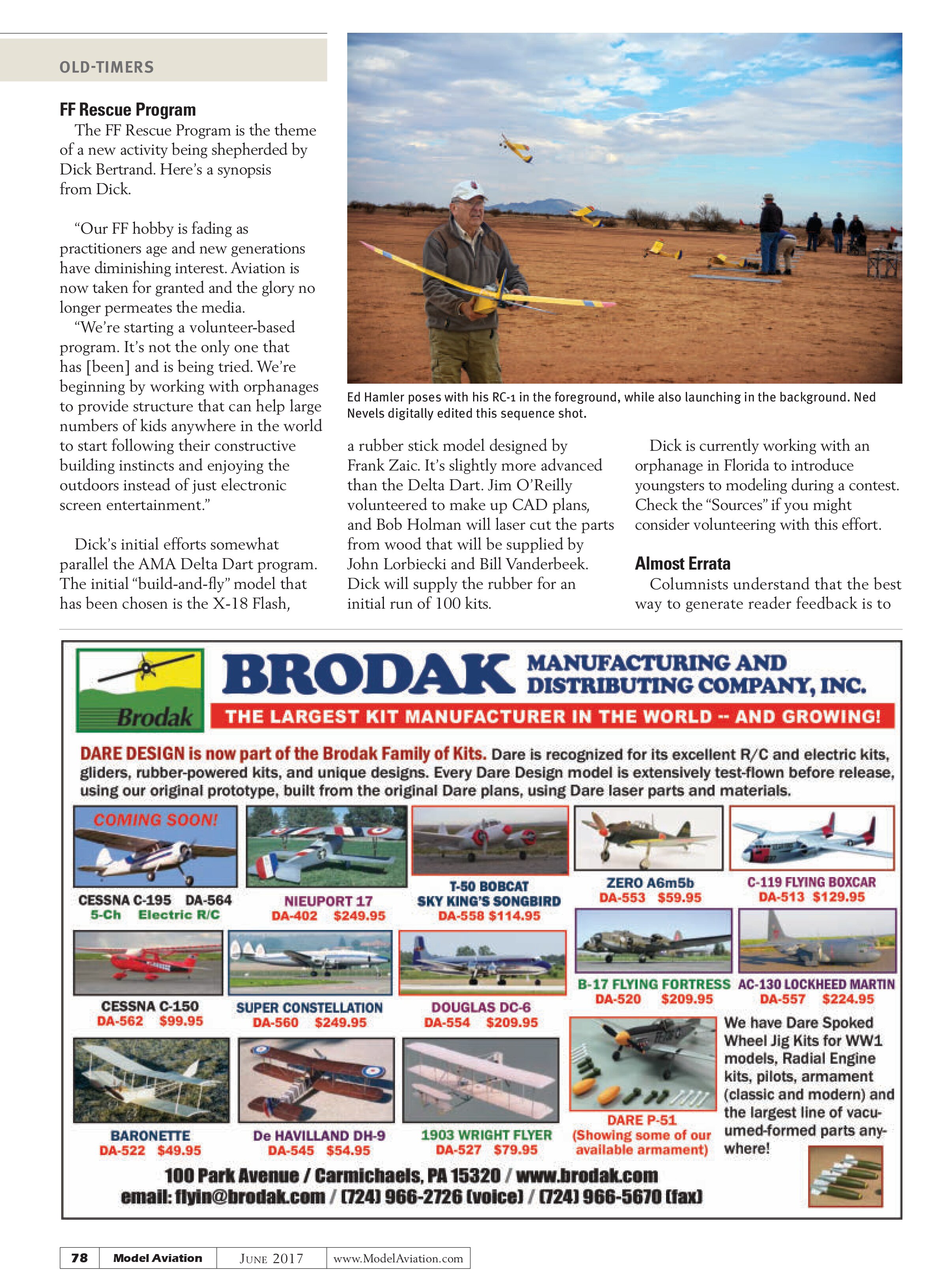
Dick’s initial efforts somewhat parallel the AMA Delta Dart program. The initial “build-and-fly” model that has been chosen is the X-18 Flash,

a rubber stick model designed by Frank Zaic. It’s slightly more advanced than the Delta Dart. Jim O’Reilly volunteered to make up CAD plans, and Bob Holman will laser cut the parts from wood that will be supplied by John Lorbiecki and Bill Vanderbeek. Dick will supply the rubber for an initial run of 100 kits.
Dick is currently working with an orphanage in Florida to introduce youngsters to modeling during a contest. Check the “Sources” if you might consider volunteering with this effort.
Almost Errata
Columnists understand that the best way to generate reader feedback is to publish an error. I perform my share of slipups, but this time I’ll share a couple of perceived errors to ease the concerns of those who noticed, but didn’t respond.
In my December 2016 column, I mentioned Top Flite Power Point propellers. One responder pointed out that it should have read Power Prop, and that Power Point is a computer program for generating presentations. “Hey, that’s right,” I said to myself, so I thanked the sender and resolved to correct that item.
But I later noticed a Top Flite Power Point propeller in my propeller collection. That cleared up some brain fog and reminded me that Top Flite had produced both Power Prop (early) and Power Point (later) labels. Like many propeller makers, the sublabels changed over time, such as stamping “RC” onto one blade.
Top Flite also printed the word “nylon” onto its plastic propellers. These propellers are all still excellent, but the early nylon ones should be used only for display. Not only do they make nastier cuts, but the blades are subject to shattering.
Apparent error number two was identifying the photo of Mark Petroli’s aircraft in the February 2017 column as a Playboy. At a casual glance, it appears to be a Lanzo Bomber. Mark’s fuselage color selection gives the illusion of the aircraft having the distinct diamond-shaped Lanzo Bomber fuselage. But the front edge of the Bomber’s fin aligns with the front edge of the stabilizer, whereas the Playboy’s fin is set back slightly, as the photo shows.

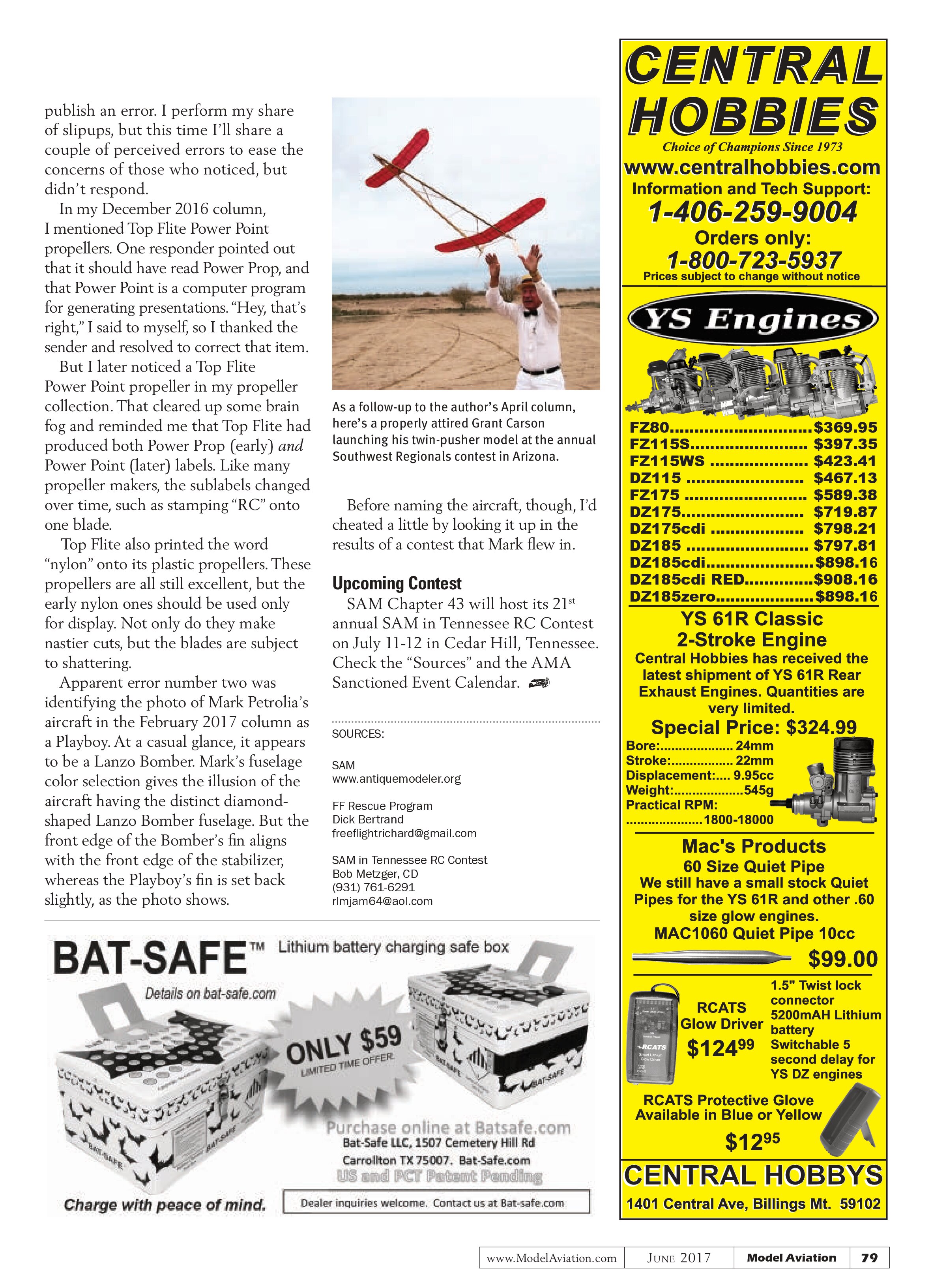
As a follow-up to the author’s April column, here’s a properly attired Grant Carson launching his twin-pusher model at the annual Southwest Regionals contest in Arizona.
Before naming the aircraft, though, I’d cheated a little by looking it up in the results of a contest that Mark flew in.
Upcoming Contest
SAM Chapter 43 will host its 21st annual SAM in Tennessee RC Contest on July 11-12 in Cedar Hill, Tennessee. Check the “Sources” and the AMA Sanctioned Event Calendar.
SOURCES:
SAM
www.antiquemodeler.org
FF Rescue Program
Dick Bertrand
freeflightrichard@gmail.com
SAM in Tennessee RC Contest
Bob Metzger, CD
(931) 761-6291
rlmjam64@aol.com