HORIZON HOBBY E-FLITE P-47 RAZORBACK 1.2M BNF BASIC
Jon Barnes

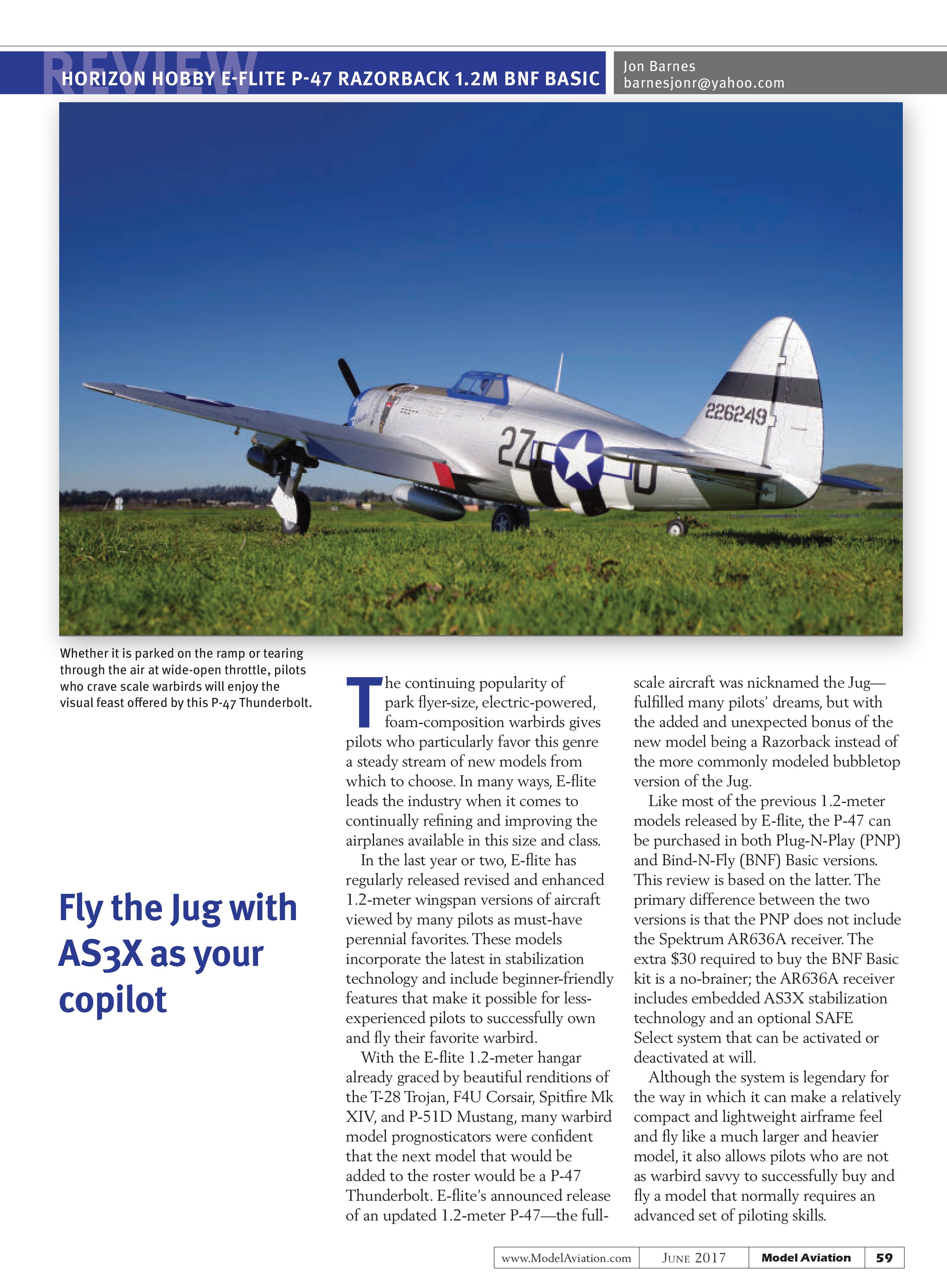
Whether it is parked on the ramp or tearing through the air at wide-open throttle, pilots who crave scale warbirds will enjoy the visual feast offered by this P-47 Thunderbolt.
Fly the Jug with AS3X as your copilot
The continuing popularity of park flyer-size, electric-powered, foam-composition warbirds gives pilots who particularly favor this genre a steady stream of new models from which to choose. In many ways, E-flite leads the industry when it comes to continually refining and improving the airplanes available in this size and class.
In the last year or two, E-flite has regularly released revised and enhanced 1.2-meter wingspan versions of aircraft viewed by many pilots as must-have perennial favorites. These models incorporate the latest in stabilization technology and include beginner-friendly features that make it possible for less-experienced pilots to successfully own and fly their favorite warbird.
With the E-flite 1.2-meter hangar already graced by beautiful renditions of the T-28 Trojan, F4U Corsair, Spitfire Mk XIV, and P-51D Mustang, many warbird model prognosticators were confident that the next model that would be added to the roster would be a P-47 Thunderbolt. E-flite’s announced release of an updated 1.2-meter P-47—the full-scale aircraft was nicknamed the Jug—fulfilled many pilots’ dreams, but with the added and unexpected bonus of the new model being a Razorback instead of the more commonly modeled bubbletop version of the Jug.
Like most of the previous 1.2-meter models released by E-flite, the P-47 can be purchased in both Plug-N-Play (PNP) and Bind-N-Fly (BNF) Basic versions. This review is based on the latter. The primary difference between the two versions is that the PNP does not include the Spektrum AR636A receiver. The extra $30 required to buy the BNF Basic kit is a no-brainer; the AR636A receiver includes embedded AS3X stabilization technology and an optional SAFE Select system that can be activated or deactivated at will.
Although the system is legendary for the way in which it can make a relatively compact and lightweight airframe feel and fly like a much larger and heavier model, it also allows pilots who are not as warbird savvy to successfully buy and fly a model that normally requires an advanced set of piloting skills.
AT A GLANCE ...
SPECIFICATIONS
Model type: Electric warbird
Skill level: Intermediate
Wingspan: 47.25 inches
Wing area: 400 square inches
Length: 42 inches
Weight: 55.5 ounces
Power system: 15-size brushless electric power system
Radio: Minimum six-channel radio required
Construction: Z-foam
Street price: $269.99
TEST-MODEL DETAILS
Motor: E-flite 15-size 880 Kv brushless outrunner (included)
Speed controller: E-flite 40-amp with 5-amp BEC; EC3 connector (included)
Battery: E-flite 30C 3S 11.1-volt, 2,200 mAh LiPo (not included)
Propeller: Four-blade 10.5 x 8 (included)
Radio system: Spektrum DX9 nine-channel 2.4 GHz DSMX transmitter; Spektrum AR636A six-channel DSMX receiver (receiver included)
Ready-to-fly weight: 60 ounces
Flight duration: 5 to 8 minutes
PLUSES
- The large battery bay allows pilots to extend their flight durations by using higher-capacity 3,000 mAh batteries.
- The included detailed and scalelike underwing armaments enhance realism and can be easily removed.
- Enabling SAFE mode can lighten the workload for less experienced warbird pilots.
- The entire airframe goes together with six small fasteners. No adhesives are required.
MINUS
- The underwing bombs and centerline tank can be difficult to remove after they are in place.
Standout features include detailed and detachable armament, electric retracts and flaps, gear doors, an authentic-looking 405th Fighter Group graphics scheme, and a scalelike four-blade propeller. Pilots who are used to grabbing the clear plastic tab typically used to initiate canopy removal will love that this model is devoid of this scale outline-detracting feature.
Removing the canopy is instead accomplished by gripping the two embedded plastic panels that are located at the lower rear corners of the cockpit hatch and pulling it upward and away from the embedded retention magnets.
Assembly
Transforming this 1.2-meter wingspan model from a box full of foam and plastic parts into a fully flight-ready electric warbird couldn’t be quicker or easier. E-flite has pretty much perfected the art of the quick build.
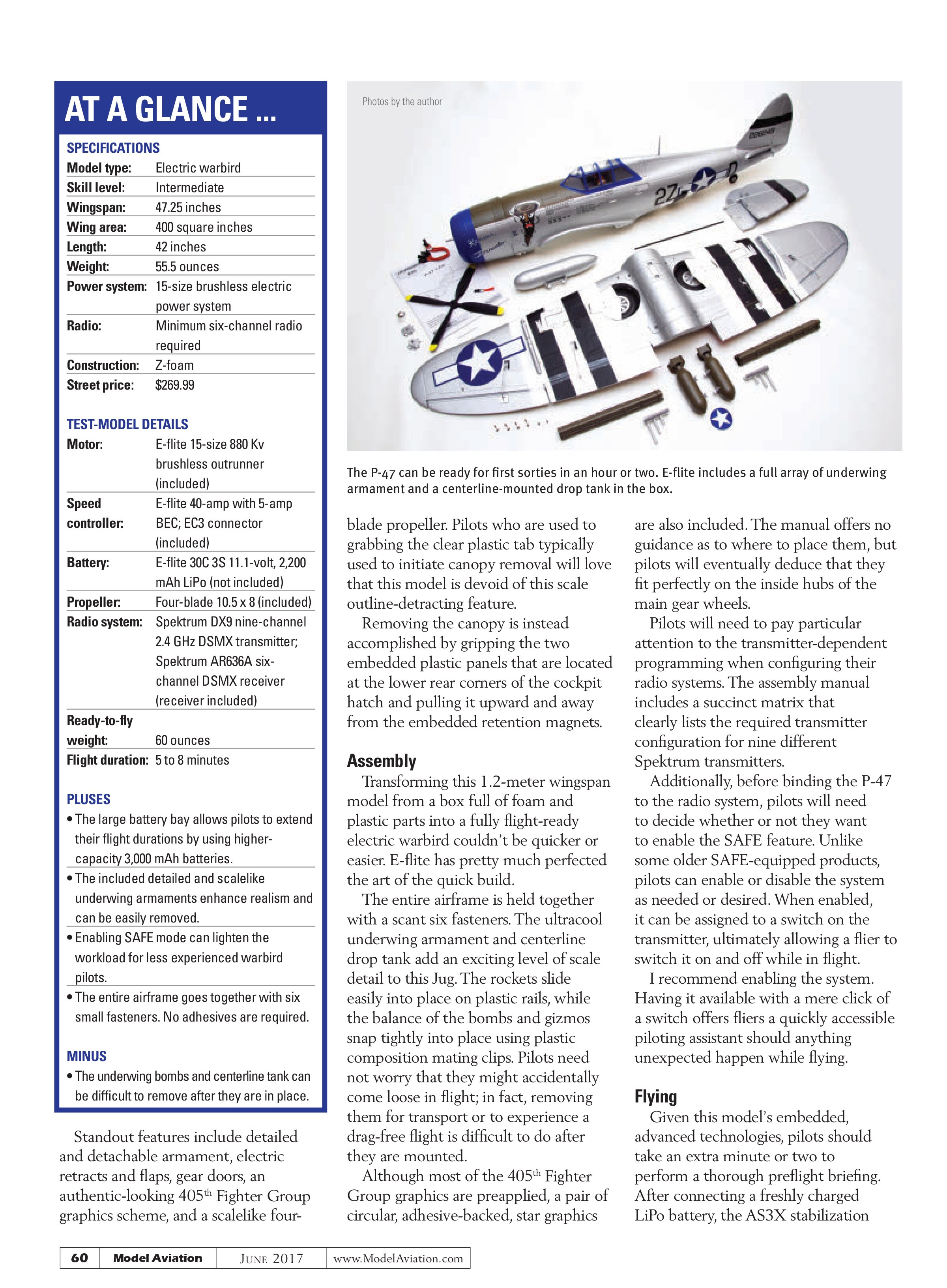
The entire airframe is held together with a scant six fasteners. The ultracool underwing armament and centerline drop tank add an exciting level of scale detail to this Jug. The rockets slide easily into place on plastic rails, while the balance of the bombs and gizmos snap tightly into place using plastic composition mating clips. Pilots need not worry that they might accidentally come loose in flight; in fact, removing them for transport or to experience a drag-free flight is difficult to do after they are mounted.
Although most of the 405th Fighter Group graphics are preapplied, a pair of circular, adhesive-backed, star graphics are also included. The manual offers no guidance as to where to place them, but pilots will eventually deduce that they fit perfectly on the inside hubs of the main gear wheels.
Pilots will need to pay particular attention to the transmitter-dependent programming when configuring their radio systems. The assembly manual includes a succinct matrix that clearly lists the required transmitter configuration for nine different Spektrum transmitters.
Additionally, before binding the P-47 to the radio system, pilots will need to decide whether or not they want to enable the SAFE feature. Unlike some older SAFE-equipped products, pilots can enable or disable the system as needed or desired. When enabled, it can be assigned to a switch on the transmitter, ultimately allowing a flier to switch it on and off while in flight.
I recommend enabling the system. Having it available with a mere click of a switch offers fliers a quickly accessible piloting assistant should anything unexpected happen while flying.
Flying
Given this model’s embedded, advanced technologies, pilots should take an extra minute or two to perform a thorough preflight briefing. After connecting a freshly charged LiPo battery, the AS3X stabilization
Photos by the author

The P-47 can be ready for first sorties in an hour or two. E-flite includes a full array of underwing armament and a centerline-mounted drop tank in the box.
system will activate when the throttle is advanced beyond 25% and remain online until the battery is disconnected. It is worth noting that this model’s AS3X system is programmed to allow even greater amounts of automatic compensating control surface deflections when the landing gear is down.
The automatic control inputs offered by the AS3X system should be verified with the landing gear both deployed and retracted. Pilots who place a premium on long flight durations will be pleased to find that, although E-flite primarily designed the Razorback to fly on the ubiquitous three-cell 2,200 mAh battery packs, LiPo batteries of 3,000 mAh capacity will also fit nicely into the battery area and can be shifted fore and aft as necessary to achieve optimal center of gravity placement.
The rocket pods mount to the underside of the wing, employing the same plastic slide rails used on previous E-flite 1.2-meter warbirds. The centerline tank and twin outboard bombs employ a new style of mounting mechanism. These snap so securely into place that pilots need not fear that they could come loose in flight.
Removing them for transport or to fly the P-47 without any of the included weapons and tanks in place will require that they be carefully pried loose from their mounts. Those smitten with the busy appearance of a scale warbird loaded for bear will probably simply opt to leave them permanently in place.
Whether merely a model or a full-scale airplane, tail-dragger-configuration warbirds typically make for more challenging ground operations, takeoffs, and landings than their tricycle gear-equipped brethren. The E-flite P-47 requires the same deft touch as any tail-dragger warbird. Pilots will need to keep the tail planted using up-elevator input while taxiing and taking off. This input will need to be slowly released as the model accelerates to rotation speed.
Holding the nose on the runway centerline can be especially challenging during the initial phase of the takeoff roll. The best approach is to ease into the throttle gradually and apply small amounts of corrective rudder input to keep the model tracking straight.
If the model begins to ground loop or oscillate left and right before the rudder has enough airflow across it to become effective, dump the throttle and begin the takeoff again.
Smoother runway surfaces will typically be more challenging than those composed of fabric, grass, or fine gravel. Activating the SAFE system and allowing it to help manage the hard pull and torque of the propeller can definitely help to perform a superior takeoff.
The SAFE Select system used in this model acts as an eminently capable copilot and can effectively lighten the net workload of flying this intermediate-level warbird. This is especially true when landing and taking off. The SAFE system allows less-experienced fliers, many of whom nonetheless love warbirds, to increase their odds of success and lessen the chances of stacking the model at their feet.
Being able to switch it on and off at will and while in flight is very much akin to having a more-experienced pilot standing next to you on the flightline,
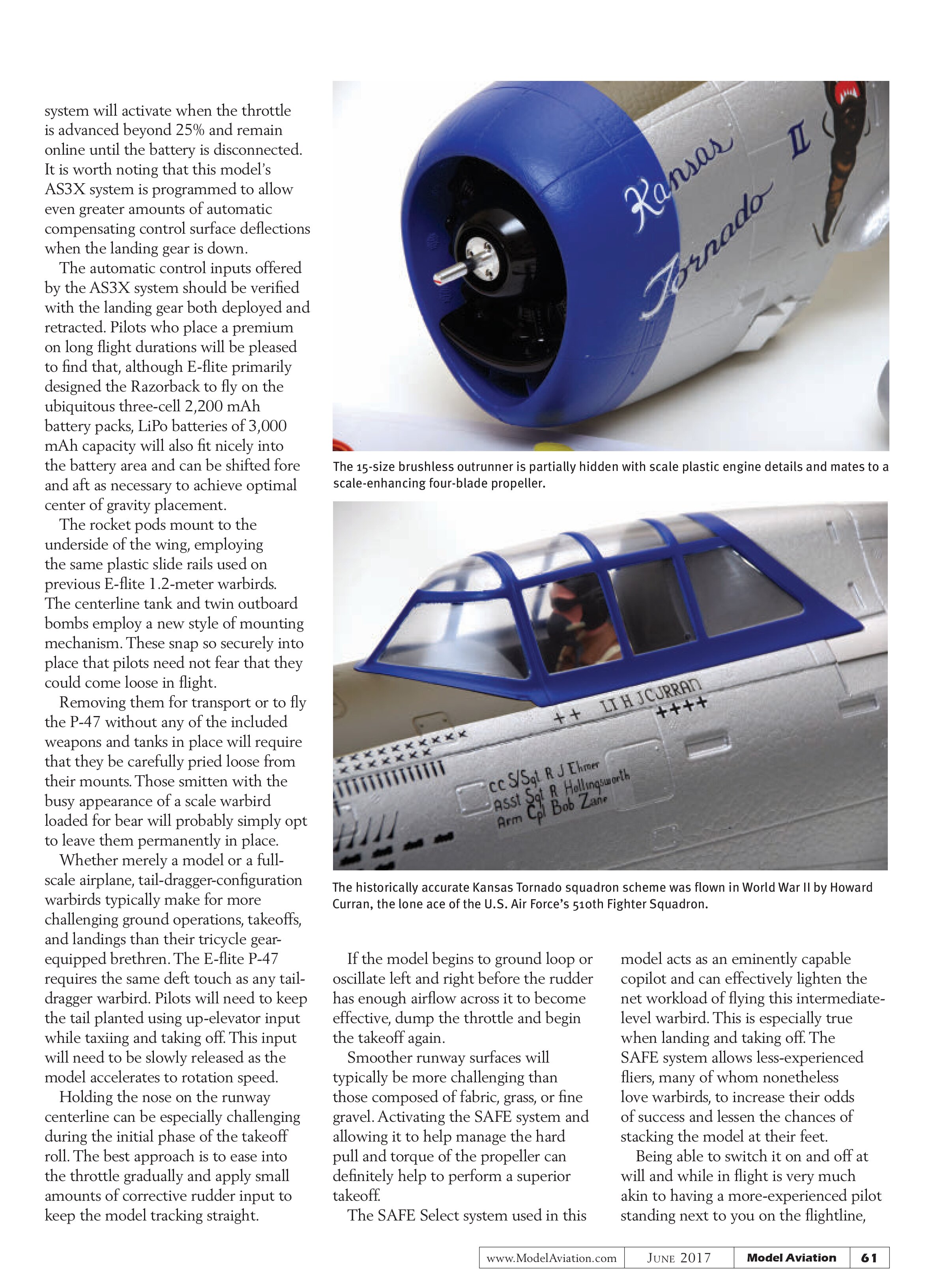
The 15-size brushless outrunner is partially hidden with scale plastic engine details and mates to a scale-enhancing four-blade propeller.

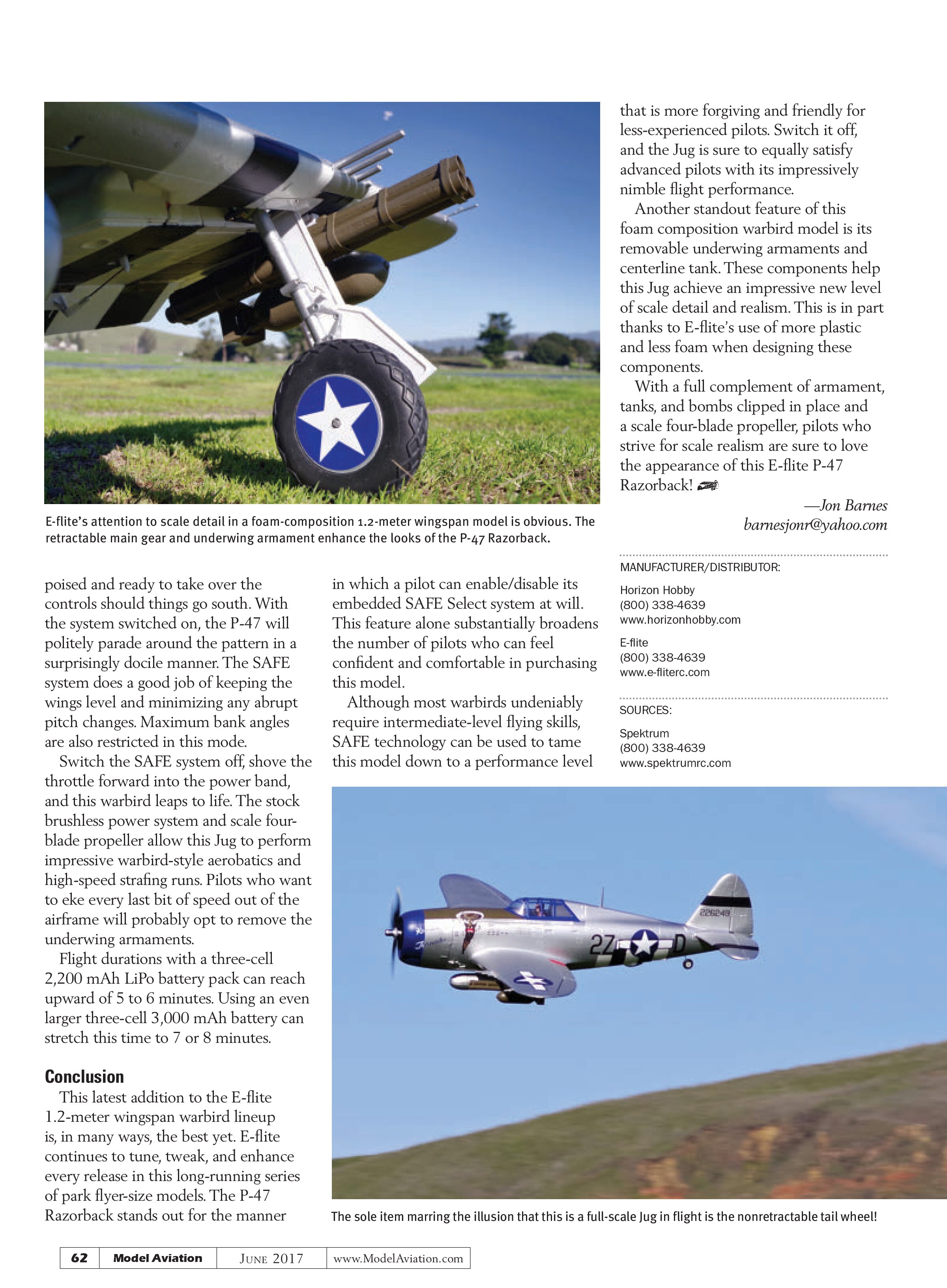
The historically accurate Kansas Tornado squadron scheme was flown in World War II by Howard Curran, the lone ace of the U.S. Air Force’s 510th Fighter Squadron.


poised and ready to take over the controls should things go south. With the system switched on, the P-47 will politely parade around the pattern in a surprisingly docile manner. The SAFE system does a good job of keeping the wings level and minimizing any abrupt pitch changes. Maximum bank angles are also restricted in this mode.
Switch the SAFE system off, shove the throttle forward into the power band, and this warbird leaps to life. The stock brushless power system and scale four-blade propeller allow this Jug to perform impressive warbird-style aerobatics and high-speed strafing runs. Pilots who want to eke every last bit of speed out of the airframe will probably opt to remove the underwing armaments.
Flight durations with a three-cell 2,200 mAh LiPo battery pack can reach upward of 5 to 6 minutes. Using an even larger three-cell 3,000 mAh battery can stretch this time to 7 or 8 minutes.
Conclusion
This latest addition to the E-flite 1.2-meter wingspan warbird lineup is, in many ways, the best yet. E-flite continues to tune, tweak, and enhance every release in this long-running series of park flyer-size models. The P-47 Razorback stands out for the manner
in which a pilot can enable/disable its embedded SAFE Select system at will. This feature alone substantially broadens the number of pilots who can feel confident and comfortable in purchasing this model.
Although most warbirds undeniably require intermediate-level flying skills, SAFE technology can be used to tame this model down to a performance level that is more forgiving and friendly for less-experienced pilots. Switch it off, and the Jug is sure to equally satisfy advanced pilots with its impressively nimble flight performance.
Another standout feature of this foam composition warbird model is its removable underwing armaments and centerline tank. These components help this Jug achieve an impressive new level of scale detail and realism. This is in part thanks to E-flite’s use of more plastic and less foam when designing these components.
With a full complement of armament, tanks, and bombs clipped in place and a scale four-blade propeller, pilots who strive for scale realism are sure to love the appearance of this E-flite P-47 Razorback!
—Jon Barnes
barnesjonr@yahoo.com
MANUFACTURER/DISTRIBUTOR:
Horizon Hobby
(800) 338-4639
www.horizonhobby.com
E-flite
(800) 338-4639
www.e-fliterc.com
SOURCES:
Spektrum
(800) 338-4639
www.spektrumrc.com