Focal Point
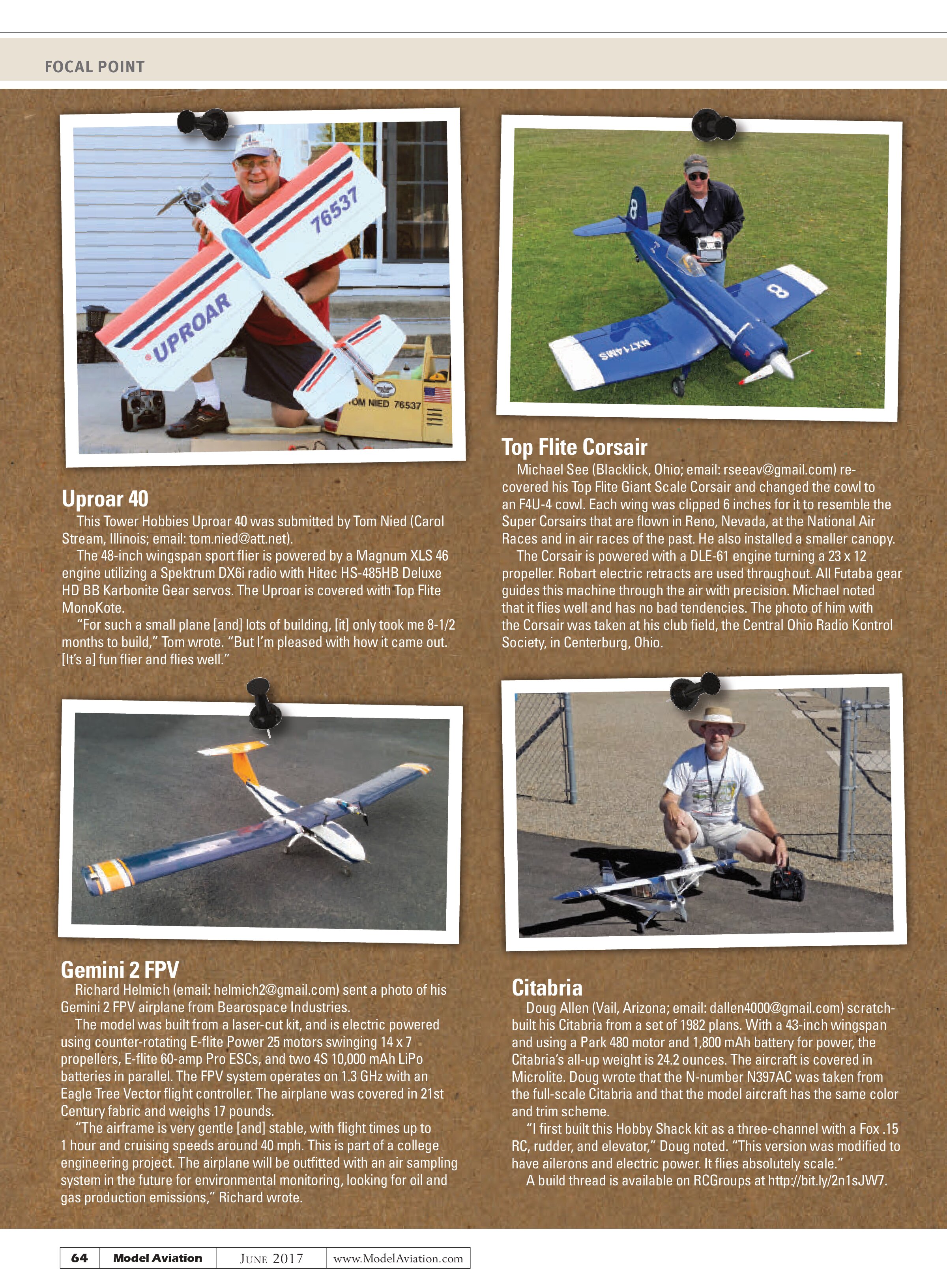
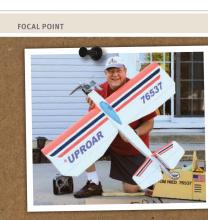
Uproar 40
This Tower Hobbies Uproar 40 was submitted by Tom Nied (Carol Stream, Illinois; email: tom.nied@att.net).
The 48-inch wingspan sport flier is powered by a Magnum XLS 46 engine utilizing a Spektrum DX6i radio with Hitec HS-485HB Deluxe HD BB Karbonite Gear servos. The Uproar is covered with Top Flite MonoKote.
“For such a small plane [and] lots of building, [it] only took me 8-1/2 months to build,” Tom wrote. “But I’m pleased with how it came out. [It’s a] fun flier and flies well.”

Gemini 2 FPV
Richard Helmich (email: helmich2@gmail.com) sent a photo of his Gemini 2 FPV airplane from Bearospace Industries.
The model was built from a laser-cut kit, and is electric powered using counter-rotating E-flite Power 25 motors swinging 14 x 7 propellers, E-flite 60-amp Pro ESCs, and two 4S 10,000 mAh LiPo batteries in parallel. The FPV system operates on 1.3 GHz with an Eagle Tree Vector flight controller. The airplane was covered in 21st Century fabric and weighs 17 pounds.
“The airframe is very gentle [and] stable, with flight times up to 1 hour and cruising speeds around 40 mph. This is part of a college engineering project. The airplane will be outfitted with an air sampling system in the future for environmental monitoring, looking for oil and gas production emissions,” Richard wrote.

Top Flite Corsair
Michael See (Blacklick, Ohio; email: rseeav@gmail.com) recovered his Top Flite Giant Scale Corsair and changed the cowl to an F4U-4 cowl. Each wing was clipped 6 inches for it to resemble the Super Corsairs that are flown in Reno, Nevada, at the National Air Races and in air races of the past. He also installed a smaller canopy.
The Corsair is powered with a DLE-61 engine turning a 23 x 12 propeller. Robart electric retracts are used throughout. All Futaba gear guides this machine through the air with precision. Michael noted that it flies well and has no bad tendencies. The photo of him with the Corsair was taken at his club field, the Central Ohio Radio Kontrol Society, in Centerburg, Ohio.

Citabria
Doug Allen (Vail, Arizona; email: dallen4000@gmail.com) scratch-built his Citabria from a set of 1982 plans. With a 43-inch wingspan and using a Park 480 motor and 1,800 mAh battery for power, the Citabria’s all-up weight is 24.2 ounces. The aircraft is covered in Microlite. Doug wrote that the N-number N397AC was taken from the full-scale Citabria and that the model aircraft has the same color and trim scheme.
“I first built this Hobby Shack kit as a three-channel with a Fox .15 RC, rudder, and elevator,” Doug noted. “This version was modified to have ailerons and electric power. It flies absolutely scale.”
A build thread is available on RCGroups at http://bit.ly/2n1sJW7.

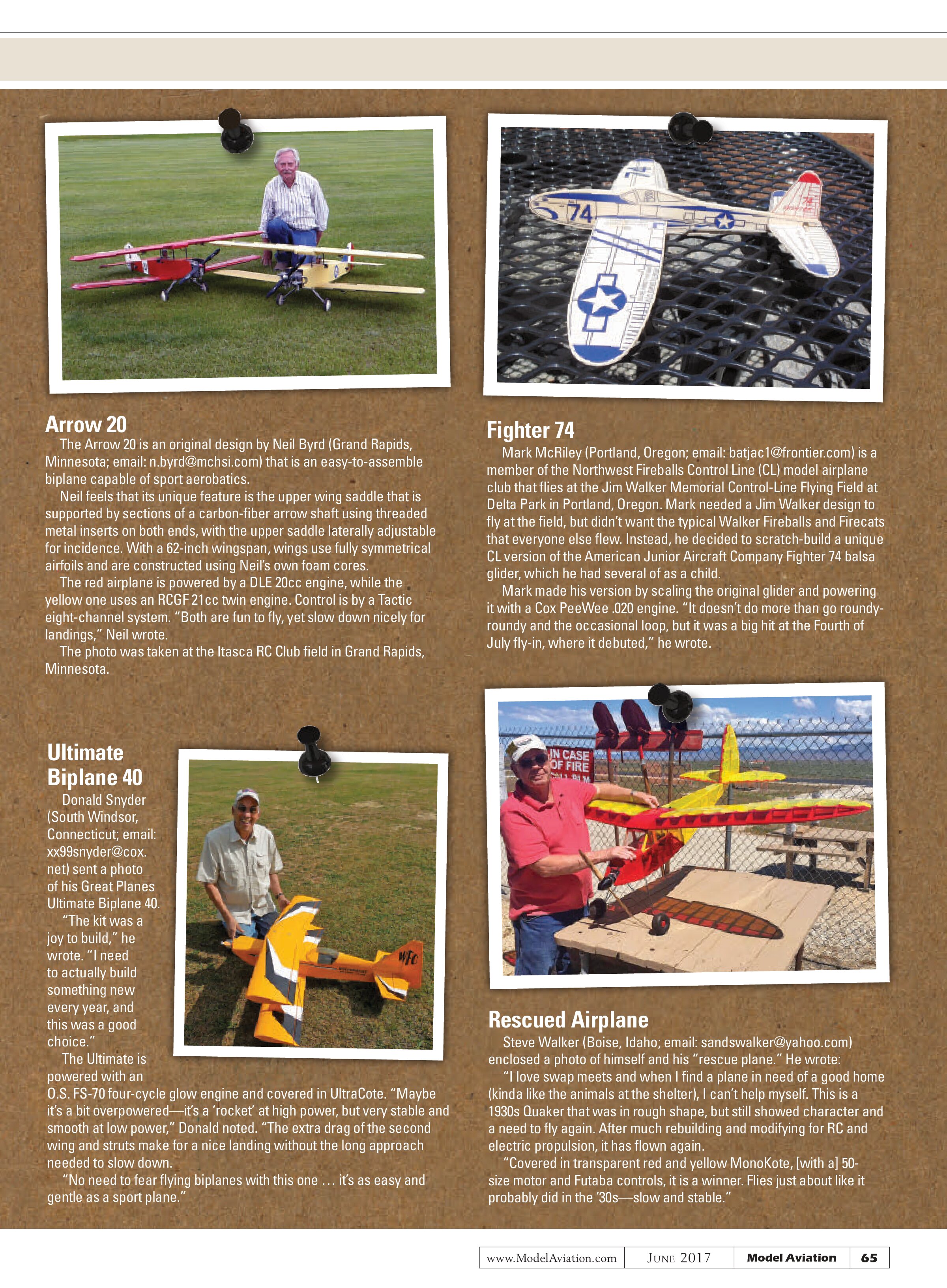
Arrow 20
The Arrow 20 is an original design by Neil Byrd (Grand Rapids, Minnesota; email: n.byrd@mchsi.com) that is an easy-to-assemble biplane capable of sport aerobatics.
Neil feels that its unique feature is the upper wing saddle that is supported by sections of a carbon-fiber arrow shaft using threaded metal inserts on both ends, with the upper saddle laterally adjustable for incidence. With a 62-inch wingspan, wings use fully symmetrical airfoils and are constructed using Neil’s own foam cores.
The red airplane is powered by a DLE 20cc engine, while the yellow one uses an RCGF 21cc twin engine. Control is by a Tactic eight-channel system. “Both are fun to fly, yet slow down nicely for landings,” Neil wrote.
The photo was taken at the Itasca RC Club field in Grand Rapids, Minnesota.

Ultimate Biplane 40
Donald Snyder (South Windsor, Connecticut; email: xx99snyder@cox.net) sent a photo of his Great Planes Ultimate Biplane 40. “The kit was a joy to build,” he wrote. “I need to actually build something new every year, and this was a good choice.”
The Ultimate is powered with an O.S. FS-70 four-cycle glow engine and covered in UltraCote. “Maybe it’s a bit overpowered—it’s a ‘rocket’ at high power, but very stable and smooth at low power,” Donald noted. “The extra drag of the second wing and struts make for a nice landing without the long approach needed to slow down.
“No need to fear flying biplanes with this one … it’s as easy and gentle as a sport plane.”

Fighter 74
Mark McRiley (Portland, Oregon; email: batjac1@frontier.com) is a member of the Northwest Fireballs Control Line (CL) model airplane club that flies at the Jim Walker Memorial Control-Line Flying Field at Delta Park in Portland, Oregon. Mark needed a Jim Walker design to fly at the field, but didn’t want the typical Walker Fireballs and Firecats that everyone else flew. Instead, he decided to scratch-build a unique CL version of the American Junior Aircraft Company Fighter 74 balsa glider, which he had several of as a child.
Mark made his version by scaling the original glider and powering it with a Cox PeeWee .020 engine. “It doesn’t do more than go roundy-roundy and the occasional loop, but it was a big hit at the Fourth of July fly-in, where it debuted,” he wrote.

Rescued Airplane
Steve Walker (Boise, Idaho; email: sandswalker@yahoo.com) enclosed a photo of himself and his “rescue plane.” He wrote:
“I love swap meets and when I find a plane in need of a good home (kinda like the animals at the shelter), I can’t help myself. This is a 1930s Quaker that was in rough shape, but still showed character and a need to fly again. After much rebuilding and modifying for RC and electric propulsion, it has flown again.
“Covered in transparent red and yellow MonoKote, [with a] 50-size motor and Futaba controls, it is a winner. Flies just about like it probably did in the ’30s—slow and stable.”

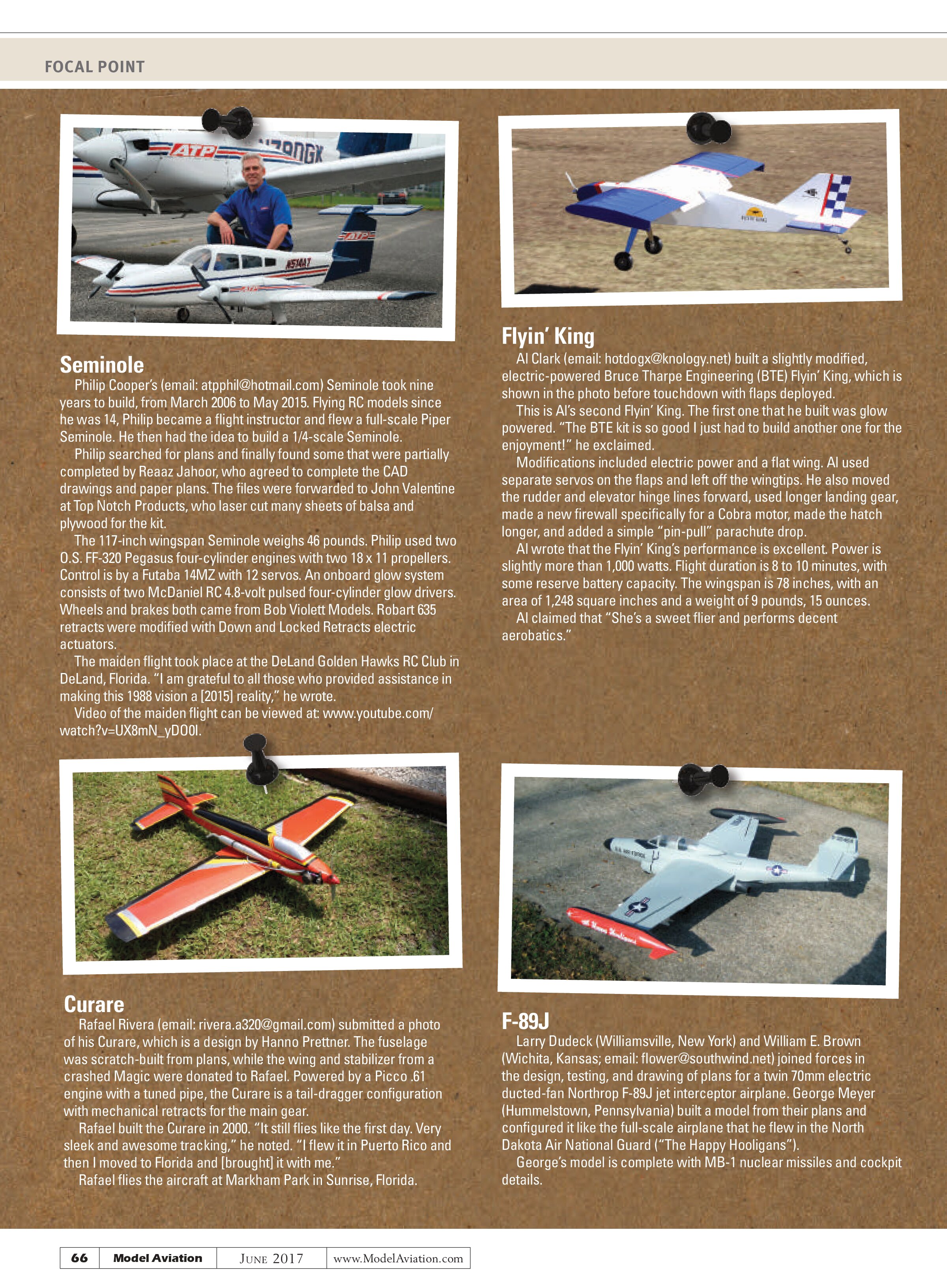
Seminole
Philip Cooper’s (email: atphil@hotmail.com) Seminole took nine years to build, from March 2006 to May 2015. Flying RC models since he was 14, Philip became a flight instructor and flew a full-scale Piper Seminole. He then had the idea to build a 1/4-scale Seminole.
Philip searched for plans and finally found some that were partially completed by Reaaz Jahoor, who agreed to complete the CAD drawings and paper plans. The files were forwarded to John Valentine at Top Notch Products, who laser cut many sheets of balsa and plywood for the kit.
The 117-inch wingspan Seminole weighs 46 pounds. Philip used two O.S. FF-320 Pegasus four-cylinder engines with two 18 x 11 propellers. Control is by a Futaba 14MZ with 12 servos. An onboard glow system consists of two McDaniel RC 4.8-volt pulsed four-cylinder glow drivers. Wheels and brakes both came from Bob Violett Models. Robart 635 retracts were modified with Down and Locked Retracts electric actuators.
The maiden flight took place at the Del and Golden Hawks RC Club in DeLand, Florida. “I am grateful to all those who provided assistance in making this 1988 vision a [2015] reality,” he wrote.
Video of the maiden flight can be viewed at: www.youtube.com/watch?v=UX8mN_yD00I.

Flyin’ King
Al Clark (email: hotdogx@knology.net) built a slightly modified, electric-powered Bruce Tharpe Engineering (BTE) Flyin’ King, which is shown in the photo before touchdown with flaps deployed.
This is Al’s second Flyin’ King. The first one that he built was glow powered. “The BTE kit is so good I just had to build another one for the enjoyment!” he exclaimed.
Modifications included electric power and a flat wing. Al used separate servos on the flaps and left off the wingtips. He also moved the rudder and elevator hinge lines forward, used longer landing gear, made a new firewall specifically for a Cobra motor, made the hatch longer, and added a simple “pin-pull” parachute drop.
Al wrote that the Flyin’ King’s performance is excellent. Power is slightly more than 1,000 watts. Flight duration is 8 to 10 minutes, with some reserve battery capacity. The wingspan is 78 inches, with an area of 1,248 square inches and a weight of 9 pounds, 15 ounces. Al claimed that “She’s a sweet flier and performs decent aerobatics.”

Curare
Rafael Rivera (email: rivera.a320@gmail.com) submitted a photo of his Curare, which is a design by Hanno Prettner. The fuselage was scratch-built from plans, while the wing and stabilizer from a crashed Magic were donated to Rafael. Powered by a Picco .61 engine with a tuned pipe, the Curare is a tail-dragger configuration with mechanical retracts for the main gear.
Rafael built the Curare in 2000. “It still flies like the first day. Very sleek and awesome tracking,” he noted. “I flew it in Puerto Rico and then I moved to Florida and [brought] it with me.”
Rafael flies the aircraft at Markham Park in Sunrise, Florida.

F-89J
Larry Dudeck (Williamsville, New York) and William E. Brown (Wichita, Kansas; email: flower@southwind.net) joined forces in the design, testing, and drawing of plans for a twin 70mm electric ducted-fan Northrop F-89J jet interceptor airplane. George Meyer (Hummelstown, Pennsylvania) built a model from their plans and configured it like the full-scale airplane that he flew in the North Dakota Air National Guard (“The Happy Hooligans”).
George’s model is complete with MB-1 nuclear missiles and cockpit details.

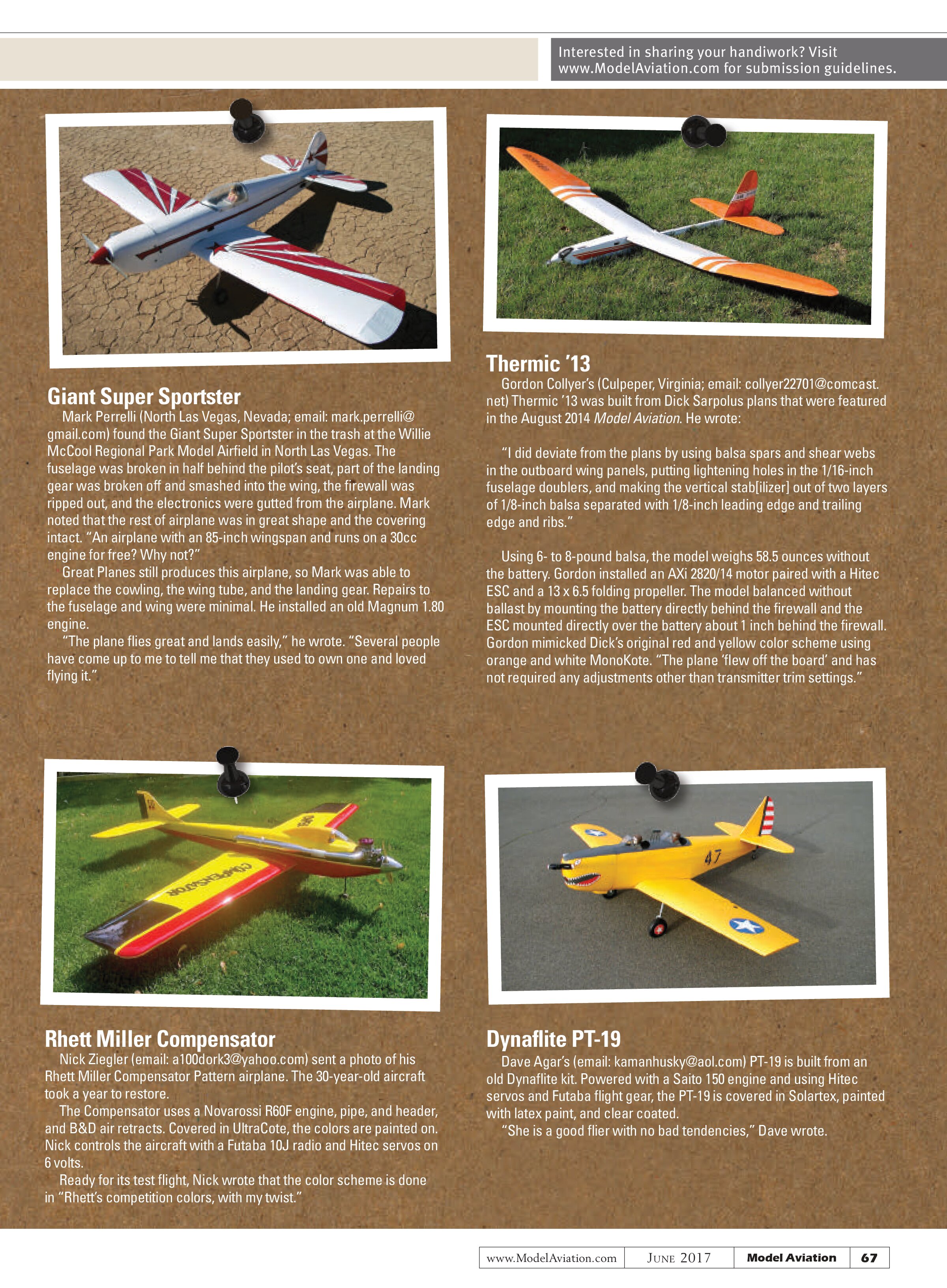
Giant Super Sportster
Mark Perrelli (North Las Vegas, Nevada; email: mark.perrelli@gmail.com) found the Giant Super Sportster in the trash at the Willie McCool Regional Park Model Airfield in North Las Vegas. The fuselage was broken in half behind the pilot’s seat, part of the landing gear was broken off and smashed into the wing, the firewall was ripped out, and the electronics were gutted from the airplane. Mark noted that the rest of airplane was in great shape and the covering intact. “An airplane with an 85-inch wingspan and runs on a 30cc engine for free? Why not?”
Great Planes still produces this airplane, so Mark was able to replace the cowling, the wing tube, and the landing gear. Repairs to the fuselage and wing were minimal. He installed an old Magnum 1.80 engine.
“The plane flies great and lands easily,” he wrote. “Several people have come up to me to tell me that they used to own one and loved flying it.”

Thermic ’13
Gordon Collyer’s (Culpeper, Virginia; email: collyer22701@comcast.net) Thermic ’13 was built from Dick Sarpolus plans that were featured in the August 2014 Model Aviation. He wrote:
“I did deviate from the plans by using balsa spars and shear webs in the outboard wing panels, putting lightening holes in the 1/16-inch fuselage doublers, and making the vertical stab[ilizer] out of two layers of 1/8-inch balsa separated with 1/8-inch leading edge and trailing edge and ribs.”
Using 6- to 8-pound balsa, the model weighs 58.5 ounces without the battery. Gordon installed an AXi 2820/14 motor paired with a Hitec ESC and a 13 x 6.5 folding propeller. The model balanced without ballast by mounting the battery directly behind the firewall and the ESC mounted directly over the battery about 1 inch behind the firewall. Gordon mimicked Dick’s original red and yellow color scheme using orange and white MonoKote. “The plane ‘flew off the board’ and has not required any adjustments other than transmitter trim settings.”

Rhett Miller Compensator
Nick Ziegler (email: a100dork3@yahoo.com) sent a photo of his Rhett Miller Compensator Pattern airplane. The 30-year-old aircraft took a year to restore.
The Compensator uses a Novarossi R60F engine, pipe, and header, and B&D air retracts. Covered in UltraCote, the colors are painted on. Nick controls the aircraft with a Futaba 10J radio and Hitec servos on 6 volts.
Ready for its test flight, Nick wrote that the color scheme is done in “Rhett’s competition colors, with my twist.”

Dynaflite PT-19
Dave Agar’s (email: kamanhusky@aol.com) PT-19 is built from an old Dynaflite kit. Powered with a Saito 150 engine and using Hitec servos and Futaba flight gear, the PT-19 is covered in Solartex, painted with latex paint, and clear coated.
“She is a good flier with no bad tendencies,” Dave wrote.