Searching for the holy grail of charger setups
In the next couple of columns, I plan to discuss finding and building the “perfect” charging setup. This will naturally be different for each person depending on his or her goals and needs, but I hope it will give you an idea of how to quit buying charger after charger before deciding which setup is right for you.
I’ve also received a couple of answers to some battery questions that some of you have asked.
John From Revolectrix Responds
Some of you have been pressing me for answers as to why we should store batteries at storage levels and not just leave them fully charged. John, a battery engineer with Revolectrix, took the time to answer a list of questions that I’ll cover now and in the next few columns. This month’s answer concerning battery storage levels is:
“Storing at high voltage makes the electrolyte react with the cathode over time and pollutes the anode, which leads to higher internal resistance (IR) and loss of capacity. Why does this not happen to cellphones? Because the coatings of anode and cathode are thicker for low C-rate cells.”
I’ve promised not to wear John out with questions, but because he designs these things, who better to ask! Thanks for your questions and thanks to John for taking time to help us out with insider knowledge.
Define Your Charging Needs
Most of us waste money buying various chargers because we don’t stop to think about what we’re going to charge—not just the immediate need, but down the road, too. Take time to figure out what your future plans will be. If you’re never going to go beyond smaller 3S battery-powered airplanes, you don’t need to buy a charger that will do multiple 6S packs at maximum charge rates.
If you might want a larger airplane in the future, think about getting that larger, greater capacity charger now, even if you’re not fully exploiting its power. If you’re not going to go beyond the smaller packs, decide whether you might want to parallel charge. Doing multiple 3S packs at one time is a handy capability, and one I regularly use.
Available Options
There are so many options that I can’t cover them in 12 issues. Look around at your club field and see what people are using. Check out a fly-in, if possible, walk around the pits to look at various setups, and ask other pilots what they think. You’ll be surprised at how candid they will be—and maybe even shocked.
There are very few “bad” chargers around right now. Prices cover a wide range, but I always try to find a charger with a good reputation for capability and service. I want a company that I can call and I want to be able to talk with someone who knows the equipment and can repair it if needed. There are several companies in the US that can do both, and I encourage you to consider those products.
My Case
My needs have changed throughout the years, although my first choice of a charger setup still covers everything nicely. By “charger setup” I mean a box with a self-contained power supply, which I can easily close up and travel with. I want it to protect my valuable charger and be able to carry a few adapters, etc.
The problem I have had with previous setups was the amount of wire and accessories I needed to disconnect and store before closing up the unit. My goal this time was to find a setup that was completely enclosed and contained. I wanted something neat and tidy, where wires wouldn’t get

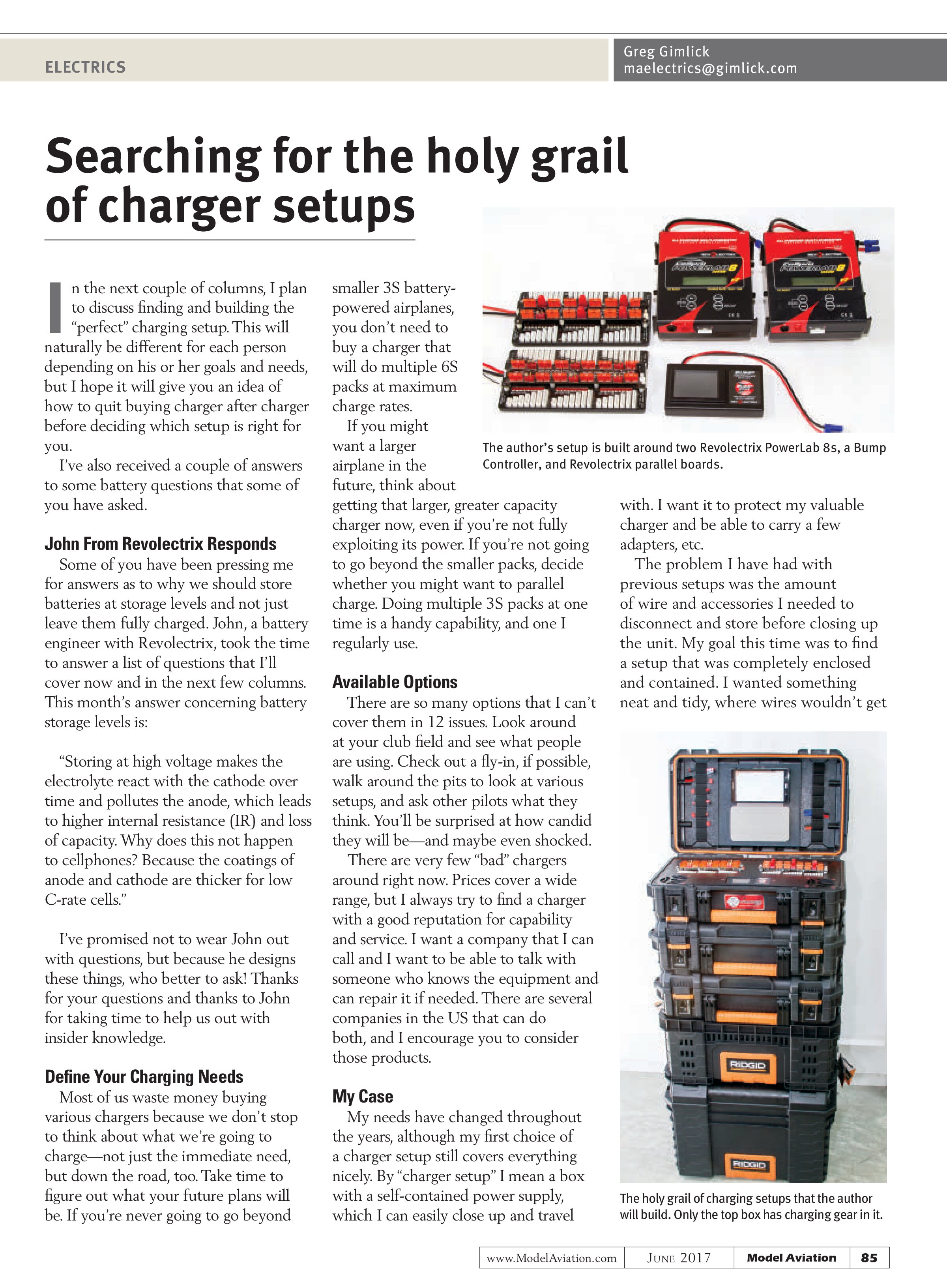
The author’s setup is built around two Revolectrix PowerLab 8s, a Bump Controller, and Revolectrix parallel boards.

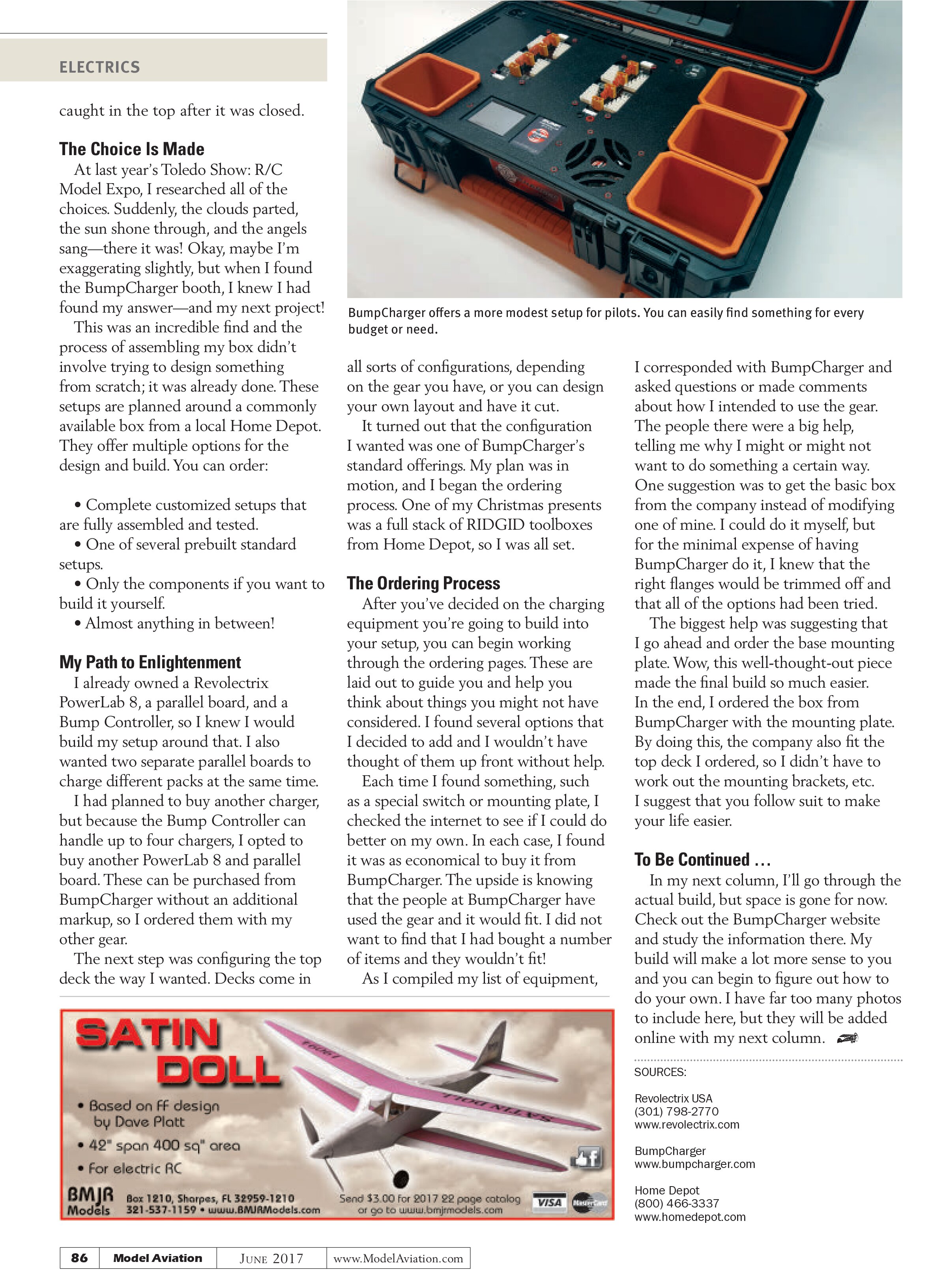
The holy grail of charging setups that the author will build. Only the top box has charging gear in it.
caught in the top after it was closed.
The Choice Is Made
At last year’s Toledo Show: R/C Model Expo, I researched all of the choices. Suddenly, the clouds parted, the sun shone through, and the angels sang—there it was! Okay, maybe I’m exaggerating slightly, but when I found the BumpCharger booth, I knew I had found my answer—and my next project! This was an incredible find and the process of assembling my box didn’t involve trying to design something from scratch; it was already done. These setups are planned around a commonly available box from a local Home Depot. They offer multiple options for the design and build. You can order:
- Complete customized setups that are fully assembled and tested.
- One of several prebuilt standard setups.
- Only the components if you want to build it yourself.
- Almost anything in between!
My Path to Enlightenment
I already owned a Revolectrix PowerLab 8, a parallel board, and a Bump Controller, so I knew I would build my setup around that. I also wanted two separate parallel boards to charge different packs at the same time.
I had planned to buy another charger, but because the Bump Controller can handle up to four chargers, I opted to buy another PowerLab 8 and parallel board. These can be purchased from BumpCharger without an additional markup, so I ordered them with my other gear.
The next step was configuring the top deck the way I wanted. Decks come in

all sorts of configurations, depending on the gear you have, or you can design your own layout and have it cut.
It turned out that the configuration I wanted was one of BumpCharger’s standard offerings. My plan was in motion, and I began the ordering process. One of my Christmas presents was a full stack of RIDGID toolboxes from Home Depot, so I was all set.
The Ordering Process
After you’ve decided on the charging equipment you’re going to build into your setup, you can begin working through the ordering pages. These are laid out to guide you and help you think about things you might not have considered. I found several options that I decided to add and I wouldn’t have thought of them up front without help.
Each time I found something, such as a special switch or mounting plate, I checked the internet to see if I could do better on my own. In each case, I found it was as economical to buy it from BumpCharger. The upside is knowing that the people at BumpCharger have used the gear and it would fit. I did not want to find that I had bought a number of items and they wouldn’t fit!
As I compiled my list of equipment, I corresponded with BumpCharger and asked questions or made comments about how I intended to use the gear. The people there were a big help, telling me why I might or might not want to do something a certain way. One suggestion was to get the basic box from the company instead of modifying one of mine. I could do it myself, but for the minimal expense of having BumpCharger do it, I knew that the right flanges would be trimmed off and that all of the options had been tried.
The biggest help was suggesting that I go ahead and order the base mounting plate. Wow, this well-thought-out piece made the final build so much easier. In the end, I ordered the box from BumpCharger with the mounting plate. By doing this, the company also fit the top deck I ordered, so I didn’t have to work out the mounting brackets, etc. I suggest that you follow suit to make your life easier.
To Be Continued . . .
In my next column, I’ll go through the actual build, but space is gone for now. Check out the BumpCharger website and study the information there. My build will make a lot more sense to you and you can begin to figure out how to do your own. I have far too many photos to include here, but they will be added online with my next column.
SOURCES:
Revolectrix USA
(301) 798-2770
www.revolectrix.com
BumpCharger
www.bumpcharger.com
Home Depot
(800) 466-3337
www.homedepot.com