AMA Expo East
From the Copilot’s Seat by Gary Fitch, Executive Vice President
amaevp@gmail.com

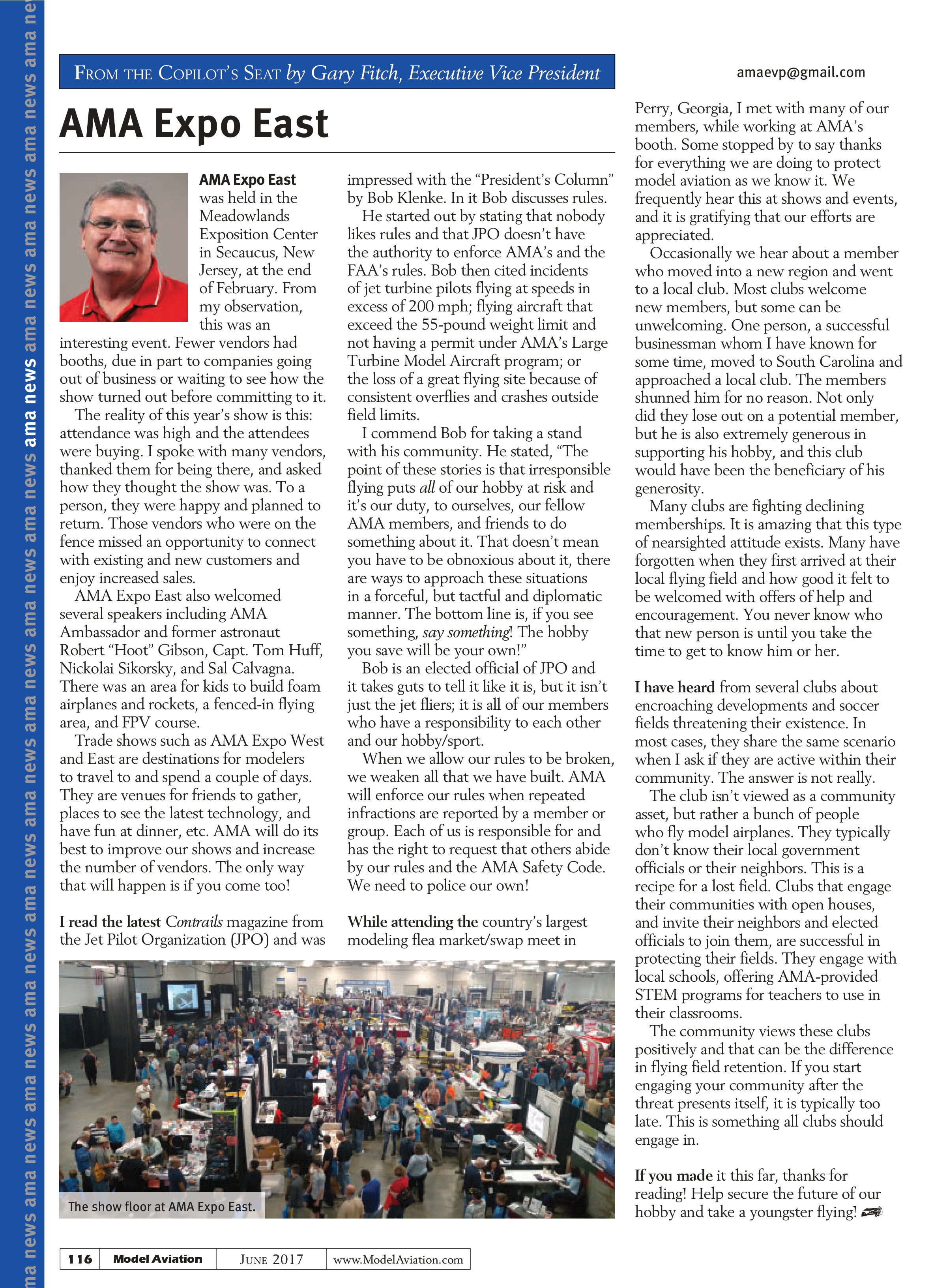
AMA Expo East was held in the Meadowlands Exposition Center in Secaucus, New Jersey, at the end of February. From my observation, this was an interesting event. Fewer vendors had booths, due in part to companies going out of business or waiting to see how the show turned out before committing to it.
The reality of this year’s show is this: attendance was high and the attendees were buying. I spoke with many vendors, thanked them for being there, and asked how they thought the show was. To a person, they were happy and planned to return. Those vendors who were on the fence missed an opportunity to connect with existing and new customers and enjoy increased sales.
AMA Expo East also welcomed several speakers including AMA Ambassador and former astronaut Robert “Hoot” Gibson, Capt. Tom Huff, Nickolai Sikorsky, and Sal Calvagna. There was an area for kids to build foam airplanes and rockets, a fenced-in flying area, and FPV course.
Trade shows such as AMA Expo West and East are destinations for modelers to travel to and spend a couple of days. They are venues for friends to gather, places to see the latest technology, and have fun at dinner, etc. AMA will do its best to improve our shows and increase the number of vendors. The only way that will happen is if you come too!
I read the latest Contrails magazine from the Jet Pilot Organization (JPO) and was impressed with the “President’s Column” by Bob Klenke. In it Bob discusses rules. He started out by stating that nobody likes rules and that JPO doesn’t have the authority to enforce AMA’s and the FAA’s rules. Bob then cited incidents of jet turbine pilots flying at speeds in excess of 200 mph; flying aircraft that exceed the 55-pound weight limit and not having a permit under AMA’s Large Turbine Model Aircraft program; or the loss of a great flying site because of consistent overflies and crashes outside field limits.
I commend Bob for taking a stand with his community. He stated, “The point of these stories is that irresponsible flying puts all of our hobby at risk and it’s our duty, to ourselves, our fellow AMA members, and friends to do something about it. That doesn’t mean you have to be obnoxious about it, there are ways to approach these situations in a forceful, but tactful and diplomatic manner. The bottom line is, if you see something, say something! The hobby you save will be your own!”
Bob is an elected official of JPO and it takes guts to tell it like it is, but it isn’t just the jet fliers; it is all of our members who have a responsibility to each other and our hobby/sport.
When we allow our rules to be broken, we weaken all that we have built. AMA will enforce our rules when repeated infractions are reported by a member or group. Each of us is responsible for and has the right to request that others abide by our rules and the AMA Safety Code. We need to police our own!
While attending the country’s largest modeling flea market/swap meet in

Perry, Georgia, I met with many of our members, while working at AMA’s booth. Some stopped by to say thanks for everything we are doing to protect model aviation as we know it. We frequently hear this at shows and events, and it is gratifying that our efforts are appreciated.
Occasionally we hear about a member who moved into a new region and went to a local club. Most clubs welcome new members, but some can be unwelcoming. One person, a successful businessman whom I have known for some time, moved to South Carolina and approached a local club. The members shunned him for no reason. Not only did they lose out on a potential member, but he is also extremely generous in supporting his hobby, and this club would have been the beneficiary of his generosity.
Many clubs are fighting declining memberships. It is amazing that this type of nearsighted attitude exists. Many have forgotten when they first arrived at their local flying field and how good it felt to be welcomed with offers of help and encouragement. You never know who that new person is until you take the time to get to know him or her.
I have heard from several clubs about encroaching developments and soccer fields threatening their existence. In most cases, they share the same scenario when I ask if they are active within their community. The answer is not really.
The club isn’t viewed as a community asset, but rather a bunch of people who fly model airplanes. They typically don’t know their local government officials or their neighbors. This is a recipe for a lost field. Clubs that engage their communities with open houses, and invite their neighbors and elected officials to join them, are successful in protecting their fields. They engage with local schools, offering AMA-provided STEM programs for teachers to use in their classrooms.
The community views these clubs positively and that can be the difference in flying field retention. If you start engaging your community after the threat presents itself, it is typically too late. This is something all clubs should engage in.
If you made it this far, thanks for reading! Help secure the future of our hobby and take a youngster flying!