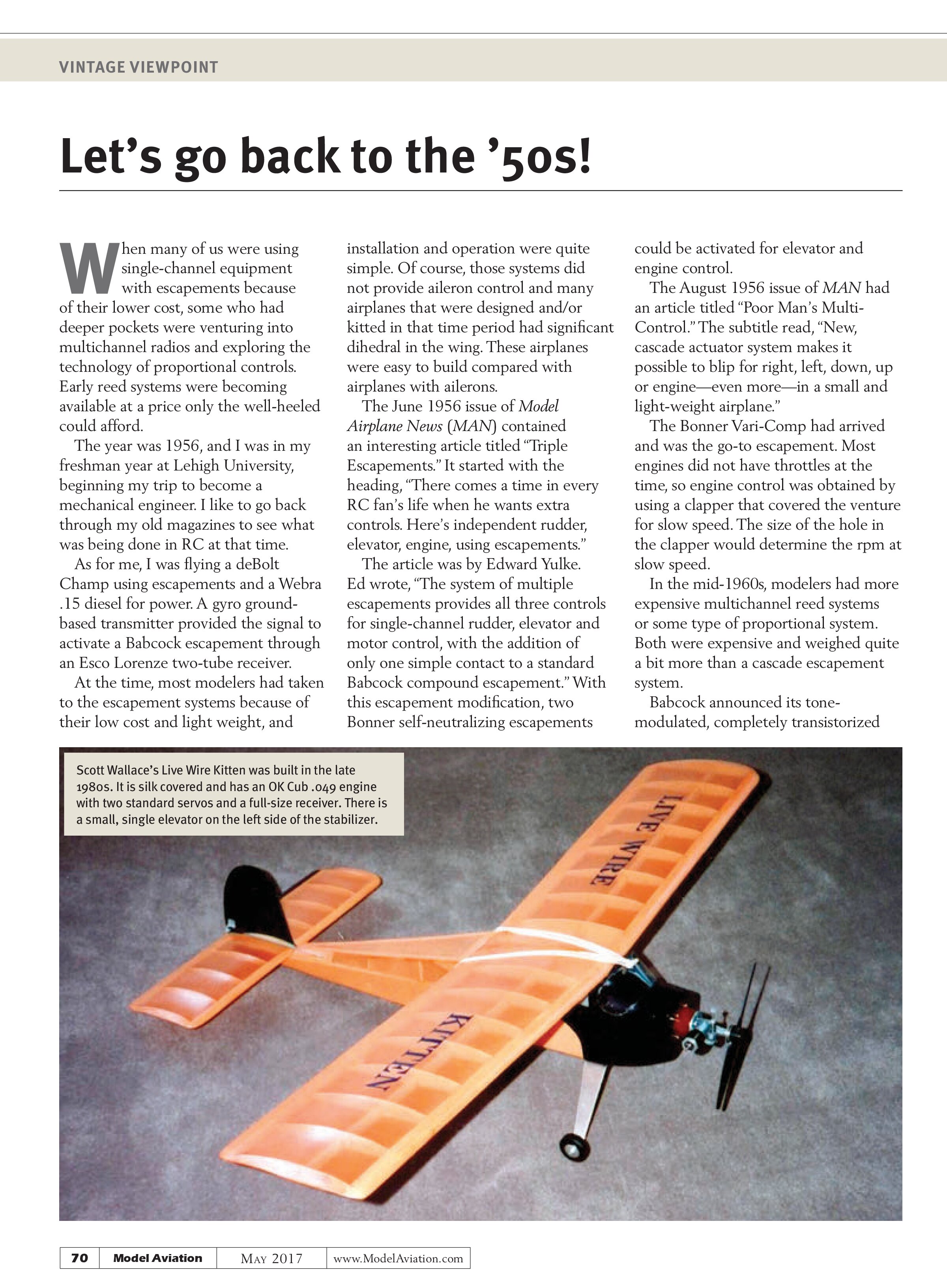
Let’s go back to the ’50s!
When many of us were using single-channel equipment with escapements because of their lower cost, some who had deeper pockets were venturing into multichannel radios and exploring the technology of proportional controls. Early reed systems were becoming available at a price only the well-heeled could afford.
The year was 1956, and I was in my freshman year at Lehigh University, beginning my trip to become a mechanical engineer. I like to go back through my old magazines to see what was being done in RC at that time.
As for me, I was flying a deBolt Champ using escapements and a Webra .15 diesel for power. A gyro ground-based transmitter provided the signal to activate a Babcock escapement through an Esco Lorenze two-tube receiver.
At the time, most modelers had taken to the escapement systems because of their low cost and light weight, and installation and operation were quite simple. Of course, those systems did not provide aileron control and many airplanes that were designed and/or kitted in that time period had significant dihedral in the wing. These airplanes were easy to build compared with airplanes with ailerons.
The June 1956 issue of Model Airplane News (MAN) contained an interesting article titled “Triple Escapements.” It started with the heading, “There comes a time in every RC fan’s life when he wants extra controls. Here’s independent rudder, elevator, engine, using escapements.”
The article was by Edward Yulke. Ed wrote, “The system of multiple escapements provides all three controls for single-channel rudder, elevator and motor control, with the addition of only one simple contact to a standard Babcock compound escapement.” With this escapement modification, two Bonner self-neutralizing escapements could be activated for elevator and engine control.
The August 1956 issue of MAN had an article titled “Poor Man’s Multi-Control.” The subtitle read, “New, cascade actuator system makes it possible to blip for right, left, down, up or engine—even more—in a small and light-weight airplane.”
The Bonner Vari-Comp had arrived and was the go-to escapement. Most engines did not have throttles at the time, so engine control was obtained by using a clapper that covered the venture for slow speed. The size of the hole in the clapper would determine the rpm at slow speed.
In the mid-1960s, modelers had more expensive multichannel reed systems or some type of proportional system. Both were expensive and weighed quite a bit more than a cascade escapement system.
Babcock announced its tone-modulated, completely transistorized

radio control system with modern printed circuits. The company’s ad read, “America’s first interference-free receivers operating on 465 Mc.” A single-channel receiver sold for $39.95 and a two-channel receiver cost $69.95. The transmitter sold for $69.95 and was advertised as the first and only 465-megacycle (Mc) modulated-tone transmitter on the market, with two modulation tones that could be used independently or simultaneously.
Berkeley advertised its Super Aerotrol crystal-controlled, single-channel system on 27 Mc in assembled or kit form for both receiver and transmitter. The assembled receiver cost $21.95, while the kit cost $13.95. The assembled transmitter cost $27.95 and was $19.95 in kit form.
The September 1956 issue of MAN had an article by Ernest Kratzet titled “This is Multi.” Ernest defined multichannel as five or more channels. The basic theory behind this type of flying is that for each job to be done,


there is a separate channel available; therefore, the problems with using a single channel for two or more operations are eliminated.
The use of reed banks was growing in popularity, along with motorized servos. Ernest used deBolt servos in his deBolt Model Engineering Co. (DMECO) LiveWire Cruiser. Most multisystems used relays along with the reed bank. Multireceivers later used transistors to eliminate the need for relays, and motor-driven servos were transistorized.
At the time, Hal deBolt and DMECO kitted a variety of RC kits for rudder-only and multicontrol. The rudder-only Kitten was designed for ½A engines—the kit cost $3.95. The Trainer was also a rudder-only airplane for .09 to .15-size engines and cost $6.95. Hal introduced his Champion as an RC Scale Aeronca for $10.95 and it became one of his best-selling kits. His Cruiser was designed for multi or rudder only with a .19 to .29 engine and cost $14.95. The Cruiser won the Nats in 1955.
DMECO also introduced two engine control servos. The 3P3N operated on 1½ volts for single channel and cost $11.95. The 3P3NX operated on 3 volts and cost $14.95. Both required a relay for operation.
Correction
I received the following email from Jack Albrecht, correcting my photo

captions in the January 2017 “Vintage Viewpoint.”
“I note that you included two photos of a couple of my Old-Timer birds, [the] Kraft Kwik Fli III and my Flat Top Stormer. However, my Flat Top Stormer is not ‘downsized’ as it mentions in the model’s information.
“The original Stormer plans that I have, which show a turtledeck, have a 63-inch wingspan. The American Modeler of May 1962 published the plans for Doug [Spreng’s] Flat Top Stormer, which is the one he flew to win the AMA Nats Pattern contest. My Flat Top Stormer American Modeler plans have a similar span that is within an inch or so. Sometimes the reproduction of plans tend to shrink plans.”