Are smaller flying sites helping smaller classes make a comeback?
by Gordon Buckland
gordon@gatorf3b.com
If you haven’t heard about the F3-Rudder-Elevator-Spoiler (RES) class yet, you must have spent the last 12 months with your head somewhere away from Thermal Soaring—maybe indulging in other RC activities or taking care of the “honey-do” list.
While you were away, the RC Soaring community in the US became excited about something “sort of” new. F3-RES is a new two-meter, mostly wood, bungee-launched Soaring class that was developed in Europe throughout the last couple of years.
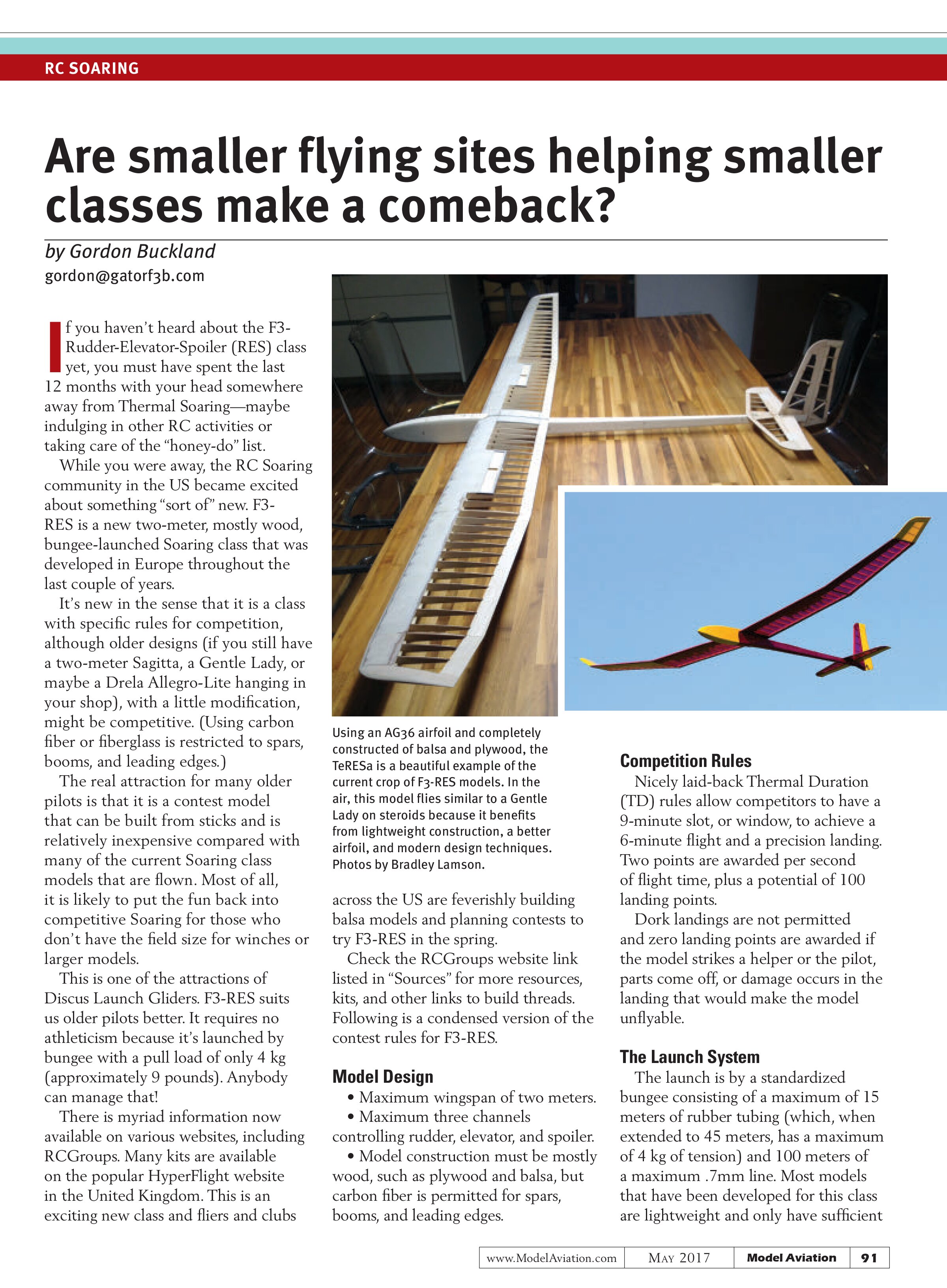
It’s new in the sense that it is a class with specific rules for competition, although older designs (if you still have a two-meter Sagitta, a Gentle Lady, or maybe a Drela Allegro-Lite hanging in your shop), with a little modification, might be competitive. (Using carbon fiber or fiberglass is restricted to spars, booms, and leading edges.)
The real attraction for many older pilots is that it is a contest model that can be built from sticks and is relatively inexpensive compared with many of the current Soaring class models that are flown. Most of all, it is likely to put the fun back into competitive Soaring for those who don’t have the field size for winches or larger models.
This is one of the attractions of Discus Launch Gliders. F3-RES suits us older pilots better. It requires no athleticism because it’s launched by bungee with a pull load of only 4 kg (approximately 9 pounds). Anybody can manage that!
There is myriad information now available on various websites, including RCGroups. Many kits are available on the popular HyperFlight website in the United Kingdom. This is an exciting new class and fliers and clubs


across the US are feverishly building balsa models and planning contests to try F3-RES in the spring.
Check the RCGroups website link listed in “Sources” for more resources, kits, and other links to build threads. Following is a condensed version of the contest rules for F3-RES.
Model Design
- Maximum wingspan of two meters.
- Maximum three channels controlling rudder, elevator, and spoiler.
- Model construction must be mostly wood, such as plywood and balsa, but carbon fiber is permitted for spars, booms, and leading edges.
Competition Rules
Nicely laid-back Thermal Duration (TD) rules allow competitors to have a 9-minute slot, or window, to achieve a 6-minute flight and a precision landing. Two points are awarded per second of flight time, plus a potential of 100 landing points.
Dork landings are not permitted and zero landing points are awarded if the model strikes a helper or the pilot, parts come off, or damage occurs in the landing that would make the model unflyable.
The Launch System
The launch is by a standardized bungee consisting of a maximum of 15 meters of rubber tubing (which, when extended to 45 meters, has a maximum of 4 kg of tension) and 100 meters of a maximum .7mm line. Most models that have been developed for this class are lightweight and only have sufficient


spar strength to withstand a bungee launch. Using these models with a winch could cause the wing structure to fail.
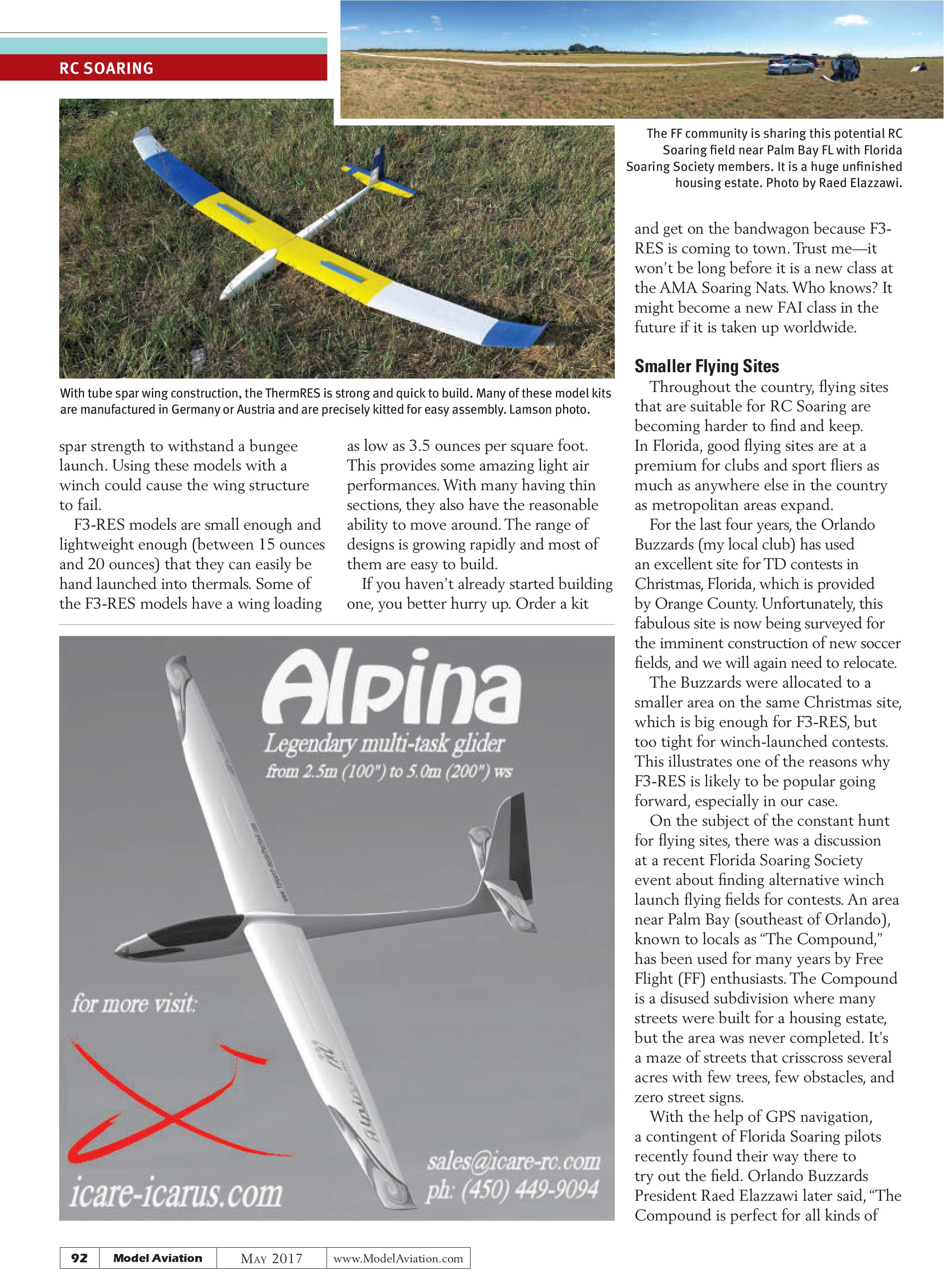
F3-RES models are small enough and lightweight enough (between 15 ounces and 20 ounces) that they can easily be hand launched into thermals. Some of the F3-RES models have a wing loading
as low as 3.5 ounces per square foot. This provides some amazing light air performances. With many having thin sections, they also have the reasonable ability to move around. The range of designs is growing rapidly and most of them are easy to build.
If you haven’t already started building one, you better hurry up. Order a kit
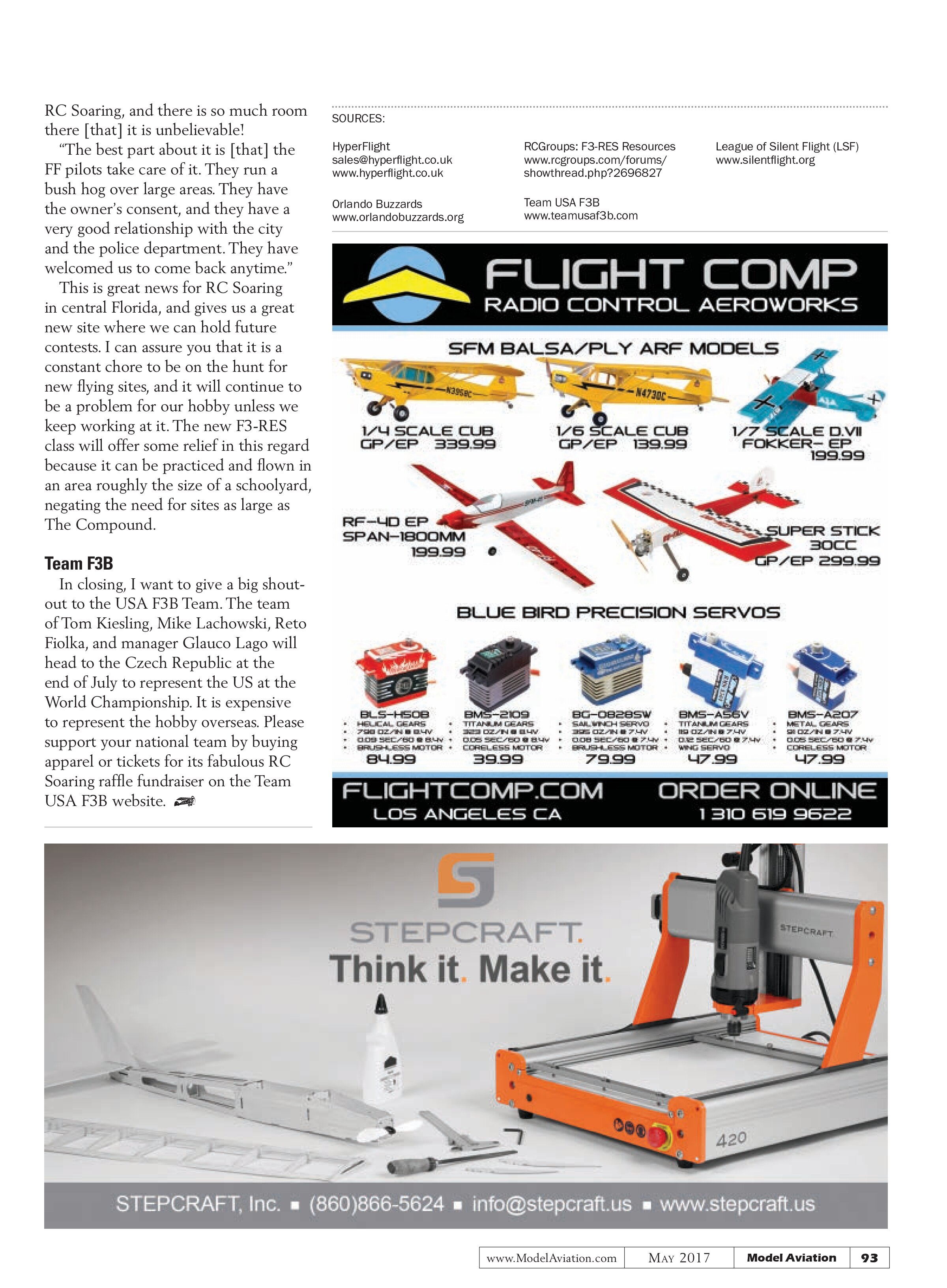
With tube spar wing construction, the ThermRES is strong and quick to build. Many of these model kits are manufactured in Germany or Austria and are precisely kitted for easy assembly. Lamson photo.
and get on the bandwagon because F3-RES is coming to town. Trust me—it won’t be long before it is a new class at the AMA Soaring Nats. Who knows? It might become a new FAI class in the future if it is taken up worldwide.
Smaller Flying Sites
Throughout the country, flying sites that are suitable for RC Soaring are becoming harder to find and keep. In Florida, good flying sites are at a premium for clubs and sport fliers as much as anywhere else in the country as metropolitan areas expand.
For the last four years, the Orlando Buzzards (my local club) has used an excellent site for TD contests in Christmas, Florida, which is provided by Orange County. Unfortunately, this fabulous site is now being surveyed for the imminent construction of new soccer fields, and we will again need to relocate.
The Buzzards were allocated to a smaller area on the same Christmas site, which is big enough for F3-RES, but too tight for winch-launched contests. This illustrates one of the reasons why F3-RES is likely to be popular going forward, especially in our case.
On the subject of the constant hunt for flying sites, there was a discussion at a recent Florida Soaring Society event about finding alternative winch launch flying fields for contests. An area near Palm Bay (southeast of Orlando), known to locals as “The Compound,” has been used for many years by Free Flight (FF) enthusiasts. The Compound is a disused subdivision where many streets were built for a housing estate, but the area was never completed. It’s a maze of streets that crisscross several acres with few trees, few obstacles, and zero street signs.
With the help of GPS navigation, a contingent of Florida Soaring pilots recently found their way there to try out the field. Orlando Buzzards President Raed Elazzawi later said, “The Compound is perfect for all kinds of RC Soaring, and there is so much room there [that] it is unbelievable!”
“The best part about it is [that] the FF pilots take care of it. They run a bush hog over large areas. They have the owner’s consent, and they have a very good relationship with the city and the police department. They have welcomed us to come back anytime.”
This is great news for RC Soaring in central Florida, and gives us a great new site where we can hold future contests. I can assure you that it is a constant chore to be on the hunt for new flying sites, and it will continue to be a problem for our hobby unless we keep working at it. The new F3-RES class will offer some relief in this regard because it can be practiced and flown in an area roughly the size of a schoolyard, negating the need for sites as large as The Compound.
Team F3B
In closing, I want to give a big shout-out to the USA F3B Team. The team of Tom Kiesling, Mike Lachowski, Reto Fiolka, and manager Glauco Lago will head to the Czech Republic at the end of July to represent the US at the World Championship. It is expensive to represent the hobby overseas. Please support your national team by buying apparel or tickets for its fabulous RC Soaring raffle fundraiser on the Team USA F3B website.
SOURCES:
HyperFlight
sales@hyperflight.co.uk
www.hyperflight.co.uk
RCGroups: F3-RES Resources
www.rcgroups.com/forums/
showthread.php?2696827
League of Silent Flight (LSF)
www.silentflight.org
Orlando Buzzards
www.orlandobuzzards.org
Team USA F3B
www.teamusaf3b.com