Tailpipes
by Jim Hiller
jetmodeler@earthlink.net

One of the least understood items in our RC jets is the tailpipe—a critical item that allows a clean, safe path for the turbine motor exhaust to exit the rear of the airframe without burning up the back end of the aircraft.
The most common question that is asked about the tailpipe is about how far forward the turbine should be mounted from the tailpipe. This question becomes complicated with additional questions, such as where to take the measurement from on the tailpipe and where to take it from on the turbine.
My measurements are all taken from the turbine nozzle exit and the beginning of the straight wall of the tailpipe. This method has served me well. It should be simple, but like almost anything aviation related, we have options and there are different ways to get to the same answer.
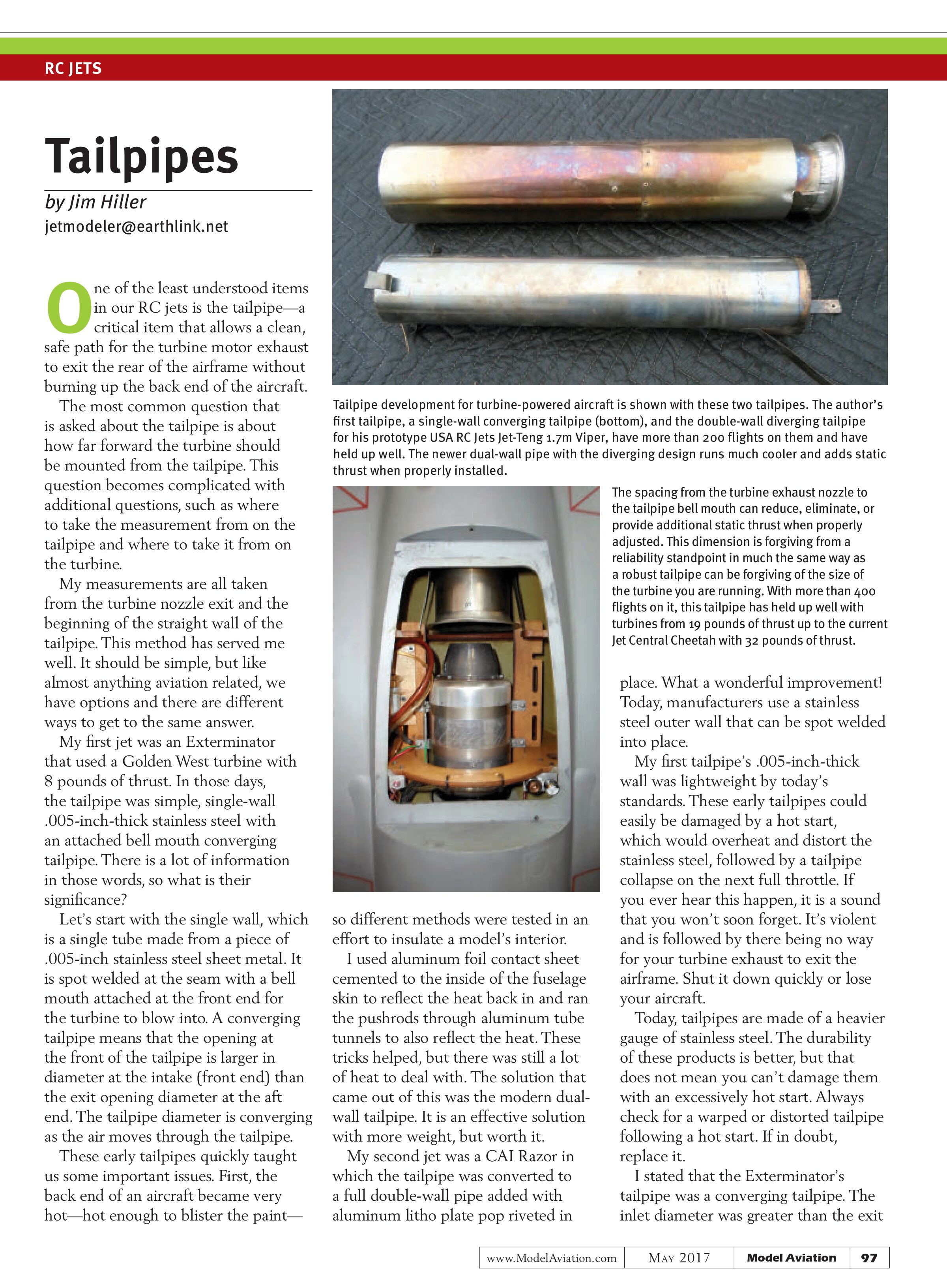
My first jet was an Exterminator that used a Golden West turbine with 8 pounds of thrust. In those days, the tailpipe was simple, single-wall .005-inch-thick stainless steel with an attached bell mouth converging tailpipe. There is a lot of information in those words, so what is their significance?
Let’s start with the single wall, which is a single tube made from a piece of .005-inch stainless steel sheet metal. It is spot welded at the seam with a bell mouth attached at the front end for the turbine to blow into. A converging tailpipe means that the opening at the front of the tailpipe is larger in diameter at the intake (front end) than the exit opening diameter at the aft end. The tailpipe diameter is converging as the air moves through the tailpipe.
These early tailpipes quickly taught us some important issues. First, the back end of an aircraft became very hot—hot enough to blister the paint—so different methods were tested in an effort to insulate a model’s interior. I used aluminum foil contact sheet cemented to the inside of the fuselage skin to reflect the heat back in and ran the pushrods through aluminum tube tunnels to also reflect the heat. These tricks helped, but there was still a lot of heat to deal with. The solution that came out of this was the modern dual-wall tailpipe. It is an effective solution with more weight, but worth it.
My second jet was a CAI Razor in which the tailpipe was converted to a full double-wall pipe added with aluminum litho plate pop riveted in

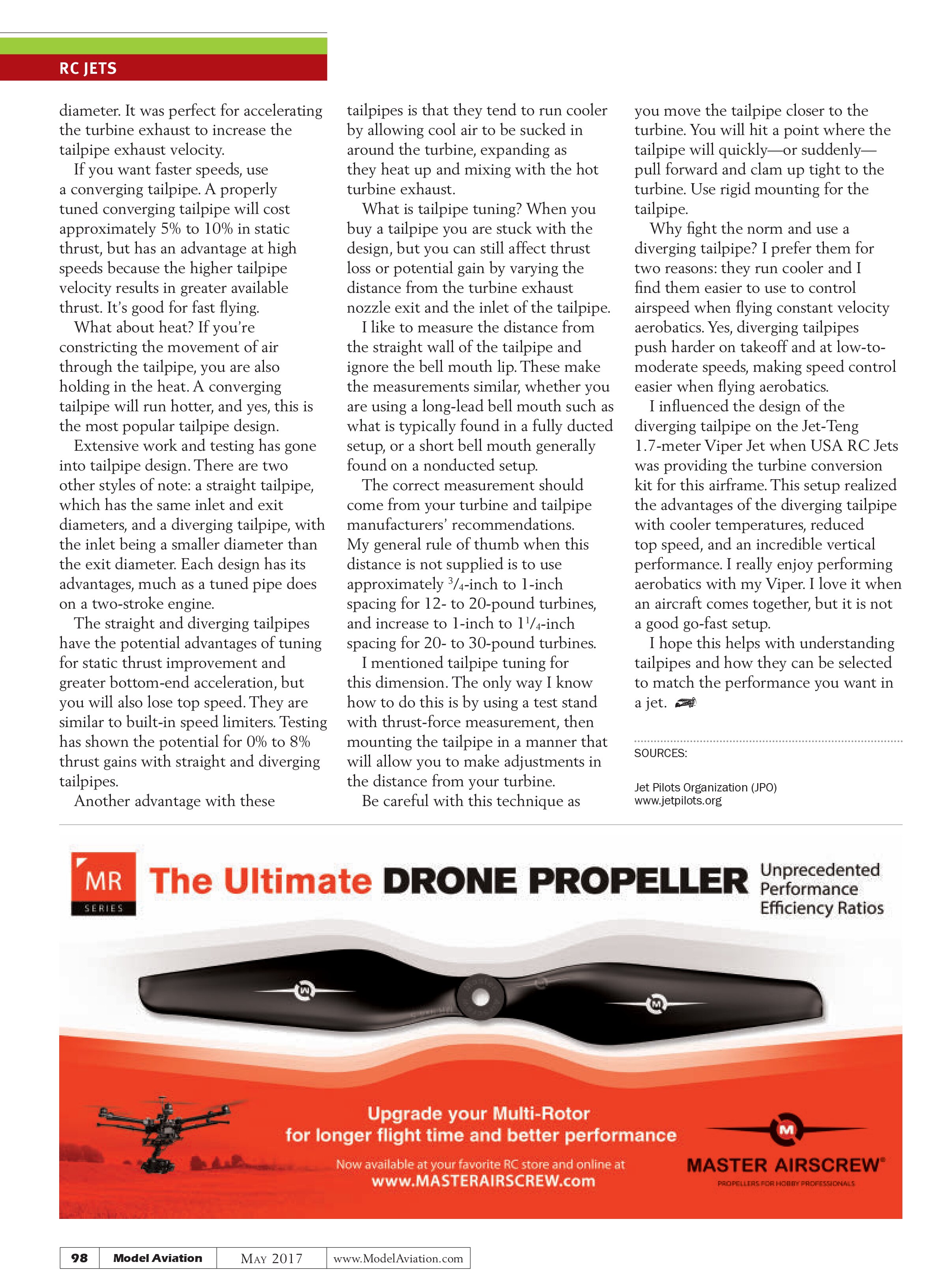
The spacing from the turbine exhaust nozzle to the tailpipe bell mouth can reduce, eliminate, or provide additional static thrust when properly adjusted. This dimension is forgiving from a reliability standpoint in much the same way as a robust tailpipe can be forgiving of the size of the turbine you are running. With more than 400 flights on it, this tailpipe has held up well with turbines from 19 pounds of thrust up to the current Jet Central Cheetah with 32 pounds of thrust.
place. What a wonderful improvement! Today, manufacturers use a stainless steel outer wall that can be spot welded into place.
My first tailpipe’s .005-inch-thick wall was lightweight by today’s standards. These early tailpipes could easily be damaged by a hot start, which would overheat and distort the stainless steel, followed by a tailpipe collapse on the next full throttle. If you ever hear this happen, it is a sound that you won’t soon forget. It’s violent and is followed by there being no way for your turbine exhaust to exit the airframe. Shut it down quickly or lose your aircraft.
Today, tailpipes are made of a heavier gauge of stainless steel. The durability of these products is better, but that does not mean you can’t damage them with an excessively hot start. Always check for a warped or distorted tailpipe following a hot start. If in doubt, replace it.
I stated that the Exterminator’s tailpipe was a converging tailpipe. The inlet diameter was greater than the exit
diameter. It was perfect for accelerating the turbine exhaust to increase the tailpipe exhaust velocity.
If you want faster speeds, use a converging tailpipe. A properly tuned converging tailpipe will cost approximately 5% to 10% in static thrust, but has an advantage at high speeds because the higher tailpipe velocity results in greater available thrust. It’s good for fast flying.
What about heat? If you’re constricting the movement of air through the tailpipe, you are also holding in the heat. A converging tailpipe will run hotter, and yes, this is the most popular tailpipe design.
Extensive work and testing has gone into tailpipe design. There are two other styles of note: a straight tailpipe, which has the same inlet and exit diameters, and a diverging tailpipe, with the inlet being a smaller diameter than the exit diameter. Each design has its advantages, much as a tuned pipe does on a two-stroke engine.
The straight and diverging tailpipes have the potential advantages of tuning for static thrust improvement and greater bottom-end acceleration, but you will also lose top speed. They are similar to built-in speed limiters. Testing has shown the potential for 0% to 8% thrust gains with straight and diverging tailpipes.
Another advantage with these tailpipes is that they tend to run cooler by allowing cool air to be sucked in around the turbine, expanding as they heat up and mixing with the hot turbine exhaust.
What is tailpipe tuning? When you buy a tailpipe you are stuck with the design, but you can still affect thrust loss or potential gain by varying the distance from the turbine exhaust nozzle exit and the inlet of the tailpipe.
I like to measure the distance from the straight wall of the tailpipe and ignore the bell mouth lip. These make the measurements similar, whether you are using a long-lead bell mouth such as what is typically found in a fully ducted setup, or a short bell mouth generally found on a nonducted setup.
The correct measurement should come from your turbine and tailpipe manufacturers’ recommendations. My general rule of thumb when this distance is not supplied is to use approximately ¾-inch to 1-inch spacing for 12- to 20-pound turbines, and increase to 1-inch to 1¼-inch spacing for 20- to 30-pound turbines.
I mentioned tailpipe tuning for this dimension. The only way I know how to do this is by using a test stand with thrust-force measurement, then mounting the tailpipe in a manner that will allow you to make adjustments in the distance from your turbine.
Be careful with this technique as you move the tailpipe closer to the turbine. You will hit a point where the tailpipe will quickly—or suddenly—pull forward and clam up tight to the turbine. Use rigid mounting for the tailpipe.
Why fight the norm and use a diverging tailpipe? I prefer them for two reasons: they run cooler and I find them easier to use to control airspeed when flying constant velocity aerobatics. Yes, diverging tailpipes push harder on takeoff and at low-to-moderate speeds, making speed control easier when flying aerobatics.
I influenced the design of the diverging tailpipe on the Jet-Teng 1.7-meter Viper Jet when USA RC Jets was providing the turbine conversion kit for this airframe. This setup realized the advantages of the diverging tailpipe with cooler temperatures, reduced top speed, and an incredible vertical performance. I really enjoy performing aerobatics with my Viper. I love it when an aircraft comes together, but it is not a good go-fast setup.
I hope this helps with understanding tailpipes and how they can be selected to match the performance you want in a jet.
SOURCES:
Jet Pilots Organization (JPO)
www.jetpilots.org