Engine break-in
Chris Mulcahy
cspaced@gmail.com
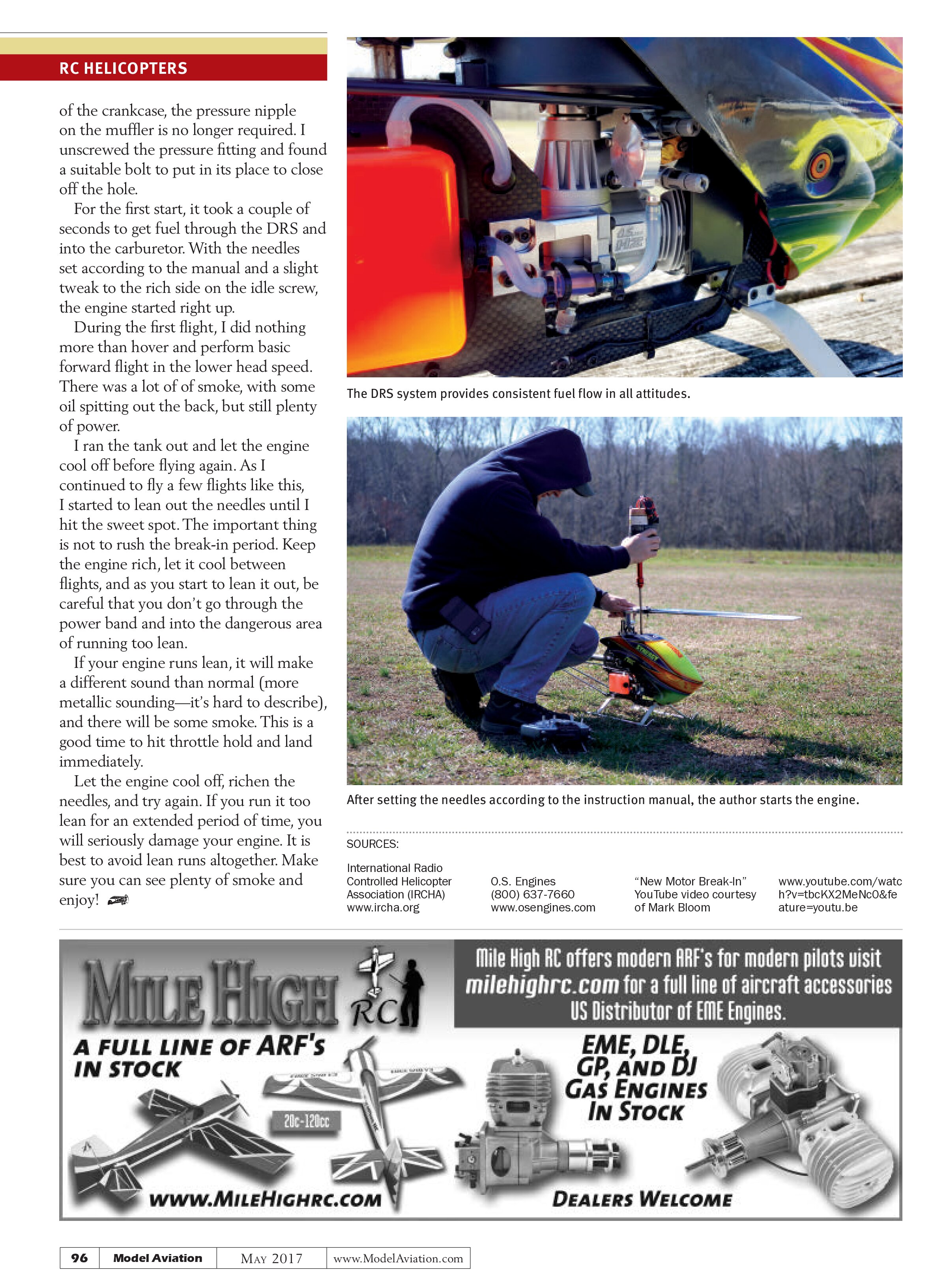
In my last column, I explained how I tore apart the old nitro engine in my Synergy N5c to see if it could be improved. Since then, and after more trial and error, I decided it was time to retire the nitro engine and buy something new. There are a few good choices out there, and I went with an O.S. 55HZ-R DRS. The O.S. PowerBoost II muffler that I was already running was a perfect match to the 55HZ-R.
DRS stands for Demand Regulator System, a pressurized system that provides optimal fuel flow to the carburetor. This means that regardless of the helicopter’s attitude or fuel level (assuming it has some), it will run consistently throughout the entire flight. No more engine leaning toward the end of the flight, and no more need for a header tank.
The O.S. 40L-R is a two-needle carburetor, so you can adjust the high speed and midrange, with an idle screw to adjust the low end.
This engine, like most that are used in our helis, features a ring around the piston that must mate with the piston sleeve. This provides a good, tight seal. When done correctly, it will leave you with a reliable engine that gives all of the power it has to offer. Although the tolerances machined at the factory are tight, you still must take measures to properly seat the piston ring, otherwise known as breaking in the engine.
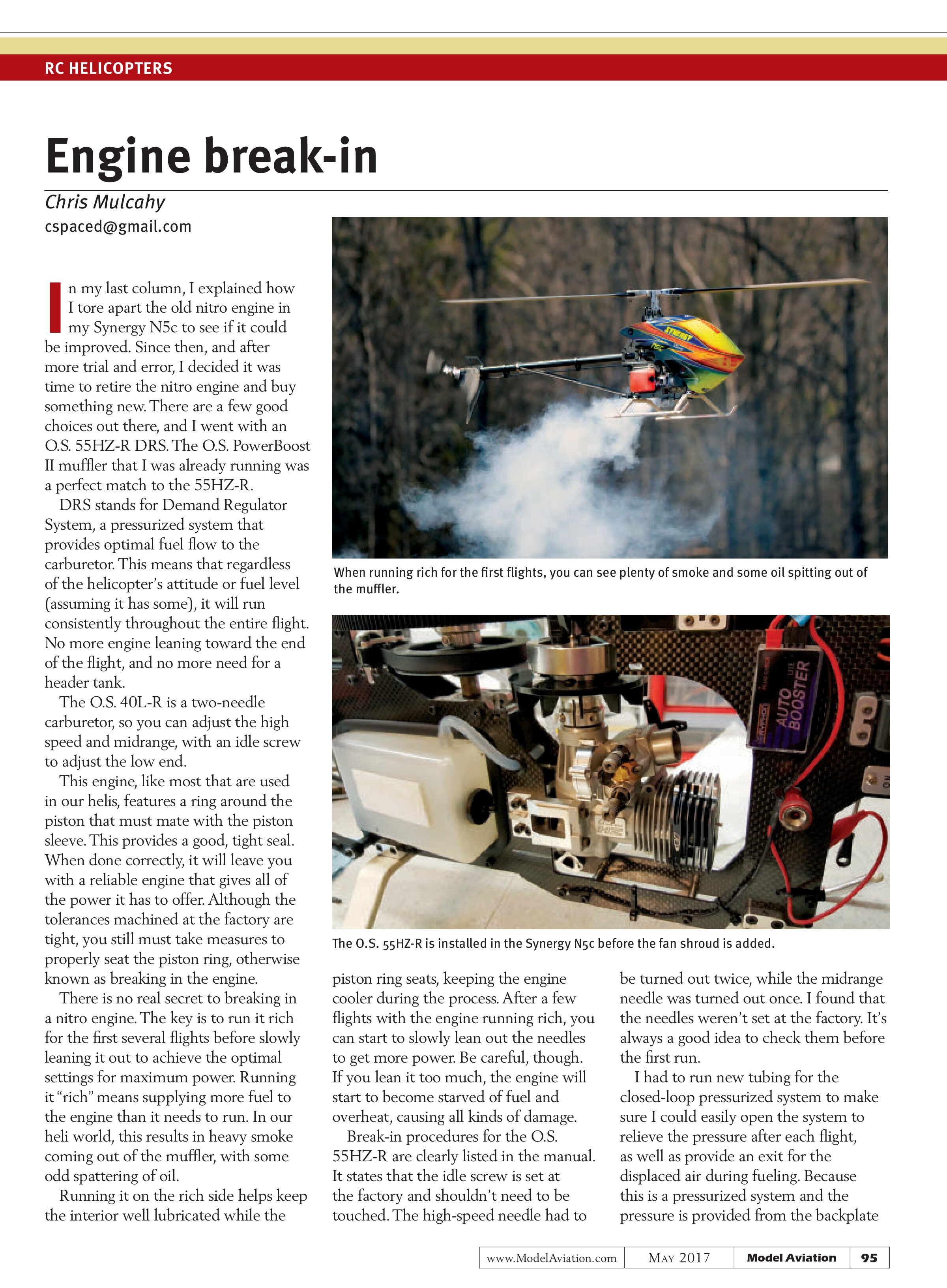
There is no real secret to breaking in a nitro engine. The key is to run it rich for the first several flights before slowly leaning it out to achieve the optimal settings for maximum power. Running it “rich” means supplying more fuel to the engine than it needs to run. In our heli world, this results in heavy smoke coming out of the muffler, with some odd spattering of oil.
Running it on the rich side helps keep the interior well lubricated while the


piston ring seats, keeping the engine cooler during the process. After a few flights with the engine running rich, you can start to slowly lean out the needles to get more power. Be careful, though. If you lean it too much, the engine will start to become starved of fuel and overheat, causing all kinds of damage.
Break-in procedures for the O.S. 55HZ-R are clearly listed in the manual. It states that the idle screw is set at the factory and shouldn’t need to be touched. The high-speed needle had to be turned out twice, while the midrange needle was turned out once. I found that the needles weren’t set at the factory. It’s always a good idea to check them before the first run.
I had to run new tubing for the closed-loop pressurized system to make sure I could easily open the system to relieve the pressure after each flight, as well as provide an exit for the displaced air during fueling. Because this is a pressurized system and the pressure is provided from the backplate
of the crankcase, the pressure nipple on the muffler is no longer required. I unscrewed the pressure fitting and found a suitable bolt to put in its place to close off the hole.
For the first start, it took a couple of seconds to get fuel through the DRS and into the carburetor. With the needles set according to the manual and a slight tweak to the rich side on the idle screw, the engine started right up.
During the first flight, I did nothing more than hover and perform basic forward flight in the lower head speed. There was a lot of of smoke, with some oil spitting out the back, but still plenty of power.
I ran the tank out and let the engine cool off before flying again. As I continued to fly a few flights like this, I started to lean out the needles until I hit the sweet spot. The important thing is not to rush the break-in period. Keep the engine rich, let it cool between flights, and as you start to lean it out, be careful that you don’t go through the power band and into the dangerous area of running too lean.
If your engine runs lean, it will make a different sound than normal (more metallic sounding—it’s hard to describe), and there will be some smoke. This is a good time to hit throttle hold and land immediately.
Let the engine cool off, richen the needles, and try again. If you run it too lean for an extended period of time, you will seriously damage your engine. It is best to avoid lean runs altogether. Make sure you can see plenty of smoke and enjoy!


SOURCES:
International Radio Controlled Helicopter Association (IRCHA)
www.ircha.org
O.S. Engines
(800) 637-7660
www.osengines.com
“New Motor Break-In” YouTube video courtesy of Mark Bloom