It’s almost time for the 2017 Nats
by Don Grissom
dongrissom@hilltopflyers.com
It is nearly time for the Nats in Muncie, Indiana, at the International Aeromodeling Center. If you have never been to the Nats, this would be a great year to come.
William Drumm III will again run four days of RC Combat. He was last year’s contest director and ran a good event. We will fly five classes of Combat, including Slow Survivable Combat (SSC), Open B, Limited B, Scale 2948, and Gnat Combat. If you plan to compete, preregister with the AMA. Information can be found on the AMA website.
One of the biggest stories happened at the end of 2016, when one of the favorite engines that we had used for many years was suddenly discontinued. This left us with only a few engine options. With that in mind, it was again time to start looking at electric power.
In the past, many pilots were not kind to electric motors when they were used for Combat. I tried many times to go electric, but the cost and the amount of equipment made the switch difficult. There was also the damage aspect of it—when I went to Florida, the sand would get into the powerplant and I could not fly unless I cleaned the motor well.
Last year, at the 2016 Nats, I was introduced to Heath Bartel, who brought nothing but electric-powered airplanes to the contest. He put on a great show, with a first-place finish in Open B and taking fourth place in Limited B. Because he put together such a nice design, I thought I would share what Heath had to say about his airplanes.
“I have been flying RC Combat with electric power for the past two years. For the 2016 season, I designed and built a new electric-powered aircraft. The goal of this new design was to be competitive

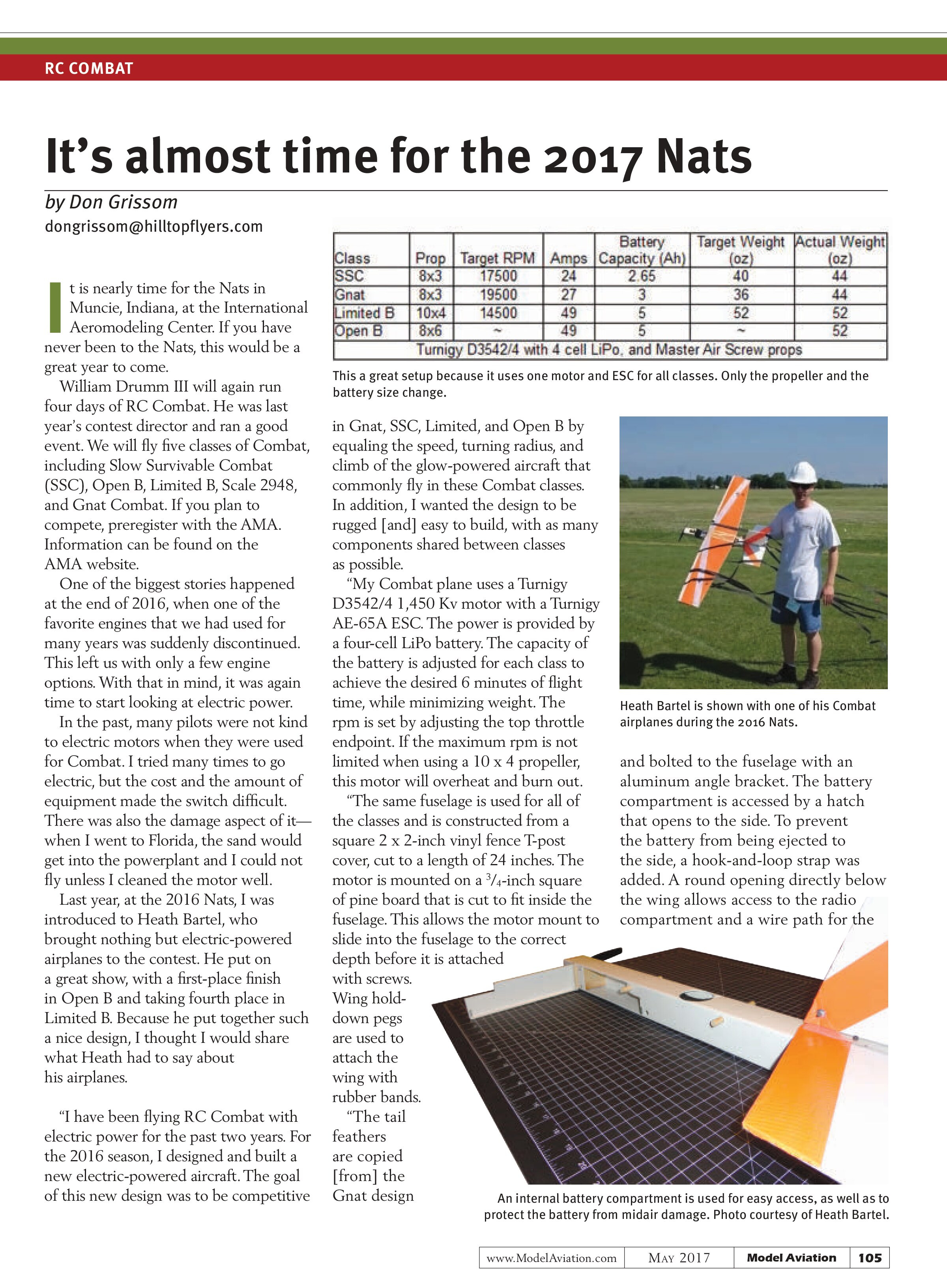
This a great setup because it uses one motor and ESC for all classes. Only the propeller and the battery size change.
in Gnat, SSC, Limited, and Open B by equaling the speed, turning radius, and climb of the glow-powered aircraft that commonly fly in these Combat classes. In addition, I wanted the design to be rugged [and] easy to build, with as many components shared between classes as possible.
“My Combat plane uses a Turnigy D3542/4 1,450 Kv motor with a Turnigy AE-65A ESC. The power is provided by a four-cell LiPo battery. The capacity of the battery is adjusted for each class to achieve the desired 6 minutes of flight time, while minimizing weight. The rpm is set by adjusting the top throttle endpoint. If the maximum rpm is not limited when using a 10 x 4 propeller, this motor will overheat and burn out.
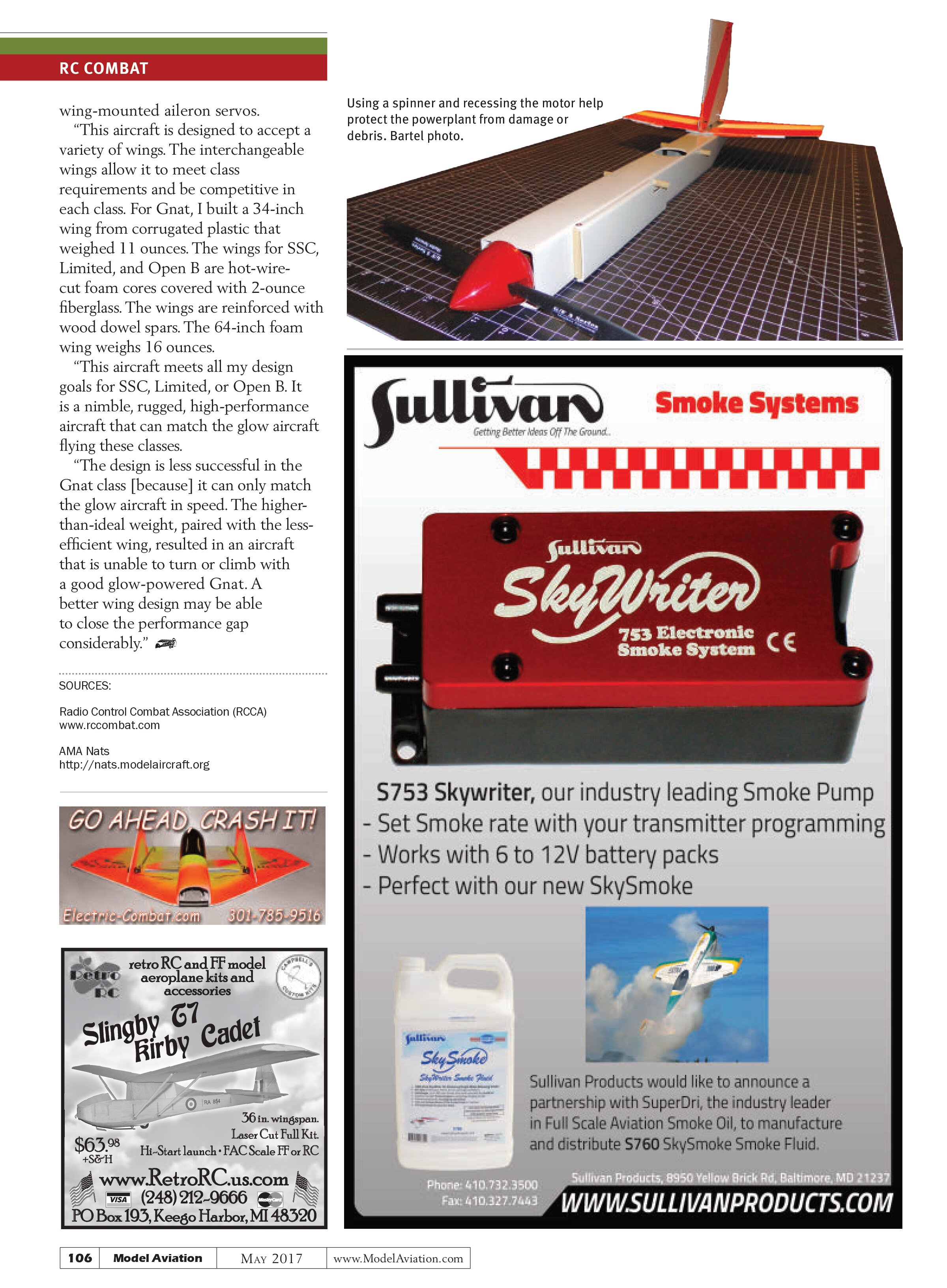
“The same fuselage is used for all of the classes and is constructed from a square 2 x 2-inch vinyl fence T-post cover, cut to a length of 24 inches. The motor is mounted on a ³/₄-inch square of pine board that is cut to fit inside the fuselage. This allows the motor mount to slide into the fuselage to the correct depth before it is attached with screws.
Wing hold-down pegs are used to attach the wing with rubber bands.
“The tail feathers are copied [from] the Gnat design

and bolted to the fuselage with an aluminum angle bracket. The battery compartment is accessed by a hatch that opens to the side. To prevent the battery from being ejected to the side, a hook-and-loop strap was added. A round opening directly below the wing allows access to the radio compartment and a wire path for the

wing-mounted aileron servos.
“This aircraft is designed to accept a variety of wings. The interchangeable wings allow it to meet class requirements and be competitive in each class. For Gnat, I built a 34-inch wing from corrugated plastic that weighed 11 ounces. The wings for SSC, Limited, and Open B are hot-wire-cut foam cores covered with 2-ounce fiberglass. The wings are reinforced with wood dowel spars. The 64-inch foam wing weighs 16 ounces.
“This aircraft meets all my design goals for SSC, Limited, or Open B. It is a nimble, rugged, high-performance aircraft that can match the glow aircraft flying these classes.
“The design is less successful in the Gnat class [because] it can only match the glow aircraft in speed. The higher-than-ideal weight, paired with the less-efficient wing, resulted in an aircraft that is unable to turn or climb with a good glow-powered Gnat. A better wing design may be able to close the performance gap considerably.”
SOURCES:
Radio Control Combat Association (RCCA)
www.rccombat.com
AMA Nats
http://nats.modelaircraft.org