AJ Aircraft Acuity
by Peter Vogel
vogel.peter@gmail.com

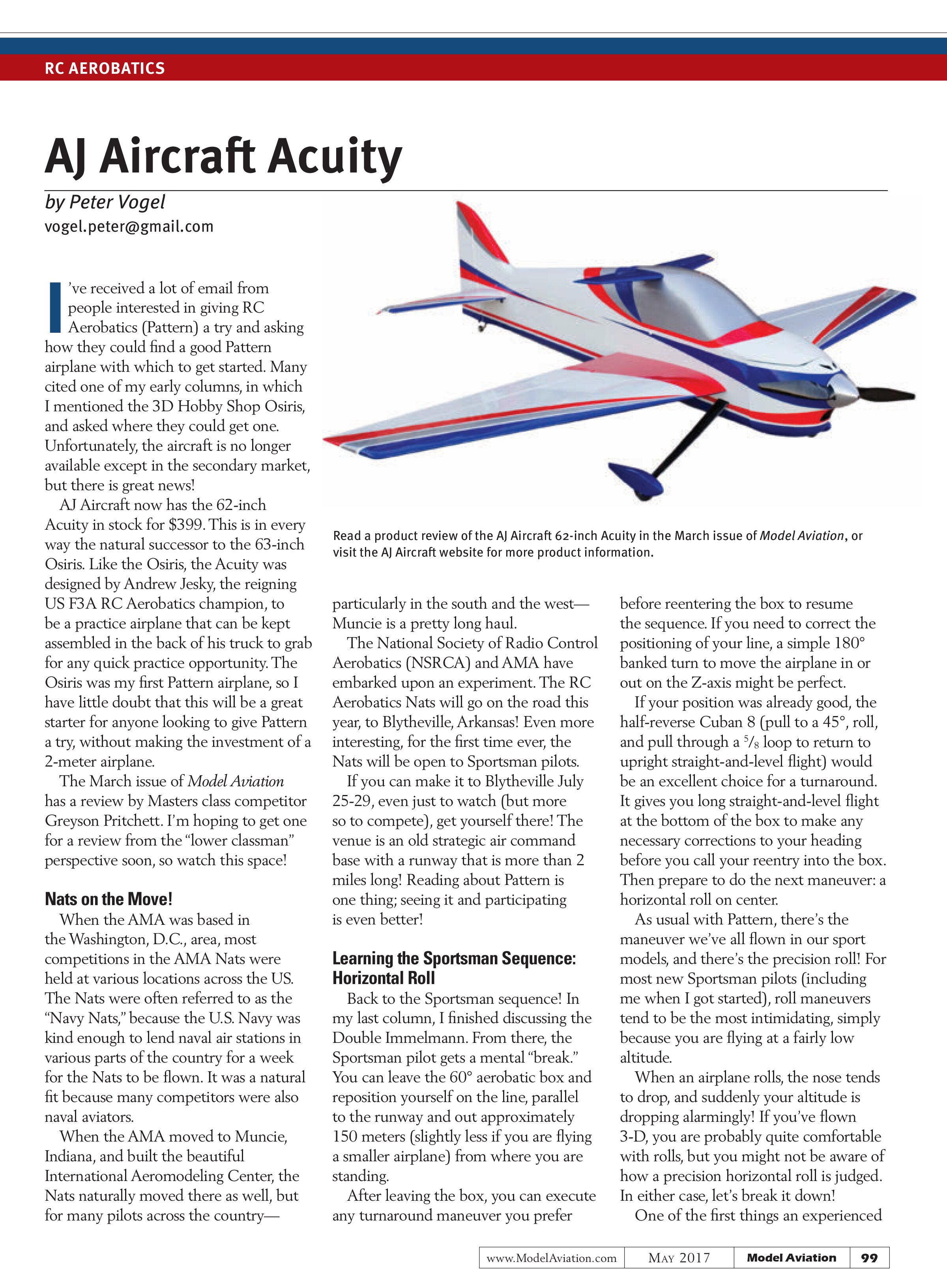
I’ve received a lot of email from people interested in giving RC Aerobatics (Pattern) a try and asking how they could find a good Pattern airplane with which to get started. Many cited one of my early columns, in which I mentioned the 3D Hobby Shop Osiris, and asked where they could get one. Unfortunately, the aircraft is no longer available except in the secondary market, but there is great news!
AJ Aircraft now has the 62-inch Acuity in stock for $399. This is in every way the natural successor to the 63-inch Osiris. Like the Osiris, the Acuity was designed by Andrew Jesky, the reigning US F3A RC Aerobatics champion, to be a practice airplane that can be kept assembled in the back of his truck to grab for any quick practice opportunity. The Osiris was my first Pattern airplane, so I have little doubt that this will be a great starter for anyone looking to give Pattern a try, without making the investment of a 2-meter airplane.
The March issue of Model Aviation has a review by Masters class competitor Greyson Pritchett. I’m hoping to get one for a review from the “lower classman” perspective soon, so watch this space!
Nats on the Move!
When the AMA was based in the Washington, D.C., area, most competitions in the AMA Nats were held at various locations across the US. The Nats were often referred to as the “Navy Nats,” because the U.S. Navy was kind enough to lend naval air stations in various parts of the country for a week for the Nats to be flown. It was a natural fit because many competitors were also naval aviators.
When the AMA moved to Muncie, Indiana, and built the beautiful International Aeromodeling Center, the Nats naturally moved there as well, but for many pilots across the country—particularly in the south and the west—Muncie is a pretty long haul.
The National Society of Radio Control Aerobatics (NSRCA) and AMA have embarked upon an experiment. The RC Aerobatics Nats will go on the road this year, to Blytheville, Arkansas! Even more interesting, for the first time ever, the Nats will be open to Sportsman pilots.
If you can make it to Blytheville July 25-29, even just to watch (but more so to compete), get yourself there! The venue is an old strategic air command base with a runway that is more than 2 miles long! Reading about Pattern is one thing; seeing it and participating is even better!
Learning the Sportsman Sequence: Horizontal Roll
Back to the Sportsman sequence! In my last column, I finished discussing the Double Immelmann. From there, the Sportsman pilot gets a mental “break.” You can leave the 60° aerobatic box and reposition yourself on the line, parallel to the runway and out approximately 150 meters (slightly less if you are flying a smaller airplane) from where you are standing.
After leaving the box, you can execute any turnaround maneuver you prefer before reentering the box to resume the sequence. If you need to correct the positioning of your line, a simple 180° banked turn to move the airplane in or out on the Z-axis might be perfect.
If your position was already good, the half-reverse Cuban 8 (pull to a 45°, roll, and pull through a 5/8 loop to return to upright straight-and-level flight) would be an excellent choice for a turnaround. It gives you long straight-and-level flight at the bottom of the box to make any necessary corrections to your heading before you call your reentry into the box. Then prepare to do the next maneuver: a horizontal roll on center.
As usual with Pattern, there’s the maneuver we’ve all flown in our sport models, and there’s the precision roll! For most new Sportsman pilots (including me when I got started), roll maneuvers tend to be the most intimidating, simply because you are flying at a fairly low altitude.
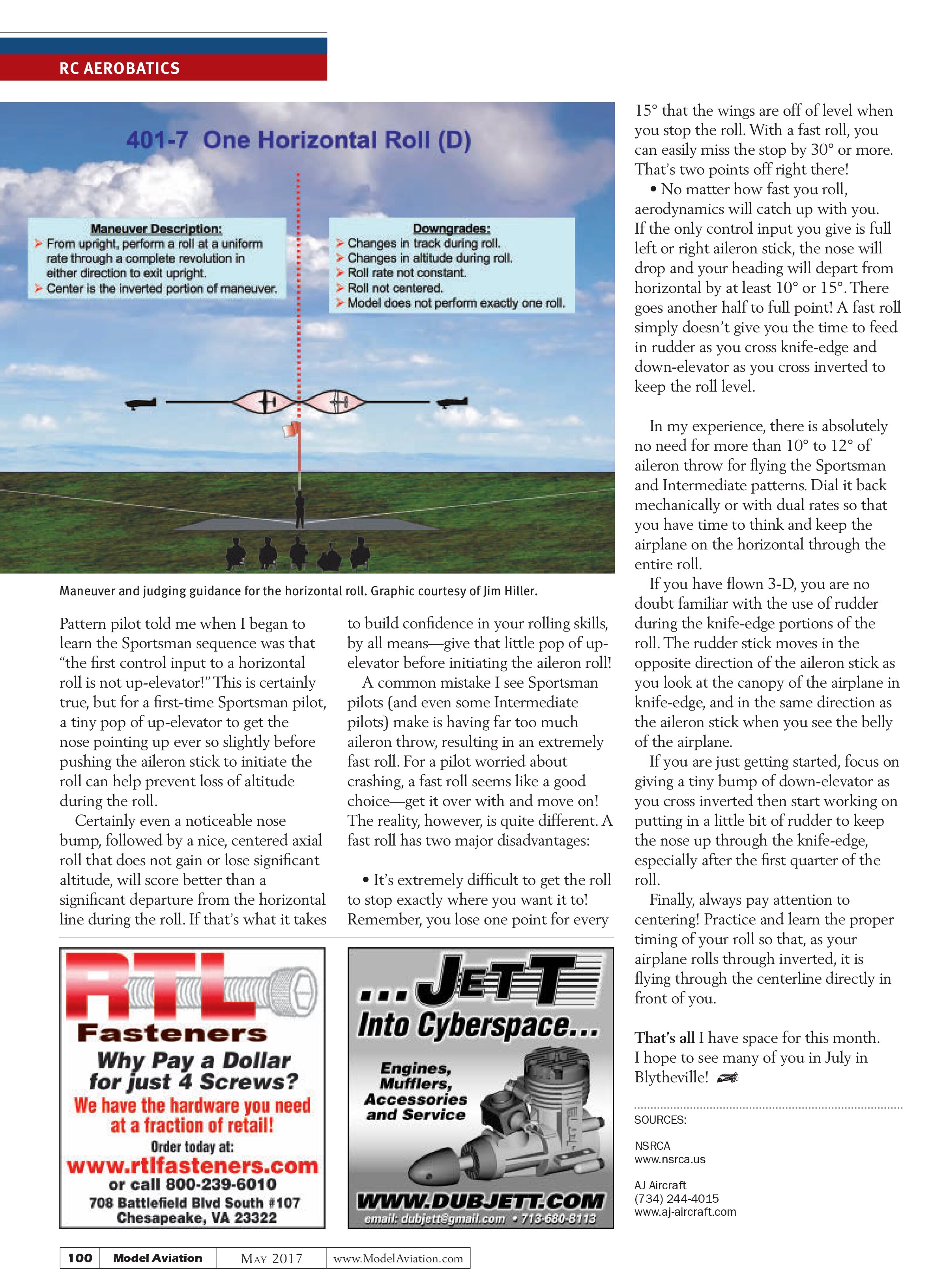
When an airplane rolls, the nose tends to drop, and suddenly your altitude is dropping alarmingly! If you’ve flown 3-D, you are probably quite comfortable with rolls, but you might not be aware of how a precision horizontal roll is judged. In either case, let’s break it down!
One of the first things an experienced

Pattern pilot told me when I began to learn the Sportsman sequence was that “the first control input to a horizontal roll is not up-elevator!” This is certainly true, but for a first-time Sportsman pilot, a tiny pop of up-elevator to get the nose pointing up ever so slightly before pushing the aileron stick to initiate the roll can help prevent loss of altitude during the roll.
Certainly even a noticeable nose bump, followed by a nice, centered axial roll that does not gain or lose significant altitude, will score better than a significant departure from the horizontal line during the roll. If that’s what it takes to build confidence in your rolling skills, by all means—give that little pop of up-elevator before initiating the aileron roll!
A common mistake I see Sportsman pilots (and even some Intermediate pilots) make is having far too much aileron throw, resulting in an extremely fast roll. For a pilot worried about crashing, a fast roll seems like a good choice—get it over with and move on! The reality, however, is quite different. A fast roll has two major disadvantages:
- It’s extremely difficult to get the roll to stop exactly where you want it to! Remember, you lose one point for every 15° that the wings are off of level when you stop the roll. With a fast roll, you can easily miss the stop by 30° or more. That’s two points off right there!
- No matter how fast you roll, aerodynamics will catch up with you. If the only control input you give is full left or right aileron stick, the nose will drop and your heading will depart from horizontal by at least 10° or 15°. There goes another half to full point! A fast roll simply doesn’t give you the time to feed in rudder as you cross knife-edge and down-elevator as you cross inverted to keep the roll level.
In my experience, there is absolutely no need for more than 10° to 12° of aileron throw for flying the Sportsman and Intermediate patterns. Dial it back mechanically or with dual rates so that you have time to think and keep the airplane on the horizontal through the entire roll.
If you have flown 3-D, you are no doubt familiar with the use of rudder during the knife-edge portions of the roll. The rudder stick moves in the opposite direction of the aileron stick as you look at the canopy of the airplane in knife-edge, and in the same direction as the aileron stick when you see the belly of the airplane.
If you are just getting started, focus on giving a tiny bump of down-elevator as you cross inverted then start working on putting in a little bit of rudder to keep the nose up through the knife-edge, especially after the first quarter of the roll.
Finally, always pay attention to centering! Practice and learn the proper timing of your roll so that, as your airplane rolls through inverted, it is flying through the centerline directly in front of you.
That’s all I have space for this month. I hope to see many of you in July in Blytheville!
SOURCES:
NSRCA
www.nsrca.us
AJ Aircraft
(734) 244-4015
www.aj-aircraft.com