½A to F1J FF model fulfilled the wish of a winning design


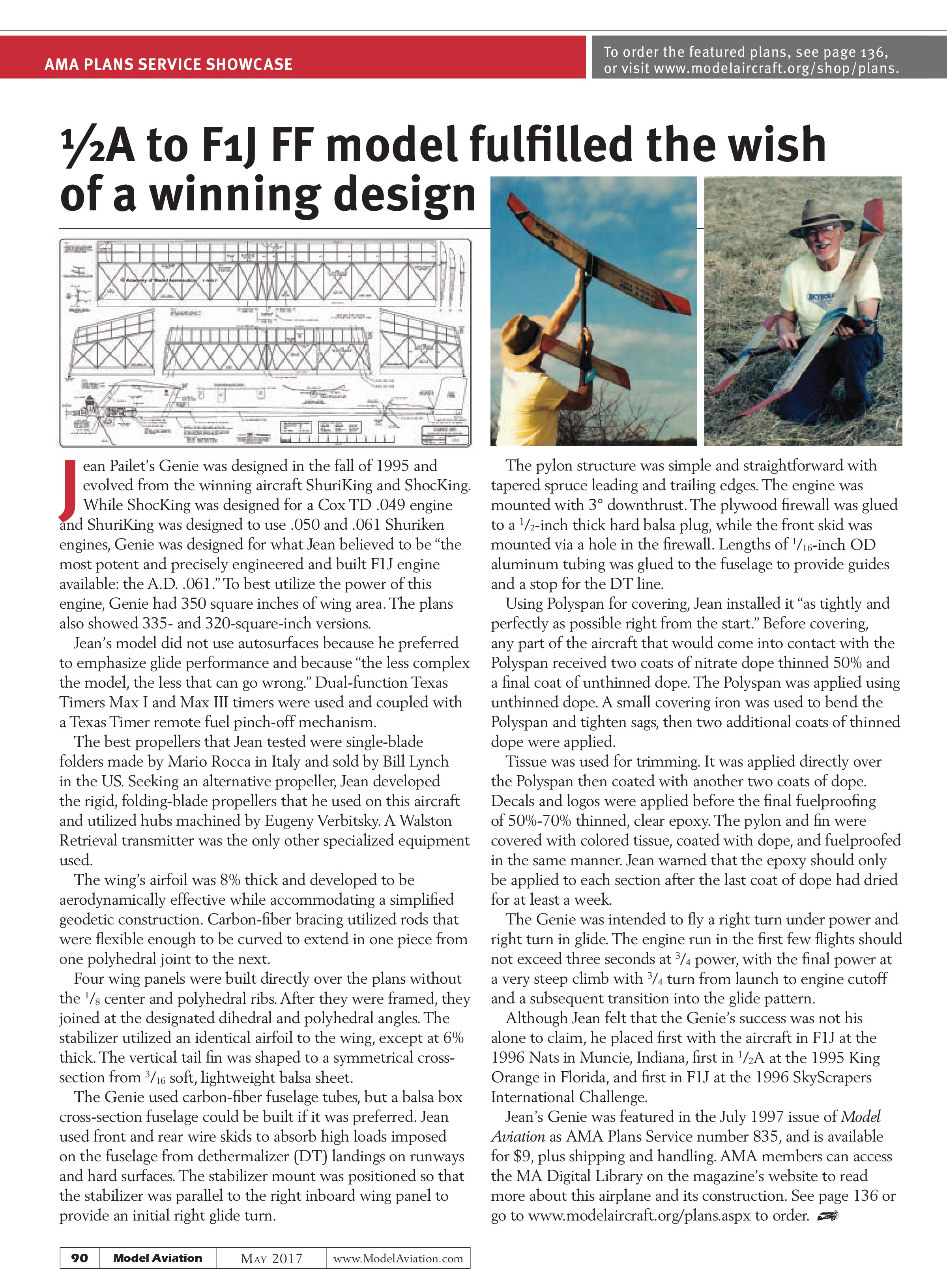
Jean Pailet’s Genie was designed in the fall of 1995 and evolved from the winning aircraft ShuriKing and ShocKing. While ShocKing was designed for a Cox TD .049 engine and ShuriKing was designed to use .050 and .061 Shuriken engines, Genie was designed for what Jean believed to be “the most potent and precisely engineered and built F1J engine available: the A.D. .061.” To best utilize the power of this engine, Genie had 350 square inches of wing area. The plans also showed 335- and 320-square-inch versions.
Jean’s model did not use autosurfaces because he preferred to emphasize glide performance and because “the less complex the model, the less that can go wrong.” Dual-function Texas Timers Max I and Max III timers were used and coupled with a Texas Timer remote fuel pinch-off mechanism.
The best propellers that Jean tested were single-blade folders made by Mario Rocca in Italy and sold by Bill Lynch in the US. Seeking an alternative propeller, Jean developed the rigid, folding-blade propellers that he used on this aircraft and utilized hubs machined by Eugene Verbitsky. A Walston Retrieval transmitter was the only other specialized equipment used.
The wing’s airfoil was 8% thick and developed to be aerodynamically effective while accommodating a simplified geodetic construction. Carbon-fiber bracing utilized rods that were flexible enough to be curved to extend in one piece from one polyhedral joint to the next.
Four wing panels were built directly over the plans without the ⅛ center and polyhedral ribs. After they were framed, they joined at the designated dihedral and polyhedral angles. The stabilizer utilized an identical airfoil to the wing, except at 6% thick. The vertical tail fin was shaped to a symmetrical cross-section from ³⁄₁₆ soft, lightweight balsa sheet.
The Genie used carbon-fiber fuselage tubes, but a balsa box cross-section fuselage could be built if it was preferred. Jean used front and rear wire skids to absorb high loads imposed on the fuselage from dethermalizer (DT) landings on runways and hard surfaces. The stabilizer mount was positioned so that the stabilizer was parallel to the right inboard wing panel to provide an initial right glide turn.
The pylon structure was simple and straightforward with tapered spruce leading and trailing edges. The engine was mounted with 3° downthrust. The plywood firewall was glued to a ½-inch thick hard balsa plug, while the front skid was mounted via a hole in the firewall. Lengths of ¹⁄₁₆-inch OD aluminum tubing was glued to the fuselage to provide guides and a stop for the DT line.
Using Polyspan for covering, Jean installed it “as tightly and perfectly as possible right from the start.” Before covering, any part of the aircraft that would come into contact with the Polyspan received two coats of nitrate dope thinned 50% and a final coat of unthinned dope. The Polyspan was applied using unthinned dope. A small covering iron was used to bend the Polyspan and tighten sags, then two additional coats of thinned dope were applied.
Tissue was used for trimming. It was applied directly over the Polyspan then coated with another two coats of dope. Decals and logos were applied before the final fuelproofing of 50%-70% thinned, clear epoxy. The pylon and fin were covered with colored tissue, coated with dope, and fuelproofed in the same manner. Jean warned that the epoxy should only be applied to each section after the last coat of dope had dried for at least a week.
The Genie was intended to fly a right turn under power and right turn in glide. The engine run in the first few flights should not exceed three seconds at ¾ power, with the final power at a very steep climb with ¾ turn from launch to engine cutoff and a subsequent transition into the glide pattern.
Although Jean felt that the Genie’s success was not his alone to claim, he placed first with the aircraft in F1J at the 1996 Nats in Muncie, Indiana, first in ½A at the 1995 King Orange in Florida, and first in F1J at the 1996 SkyScrapers International Challenge.
Jean’s Genie was featured in the July 1997 issue of Model Aviation as AMA Plans Service number 835, and is available for $9, plus shipping and handling. AMA members can access the MA Digital Library on the magazine’s website to read more about this airplane and its construction. See page 136 or go to www.modelaircraft.org/plans.aspx to order.