PARALLEL POSITIONING THE FOUNDATION
THAT GREAT AEROBATIC FLYING IS BUILT UPON
BY DAVE SCOTT | ILLUSTRATIONS BY THE AUTHOR
If you have ever watched a proficient aerobatics pilot fly (you can tell by his or her ability to perform a variety of consecutive maneuvers rather than individual stunts), you might have noted the absence of visible corrections or realignments between maneuvers. This is often referred to as being “smooth,” and “the good guys make it look easy.”
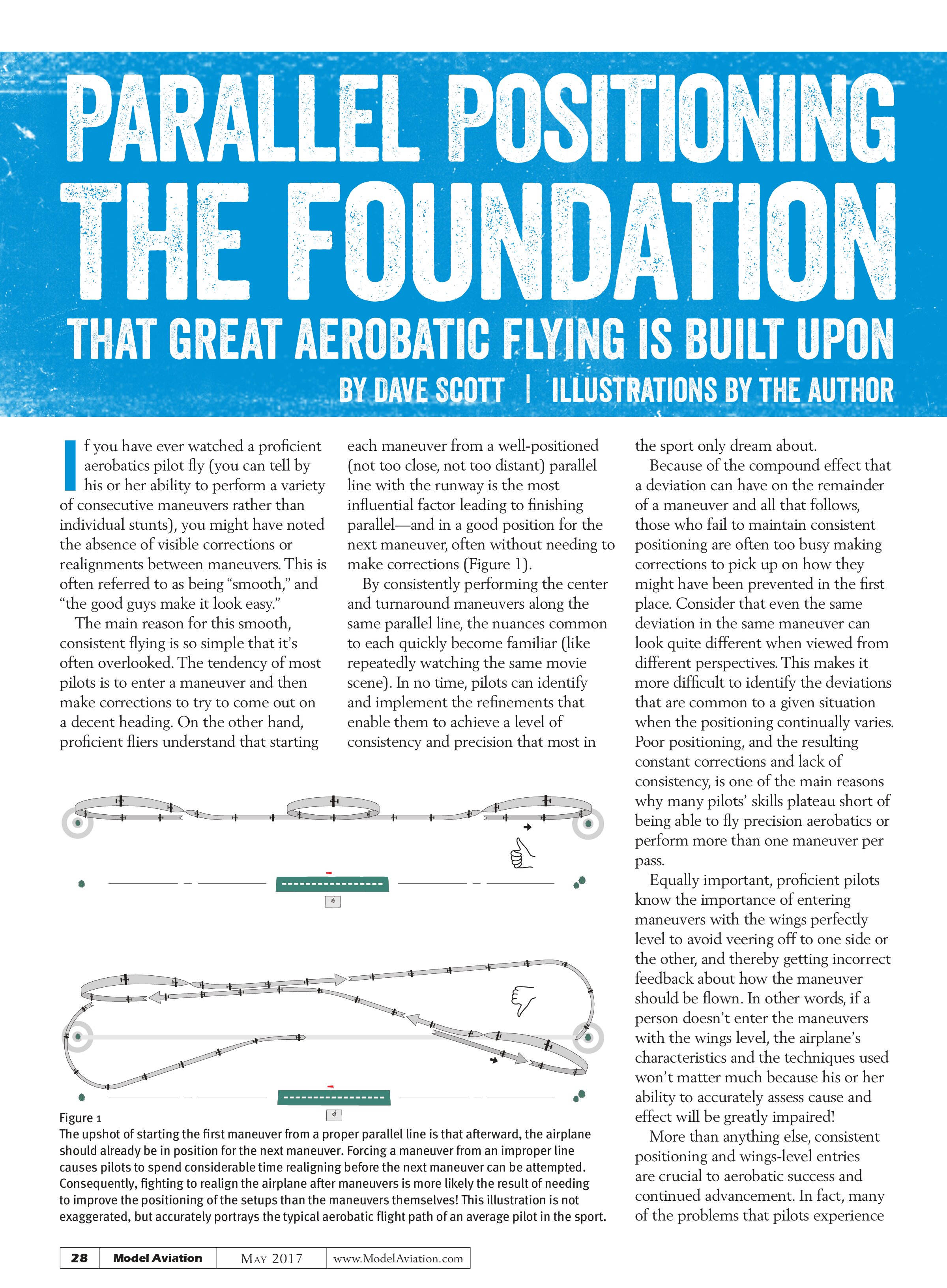
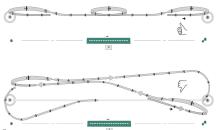
The main reason for this smooth, consistent flying is so simple that it’s often overlooked. The tendency of most pilots is to enter a maneuver and then make corrections to try to come out on a decent heading. On the other hand, proficient fliers understand that starting each maneuver from a well-positioned (not too close, not too distant) parallel line with the runway is the most influential factor leading to finishing parallel—and in a good position for the next maneuver, often without needing to make corrections (Figure 1).
By consistently performing the center and turnaround maneuvers along the same parallel line, the nuances common to each quickly become familiar (like repeatedly watching the same movie scene). In no time, pilots can identify and implement the refinements that enable them to achieve a level of consistency and precision that most in

the sport only dream about.
Because of the compound effect that a deviation can have on the remainder of a maneuver and all that follows, those who fail to maintain consistent positioning are often too busy making corrections to pick up on how they might have been prevented in the first place. Consider that even the same deviation in the same maneuver can look quite different when viewed from different perspectives. This makes it more difficult to identify the deviations that are common to a given situation when the positioning continually varies. Poor positioning, and the resulting constant corrections and lack of consistency, is one of the main reasons why many pilots’ skills plateau short of being able to fly precision aerobatics or perform more than one maneuver per pass.
Equally important, proficient pilots know the importance of entering maneuvers with the wings perfectly level to avoid veering off to one side or the other, and thereby getting incorrect feedback about how the maneuver should be flown. In other words, if a person doesn’t enter the maneuvers with the wings level, the airplane’s characteristics and the techniques used won’t matter much because his or her ability to accurately assess cause and effect will be greatly impaired!
More than anything else, consistent positioning and wings-level entries are crucial to aerobatic success and continued advancement. In fact, many of the problems that pilots experience when learning aerobatics—for which people come up with all kinds of ideas about how to fix—would quickly be solved or even disappear if they concentrated more on flying consistent parallel lines with the runway.
Ultimately, making consistent parallel lines your number-one priority will enable you to more often think ahead of the airplane, fly a continuous aerobatic sequence more easily, more quickly identify when the deviations in the maneuvers typically occur, and subsequently, what to do about them—just like a pro.

Step 1: Choosing Ground Targets
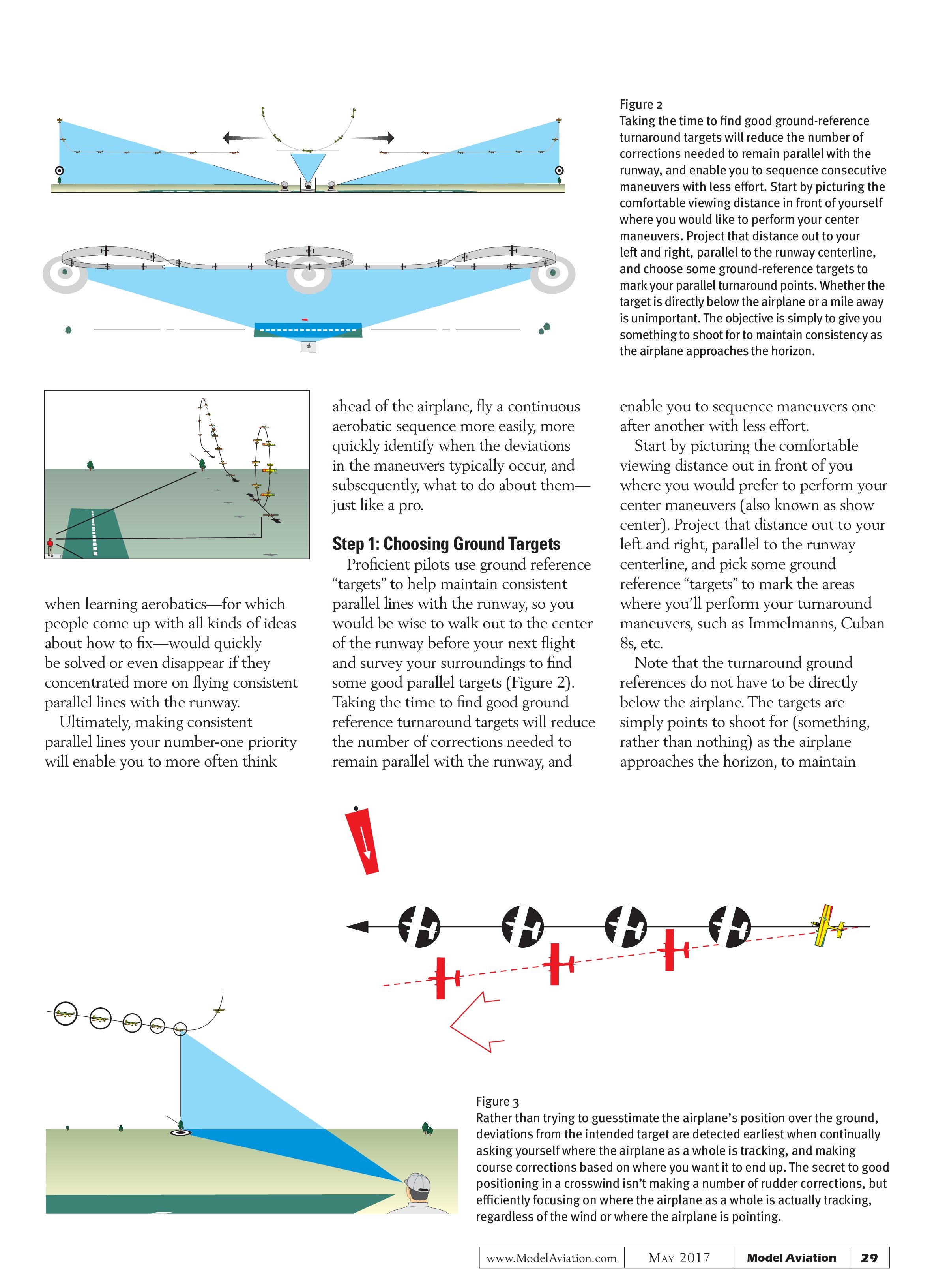
Proficient pilots use ground reference “targets” to help maintain consistent parallel lines with the runway, so you would be wise to walk out to the center of the runway before your next flight and survey your surroundings to find some good parallel targets (Figure 2). Taking the time to find good ground reference turnaround targets will reduce the number of corrections needed to remain parallel with the runway, and

enable you to sequence maneuvers one after another with less effort.
Start by picturing the comfortable viewing distance out in front of you where you would prefer to perform your center maneuvers (also known as show center). Project that distance out to your left and right, parallel to the runway centerline, and pick some ground reference “targets” to mark the areas where you’ll perform your turnaround maneuvers, such as Immelmanns, Cuban 8s, etc.
Note that the turnaround ground references do not have to be directly below the airplane. The targets are simply points to shoot for (something, rather than nothing) as the airplane approaches the horizon, to maintain


ABOUT THE AUTHOR:
Dave Scott is a champion full-scale aerobatics competitor, air show pilot, aviation author, and he operates 1st U.S. R/C Flight School. His manuals and articles feature the specialized training techniques that he has developed—instructing more than 1,700 RC pilots of all skill levels and setting up and test-flying more than 1,000 airplanes at his school. More information about Dave’s books and school can be found at www.rcflightschool.com.

consistency. If it turns out that you regularly don’t like where the airplane is heading after your turnaround maneuvers (it’s consistently too close or too far away), simply adjust your turnaround target versus meddling with the maneuvers.
Step 2: Projecting Flight Paths and Objects as a Whole
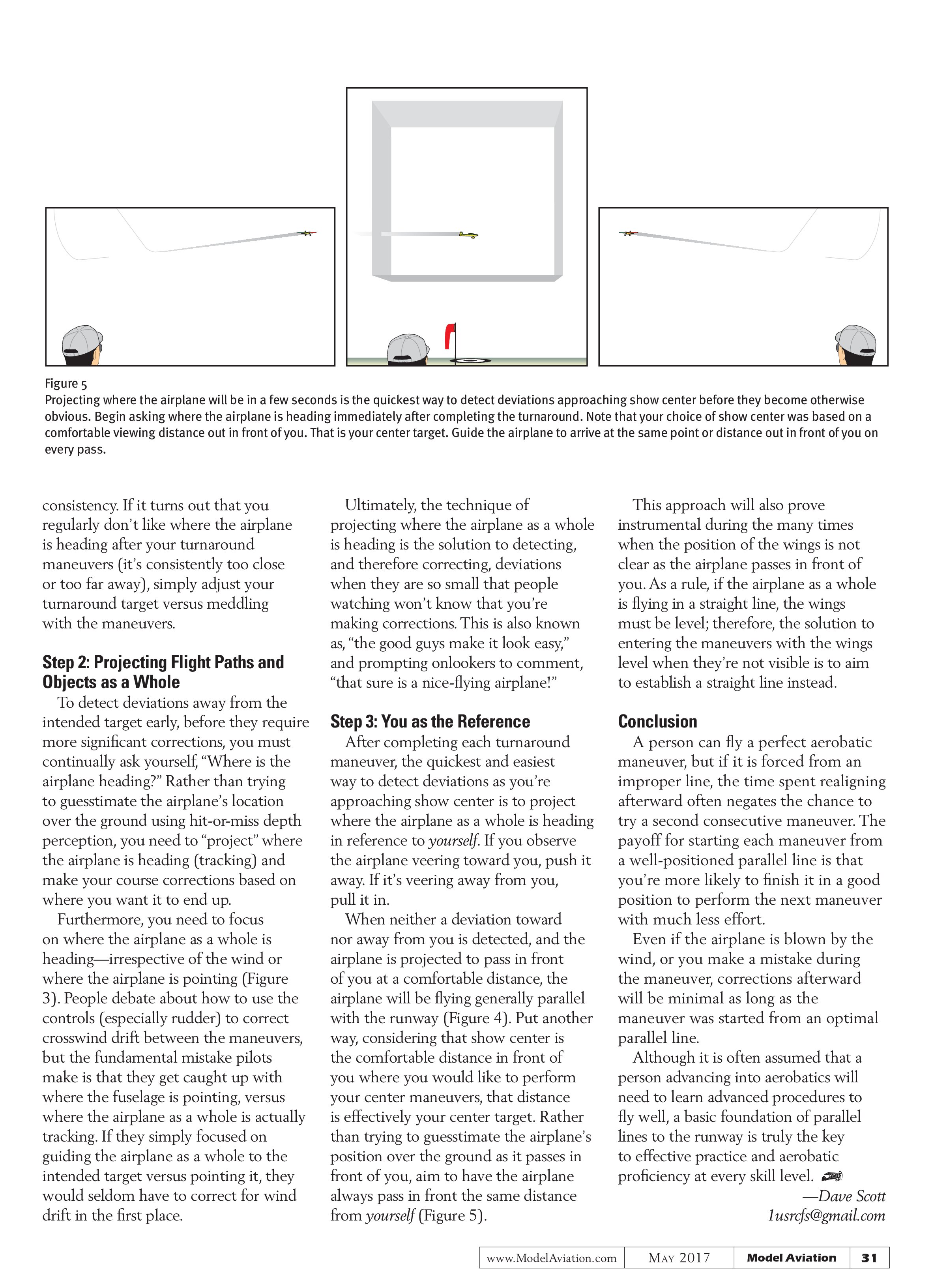
To detect deviations away from the intended target early, before they require more significant corrections, you must continually ask yourself, “Where is the airplane heading?” Rather than trying to guesstimate the airplane’s location over the ground using hit-or-miss depth perception, you need to “project” where the airplane is heading (tracking) and make your course corrections based on where you want it to end up.
Furthermore, you need to focus on where the airplane as a whole is heading—irrespective of the wind or where the airplane is pointing (Figure 3). People debate about how to use the controls (especially rudder) to correct crosswind drift between the maneuvers, but the fundamental mistake pilots make is that they get caught up with where the fuselage is pointing, versus where the airplane as a whole is actually tracking. If they simply focused on guiding the airplane as a whole to the intended target versus pointing it, they would seldom have to correct for wind drift in the first place.
Ultimately, the technique of projecting where the airplane as a whole is heading is the solution to detecting, and therefore correcting, deviations when they are so small that people watching won’t know that you’re making corrections. This is also known as, “the good guys make it look easy,” and prompting onlookers to comment, “that sure is a nice-flying airplane.”
Step 3: You as the Reference
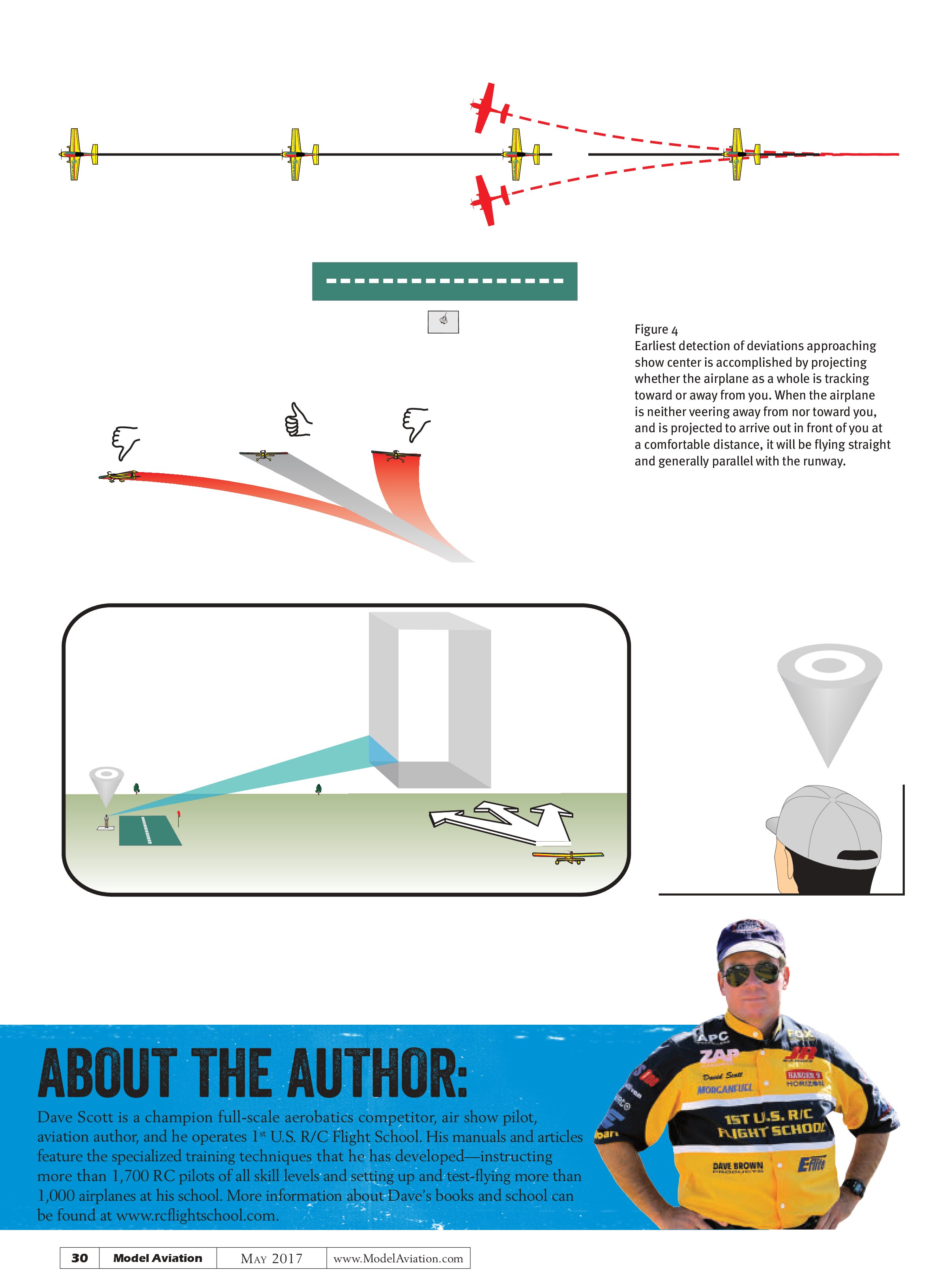
After completing each turnaround maneuver, the quickest and easiest way to detect deviations as you’re approaching show center is to project where the airplane as a whole is heading in reference to yourself. If you observe the airplane veering toward you, push it away. If it’s veering away from you, pull it in.
When neither a deviation toward nor away from you is detected, and the airplane is projected to pass in front of you at a comfortable distance, the airplane will be flying generally parallel with the runway (Figure 4). Put another way, considering that show center is the comfortable distance in front of you where you would like to perform your center maneuvers, that distance is effectively your center target. Rather than trying to guesstimate the airplane’s position over the ground as it passes in front of you, aim to have the airplane always pass in front the same distance from yourself (Figure 5).

This approach will also prove instrumental during the many times when the position of the wings is not clear as the airplane passes in front of you. As a rule, if the airplane as a whole is flying in a straight line, the wings must be level; therefore, the solution to entering the maneuvers with the wings level when they’re not visible is to aim to establish a straight line instead.
Conclusion
A person can fly a perfect aerobatic maneuver, but if it is forced from an improper line, the time spent realigning afterward often negates the chance to try a second consecutive maneuver. The payoff for starting each maneuver from a well-positioned parallel line is that you’re more likely to finish it in a good position to perform the next maneuver with much less effort.
Even if the airplane is blown by the wind, or you make a mistake during the maneuver, corrections afterward will be minimal as long as the maneuver was started from an optimal parallel line.
Although it is often assumed that a person advancing into aerobatics will need to learn advanced procedures to fly well, a basic foundation of parallel lines to the runway is truly the key to effective practice and aerobatic proficiency at every skill level.
—Dave Scott
1usrcfs@gmail.com