2017 FAC Non-Nats
by Gene Smith
grwhiskey@brightok.net

The Flying Aces Club (FAC) is holding its Non-Nats July 19-23 in Geneseo, New York. The event is almost as big as the FAC Nats, which is held during even-numbered years. If you have an interest in stick-and-tissue scale models, drop by and check out the event. Visit the FAC website for details.
Roger Willis’ Heinkel He 51
Now that Roger Willis has “retired” from his gig as founder and chief of the Western Region Flying Aces Club (WESTFAC), he has had more time to spend in the shop. The result is a beautiful Heinkel He 51.
This big model has a 30-inch wingspan and weighs 138 grams. Part of the detailing includes scale MG 30 machine guns with flash suppressors such as what were used in 1935. The wing and stabilizer wires are made from black elasticized thread.
Half-Sized Wakefield Velivole
The FAC Half-Sized Wakefield event has interested a number of builders and fliers. These are half-size models of Wakefield designs from 1934 through 1950. “Half Wakes” are approximately the size of Embryo models, but have a higher wing loading because they have to weigh at least an ounce without the motor. That tends to tone down the performance and lessen the chance of a flyaway.
For contests, you must launch from the ground or a card table. Rich Weber couldn’t resist the new Easy Built Models kit of the PD-16 Velivole. The Velivole is based on a 1936 Belgian Wakefield design. Rich saw old plans for it online and kept a copy just because it looked so cool.
Rich reported that his model flies nicely with a wonderful climb and cruise. He says the glide is slightly steep, but that works out well at his local field.
The Velivole always turns heads as it zooms into the sky.
The model has a 22-inch wingspan and weighs slightly more than the required 1-ounce minimum. It uses an 8-inch Easy Built propeller that has been cut down to 7.5 inches so that it will clear the table for rise-off-ground launches. Power is two loops of 1/8 x 30-inch rubber.
Stick & Tissue
I came across a neat website called Stick & Tissue. It has plenty of useful information for beginner and experienced modelers alike. Many builds are going on, with questions answered for those who want to get started in the hobby or learn more about it. There are also some RC and Control Line forums, but stick-and-tissue construction dominates the website.
There is a library of plans to browse. I picked up plans for a Peanut Scale Piper Cherokee. I used to fly a Piper Arrow and building a model of it has been on my list for a long time. Maybe I can get it done now.
Bill Schmidt’s Skyhopper
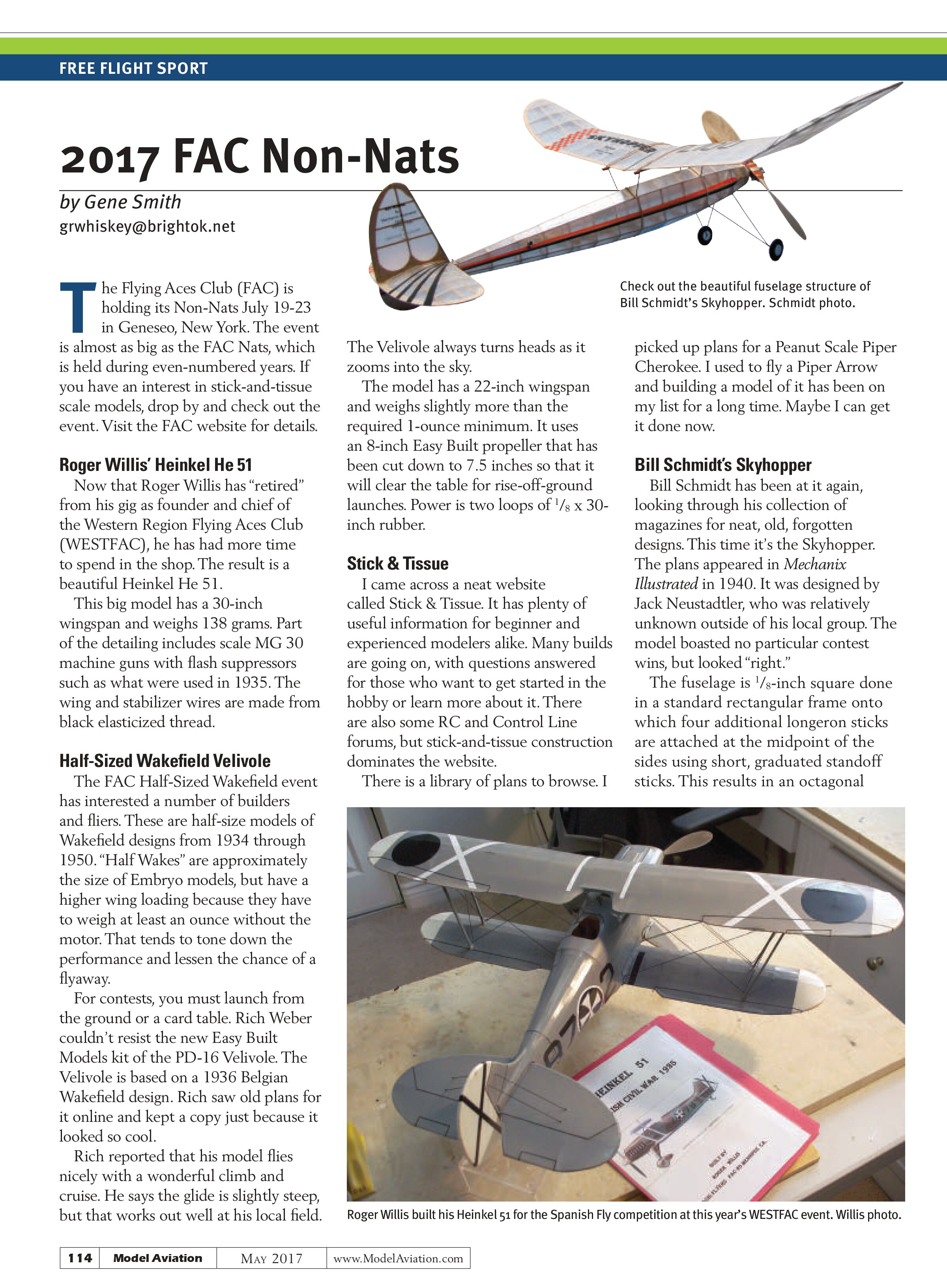
Bill Schmidt has been at it again, looking through his collection of magazines for neat, old, forgotten designs. This time it’s the Skyhopper. The plans appeared in Mechanix Illustrated in 1940. It was designed by Jack Neustadtler, who was relatively unknown outside of his local group. The model boasted no particular contest wins, but looked “right.”
The fuselage is 1/8-inch square done in a standard rectangular frame onto which four additional longeron sticks are attached at the midpoint of the sides using short, graduated standoff sticks. This results in an octagonal

fuselage cross-section.
The wingspan is 32 inches. It uses a McCombs modified X block II 1.2-pitch 11-inch propeller, made into a freewheeling folder to prevent damage when landing. Power is provided by six strands of 3/16-inch rubber. The weight, including the motor, is 3.85 ounces.
The fuselage was covered with silk because of its ability to cover compound curves. Only two pieces were needed—one on each side. The rest of the model is covered in lightweight Polyspan and A-280 Randolph nitrate dope. The wheels are 1/16-inch plywood in the center, with 1/8-inch sheet on each side.
Laser-Cut Jigs and Gussets
Bob Holman has offered laser-cut building jigs for several years and is always working to improve his product. His latest jig, version V, will help you build that next fuselage straight! He also sells laser-cut gussets in three sizes and different thicknesses. I tried them and they are real time-savers.
FAC Jet Catapult
The FAC Jet Catapult Glider event has proven to be extremely popular. It is a real challenge to get these little gliders to perform, but it can be done. When you see one fly well, that is its own reward.
Glen Simpers had a great article about the Scale Jet Catapult Glider event in the 2016 third-quarter issue of Max Fax, the newsletter of the DC Maxecuters Model Airplane Club. The newsletter contains plans for six Jet Catapult gliders, including two of Glen’s: a Canberra and a Banshee.
Glen’s article discusses the design, building, and trimming factors that are unique to Scale Catapult gliders as compared to typical Duration Catapult gliders. If you are interested in Jet Catapult, this issue has some useful information.
Littman’s “Wright” Embryo
Howard Littman has added an Embryo biplane to his kit list. It’s called the Wright Amount of Wrong, but despite the name, it flies great. Search YouTube with Howard’s name and see a video of it flying indoors.
SOURCES:
- National Free Flight Society (NFFS)
www.freeflight.org - FAC
www.flyingacesclub.com - WESTFAC
www.westernfac.com - Easy Built Models
(334) 358-5184
www.easybuiltmodels.com - Stick & Tissue
www.stickandtissue.com - Bob Holman Plans
(909) 885-3959
www.bhplans.com - DC Maxecuters Model Airplane Club
www.dcmaxecuter.org - Howard Littman Model Aircraft
howard@hjlmodels.com
www.hjlmodels.com