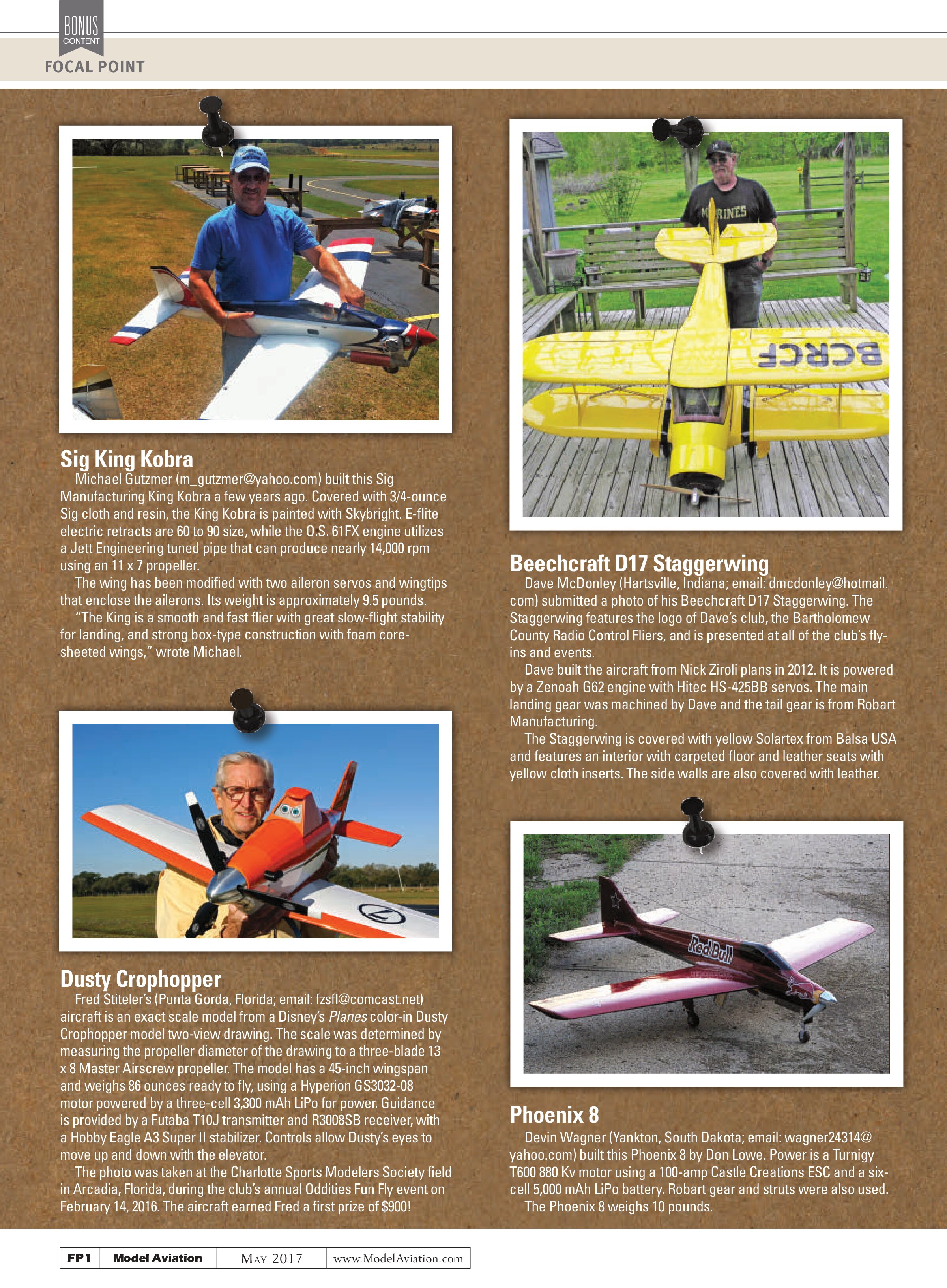
Sig King Kobra
Michael Gutzmer (m_gutzmer@yahoo.com) built this Sig Manufacturing King Kobra a few years ago. Covered with 3/4-ounce Sig cloth and resin, the King Kobra is painted with Skybright. E-flite electric retracts are 60 to 90 size, while the O.S. 61FX engine utilizes a Jett Engineering tuned pipe that can produce nearly 14,000 rpm using an 11 x 7 propeller.
The wing has been modified with two aileron servos and wingtips that enclose the ailerons. Its weight is approximately 9.5 pounds.
“The King is a smooth and fast flier with great slow-flight stability for landing, and strong box-type construction with foam core-sheeted wings,” wrote Michael.

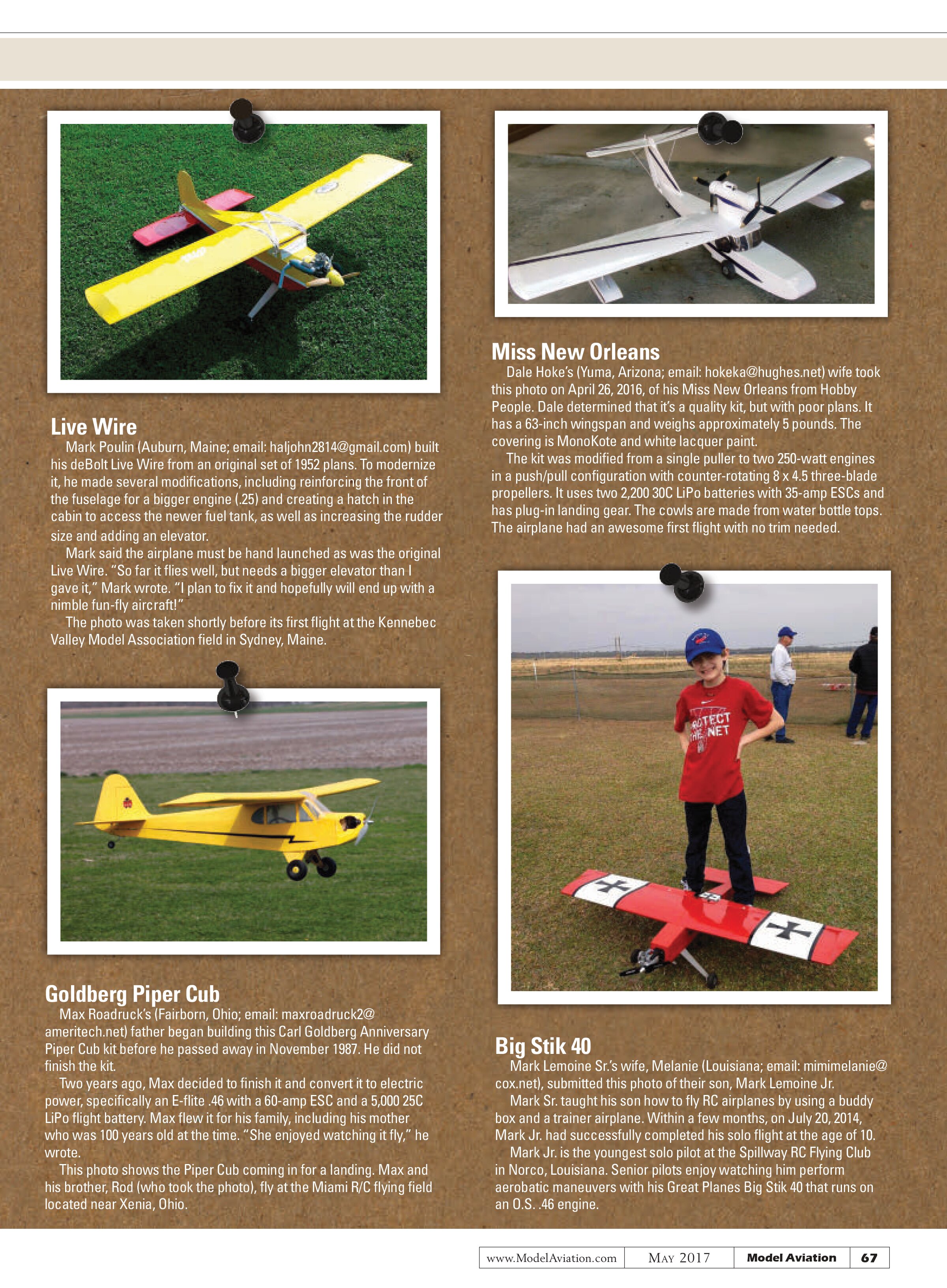
Dusty Crophopper
Fred Stiteler’s (Punta Gorda, Florida; email: fzsfl@comcast.net) aircraft is an exact scale model from a Disney’s Planes color-in Dusty Crophopper model two-view drawing. The scale was determined by measuring the propeller diameter of the drawing to a three-blade 13 x 8 Master Airscrew propeller. The model has a 45-inch wingspan and weighs 86 ounces ready to fly, using a Hyperion GS3032-08 motor powered by a three-cell 3,300 mAh LiPo for power. Guidance is provided by a Futaba T10J transmitter and R3008SB receiver, with a Hobby Eagle A3 Super II stabilizer. Controls allow Dusty’s eyes to move up and down with the elevator.
The photo was taken at the Charlotte Sports Modelers Society field in Arcadia, Florida, during the club’s annual Oddities Fun Fly event on February 14, 2016. The aircraft earned Fred a first prize of $900!

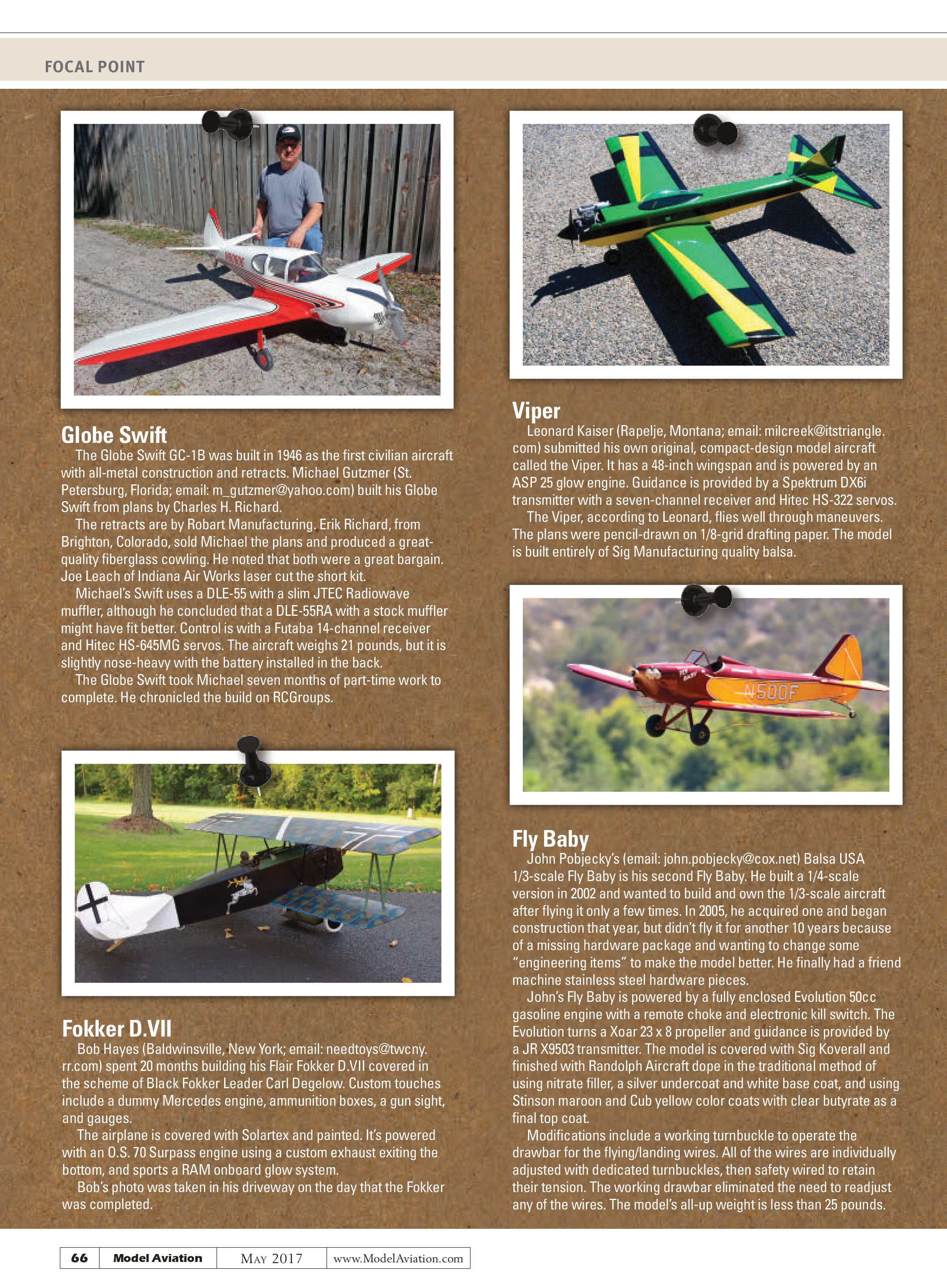
Beechcraft D17 Staggerwing
Dave McDonley (Hartsville, Indiana; email: dmcdonley@hotmail.com) submitted a photo of his Beechcraft D17 Staggerwing. The Staggerwing features the logo of Dave’s club, the Bartholomew County Radio Control Fliers, and is presented at all of the club’s fly-ins and events.
Dave built the aircraft from Nick Ziroli plans in 2012. It is powered by a Zenoah G62 engine with Hitec HS-425BB servos. The main landing gear was machined by Dave and the tail gear is from Robart Manufacturing.
The Staggerwing is covered with yellow Solartex from Balsa USA and features an interior with carpeted floor and leather seats with yellow cloth inserts. The side walls are also covered with leather.

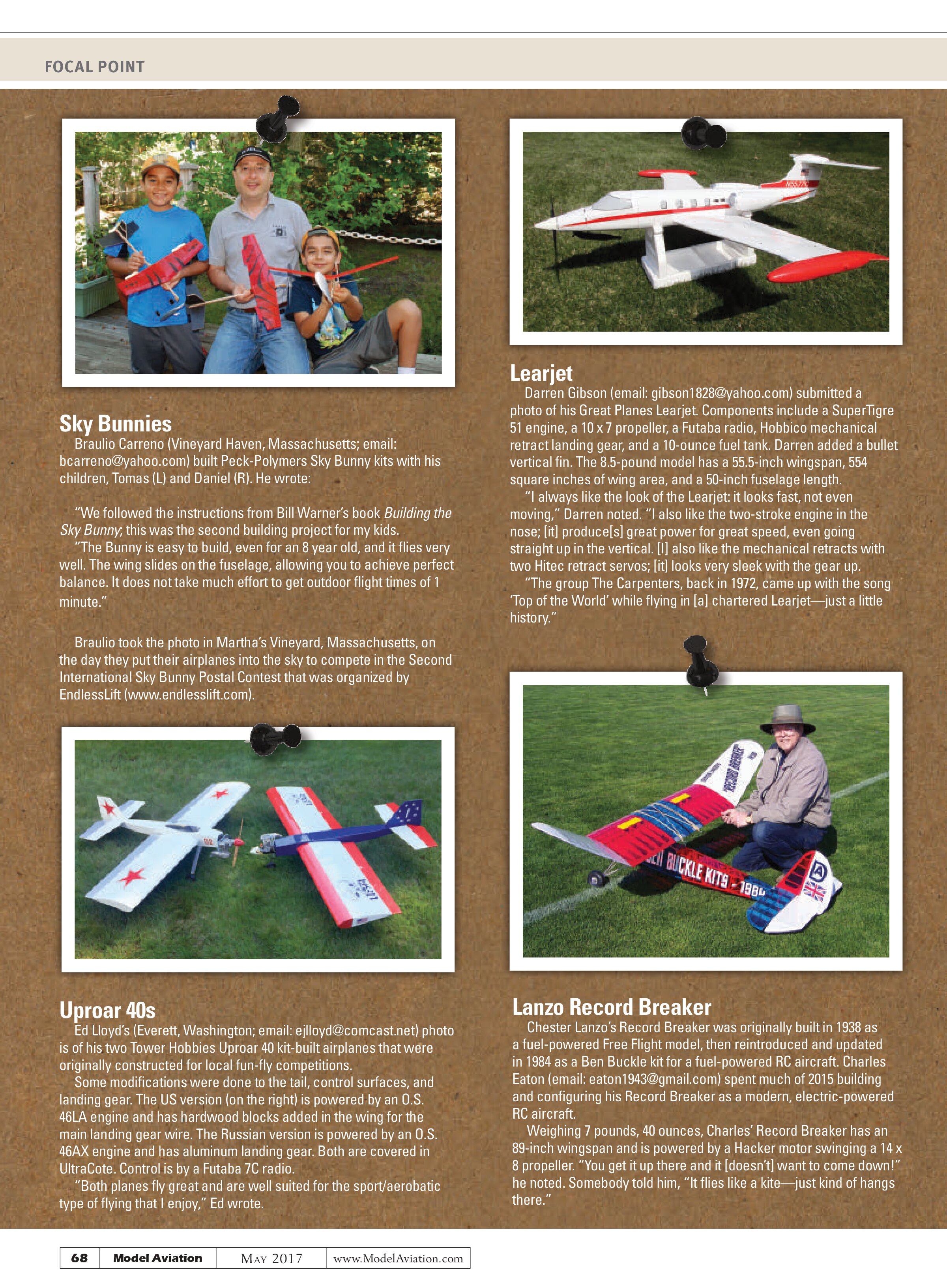
Phoenix 8
Devin Wagner (Yankton, South Dakota; email: wagner24314@yahoo.com) built this Phoenix 8 by Don Lowe. Power is a Turnigy T600 880 Kv motor using a 100-amp Castle Creations ESC and a six-cell 5,000 mAh LiPo battery. Robart gear and struts were also used.
The Phoenix 8 weighs 10 pounds.


Globe Swift
The Globe Swift GC-1B was built in 1946 as the first civilian aircraft with all-metal construction and retracts. Michael Gutzmer (St. Petersburg, Florida; email: m_gutzmer@yahoo.com) built his Globe Swift from plans by Charles H. Richard.
The retracts are by Robart Manufacturing. Erik Richard, from Brighton, Colorado, sold Michael the plans and produced a great-quality fiberglass cowling. He noted that both were a great bargain. Joe Leach of Indiana Air Works laser cut the short kit.
Michael’s Swift uses a DLE-55 with a slim JTEC Radiowave muffler, although he concluded that a DLE-55RA with a stock muffler might have fit better. Control is with a Futaba 14-channel receiver and Hitec HS-645MG servos. The aircraft weighs 21 pounds, but it is slightly nose-heavy with the battery installed in the back.
The Globe Swift took Michael seven months of part-time work to complete. He chronicled the build on RCGroups.

Fokker D.VII
Bob Hayes (Baldwinsville, New York; email: needtoys@twcny.rr.com) spent 20 months building his Flair Fokker D.VII covered in the scheme of Black Fokker Leader Carl Degelow. Custom touches include a dummy Mercedes engine, ammunition boxes, a gun sight, and gauges.
The airplane is covered with Solartex and painted. It’s powered with an O.S. 70 Surpass engine using a custom exhaust exiting the bottom, and sports a RAM onboard glow system.
Bob’s photo was taken in his driveway on the day that the Fokker was completed.

Viper
Leonard Kaiser (Rapelje, Montana; email: milcreek@itstriangle.com) submitted his own original, compact-design model aircraft called the Viper. It has a 48-inch wingspan and is powered by an ASP 25 glow engine. Guidance is provided by a Spektrum DX6i transmitter with a seven-channel receiver and Hitec HS-322 servos.
The Viper, according to Leonard, flies well through maneuvers. The plans were pencil-drawn on 1/8-grid drafting paper. The model is built entirely of Sig Manufacturing quality balsa.

Fly Baby
John P obej e cky’s (email: john.pobj ecky@cox.net) Balsa USA 1/3-scale Fly Baby is his second Fly Baby. He built a 1/4-scale version in 2002 and wanted to build and own the 1/3-scale aircraft after flying it only a few times. In 2005, he acquired one and began construction that year, but didn’t fly it for another 10 years because of a missing hardware package and wanting to change some “engineering items” to make the model better. He finally had a friend machine stainless steel hardware pieces.
John’s Fly Baby is powered by a fully enclosed Evolution 50cc gasoline engine with a remote choke and electronic kill switch. The Evolution turns a Xoar 23 x 8 propeller and guidance is provided by a JR X9503 transmitter. The model is covered with Sig Koverall and finished with Randolph Aircraft dope in the traditional method of using nitrate filler, a silver undercoat and white base coat, and using Stinson maroon and Cub yellow color coats with clear butyrate as a final top coat.
Modifications include a working turnbuckle to operate the drawbar for the flying/landing wires. All of the wires are individually adjusted with dedicated turnbuckles, then safety wired to retain their tension. The working drawbar eliminated the need to readjust any of the wires. The model’s all-up weight is less than 25 pounds.

Live Wire
Mark Poulin (Auburn, Maine; email: haljohn2814@gmail.com) built his deBolt Live Wire from an original set of 1952 plans. To modernize it, he made several modifications, including reinforcing the front of the fuselage for a bigger engine (.25) and creating a hatch in the cabin to access the newer fuel tank, as well as increasing the rudder size and adding an elevator.
Mark said the airplane must be hand launched as was the original Live Wire. “So far it flies well, but needs a bigger elevator than I gave it,” Mark wrote. “I plan to fix it and hopefully will end up with a nimble fun-fly aircraft!”
The photo was taken shortly before its first flight at the Kennebec Valley Model Association field in Sydney, Maine.

Goldberg Piper Cub
Max Roadruck’s (Fairborn, Ohio; email: maxroadr uck2@ameritech.net) father began building this Carl Goldberg Anniversary Piper Cub kit before he passed away in November 1987. He did not finish the kit.
Two years ago, Max decided to finish it and convert it to electric power, specifically an E-flite .46 with a 60-amp ESC and a 5,000 25C LiPo flight battery. Max flew it for his family, including his mother who was 100 years old at the time. “She enjoyed watching it fly,” he wrote.
This photo shows the Piper Cub coming in for a landing. Max and his brother, Rod (who took the photo), fly at the Miami R/C flying field located near Xenia, Ohio.

Miss New Orleans
Dale Hoke’s (Yuma, Arizona; email: hokeka@hughes.net) wife took this photo on April 26, 2016, of his Miss New Orleans from Hobby People. Dale determined that it’s a quality kit, but with poor plans. It has a 63-inch wingspan and weighs approximately 5 pounds. The covering is MonoKote and white lacquer paint.
The kit was modified from a single puller to two 250-watt engines in a push/pull configuration with counter-rotating 8 x 4.5 three-blade propellers. It uses two 2,200 30C LiPo batteries with 35-amp ESCs and has plug-in landing gear. The cowls are made from water bottle tops. The airplane had an awesome first flight with no trim needed.

Big Stik 40
Mark Lemoine Sr.’s wife, Melanie (Louisiana; email: mimimelanie@cox.net), submitted this photo of their son, Mark Lemoine Jr.
Mark Sr. taught his son how to fly RC airplanes by using a buddy box and a trainer airplane. Within a few months, on July 20, 2014, Mark Jr. had successfully completed his solo flight at the age of 10.
Mark Jr. is the youngest solo pilot at the Spillway RC Flying Club in Norco, Louisiana. Senior pilots enjoy watching him perform aerobatic maneuvers with his Great Planes Big Stik 40 that runs on an O.S. 46 engine.
Sky Bunnies
Braulio Carreno (Vineyard Haven, Massachusetts; email: bcarreno@yahoo.com) built Peck-Polymers Sky Bunny kits with his children, Tomas (L) and Daniel (R). He wrote:
“We followed the instructions from Bill Warner’s book Building the Sky Bunny; this was the second building project for my kids.
“The Bunny is easy to build, even for an 8 year old, and it flies very well. The wing slides on the fuselage, allowing you to achieve perfect balance. It does not take much effort to get outdoor flight times of 1 minute.”
Braulio took the photo in Martha’s Vineyard, Massachusetts, on the day they put their airplanes into the sky to compete in the Second International Sky Bunny Postal Contest that was organized by EndlessLift (www.endlesslift.com).

Uproar 40s
Ed Lloyd’s (Everett, Washington; email: ejlloyd@comcast.net) photo is of his two Tower Hobbies Uproar 40 kit-built airplanes that were originally constructed for local fun-fly competitions.
Some modifications were done to the tail, control surfaces, and landing gear. The US version (on the right) is powered by an O.S. 46LA engine and has hardwood blocks added in the wing for the main landing gear wire. The Russian version is powered by an O.S. 46AX engine and has aluminum landing gear. Both are covered in UltraCote. Control is by a Futaba 7C radio.
“Both planes fly great and are well suited for the sport/aerobatic type of flying that I enjoy,” Ed wrote.

Learjet
Darren Gibson (email: gibson1828@yahoo.com) submitted a photo of his Great Planes Learjet. Components include a SuperTigre 51 engine, a 10 x 7 propeller, a Futaba radio, Hobbico mechanical retract landing gear, and a 10-ounce fuel tank. Darren added a bullet vertical fin. The 8.5-pound model has a 55.5-inch wingspan, 554 square inches of wing area, and a 50-inch fuselage length.
“I always like the look of the Learjet: it looks fast, not even moving,” Darren noted. “I also like the two-stroke engine in the nose; [it] produce[s] great power for great speed, even going straight up in the vertical. [I] also like the mechanical retracts with two Hitec retract servos; [it] looks very sleek with the gear up.”
“The group The Carpenters, back in 1972, came up with the song ‘Top of the World’ while flying in [a] chartered Learjet—just a little history.”

Lanzo Record Breaker
Chester Lanzo’s Record Breaker was originally built in 1938 as a fuel-powered Free Flight model, then reintroduced and updated in 1984 as a Ben Buckle kit for a fuel-powered RC aircraft. Charles Eaton (email: eaton1943@gmail.com) spent much of 2015 building and configuring his Record Breaker as a modern, electric-powered RC aircraft.
Weighing 7 pounds, 40 ounces, Charles’ Record Breaker has an 89-inch wingspan and is powered by a Hacker motor swinging a 14 x 8 propeller. “You get it up there and it [doesn’t] want to come down!” he noted. Somebody told him, “It flies like a kite—just kind of hangs there.”

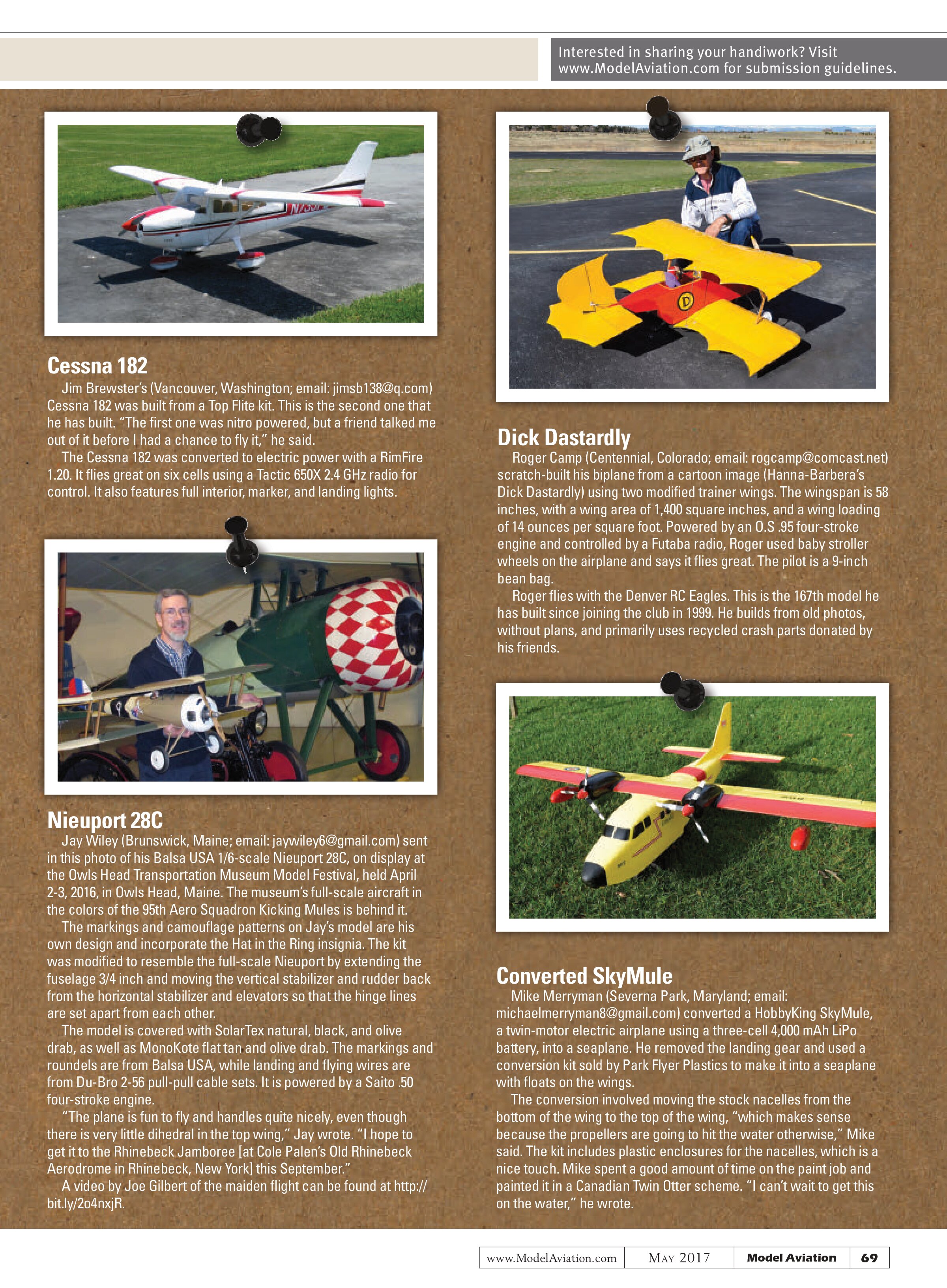
Cessna 182
Jim Brewster’s (Vancouver, Washington; email: jimsb138@q.com) Cessna 182 was built from a Top Flite kit. This is the second one that he has built. “The first one was nitro powered, but a friend talked me out of it before I had a chance to fly it,” he said.
The Cessna 182 was converted to electric power with a RimFire 1.20. It flies great on six cells using a Tactic 650X 2.4 GHz radio for control. It also features full interior, marker, and landing lights.

Nieuport 28C
Jay Wiley (Brunswick, Maine; email: jaywiley6@gmail.com) sent in this photo of his Balsa USA 1/6-scale Nieuport 28C, on display at the Owls Head Transportation Museum Model Festival, held April 2-3, 2016, in Owls Head, Maine. The museum’s full-scale aircraft in the colors of the 95th Aero Squadron Kicking Mules is behind it.
The markings and camouflage patterns on Jay’s model are his own design and incorporate the Hat in the Ring insignia. The kit was modified to resemble the full-scale Nieuport by extending the fuselage 3/4 inch and moving the vertical stabilizer and rudder back from the horizontal stabilizer and elevators so that the hinge lines are set apart from each other.
The model is covered with SolarTex natural, black, and olive drab, as well as MonoKote flat tan and olive drab. The markings and roundels are from Balsa USA, while landing and flying wires are from Du-Bro 2-56 pull-pull cable sets. It is powered by a Saito .50 four-stroke engine.
“The plane is fun to fly and handles quite nicely, even though there is very little dihedral in the top wing,” Jay wrote. “I hope to get it to the Rhinebeck Jamboree [at Cole Palen’s Old Rhinebeck Aerodrome in Rhinebeck, New York] this September.”
A video by Joe Gilbert of the maiden flight can be found at http://bit.ly/2o4nxjR.

Dick Dastardly
Roger Camp (Centennial, Colorado; email: rogcamp@comcast.net) scratch-built his biplane from a cartoon image (Hanna-Barbera’s Dick Dastardly) using two modified trainer wings. The wingspan is 58 inches, with a wing area of 1,400 square inches, and a wing loading of 14 ounces per square foot. Powered by an O.S .95 four-stroke engine and controlled by a Futaba radio, Roger used baby stroller wheels on the airplane and says it flies great. The pilot is a 9-inch bean bag.
Roger flies with the Denver RC Eagles. This is the 167th model he has built since joining the club in 1999. He builds from old photos, without plans, and primarily uses recycled crash parts donated by his friends.

Converted SkyMule
Mike Merryman (Severna Park, Maryland; email: michaelmerryman8@gmail.com) converted a HobbyKing SkyMule, a twin-motor electric airplane using a three-cell 4,000 mAh LiPo battery, into a seaplane. He removed the landing gear and used a conversion kit sold by Park Flyer Plastics to make it into a seaplane with floats on the wings.
The conversion involved moving the stock nacelles from the bottom of the wing to the top of the wing, “which makes sense because the propellers are going to hit the water otherwise,” Mike said. The kit includes plastic enclosures for the nacelles, which is a nice touch. Mike spent a good amount of time on the paint job and painted it in a Canadian Twin Otter scheme. “I can’t wait to get this on the water,” he wrote.