Education Through Aviation
by Bill Pritchett, Education Director
“Newspaper readership is declining like crazy. In fact, there’s a good chance that nobody is reading my column.” —Dave Barry

Dave Barry hit a little close to home here, but I’m convinced that there are some loyal readers of this column. I regularly hear from many of them. And sometimes it reminds me that while things change, many things stay the same.
A recurring theme for this column has been how can we—you, me, everyone who participates in model aviation—share the fun, the educational opportunities, and the great relationships we’ve made? Although we have websites, newsletters, countless social media outlets, and probably other ways we communicate out of our organization, the basics are still in play—Model Aviation magazine!
I’ve looked at a great deal of data the last few years detailing survey results that poll our members on what they consider to be the value of membership in the AMA. To my recollection, there hasn’t been one of those without our magazine at or near the top.
So, we all get the magazine; look forward to reading it, and then what? Some people are collectors and that’s okay. My guess is that most of us keep a few around for a while then throw them away. I recently received a nice note and here’s a portion:
“If the AMA isn’t already doing so, I believe that they should provide copies of Model Aviation to grade school students (hard copies don’t require computers and can be passed around) to encourage STEM. We have far too many people studying stuff that is of little consequence in today’s environment … and STEM is what makes our country one of the greatest ever … before this term was ever ‘coined.’
“Cheers, Gene Goldstein AMA 3276”
Thanks, Gene! Although we don’t provide a magazine in hard copy to Youth members unless they pay extra, this email reminded me of a story that was told recently about what a club chose to do and maybe you can lead this charge in your own club.
At every monthly club meeting, attendees bring in their magazine(s) that they’ve finished with. One person volunteers to collect them and remove the mailing label. Now comes the cool part—this wonderful volunteer then goes around to doctors, dentists, and any office with a waiting room, dropping off a couple copies of our magazine! Bam! This approach isn’t necessarily just for kids, but that’s okay! I’ll bet there are copies being carried out and given to a likely modeler in the family. Run this by your club and see if it might work in your community.
The Delta Dart, or AMA Cub, has been a staple of youth activities for generations. I’m sure as you read this, memories of your experiences with a Delta Dart are flooding back.
I tried to figure out how many of these the AMA Education department sends out each year, but because of the different ways they go out, it’s virtually impossible. I think it’s safe to say that 10s, if not 100s of thousands of these have been sent out for kids to build at events with our members.
Several years ago, we kind of threw a wrinkle into that by introducing the venerable FPG-9. Now we have a foam glider that is easy to put together for all ages and demonstrates controlled flight! And yet, the Delta Darts continue to go out the door.
Don’t misunderstand me—the Delta Dart has served a great and noble purpose. I just think there has to be something better. The days of taking #11 blades and CA glue into a classroom are long gone. The FPG-9 is great, but it is hand launched, and if you’ve presented those, wouldn’t it be nice to have a next step? Well now you do!
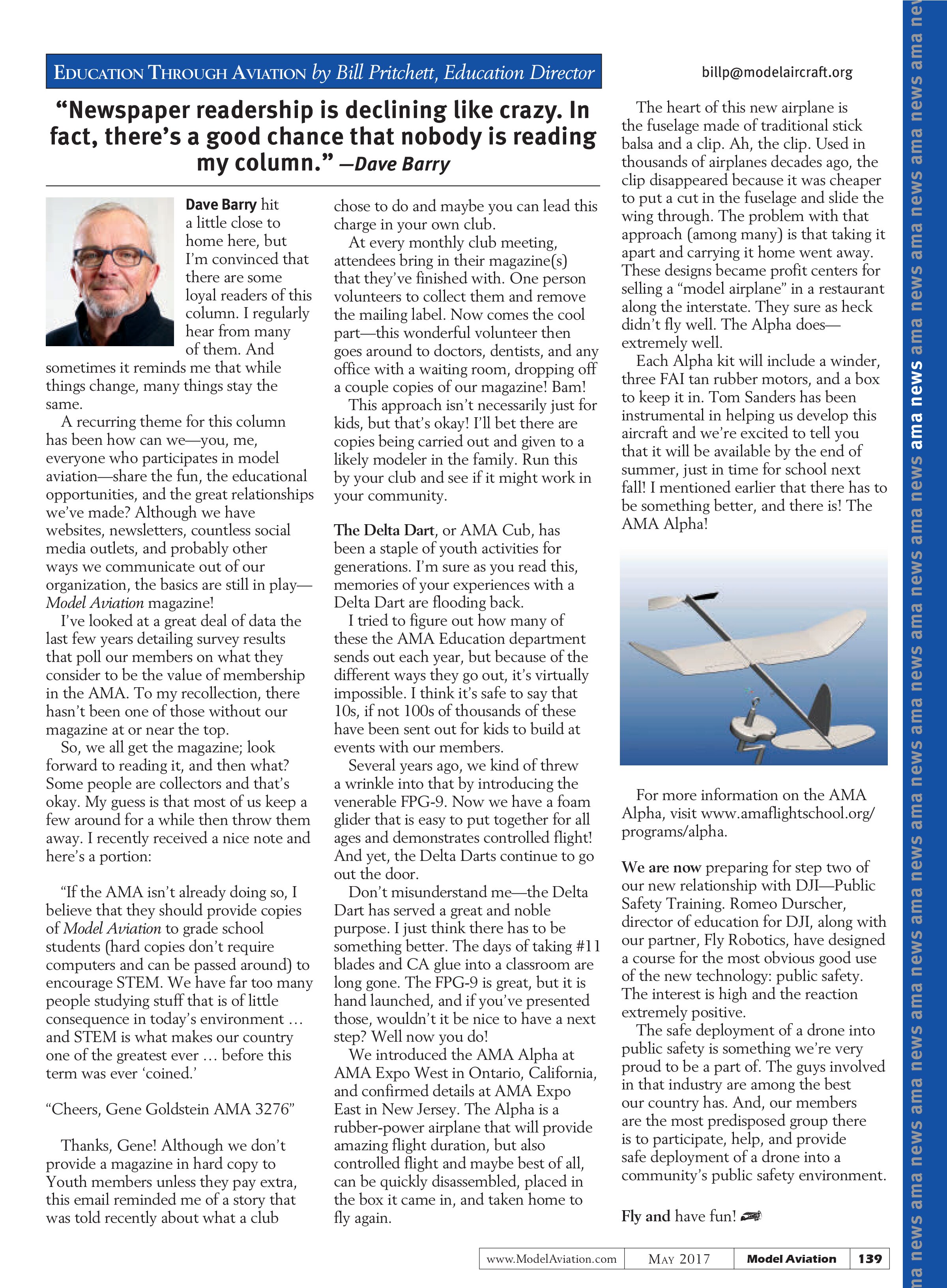
We introduced the AMA Alpha at AMA Expo West in Ontario, California, and confirmed details at AMA Expo East in New Jersey. The Alpha is a rubber-power airplane that will provide amazing flight duration, but also controlled flight and maybe best of all, can be quickly disassembled, placed in the box it came in, and taken home to fly again.
The heart of this new airplane is the fuselage made of traditional stick balsa and a clip. Ah, the clip. Used in thousands of airplanes decades ago, the clip disappeared because it was cheaper to put a cut in the fuselage and slide the wing through. The problem with that approach (among many) is that taking it apart and carrying it home went away. These designs became profit centers for selling a “model airplane” in a restaurant along the interstate. They sure as heck didn’t fly well. The Alpha does—extremely well.
Each Alpha kit will include a winder, three FAI tan rubber motors, and a box to keep it in. Tom Sanders has been instrumental in helping us develop this aircraft and we’re excited to tell you that it will be available by the end of summer, just in time for school next fall! I mentioned earlier that there has to be something better, and there is! The AMA Alpha!

For more information on the AMA Alpha, visit www.amaflightschool.org/programs/alpha.
We are now preparing for step two of our new relationship with DJI—Public Safety Training. Romeo Durscher, director of education for DJI, along with our partner, Fly Robotics, have designed a course for the most obvious good use of the new technology: public safety. The interest is high and the reaction extremely positive.
The safe deployment of a drone into public safety is something we’re very proud to be a part of. The guys involved in that industry are among the best our country has. And, our members are the most predisposed group there is to participate, help, and provide safe deployment of a drone into a community’s public safety environment.
Fly and have fun!