Remembering Bill Rutherford
by Bob Hunt
robinhunt@rcn.com
The Control Line (CL) Aerobatics (Stunt) world mourns the loss of one of its most beloved members. Bill Rutherford passed away on December 30, 2016, following a massive stroke.
I first met Bill in 1974 at the Nats in Lake Charles, Louisiana, and immediately became friends with him. He had that effect on nearly everybody he ever met; he was simply a naturally friendly guy.
Throughout the years, we had many telephone conversations about modeling, family, and faith. I’ll miss hearing him say, “Hey Bobby!” whenever he called.
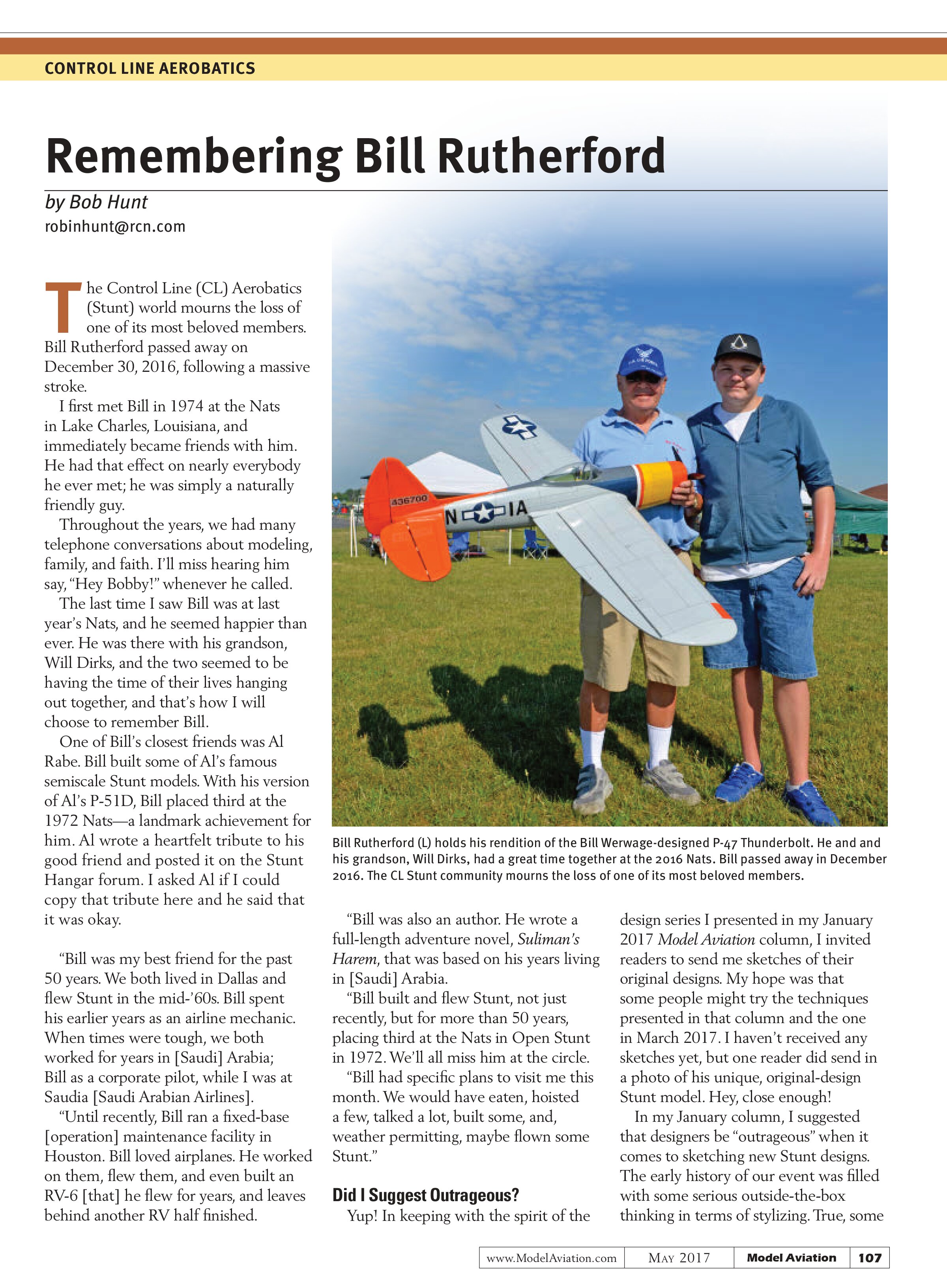
The last time I saw Bill was at last year’s Nats, and he seemed happier than ever. He was there with his grandson, Will Dirks, and the two seemed to be having the time of their lives hanging out together, and that’s how I will choose to remember Bill.
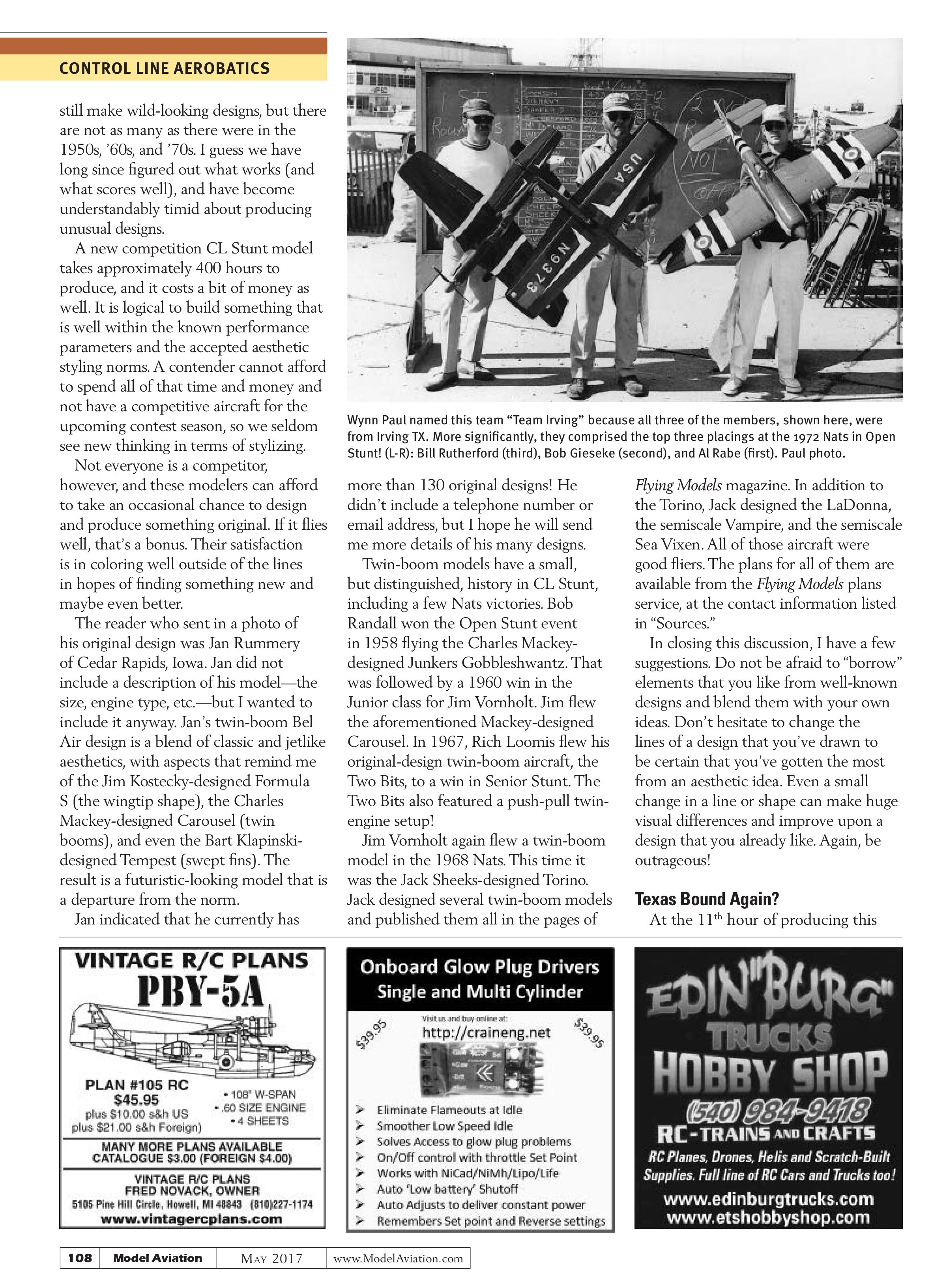
One of Bill’s closest friends was Al Rabe. Bill built some of Al’s famous semiscale Stunt models. With his version of Al’s P-51D, Bill placed third at the 1972 Nats—a landmark achievement for him. Al wrote a heartfelt tribute to his good friend and posted it on the Stunt Hangar forum. I asked Al if I could copy that tribute here and he said that it was okay.
“Bill was my best friend for the past 50 years. We both lived in Dallas and flew Stunt in the mid-’60s. Bill spent his earlier years as an airline mechanic. When times were tough, we both worked for years in [Saudi] Arabia; Bill as a corporate pilot, while I was at Saudia [Saudi Arabian Airlines].
“Until recently, Bill ran a fixed-base [operation] maintenance facility in Houston. Bill loved airplanes. He worked on them, flew them, and even built an RV-6 [that] he flew for years, and leaves behind another RV half finished.

“Bill was also an author. He wrote a full-length adventure novel, Suliman’s Harem, that was based on his years living in [Saudi] Arabia.
“Bill built and flew Stunt, not just recently, but for more than 50 years, placing third at the Nats in Open Stunt in 1972. We’ll all miss him at the circle.
“Bill had specific plans to visit me this month. We would have eaten, hoisted a few, talked a lot, built some, and, weather permitting, maybe flown some Stunt.”
Did I Suggest Outrageous?
Yup! In keeping with the spirit of the design series I presented in my January 2017 Model Aviation column, I invited readers to send me sketches of their original designs. My hope was that some people might try the techniques presented in that column and the one in March 2017. I haven’t received any sketches yet, but one reader did send in a photo of his unique, original-design Stunt model. Hey, close enough!
In my January column, I suggested that designers be “outrageous” when it comes to sketching new Stunt designs. The early history of our event was filled with some serious outside-the-box thinking in terms of stylizing. True, some
still make wild-looking designs, but there are not as many as there were in the 1950s, ’60s, and ’70s. I guess we have long since figured out what works (and what scores well), and have become understandably timid about producing unusual designs.
A new competition CL Stunt model takes approximately 400 hours to produce, and it costs a bit of money as well. It is logical to build something that is well within the known performance parameters and the accepted aesthetic styling norms. A contender cannot afford to spend all of that time and money and not have a competitive aircraft for the upcoming contest season, so we seldom see new thinking in terms of stylizing.
Not everyone is a competitor, however, and these modelers can afford to take an occasional chance to design and produce something original. If it flies well, that’s a bonus. Their satisfaction is in coloring well outside of the lines in hopes of finding something new and maybe even better.
The reader who sent in a photo of his original design was Jan Rummery of Cedar Rapids, Iowa. Jan did not include a description of his model—the size, engine type, etc.—but I wanted to include it anyway. Jan’s twin-boom Bel Air design is a blend of classic and jetlike aesthetics, with aspects that remind me of the Jim Kostecky-designed Formula S (the wingtip shape), the Charles Mackey-designed Carousel (twin booms), and even the Bart Klapinski-designed Tempest (swept fins). The result is a futuristic-looking model that is a departure from the norm.
Jan indicated that he currently has

more than 130 original designs! He didn’t include a telephone number or email address, but I hope he will send me more details of his many designs.
Twin-boom models have a small, but distinguished, history in CL Stunt, including a few Nats victories. Bob Randall won the Open Stunt event in 1958 flying the Charles Mackey-designed Junkers Gobbleshwantz. That was followed by a 1960 win in the Junior class for Jim Vornholt. Jim flew the aforementioned Mackey-designed Carousel. In 1967, Rich Loomis flew his original-design twin-boom aircraft, the Two Bits, to a win in Senior Stunt. The Two Bits also featured a push-pull twin-engine setup!
Jim Vornholt again flew a twin-boom model in the 1968 Nats. This time it was the Jack Sheeks-designed Torino. Jack designed several twin-boom models and published them all in the pages of Flying Models magazine. In addition to the Torino, Jack designed the LaDonna, the semiscale Vampire, and the semiscale Sea Vixen. All of those aircraft were good fliers. The plans for all of them are available from the Flying Models plans service, at the contact information listed in “Sources.”
In closing this discussion, I have a few suggestions. Do not be afraid to “borrow” elements that you like from well-known designs and blend them with your own ideas. Don’t hesitate to change the lines of a design that you’ve drawn to be certain that you’ve gotten the most from an aesthetic idea. Even a small change in a line or shape can make huge visual differences and improve upon a design that you already like. Again, be outrageous!
Texas Bound Again?
At the 11th hour of producing this