FPV goggles and you!
Jim T. Graham
jgraham@rcgroups.com

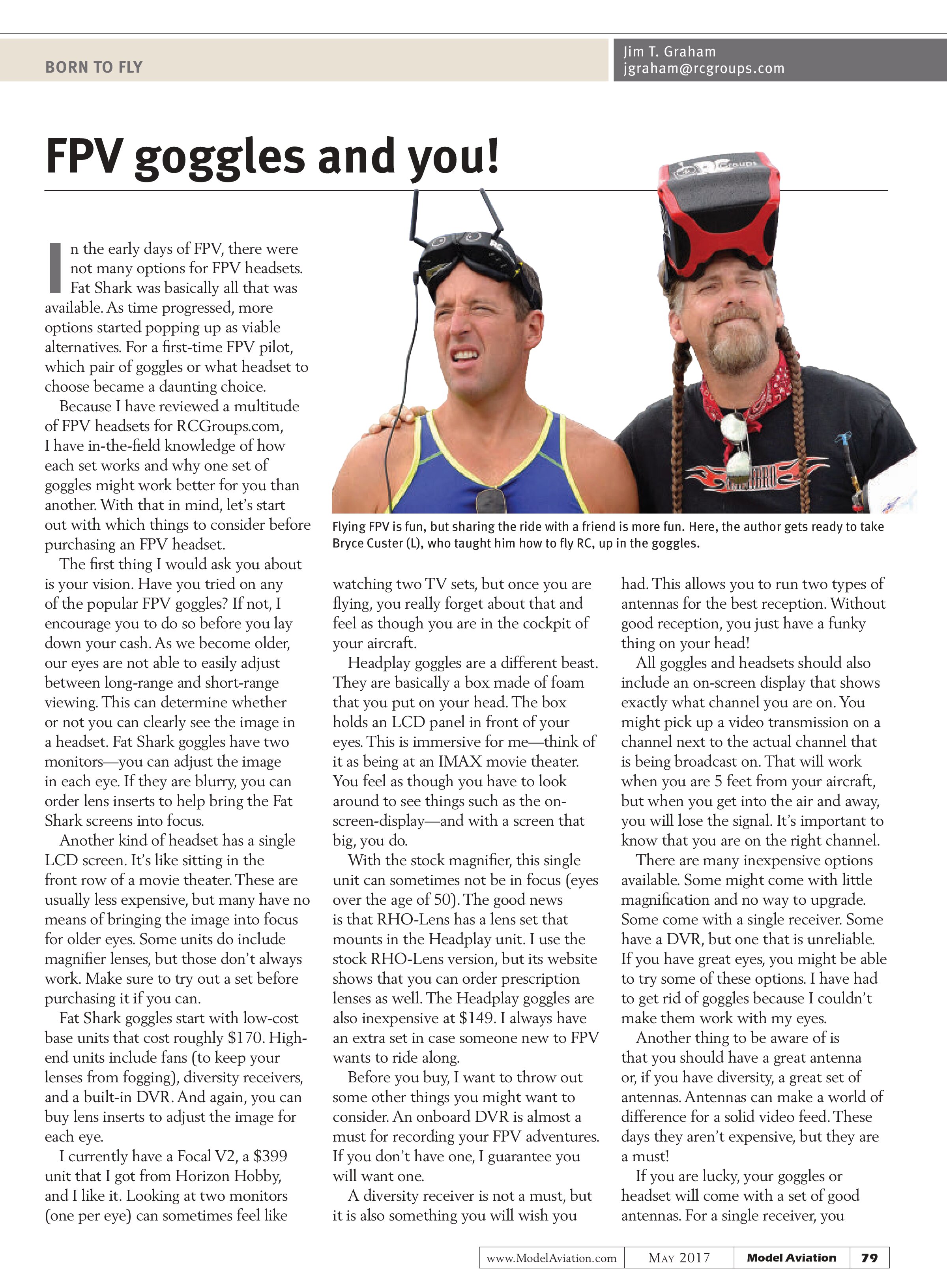
In the early days of FPV, there were not many options for FPV headsets. Fat Shark was basically all that was available. As time progressed, more options started popping up as viable alternatives. For a first-time FPV pilot, which pair of goggles or what headset to choose became a daunting choice.
Because I have reviewed a multitude of FPV headsets for RCGroups.com, I have in-the-field knowledge of how each set works and why one set of goggles might work better for you than another. With that in mind, let’s start out with which things to consider before purchasing an FPV headset.
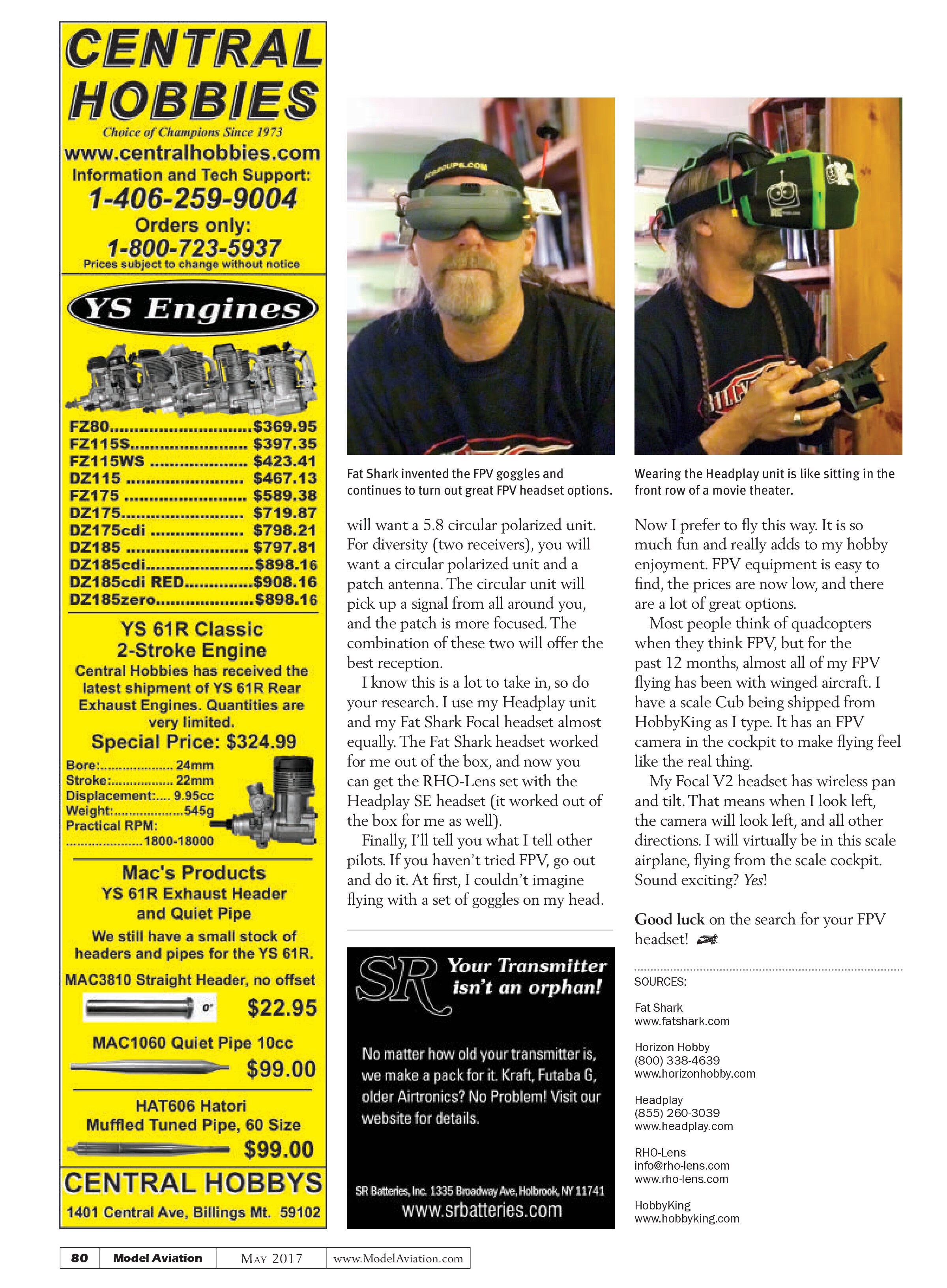
The first thing I would ask you about is your vision. Have you tried on any of the popular FPV goggles? If not, I encourage you to do so before you lay down your cash. As we become older, our eyes are not able to easily adjust between long-range and short-range viewing. This can determine whether or not you can clearly see the image in a headset. Fat Shark goggles have two monitors—you can adjust the image in each eye. If they are blurry, you can order lens inserts to help bring the Fat Shark screens into focus.
Another kind of headset has a single LCD screen. It’s like sitting in the front row of a movie theater. These are usually less expensive, but many have no means of bringing the image into focus for older eyes. Some units do include magnifier lenses, but those don’t always work. Make sure to try out a set before purchasing it if you can.
Fat Shark goggles start with low-cost base units that cost roughly $170. High-end units include fans (to keep your lenses from fogging), diversity receivers, and a built-in DVR. And again, you can buy lens inserts to adjust the image for each eye.
I currently have a Focal V2, a $399 unit that I got from Horizon Hobby, and I like it. Looking at two monitors (one per eye) can sometimes feel like watching two TV sets, but once you are flying, you really forget about that and feel as though you are in the cockpit of your aircraft.
Headplay goggles are a different beast. They are basically a box made of foam that you put on your head. The box holds an LCD panel in front of your eyes. This is immersive for me—think of it as being at an IMAX movie theater. You feel as though you have to look around to see things such as the on-screen-display—and with a screen that big, you do.
With the stock magnifier, this single unit can sometimes not be in focus (eyes over the age of 50). The good news is that RHO-Lens has a lens set that mounts in the Headplay unit. I use the stock RHO-Lens version, but its website shows that you can order prescription lenses as well. The Headplay goggles are also inexpensive at $149. I always have an extra set in case someone new to FPV wants to ride along.
Before you buy, I want to throw out some other things you might want to consider. An onboard DVR is almost a must for recording your FPV adventures. If you don’t have one, I guarantee you will want one.
A diversity receiver is not a must, but it is also something you will wish you had. This allows you to run two types of antennas for the best reception. Without good reception, you just have a funky thing on your head!
All goggles and headsets should also include an on-screen display that shows exactly what channel you are on. You might pick up a video transmission on a channel next to the actual channel that is being broadcast on. That will work when you are 5 feet from your aircraft, but when you get into the air and away, you will lose the signal. It’s important to know that you are on the right channel.
There are many inexpensive options available. Some might come with little magnification and no way to upgrade. Some come with a single receiver. Some have a DVR, but one that is unreliable. If you have great eyes, you might be able to try some of these options. I have had to get rid of goggles because I couldn’t make them work with my eyes.
Another thing to be aware of is that you should have a great antenna or, if you have diversity, a great set of antennas. Antennas can make a world of difference for a solid video feed. These days they aren’t expensive, but they are a must!
If you are lucky, your goggles or headset will come with a set of good antennas. For a single receiver, you
will want a 5.8 circular polarized unit. For diversity (two receivers), you will want a circular polarized unit and a patch antenna. The circular unit will pick up a signal from all around you, and the patch is more focused. The combination of these two will offer the best reception.
I know this is a lot to take in, so do your research. I use my Headplay unit and my Fat Shark Focal headset almost equally. The Fat Shark headset worked for me out of the box, and now you can get the RHO-Lens set with the Headplay SE headset (it worked out of the box for me as well).
Finally, I’ll tell you what I tell other pilots. If you haven’t tried FPV, go out and do it. At first, I couldn’t imagine flying with a set of goggles on my head.

Now I prefer to fly this way. It is so much fun and really adds to my hobby enjoyment. FPV equipment is easy to find, the prices are now low, and there are a lot of great options.
Most people think of quadcopters when they think FPV, but for the past 12 months, almost all of my FPV flying has been with winged aircraft. I have a scale Cub being shipped from HobbyKing as I type. It has an FPV camera in the cockpit to make flying feel like the real thing.
My Focal V2 headset has wireless pan and tilt. That means when I look left, the camera will look left, and all other directions. I will virtually be in this scale airplane, flying from the scale cockpit. Sound exciting? Yes!
Good luck on the search for your FPV headset!

SOURCES:
Fat Shark
www.fatshark.com
Horizon Hobby
(800) 338-4639
www.horizonhobby.com
Headplay
(855) 260-3039
www.headplay.com
RHO-Lens
info@rho-lens.com
www.rho-lens.com
HobbyKing
www.hobbyking.com