US vs. China
Patrick Sherman
lucidity@roswellflighttestcrew.com

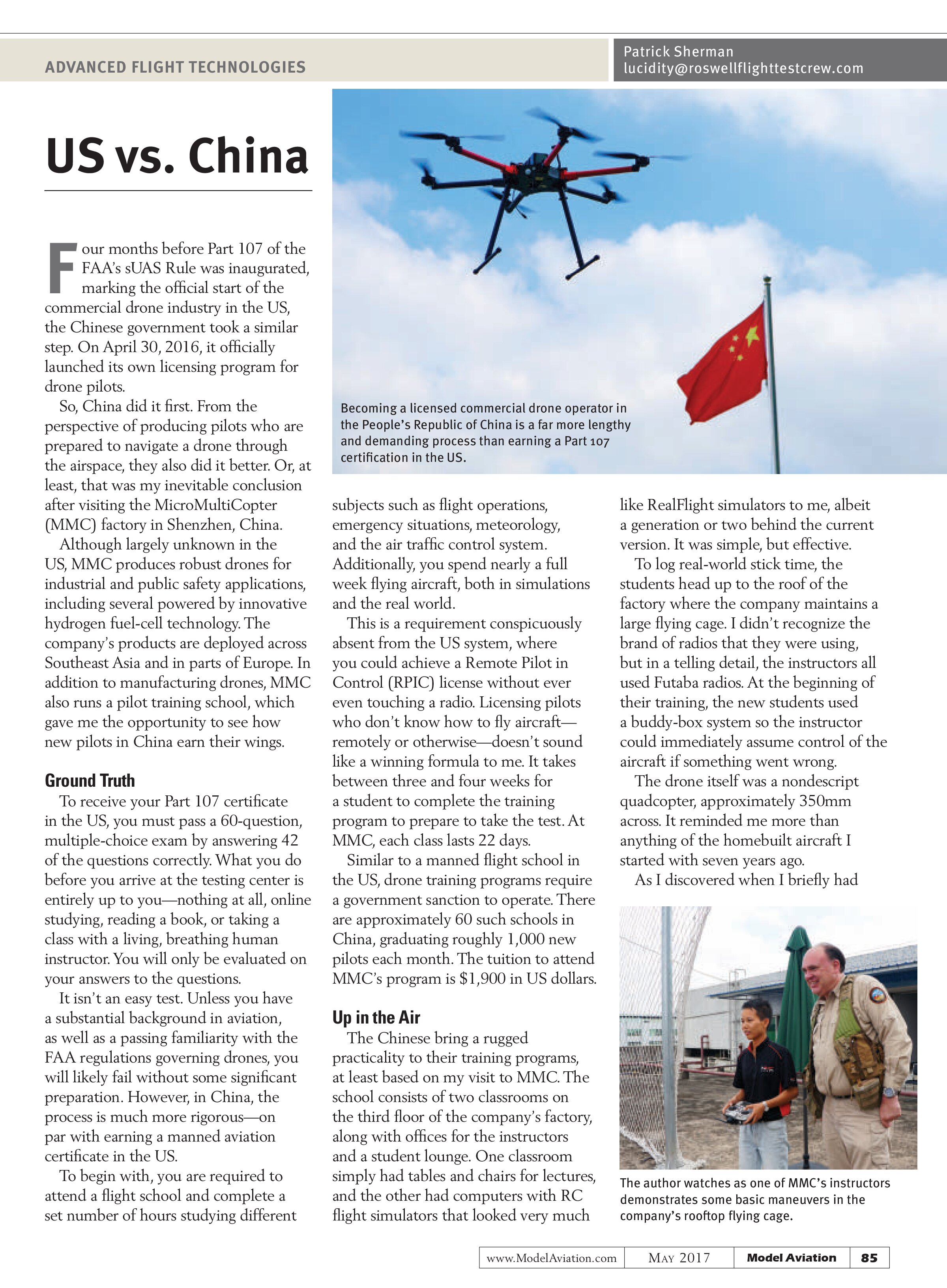
Four months before Part 107 of the FAA’s sUAS Rule was inaugurated, marking the official start of the commercial drone industry in the US, the Chinese government took a similar step. On April 30, 2016, it officially launched its own licensing program for drone pilots.
So, China did it first. From the perspective of producing pilots who are prepared to navigate a drone through the airspace, they also did it better. Or, at least, that was my inevitable conclusion after visiting the MicroMultiCopter (MMC) factory in Shenzhen, China.
Although largely unknown in the US, MMC produces robust drones for industrial and public safety applications, including several powered by innovative hydrogen fuel-cell technology. The company’s products are deployed across Southeast Asia and in parts of Europe. In addition to manufacturing drones, MMC also runs a pilot training school, which gave me the opportunity to see how new pilots in China earn their wings.
Ground Truth
To receive your Part 107 certificate in the US, you must pass a 60-question, multiple-choice exam by answering 42 of the questions correctly. What you do before you arrive at the testing center is entirely up to you—nothing at all, online studying, reading a book, or taking a class with a living, breathing human instructor. You will only be evaluated on your answers to the questions.
It isn’t an easy test. Unless you have a substantial background in aviation, as well as a passing familiarity with the FAA regulations governing drones, you will likely fail without some significant preparation. However, in China, the process is much more rigorous—on par with earning a manned aviation certificate in the US.
To begin with, you are required to attend a flight school and complete a set number of hours studying different subjects such as flight operations, emergency situations, meteorology, and the air traffic control system. Additionally, you spend nearly a full week flying aircraft, both in simulations and the real world.
This is a requirement conspicuously absent from the US system, where you could achieve a Remote Pilot in Control (RPIC) license without ever even touching a radio. Licensing pilots who don’t know how to fly aircraft—remotely or otherwise—doesn’t sound like a winning formula to me. It takes between three and four weeks for a student to complete the training program to prepare to take the test. At MMC, each class lasts 22 days.
Similar to a manned flight school in the US, drone training programs require a government sanction to operate. There are approximately 60 such schools in China, graduating roughly 1,000 new pilots each month. The tuition to attend MMC’s program is $1,900 in US dollars.
Up in the Air
The Chinese bring a rugged practicality to their training programs, at least based on my visit to MMC. The school consists of two classrooms on the third floor of the company’s factory, along with offices for the instructors and a student lounge. One classroom simply had tables and chairs for lectures, and the other had computers with RC flight simulators that looked very much like RealFlight simulators to me, albeit a generation or two behind the current version. It was simple, but effective.
To log real-world stick time, the students head up to the roof of the factory where the company maintains a large flying cage. I didn’t recognize the brand of radios that they were using, but in a telling detail, the instructors all used Futaba radios. At the beginning of their training, the new students used a buddy-box system so the instructor could immediately assume control of the aircraft if something went wrong.
The drone itself was a nondescript quadcopter, approximately 350mm across. It reminded me more than anything of the homebuilt aircraft I started with seven years ago.
As I discovered when I briefly had


the opportunity to take the controls, although a GPS antenna was plainly visible on a mast above the body of the aircraft, it was not providing any input to the flight controller. I was flying in a primitive form of attitude mode. Although the aircraft was self-leveling, I had to manually manage altitude and position hold—old school to be sure, but a standard every drone pilot who describes himself or herself as a professional should be able to meet.
At MMC’s facility, students have the opportunity to fly not only in the cage, but also in the adjacent, walled courtyard that the company uses to test its larger aircraft. The space is constantly—and literally—buzzing with activity. Most of the aircraft are more than 1,000mm across and feature a refined, weatherproof design, with brightly painted carbon-fiber airframes and interchangeable payload modules.
Test Time
The certification test for Chinese drone pilots is conducted in two phases. First, a prospective pilot must sit for an academic test and, if he or she is successful, must also pass a hands-on flying test, including maneuvers such as hovering inside a small circle and demonstrating Figure Eight flight patterns—all without the assistance of GPS stabilization. In short, if you want to earn your drone pilot’s license in China, you have to know how to fly.
Similar to written aviation tests in the US, these exams are not directly administered by China’s civil aviation authority, but are contracted through a private testing company that provides the results to the government.
Susan Sun, who heads MMC’s North American outreach and who served as the primary translator during my visit, told me (with no small measure of pride) that the company has graduated more than 2,000 pilots to date and that 98% of them had gone on to pass the test and earn their license.
It’s impossible to make an accurate comparison, but the current success rate for people taking the Part 107 test is approximately 88%—roughly the same as the pass rate for other aeronautical written tests for private pilots, airline transport pilots, and so forth. That’s a sign that individual drone pilots in the US are taking their responsibility to study and prepare every bit as seriously as other aviators.
However, my experience in China led me to question whether our industry and its regulators are taking unmanned systems as seriously as other forms of aviation—and whether their decisions will leave us at a disadvantage in the long run.
SOURCES:
MicroMultiCopter Aero Technology Co., Ltd.
(504) 518-0572 (North American Branch)
http://en.mmcuav.com