Trio of terror
Dave Gee
safetycolumn@cs.com
My email was filled with stories of narrow escapes this month. Here are three close-call reports of situations that you might face some day, so be prepared.
Crazy Marion (a careful man, despite his nickname) was adjusting the needle valve on his airplane while the gas engine was running. This involved reaching a hand close to the rear of the propeller, which should always be done with great care.
On this occasion, instead of twisting the knurled valve handle between his fingers, our hero rotated his whole hand. This brought the spinning propeller into contact with unsuspecting knuckles—thus rating a mention here. A common task that has safely been done hundreds of times turned into an adventure on just one occasion because of that nefarious momentary lapse of attention.
When you are near a running engine, concentrate on what you are doing, and remember this story the next time that you tweak a needle valve.
Next is Charles Castaing, who combined modeling and computers for an exciting, unplanned flight right off the workbench.
He wrote:
“I was testing the programming on my ElectroStik model. There was a problem with the flap-elevator function. I had programmed a switch on the transmitter to turn off the throttle function. This was a safety function that [prevented] an accident if the throttle stick was inadvertently moved to turn on the motor. All [of] my models are programmed in this manner.
“In trying to get the flap-elevator function, it was suggested that I go to the servo program on the transmitter, which moves servos from one extreme to the other. I tried it and was shocked when the motor on the model came on and the plane flew off the bench and crashed into another bench, breaking the motor mount (firewall) from the fuselage! Although I had the ‘safety switch’ on, the motor servo moved exactly as the transmitter program told it to.”
Those digital RC systems are great, and the features come in handy, but Charles proved that they will blindly do what we tell them, even if it leads to trouble. Double-check your actions, and consider removing the propeller while tinkering with a model. It will impede the airscrew in case you outsmart the computer, and might keep you from wrapping the same rag around your knuckles after an incident.
Finally, my friend, Lance Novak, told a chilling tale about a rotary tool cutoff wheel that broke in half while in use. A jagged piece struck the lens of Lance’s safety goggles. Wow!
Eye protection is vital when using power tools. Impact-resistant glasses or goggles have saved many modelers from eye injuries. Don’t skip this piece of personal protective equipment! If you wear prescription lenses, get them made into safety glasses so you’ll always have them on when needed.
Multirotor Ups and Downs
It’s not exactly a secret that the rise of the drone movement has made for mixed feelings among some modelers. I imagine it’s similar to when rubber power was overshadowed by gas engines, or when Control Line (CL) flying was the next big thing, or those distant days when balsa made bamboo obsolete.
Rubber power, CL models, and bamboo wingtips are all still around and thriving, and I bet that multirotors will end up as just one more color in the rainbow of model aviation. These days, however, quadcopters are the big thing in our hobby and many new pilots are entering the sport via these versatile aircraft. Many fixed-wing modelers have a little quadcopter tucked away among their “real” models. These sport drones are inexpensive and fun.
I recently attended a local drone expo with an open mind (and wallet). Rows of vendor booths displayed the latest in flying machines and accessories.
Companies seem to be scrambling as the industry settles into hobby and professional categories. There were big agricultural multirotors equipped for crop dusting and camera-carrying showbiz drones at the expo. The latest sport machines and FPV racers were displayed as well.
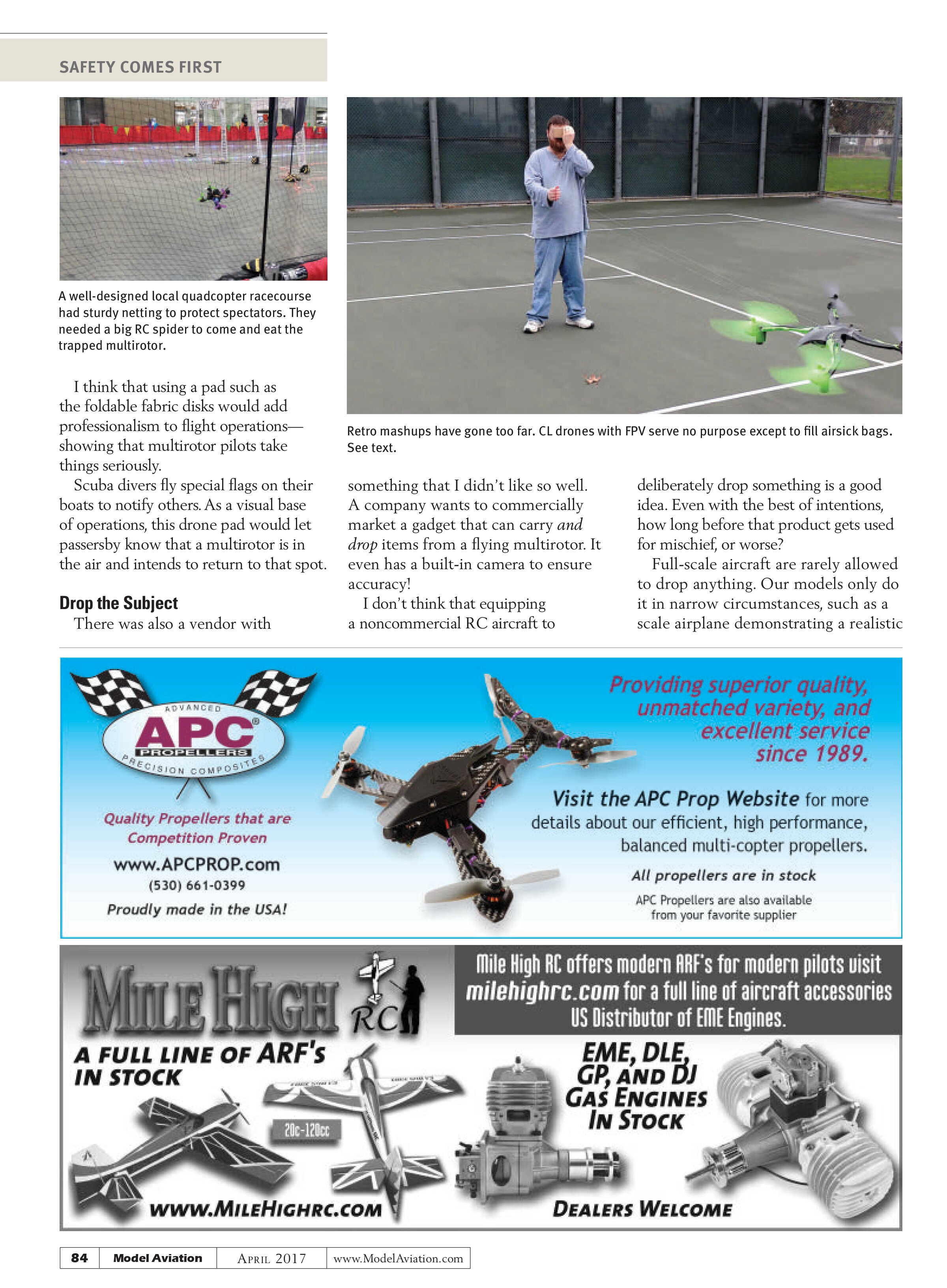
The quadcopter races were big crowd-pleasers. This sport is growing fast! Standardized classes of multirotors are flown through challenging courses with various obstacles and distracting lights flashing away. Negotiating the barriers was one thing, but to do it fast? That takes some skill!
Attendees could tune their FPV goggles to the race channels and view what the competitors were seeing. It was reassuring to see heavy netting between the racecourse and the spectators. The organizers made safety a priority.
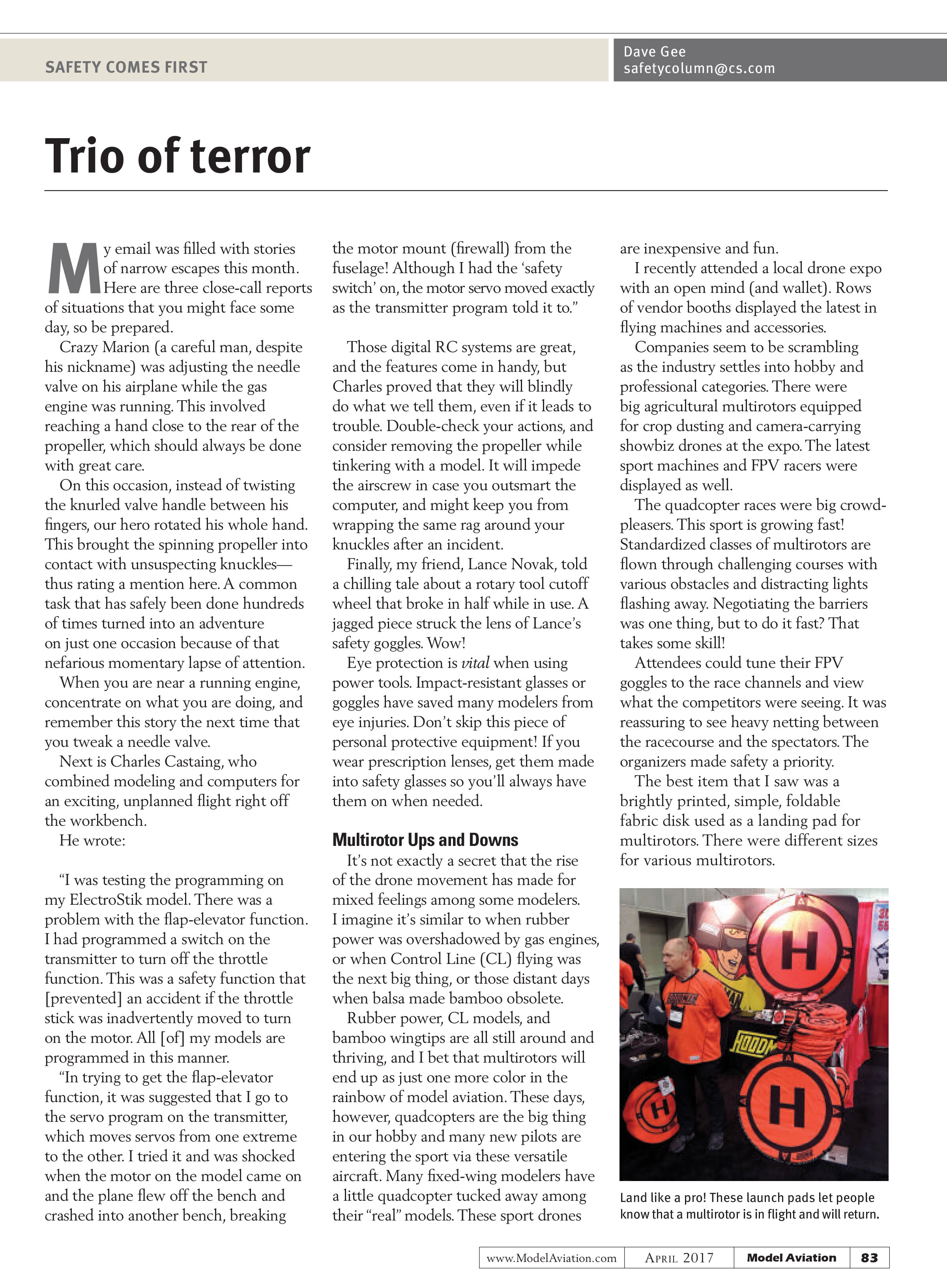
The best item that I saw was a brightly printed, simple, foldable fabric disk used as a landing pad for multirotors. There were different sizes for various multirotors.

I think that using a pad such as the foldable fabric disks would add professionalism to flight operations—showing that multirotor pilots take things seriously. Scuba divers fly special flags on their boats to notify others. As a visual base of operations, this drone pad would let passersby know that a multirotor is in the air and intends to return to that spot.

Drop the Subject
There was also a vendor with something that I didn’t like so well. A company wants to commercially market a gadget that can carry and drop items from a flying multirotor. It even has a built-in camera to ensure accuracy!
I don’t think that equipping a noncommercial RC aircraft to deliberately drop something is a good idea. Even with the best of intentions, how long before that product gets used for mischief, or worse?
Full-scale aircraft are rarely allowed to drop anything. Our models only do it in narrow circumstances, such as a scale airplane demonstrating a realistic function of a full-scale aircraft during a contest.
The drone crisis prompted a panicked deluge of new laws and regulations—some of which interfere with conventional aeromodeling. With all of that, I wouldn’t mind one more rule—something about not rigging a drone to irresponsibly drop stuff ...

Retro-Mashup Mayhem
Modelers love to experiment and modify. Scratch-built airplanes often feature small improvements that weren’t in the drawings. Even RTF aircraft get custom upgrades. We need to think carefully about what the side effects might be when we tinker with a design or flying technique.
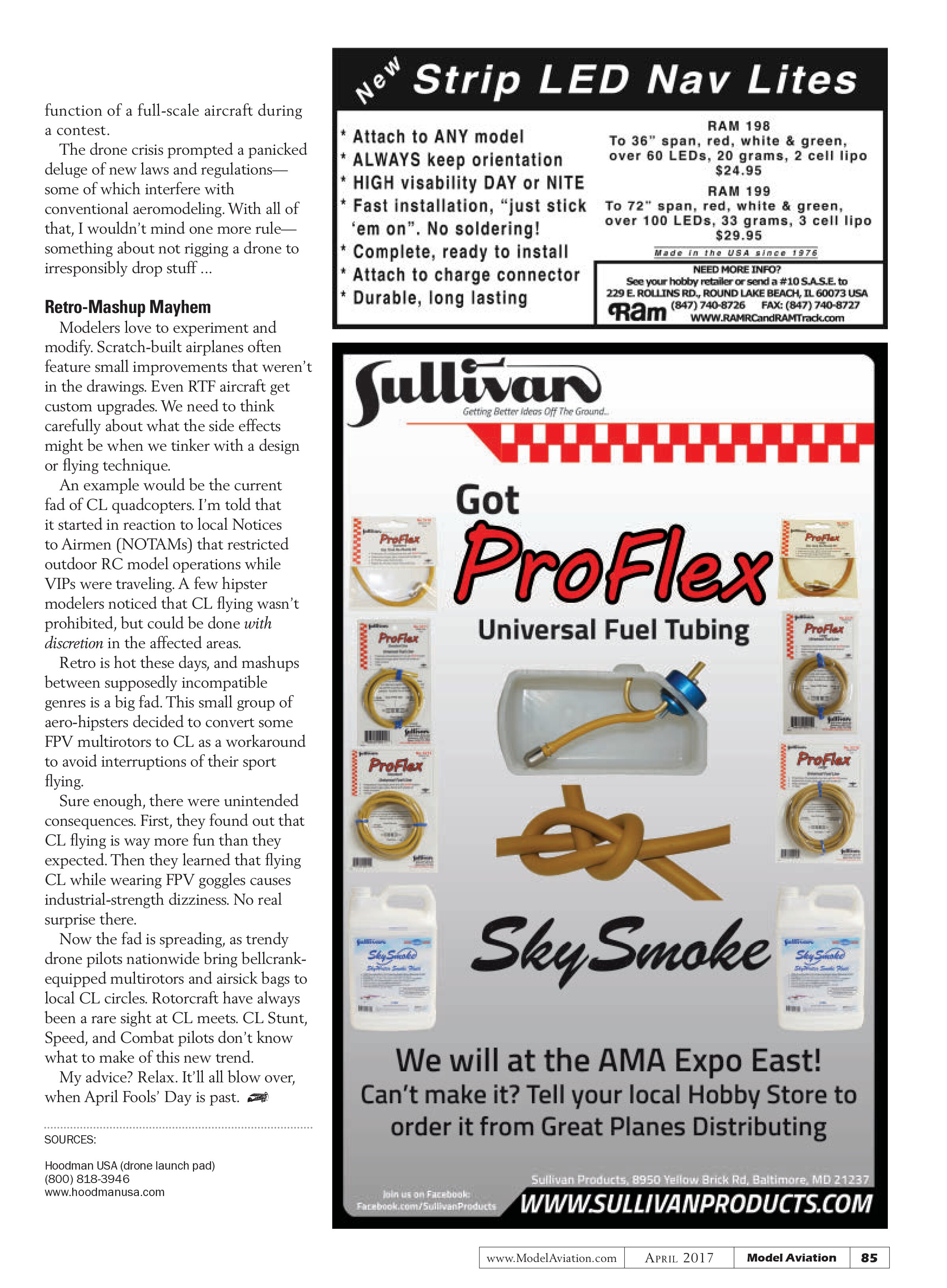
An example would be the current fad of CL quadcopters. I’m told that it started in reaction to local Notices to Airmen (NOTAMs) that restricted outdoor RC model operations while VIPs were traveling. A few hipster modelers noticed that CL flying wasn’t prohibited, but could be done with discretion in the affected areas.
Retro is hot these days, and mashups between supposedly incompatible genres is a big fad. This small group of aero-hipsters decided to convert some FPV multirotors to CL as a workaround to avoid interruptions of their sport flying.
Sure enough, there were unintended consequences. First, they found out that CL flying is way more fun than they expected. Then they learned that flying CL while wearing FPV goggles causes industrial-strength dizziness. No real surprise there.
Now the fad is spreading, as trendy drone pilots nationwide bring bellcrank-equipped multirotors and airsick bags to local CL circles. Rotorcraft have always been a rare sight at CL meets. CL Stunt, Speed, and Combat pilots don’t know what to make of this new trend.
My advice? Relax. It’ll all blow over, when April Fools’ Day is past.
SOURCES:
Hoodman USA (drone launch pad)
(800) 818-3946
www.hoodmanusa.com