Flying season is here
by Stan Alexander
onawing4602@att.net
It’s now flying season in most parts of the country, and Scale fly-ins and warbird or Dawn Patrol events are popping up. As Scale modelers, we have many activities from which to choose. This year, I plan to attend a few regular events, but I also want to go to a warbird gathering, as well as a Dawn Patrol event. I enjoyed the Coffee Airfoilers Model R/C Club’s Warbird Fly-In in Tullahoma, Tennessee, last year, and hope to see those pilots again.
Around Scale
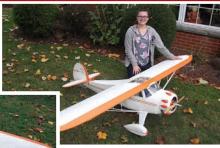
I’ve been lucky enough to receive photos of several completed models in the past few months. This time, Tom Poole sent me some photos and statistics about his latest project.
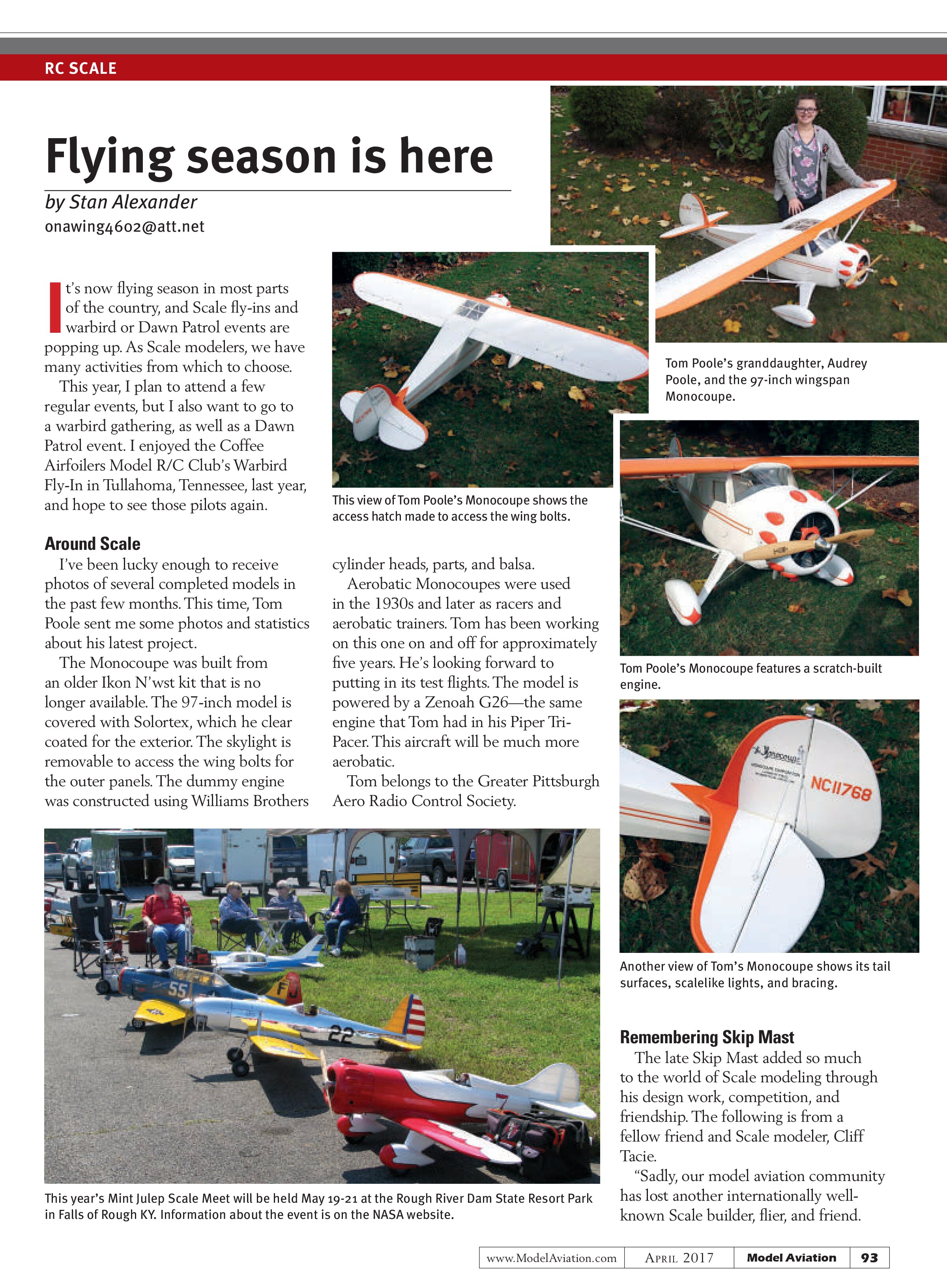
The Monocoupe was built from an older Ikon N’wst kit that is no longer available. The 97-inch model is covered with Solortex, which he clear coated for the exterior. The skylight is removable to access the wing bolts for the outer panels. The dummy engine was constructed using Williams Brothers cylinder heads, parts, and balsa.
Aerobatic Monocoupes were used in the 1930s and later as racers and aerobatic trainers. Tom has been working on this one on and off for approximately five years. He’s looking forward to putting in its test flights. The model is powered by a Zenoah G26—the same engine that Tom had in his Piper Tri-Pacer. This aircraft will be much more aerobatic.
Tom belongs to the Greater Pittsburgh Aero Radio Control Society.


This year’s Mint Julep Scale Meet will be held May 19-21 at the Rough River Dam State Resort Park in Falls of Rough KY. Information about the event is on the NASA website.
Remembering Skip Mast
The late Skip Mast added so much to the world of Scale modeling through his design work, competition, and friendship. The following is from a fellow friend and Scale modeler, Cliff Tacie.
“Sadly, our model aviation community has lost another internationally well-known Scale builder, flier, and friend.

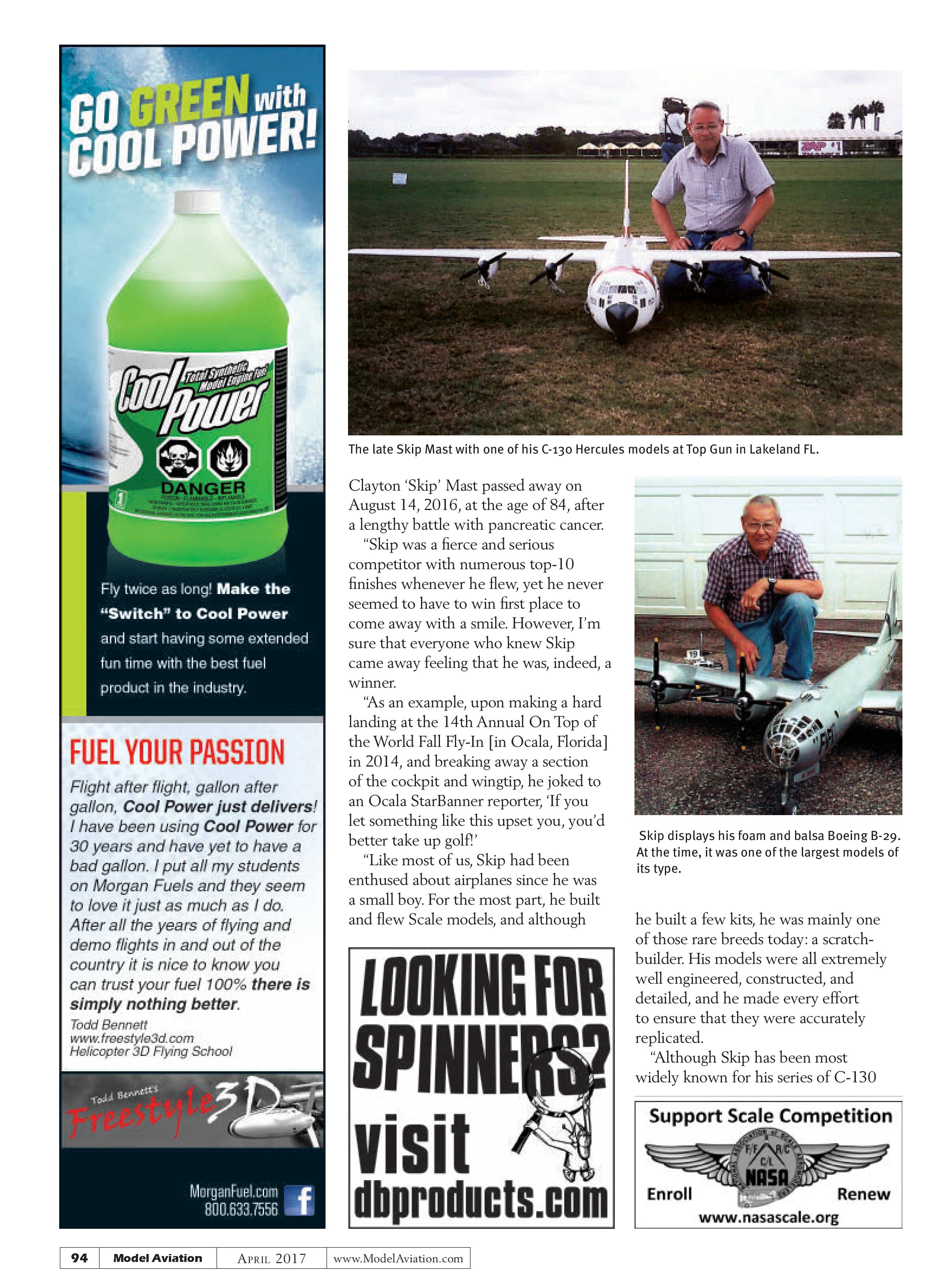
Clayton ‘Skip’ Mast passed away on August 14, 2016, at the age of 84, after a lengthy battle with pancreatic cancer.
“Skip was a fierce and serious competitor with numerous top-10 finishes whenever he flew, yet he never seemed to have to win first place to come away with a smile. However, I’m sure that everyone who knew Skip came away feeling that he was, indeed, a winner.
“As an example, upon making a hard landing at the 14th Annual On Top of the World Fall Fly-In [in Ocala, Florida] in 2014, and breaking away a section of the cockpit and wingtip, he joked to an Ocala Star-Banner reporter, ‘If you let something like this upset you, you’d better take up golf!’
“Like most of us, Skip had been enthused about airplanes since he was a small boy. For the most part, he built and flew Scale models, and although

he built a few kits, he was mainly one of those rare breeds today: a scratch-builder. His models were all extremely well engineered, constructed, and detailed, and he made every effort to ensure that they were accurately replicated.
“Although Skip has been most widely known for his series of C-130
Hercules models in striking red, white, and blue U.S. Coast Guard colors (several of which flew in FAI world championships), he also built and flew other beautiful Scale aircraft such as the P-51 and Sig J-3 Cub.
“Skip Mast was a lifetime member of the Radio Control Club of Detroit (RCCD). The club’s website proclaims his true love to be multiengine aircraft. His early efforts were a DC-3, followed by a B-29. Both models were glow-engine powered, and he supposedly flew them regularly in club Pylon Racing and Pattern events!
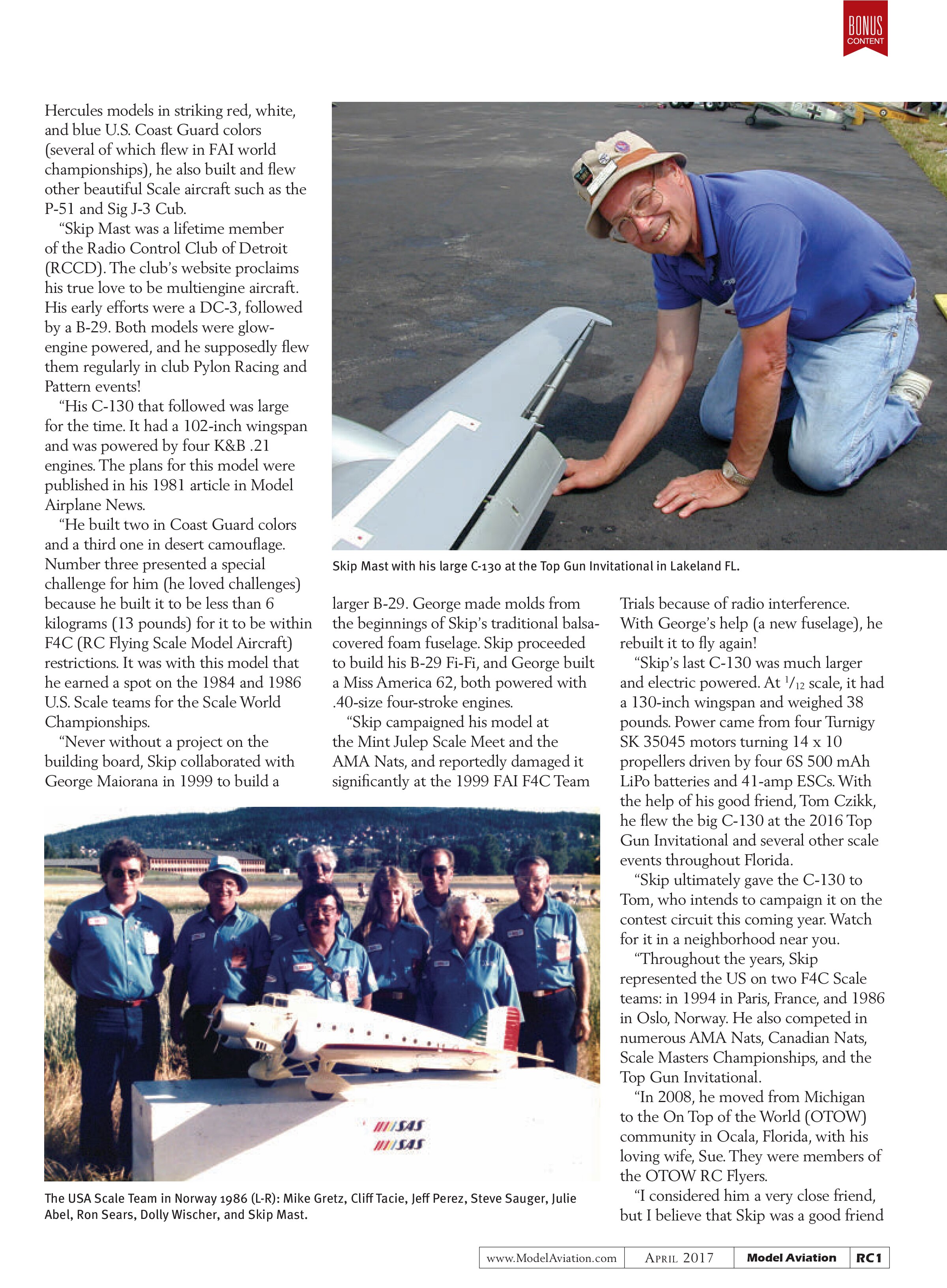
“His C-130 that followed was large for the time. It had a 102-inch wingspan and was powered by four K&B .21 engines. The plans for this model were published in his 1981 article in Model Airplane News.
“He built two in Coast Guard colors and a third one in desert camouflage. Number three presented a special challenge for him (he loved challenges) because he built it to be less than 6 kilograms (13 pounds) for it to be within F4C (RC Flying Scale Model Aircraft) restrictions. It was with this model that he earned a spot on the 1984 and 1986 U.S. Scale teams for the Scale World Championships.
“Never without a project on the building board, Skip collaborated with George Maiorana in 1999 to build a

“Skip campaigned his model at the Mint Julep Scale Meet and the AMA Nats, and reportedly damaged it significantly at the 1999 FAI F4C Team Trials because of radio interference. With George’s help (a new fuselage), he rebuilt it to fly again!
“Skip’s last C-130 was much larger and electric powered. At 1/12 scale, it had a 130-inch wingspan and weighed 38 pounds. Power came from four Turnigy SK 35045 motors turning 14 x 10 propellers driven by four 6S 500 mAh LiPo batteries and 41-amp ESCs. With the help of his good friend, Tom Czik, he flew the big C-130 at the 2016 Top Gun Invitational and several other scale events throughout Florida.
“Skip ultimately gave the C-130 to Tom, who intends to campaign it on the contest circuit this coming year. Watch for it in a neighborhood near you.
“Throughout the years, Skip represented the US on two F4C Scale teams: in 1994 in Paris, France, and 1986 in Oslo, Norway. He also competed in numerous AMA Nats, Canadian Nats, Scale Masters Championships, and the Top Gun Invitational.
“In 2008, he moved from Michigan to the On Top of the World (OTOW) community in Ocala, Florida, with his loving wife, Sue. They were members of the OTOW RC Flyers.
“I considered him a very close friend, but I believe that Skip was a good friend

to everyone who ever met him. We miss him.”
In the Shop
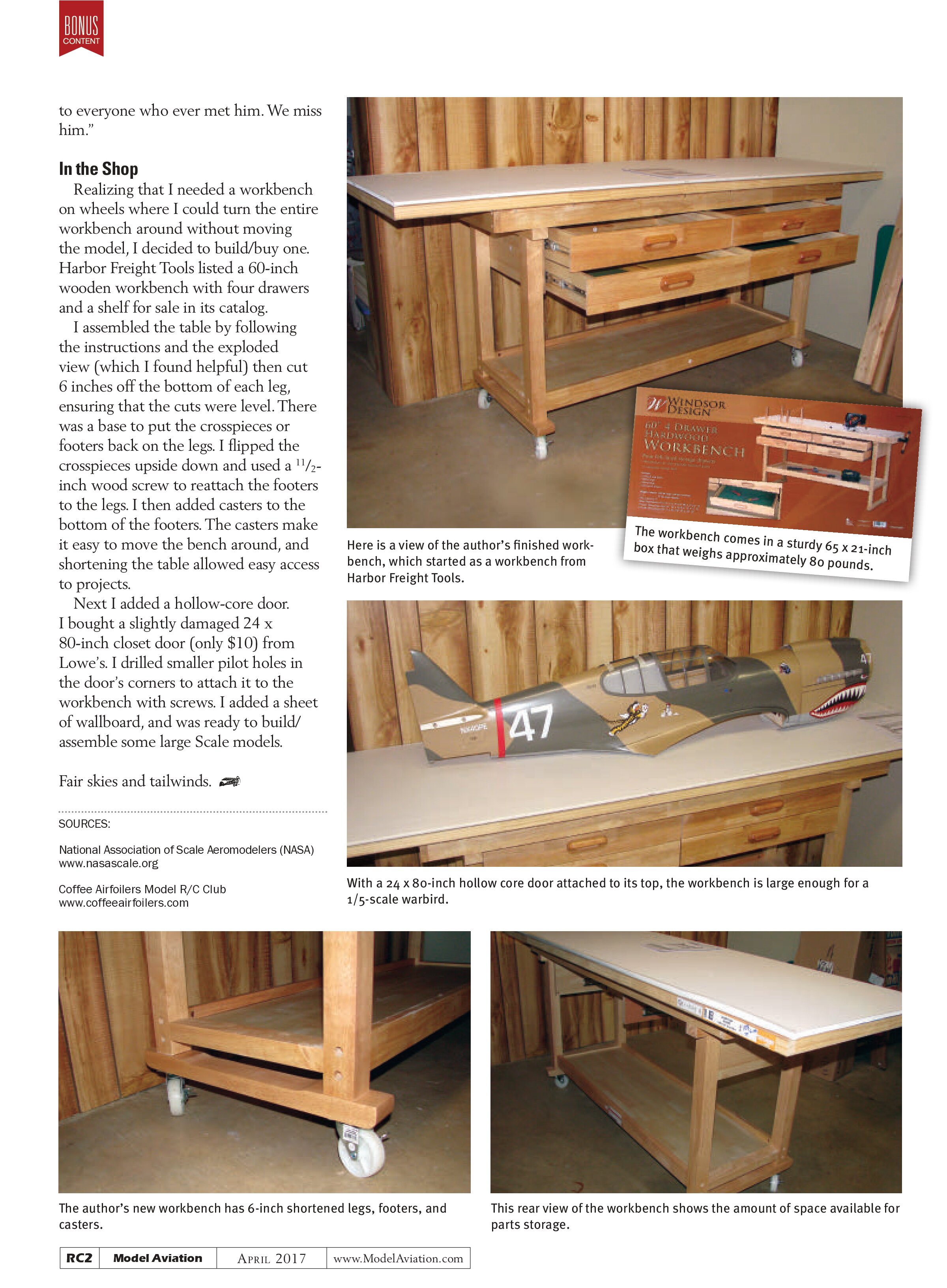
Realizing that I needed a workbench on wheels where I could turn the entire workbench around without moving the model, I decided to build/buy one. Harbor Freight Tools listed a 60-inch wooden workbench with four drawers and a shelf for sale in its catalog.
I assembled the table by following the instructions and the exploded view (which I found helpful) then cut 6 inches off the bottom of each leg, ensuring that the cuts were level. There was a base to put the crosspieces or footers back on the legs. I flipped the crosspieces upside down and used a 1½-inch wood screw to reattach the footers to the legs. I then added casters to the bottom of the footers. The casters make it easy to move the bench around, and shortening the table allowed easy access to projects.
Next I added a hollow-core door. I bought a slightly damaged 24 x 80-inch closet door (only $10) from Lowe’s. I drilled smaller pilot holes in the door’s corners to attach it to the workbench with screws. I added a sheet of wallboard, and was ready to build/assemble some large Scale models.


Fair skies and tailwinds.
SOURCES:
National Association of Scale Aeromodelers (NASA)
www.nasascale.org
Coffee Airfoilers Model R/C Club
www.coffeeairfoilers.com